
B2B Social Media Content Ideas: What to Post When You Sell to Businesses
Fourteen kinds of post a B2B company can publish every month, where the ideas come from, and how to turn one into a LinkedIn post people read.

The best B2B social media content ideas come from what your company already knows and does: products at work in real applications, how things are made and tested, the questions customers ask every week, your experts’ views, trade fairs, certificates explained, customer stories you may share and scenes from behind the scenes. Collect them from sales, service and engineering, then turn each into one clear LinkedIn post, a carousel, a short video or a poll.
Most B2B companies do not lack things to say. They lack a habit of noticing them. The answer an engineer gives a customer on Tuesday, the photo of a pump leaving the test bench, the certificate the quality team renewed: each is a post that nobody wrote. This list gives fourteen kinds of post, where to find them and LinkedIn examples to adapt. For planning, formats, approval and repurposing, see our guide to B2B social media content; the examples here come from a hypothetical pump maker.
Product, application and process posts
Product and application examples show a product doing its job in a real setting, and why it was chosen there. They work best when the post explains one decision: the material, the seal, the size, and what the customer would have risked with another choice.
Production and process posts show how things are made and tested. Thirty seconds of a pressure test or a dimensional check shows care in a way no brochure adjective can. Behind the scenes posts widen the view: packing, loading, a night shift, a prototype on the bench.
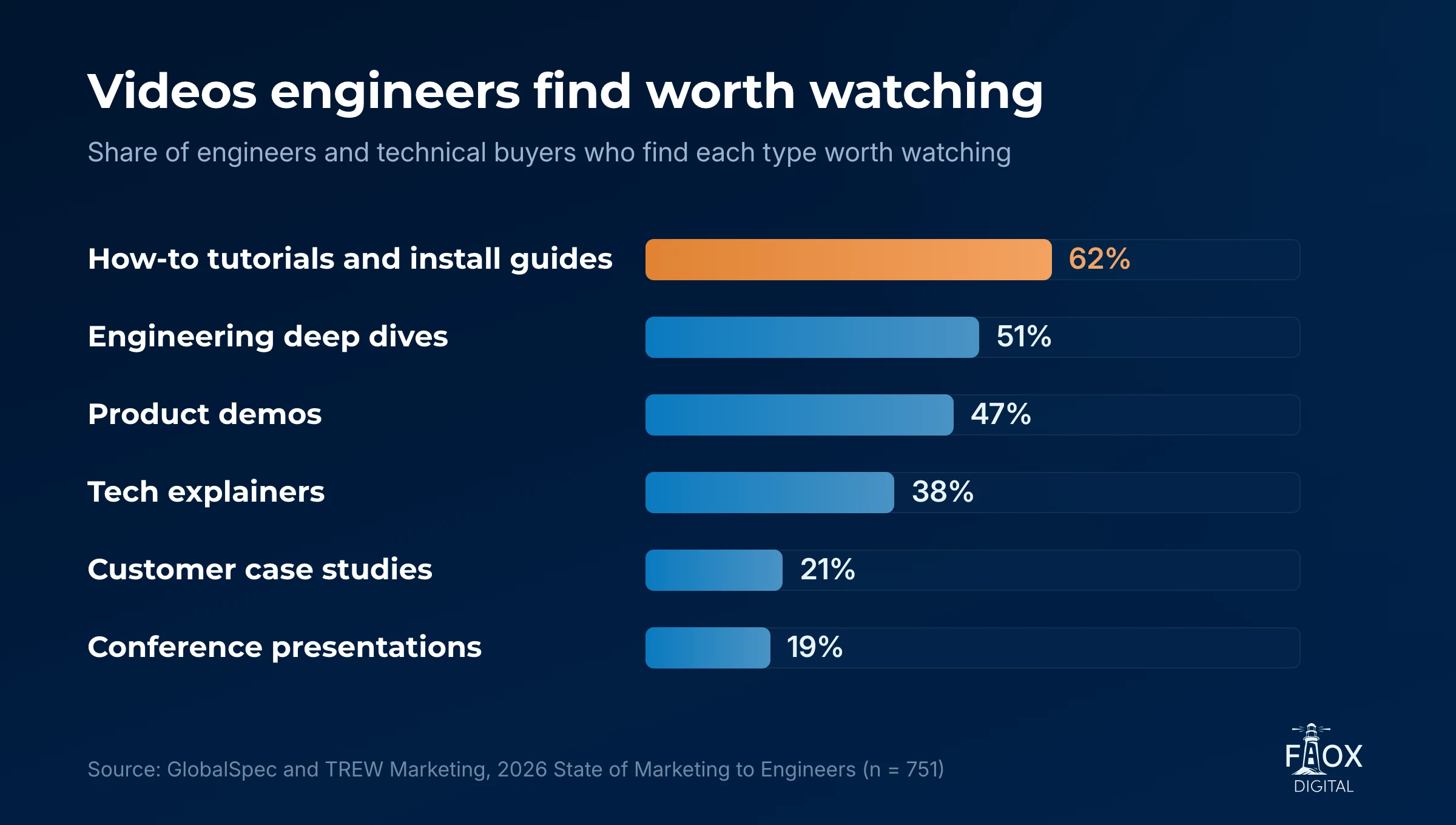
Engineers have said which videos they find worth watching. In GlobalSpec and TREW Marketing’s 2026 State of Marketing to Engineers, 751 engineers and technical buyers answered: how-to tutorials and install guides came first at 62%, engineering deep dives at 51% and product demos at 47%, ahead of customer case studies at 21%.
Customer questions, experts and industry commentary
Customer questions are the easiest ideas to find and among the most useful to publish, because someone has already shown they want the answer. Keep one question per post and answer it in the first lines.
Team and experts posts put a face to the knowledge: an engineer explaining a choice, a service technician describing a repair, a product manager on what a new model changes. Write them with the person, in their words, and ask whether they want to post them under their own name too.
Industry commentary is where your experts say what a change means: a new standard, a regulation, a shift in materials or energy prices. It does not need a strong opinion on everything; it needs a clear view on the few topics where your people know more than most.
Proof: certificates, standards and customer stories
Certifications and standards are dull as an announcement and useful as an explanation. Say what the certificate covers, what it means for a buyer and how to check it; accredited ISO management system certificates can be verified in IAF CertSearch, the global database of accredited management system certifications. A post that explains what a standard requires, in plain words, helps buyers who must specify it.
A customer story is the strongest proof you can publish: the problem, what was done and what changed. Ask permission first, agree what may be named, and keep figures out unless the customer approves them. Told well, it gives buyers a reason that a specification sheet cannot; our article on why storytelling matters in B2B explains how.
Trade shows and events
Trade fairs give you three posts at least: before (where to find you and what you will show), during (short posts from the stand and talks) and after (what visitors asked, and what you learned). Webinars, open days and conference talks work the same way. Write the visitors’ questions down at the stand, because they are next month’s posts.
Polls, carousels and short video
A poll asks your audience a question with up to four answers. LinkedIn Help says polls run for one day, three days, one week or two weeks, and that the admins of a Page can see who voted and how. That makes a poll a small piece of research as well as a post. Ask about practice ("which maintenance interval do you use?"), not about opinions you cannot act on, and LinkedIn’s rules do not let poll authors ask for political opinions, health status or other sensitive data. Share the results in a later post.
A carousel, on LinkedIn a document post of several slides, suits steps, checklists and comparisons. A short video suits anything that moves: a test, an installation, a product being taken apart. The ideas above can each take more than one form: a customer question can be a text post today and a thirty-second video next month.
LinkedIn post examples you can adapt
A LinkedIn post from a company works when its first lines carry the point. Two examples for the pump maker:
A customer question. "How often should the seal be replaced? It depends on three things: what the pump moves, how many hours it runs and how often it starts and stops. Here is how our service team works it out for a site." Below it, a carousel with the three factors and a worked example.
A behind-the-scenes post. "Every pump that leaves this hall spends time on the test bench first. This is what our technicians check, and what happens when a pump fails a check." Below it, a short video from the bench, with subtitles.
How to turn an idea into a post
- Choose one point. One idea per post, tied to one of your content pillars.
- Find the proof. A photo, a measurement, a short quote from your expert.
- Pick the format. Text for a view, a carousel for steps, a video for movement, a poll for a question.
- Write the first lines last. Once the post is written, make its opening say the point.
- Check it with the expert. Facts, terms and anything confidential.
- Add a next step. A link to the product page, guide or contact form.
- Publish and reply. Answer comments the same day where you can.
Before you publish
- The customer has agreed to be shown or named
- No drawings, prices or confidential details are visible in photos
- An expert has checked every technical claim
- Images have alternative text and videos have subtitles
- The post has one point and one next step
How Faox Digital finds content ideas with a B2B team
Faox Digital, a digital growth partner for B2B companies in complex and international markets, starts by listening: what the company already posts, who follows it and what its buyers care about. Posts are then written, designed and filmed in the company’s own voice, and the client reviews the monthly plan rather than every post.
Key takeaways
- B2B social media content ideas come from sales, service, engineering and trade fairs; collect them weekly.
- Teach before you sell: engineers rate how-to and installation videos above case studies.
- Proof works when it is explained: certificates, standards and customer stories, with permission.
- Use polls for practical questions, carousels for steps and short video for anything that moves.
- One point per post, checked by an expert, with a clear next step.
Frequently asked questions
What should a B2B company post on social media?
Post what helps a buyer decide: products in real applications, how they are made and tested, answers to common questions, your experts’ views, certificates explained and customer stories you may share. Mix formats, and keep one point per post.
How do you create social media content for a small business?
Start with the questions customers ask most and photos taken on a phone in good light. One post a week from one content pillar is a sound start; add a second pillar once the first is routine.
How do B2B companies get engagement on LinkedIn?
By being useful to a specific audience: answer real questions, show real work and let experts speak in their own words. Reply to comments, ask practical questions, and avoid engagement tricks.
What are good B2B social media examples?
An installation tip as a carousel, a test-bench video, an engineer answering a common question, a poll on maintenance practice and a customer story told with permission. The table above gives fourteen kinds to adapt.
Sources
- GlobalSpec and TREW Marketing: 2026 State of Marketing to Engineers, 2026
- LinkedIn Help: LinkedIn Polls, accessed November 2026
- IAF CertSearch: Search and verify ISO certification, accessed November 2026
Let’s talk
Want social media that reaches the right people?
Tell us who you want to reach. We will look at your channels and suggest a plan your team can keep up with.