
How to Increase LinkedIn Engagement Without Pods or Tricks
The honest ways a B2B company earns comments and conversations on LinkedIn, why pods and bait backfire, and how to turn a conversation into an inquiry.

How to increase LinkedIn engagement without tricks: publish posts that give your buyers something useful and invite a real answer, reply to every comment while the post is fresh, add meaningful comments on other people’s posts and involve the employees who want to take part. Skip engagement pods and "comment to agree" prompts, because LinkedIn says it is working to make pods ineffective and to show less engagement bait.
Most B2B companies want more LinkedIn engagement for a good reason: comments and replies are where a buyer stops scrolling and starts a conversation. The shortcuts sold to get there, such as engagement pods, automated comments and bait, produce numbers without those conversations, and they now carry a real risk.
This guide shows the honest alternatives, from the posts you write to the way a comment becomes an inquiry. It is part of our approach to B2B community management, which covers comments, messages and conversations in general.
How to increase LinkedIn engagement, and why tricks backfire
LinkedIn engagement means the reactions, comments, reposts and clicks that people give your posts. It matters because it shows that the right people read and respond, not because the number itself sells anything.
LinkedIn has said plainly where it stands. In March 2026, it announced that it is working to make engagement pods ineffective and to curb comment automation and third-party tools that create fake conversations. It is also reducing engagement bait, such as "comment to agree" prompts, and says it wants the feed to be relevant, "not a popularity contest". Its spam policy adds that it may remove or limit the distribution of content designed to artificially increase engagement through misuse or misrepresentation of LinkedIn’s features, and it lists reaction polls, chain-letter posts that ask for likes and shares, and excessive or repetitive comments among its examples of spam. Its User Agreement forbids bots that comment, like or share to drive inauthentic engagement.
Engagement pods, groups that agree to like and comment on each other’s posts, carry three risks: LinkedIn acts against them, they fill your analytics with people who will never buy, and buyers notice generic comments from strangers under every post.
Posts that ask questions
The simplest way to get comments is to ask something your readers can answer from their own work. Posts that ask questions work when the question is specific and the post gives something first:
- "We tested three seal materials at high temperature; here is what failed. Which material has lasted longest in your plant?"
- "Lead times for this kind of component have grown this year. How are your purchasing teams planning for it?"
A real LinkedIn poll is fine for a quick show of hands. Avoid reaction polls, where people vote by choosing an emoji, and prompts such as "type YES if you agree": LinkedIn names both as engagement bait or spam.
Replying to comments
Replying to comments is where engagement turns into conversation. Answer every relevant comment, ideally within a working day and faster in the first hours. Reply as the page for company questions and let a named expert answer technical ones, so readers see who stands behind the answer.
A good reply adds something: a figure, an example, a follow-up question. "Thanks for sharing" ends the thread; "Which grade did you use, and at what temperature?" keeps it going. Delete spam, answer criticism calmly in public, and move prices, orders and complaints to a private conversation.
Meaningful comments on other posts
Engagement also comes from what you write under other people’s posts. Super and content admins can comment and react as the page, but comments from named people usually carry more weight than a logo. Ask your experts to follow the customers, partners and trade publications that matter, and to comment when they can add something: a fact, an example from a project, a respectful counterpoint or a good question.
Meaningful comments on other posts are a few sentences long, specific to the post and never pasted from one thread to the next. LinkedIn lists excessive, irrelevant or repetitive comments as spam, and its 2026 changes target comment automation.
Post formats that invite engagement
Some post formats earn more engagement than others. Socialinsider, which tracked 2.45 million posts from 26,000 LinkedIn company pages, reported these average engagement rates for the third quarter of 2026, counting reactions, comments and shares against impressions:
| Post format | Average engagement rate, Q3 2026 | Good for |
|---|---|---|
| Native document | 6.40% | Step-by-step guides, checklists, technical explainers |
| Multi-image post | 6.40% | Projects, processes, trade fair recaps |
| Video | 5.25% | Products at work, short expert explanations |
| Image | 4.70% | One clear photo with a short story |
| Poll | 3.60% | A quick question with real options |
| Text | 3.50% | Opinions, lessons and questions |
| Link | 2.50% | Sending readers to a page, when the click is the goal |
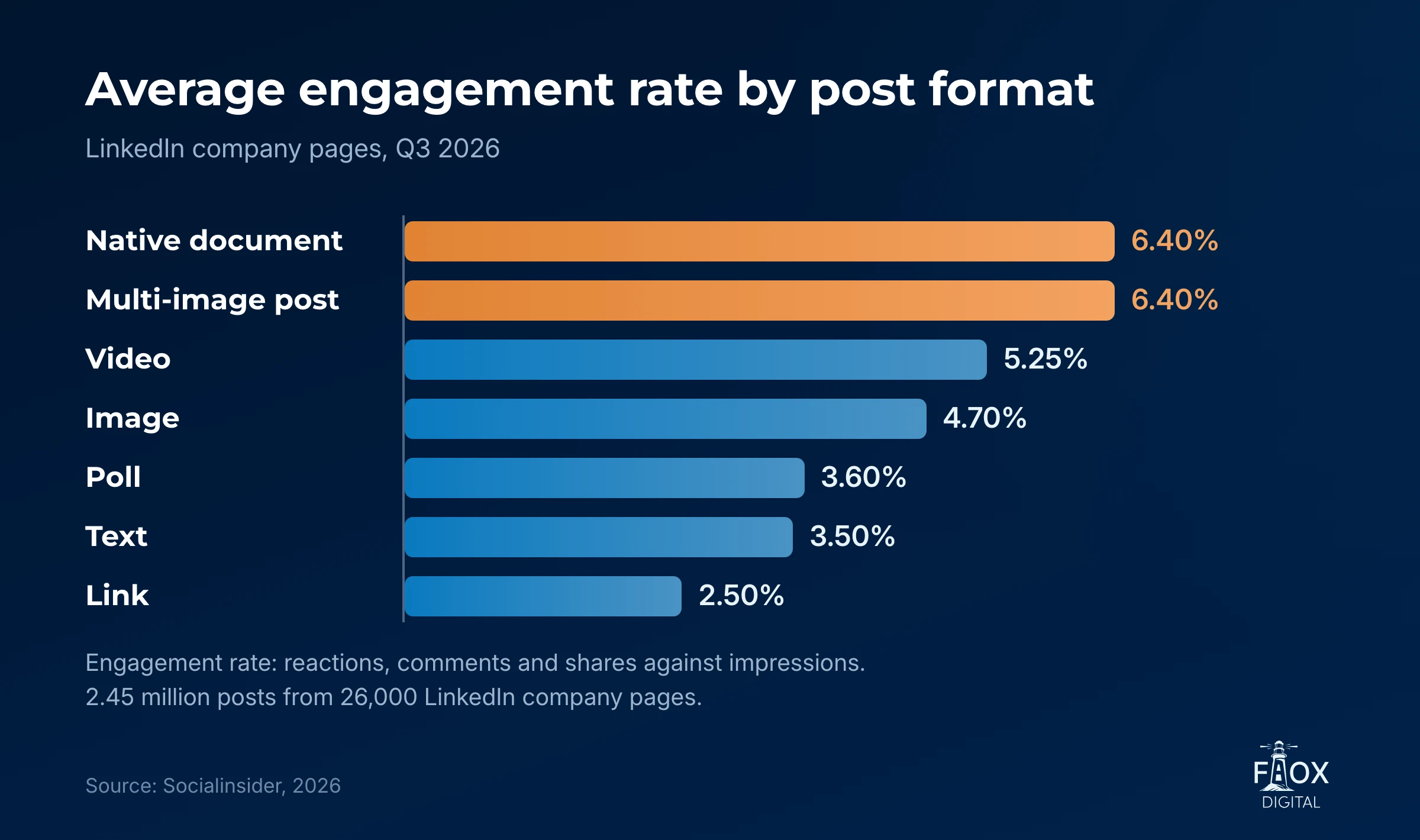
These are averages across many industries, measured by a company that sells analytics software, so use them as a starting point. Your own analytics will show which formats your audience responds to.
Where to put the link
LinkedIn has not published a rule against links. What the numbers show is that link posts had the lowest average engagement rate in Socialinsider’s Q3 2026 data. So decide where to put the link by the goal of the post:
- If the click is the goal, put the link in the post, write two or three lines that make the click worth it, and judge the post by clicks rather than comments.
- If the conversation is the goal, put the substance in the post itself, as text, images or a document, and offer the link at the end for readers who want more.
Either way, check in your analytics which approach brings more visits from the people you want.
Posting times
Buffer’s analysis of 4.8 million LinkedIn posts, published in September 2026, found the best engagement on weekdays between 3 p.m. and 8 p.m., with Wednesday at 4 p.m. the strongest slot. Those posts came from all kinds of accounts, not just B2B companies, so treat them as a first guess.
Your own posting times depend on where your buyers are. If you sell in several time zones, post when your main market is at work and someone from your team can reply. LinkedIn’s Tim Jurka suggests looking at your own posting patterns by topic, format and timing; a month of tests at different times will tell you more than any general rule.
Employee participation
Employees reach networks your page does not, and a comment from a named engineer often starts a better conversation than the page’s post. Employee participation works when it is voluntary and personal: share the posts that matter with colleagues, explain why they matter, and let them add their own view.
At the time of writing, a page admin can notify employees about a post once per day, not for targeted posts, and employees can opt out. Use it for posts that are worth their time. Never set like or comment quotas or hand out comments to paste, because an internal pod is still a pod, and ask employees to say where they work when they mention your products.
From conversation to inquiry
Engagement is only worth the effort if some conversations lead to business. The path from conversation to inquiry usually runs like this:
- Answer in public. Reply to the comment with substance, so others can see the exchange.
- Offer the next step. If the commenter has a specific need, invite them to continue in a private message or a call.
- Let them write first to the page. At the time of writing, page admins can only message a member who has messaged the page first, so a personal message from the expert is often the better route.
- Hand over to sales. Pass buying questions to the right person, with the context of the conversation.
- Record the source. Log the contact in your CRM with LinkedIn as the source, so you can see which posts start real conversations.
Plan, set up and measure
Engagement depends on what you post and on the page behind it. Our list of what B2B companies can post gives ideas that invite comments, and our checklist for creating a LinkedIn company page makes sure the page people visit after a comment looks complete. To see which posts work, our guide to reading LinkedIn analytics explains the engagement rate and the other numbers in detail.
If your employees want to take part more regularly, the next question is whether you need a formal employee advocacy program and a platform to run it.
How Faox Digital builds engagement on LinkedIn
Faox Digital runs LinkedIn as part of a B2B company’s organic social media: we publish on a steady rhythm, reply to comments and messages, and join the conversations where the company’s buyers already are. We judge the work by whether it reaches the right people and starts the conversations and inquiries that follow, not by reaction counts.
Key takeaways
- How to increase LinkedIn engagement honestly: useful posts that invite a real answer, fast and substantial replies, and meaningful comments on other people’s posts.
- Engagement pods, comment automation and bait are what LinkedIn says it is working against, and they fill your numbers with the wrong people.
- Documents and multi-image posts led average engagement in Socialinsider’s Q3 2026 data; link posts came last, so place the link by the goal of the post.
- Treat general posting-time studies as a first guess and test your own times.
- Turn conversations into inquiries: answer in public, offer a private next step, hand over to sales and record the source.
Frequently asked questions
How do you get more engagement on a LinkedIn company page?
Post things your buyers can use or answer, such as findings, checklists and specific questions, in formats like documents and multi-image posts. Reply to every relevant comment, involve experts by name and ask employees to share with their own words.
How do you calculate your LinkedIn engagement rate?
LinkedIn’s page analytics show it as interactions per impression, where interactions include clicks, reactions, comments and shares. Third-party studies may count differently, for example without clicks, so compare like with like.
Are LinkedIn engagement pods allowed?
LinkedIn says it is working to make engagement pods ineffective, its spam policy covers content designed to inflate engagement artificially, and its User Agreement forbids bots that like, comment or share. Even manual pods add reactions from people who will never buy.
How can a small B2B company get LinkedIn engagement?
Post less often but better: one useful post a week, written by or with the person who knows the subject, and an hour set aside to reply. Comment on customers’ and partners’ posts where you can add something, and ask a few colleagues to share posts they genuinely find useful.
Sources
- LinkedIn Newsroom: How LinkedIn Is Improving the Feed to Show More Relevant, Authentic Professional Content, March 12, 2026
- LinkedIn Help: Content analytics for your LinkedIn Page, accessed November 2026
- Socialinsider: LinkedIn Organic Benchmarks 2026, accessed November 2026 (Q3 2026 data)
- Buffer: The Best Time to Post on LinkedIn in 2026, 4.8 Million Posts Analyzed, September 9, 2026
Let’s talk
Want social media that reaches the right people?
Tell us who you want to reach. We will look at your channels and suggest a plan your team can keep up with.
Comments in the first hour
LinkedIn publishes no "first hour" rule. Tim Jurka, who has worked on LinkedIn’s feed for over a decade, wrote in 2025 that many signals shape what people see and that every post takes its own path to its audience.
What you control is simpler: be available when you post. Publish when someone who can answer is free for the next hour or two, reply to the first comments quickly and with substance, and add a useful detail in your reply that was not in the post. What you should not do is ask colleagues or contacts to comment on cue, because that is exactly what a pod does.