
Social Media Platforms for B2B: How to Choose the Right Channels
How a B2B company chooses its social media platforms: nine platforms compared, five criteria for choosing and how to settle on one main channel.
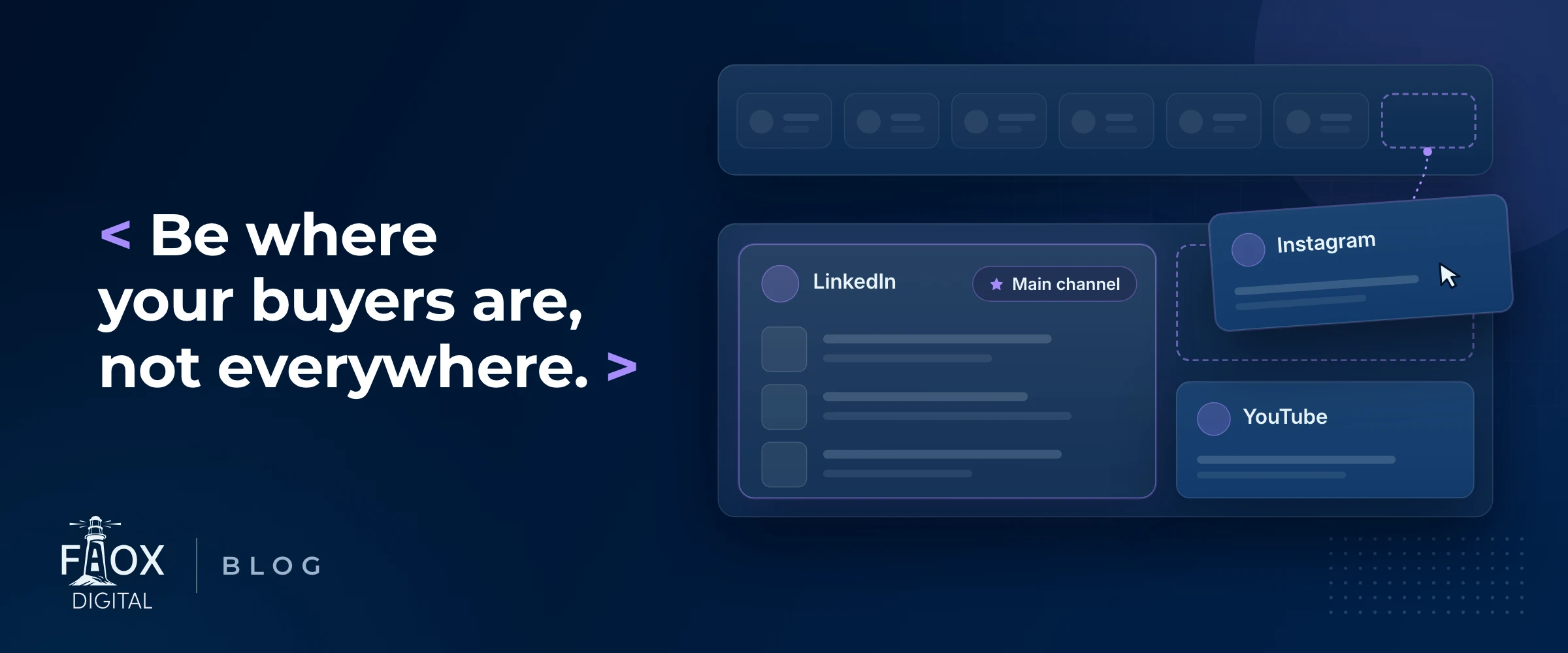
The right social media platforms for B2B are the ones your buyers and decision makers actually use, in the markets you sell to, and that your team can feed with the content each platform needs. For most B2B companies that means LinkedIn as the main channel, plus one or two supporting channels such as YouTube or Instagram chosen on evidence. A few platforms run well usually do more than many run thinly.
Most B2B companies start out wanting to be on every platform, then find they can keep only one or two going. Choosing channels is one of the first decisions in a B2B social media strategy, and it is easier once you know what each platform can do for a company that sells to other businesses.
This guide compares nine social media platforms for B2B, from LinkedIn to TikTok, and gives five criteria for choosing: where your buyers are, who decides, which markets you serve, what content you can make and how much your team can run. It covers the choice itself; running each channel is a topic of its own.
Start from the platforms your buyers use
The first criterion is simple and often skipped: which platforms do the people you sell to actually use? Forrester’s 2026 survey of more than 17,000 business buyers produced a surprise. Buyers most often cited Facebook as meaningful in their buying journey, followed by Instagram and YouTube, with LinkedIn next, while most marketers said they see the biggest impact from LinkedIn. Forrester asks whether that signals a shift toward more varied sources of validation or simply reflects the size of those platforms.
Pew Research Center’s 2025 survey of 5,022 US adults shows how large the general platforms are: 84% use YouTube, 71% use Facebook and half use Instagram. Many of your buyers are on these platforms anyway; the question is whether they want to hear from suppliers there.
Do not copy averages. Find out for your own buyers: ask your sales team and distributors where customers share news, look at where your customers’ companies and engineers post, and ask a few customers directly which platforms they use for work. Ten honest answers tell you more than a global ranking.
Weigh the platforms decision makers use
Your followers are not always the people who decide. An engineer may watch your installation videos on YouTube while the plant manager and the purchasing director only see what reaches them on LinkedIn or in trade media. So check the platforms against each buyer role: who influences, who evaluates and who signs.
Age makes a difference. In Forrester’s 2026 research, millennials and Gen Z made up 63% of the buyers surveyed, and over half of Gen Z buyers found five or more social sites meaningful, compared with 21% of baby boomers. Pew’s 2025 survey shows the same gap in general use: eight in ten US adults aged 18 to 29 use Instagram, against 19% of those 65 and older, and YouTube and Facebook were the only platforms used by a majority of every age group. Senior decision makers are often older and use fewer platforms, so check which ones they use rather than assume.
Technical evaluators look for depth. Forrester notes that communities such as Reddit and Discord matter for technical depth and peer trust, and Pew found in 2025 that about four in ten US adults with at least a college degree use Reddit.
Allow for market and country differences
A platform that works in one country can be missing in another. LinkedIn is the clearest example: it closed its localized social network in China in 2021 and its local jobs app there, InCareer, in August 2023. LinkedIn said in 2023 that its China business would focus on helping companies operating in China hire, market and train abroad, so buyers in mainland China have to be reached through other channels.
In most markets the differences are of degree: which network professionals use for work, how much business moves to messaging apps and which language buyers expect can all change from one country to the next. The Pew figures above describe the United States only. For each priority market, ask local sales staff or distributors which platforms buyers use for work, and plan the language versions together with the channel.
Match each platform to the content you can make
Every platform rewards a different content type, and the content you can produce every week narrows the list quickly:
- Text, documents and expert posts: LinkedIn, and to a lesser degree X.
- Long demonstrations and how-to videos: YouTube.
- Short vertical video: TikTok, Instagram Reels and YouTube Shorts.
- Photos of products, plants and people: Instagram, Facebook and Pinterest.
- Answers to specific questions: Quora and Reddit.
If you have an application engineer who explains well on camera, YouTube may earn a place. If your strength is detailed technical writing, LinkedIn and Quora suit you better. Instagram rewards visual material; our guide to Instagram for B2B covers when it is worth the effort.
Before adding a platform, list ten posts you could publish there next month. If the list is hard to fill, the platform is not ready for you. Our B2B social media content ideas can help you fill it.
Be honest about team capacity
Each platform needs more than posts: someone to adapt the format, reply to comments and messages, and keep going in every language. Forrester’s 2024 survey found that nearly three-quarters of the large B2B companies it asked run branded accounts on four or more platforms, and Forrester notes that each account takes investment in content, operations and governance. Most smaller teams cannot match that, and they do not need to.
Before you add a channel, check that:
- Someone owns the channel and can post on it every week
- Someone answers comments and messages within an agreed time
- You can produce its content type without starving your other channels
- Each language version has a native speaker to write or review it
- You know what the channel is for and how you will measure it
Put the workload of every channel into a B2B content calendar template before you commit. If the calendar looks crowded on paper, it will look empty on the platform.
Choose one main channel and one or two supporting channels
The main channel is where most of your buyers are and where you publish most often; for most B2B companies that is LinkedIn. Supporting channels each get one clear job, for example:
- YouTube as the video library your sales team and website link to
- Instagram or Facebook for plants, people and hiring
- Reddit or Quora for expert answers to buyers’ questions
- X for press and analysts, in sectors where they are active
Limiting the number of platforms keeps quality up, because every channel needs a steady rhythm and answers to comments. You can still register your company name on other platforms, with a short description and a link to your main channel, so that nobody else takes it. Add a new channel only when the current ones run steadily, and drop one that still has no clear job after two quarters.
As an invented example, a pump maker selling to food plants in Germany and Poland might choose LinkedIn as its main channel and YouTube for installation videos, and leave TikTok, Pinterest and X for later: its buyers are engineers and plant managers, and its team can film about once a month.
Social media is only one part of your marketing, and how it works with your website, search and email belongs to building a B2B marketing strategy. Once your channels are set, the next question is what to post on them and how to grow without paid ads; our article on social media marketing for manufacturers shows one brand’s answer.
How Faox Digital chooses platforms with a client
Faox Digital chooses platforms after listening to the company: what it already posts, who follows it and what its buyers care about. We then set the platforms and the rhythm market by market and language by language, working organically on LinkedIn, Instagram, X, YouTube and Facebook, with community work on Quora and Reddit where it fits.
Key takeaways
- Choose platforms by where your buyers and decision makers are, not by platform size or habit.
- Check each market: a platform that works in one country can be missing in another.
- Match platforms to the content your team can make every week.
- Run one main channel, usually LinkedIn, and one or two supporting channels with clear jobs.
- Keep only the platforms your team can feed and answer, and review the mix every quarter.
Frequently asked questions
What is the best social media platform for B2B marketing?
There is no single best platform for every B2B company. LinkedIn is the usual main channel, and most marketers in Forrester’s 2026 research said they see the biggest impact there, but the buyers in the same research cited Facebook, Instagram and YouTube as meaningful too. Choose by where your own buyers and decision makers are.
How many social media platforms should a B2B company use?
For most B2B companies, one main channel and one or two supporting channels are enough to start. Large companies with dedicated teams often run more: in Forrester’s 2024 survey, nearly three-quarters of B2B companies with revenue above $100 million had branded accounts on four or more platforms. Add a platform only when you can post and reply on it every week.
Is Facebook still useful for B2B?
It can be. Pew’s 2025 survey found that 71% of US adults use Facebook, and buyers in Forrester’s 2026 research cited it as meaningful in their buying journey. It tends to suit hiring, local communities and markets where your buyers use it for work, while LinkedIn usually stays the main channel.
Is TikTok worth it for B2B companies?
For most, not yet as a main channel. Forrester found in 2026 that it is gaining traction among younger buyers, and Pew’s 2025 survey puts its use at 37% of US adults, but most B2B companies still treated it as an experiment in Forrester’s 2024 survey. It can work if you hire young people or sell to younger buyers and can film short videos every week.
Sources
Let’s talk
Want social media that reaches the right people?
Tell us who you want to reach. We will look at your channels and suggest a plan your team can keep up with.
Social media platforms for B2B compared
Each platform suits a different kind of content and audience. Here is how they compare for a company that sells to other businesses:
Large B2B companies spread wide. In Forrester’s 2024 survey of more than 100 marketing leaders at B2B companies with revenue above $100 million, almost all kept an official LinkedIn account, more than half also had YouTube, Facebook and Instagram, and 59% kept one on X, although X had lost priority over brand safety concerns. TikTok, Threads and Reddit were still experiments for most of them.