
B2B Social Media Strategy: A Complete Guide
The decisions behind a B2B social media strategy, from buyer roles and point of view to channels, content, languages and measurement, in the order to make them.

A B2B social media strategy is a short written plan that says what social media should do for the business, which buyer roles on the buying committee to reach, what point of view to share, on which channels and how often, and how progress toward inquiries will be measured. Make those decisions in that order before you plan posts, and review the plan every quarter.
Many B2B companies post because they feel they should: a product photo, a trade fair announcement, a holiday greeting. The posts collect a few reactions from colleagues, and nothing else happens. The problem is rarely the posts themselves. It is that nobody decided whom they were for and what they should achieve.
This guide shows how to build a B2B social media strategy from those decisions up: goal, buyer roles, point of view, channels, content, rhythm, conversations, languages and measurement. It covers organic social media, meaning your own posts, people and conversations, not paid advertising. It opens our series on social media strategy; you can find all Social Media articles on the category page.
How to create a B2B social media strategy, step by step
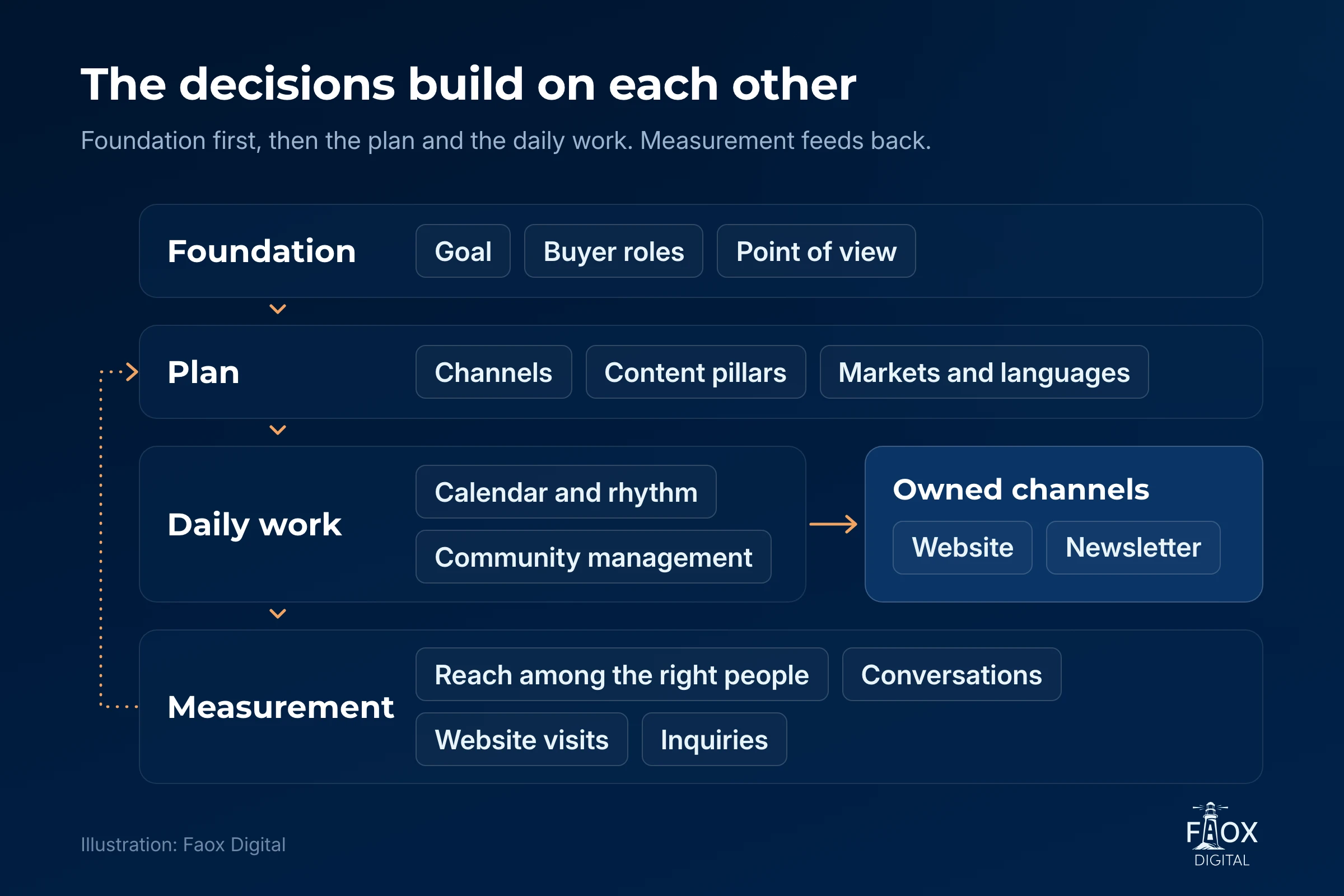
The decisions build on each other, so make them in order. Choosing channels before you know whom you need to reach, or writing posts before you have a point of view, is how many company Pages end up busy and unread.
- Set the goal. Decide what social media should do for the business over the next 12 months.
- Map the buyer roles. List who sits on your buyers’ committees and what each person needs.
- Define your point of view. Write down what you believe about your customers’ problems.
- Choose your channels. Start where your buyers are, usually LinkedIn, and decide where each post should lead.
- Build content pillars. Pick three to five themes and the experts who can speak on each.
- Plan for your markets. Decide how each language and region is served.
- Set the calendar and rhythm. Plan a month ahead, at a posting frequency you can keep for a year.
- Plan the conversations. Decide who answers comments and messages, and how fast.
- Measure and report. Agree the few numbers you will review each month.
The first three steps are the foundation, the next three make the plan and the next two are the daily work. Measurement then feeds back into the plan, and the daily work should lead interested readers to your own channels.
Map the buyer roles on the buying committee
Your target audience is not "manufacturers" or "logistics companies" but the people inside them who take part in a purchase. Map the buyer roles first:
| Buyer role | What they look for | Content that helps |
|---|---|---|
| Engineers and technical specialists | Specifications, applications, limits, installation | Application notes, technical explainers, answers from your engineers |
| Purchasing and procurement | Reliability, delivery, certifications, total cost | Certifications, quality and delivery processes, plant capabilities |
| Management | Risk, return, the supplier’s stability and direction | Your view on the market, leadership posts, news that matters |
| Users and operators | Ease of use, training, service | Short how-to videos, service tips, training material |
| External influencers such as consultants and trade media | An independent, credible view | Expert posts worth sharing, trade media articles, talks at industry events |
The buying committee is larger than the few people you usually meet. Forrester’s State of Business Buying 2026 counts 13 internal stakeholders and nine external influencers in a typical buying decision. Forrester’s 2026 report also found that procurement professionals are decision makers in 53% of business buying cycles, and that they look beyond price at features and functions.
Most of these people stay out of sight. Edelman and LinkedIn’s 2025 B2B Thought Leadership Impact Report, based on nearly 2,000 professionals, found that these "hidden buyers" discover, read and evaluate thought leadership just as the main decision makers do. LinkedIn co-authored the study, so weigh its interest, but the point stands: a colleague you never meet may still read your posts and speak for or against you.
Fill the table for your own market with your sales team and a few customers, using real job titles.
Decide your point of view and message
A point of view is what your company believes about its customers’ problems and how they should be solved. It is what makes a post worth reading, and it gives everyone who posts for you the same direction.
Write it down in three parts:
- The problem you see that buyers underestimate. A valve maker might argue, for example, that many leaks in food plants start with the wrong seal material rather than the valve.
- What you think should change, in a sentence a buyer could disagree with.
- Why you can say it: the experience, tests and projects behind the view.
From the point of view, derive three or four messages that every buyer role should remember, and a short list of words you use and avoid. Forrester’s 2026 social media research found that buyers value content that helps them define the problem and its consequences, not only product details. A clear point of view produces exactly that kind of content.
If your positioning is not settled yet, settle it first. Social media spreads whatever message you have, including a vague one.
Choose your channels, starting with LinkedIn
Channel selection starts from where your buyer roles spend time, not from where competitors post. For most B2B companies the first answer is LinkedIn: it is organized around professional identity, its Page analytics show followers by job function, seniority and industry, and Forrester’s 2026 research says most marketers see the biggest impact there.
Check that assumption, though. In the same research, buyers cited Facebook, Instagram and YouTube as meaningful in the buying journey ahead of LinkedIn, and Forrester asks whether that simply reflects the size of those platforms. It also notes that niche communities such as Reddit and Discord matter for technical depth and peer trust. Ask your sales team and a few customers which platforms they use, market by market.
| Channel | Typical role in B2B | Worth it when |
|---|---|---|
| Company Page plus your people’s profiles; reach by role and industry | Almost always the starting point | |
| YouTube | Demonstrations, installation and how-to videos that stay findable | You can film your products and processes |
| Instagram and Facebook | Plant, people and project visuals; local communities | Your buyers or future employees use them in your markets |
| X | News and industry conversations | Your sector’s journalists, analysts or engineers are active there |
| Reddit and Quora | Answering technical questions in communities | Your experts can answer honestly, without selling |
Start with one or two channels you can run well rather than five you update once a month. Our guide to choosing your social channels compares the platforms in detail.
Organic reach and the channels you own
Organic reach, the number of people who see your posts without paid promotion, is limited on every platform and changes whenever a platform changes its feed. Our article on why posts go unseen explains how feeds decide what to show.
So treat social media as the start of a path, not the end of it. The path should lead to owned channels, such as your website and your newsletter, which you control and which keep working when a platform changes its rules. For each content pillar, decide where an interested reader should go next: an application page, a technical guide, a newsletter sign-up or a contact form. A newsletter published on a social platform can be useful, but its readers remain that platform’s audience, while your own email list stays yours.
Build content pillars around your experts
Content pillars are the three to five themes you return to every month. They keep the feed coherent and make planning faster, because each post starts from a pillar rather than a blank page. Derive them from your point of view and from the questions your buyer roles ask.
| Pillar | What it does | Example posts |
|---|---|---|
| Applications and know-how | Shows engineers you understand their problem | A short explainer on choosing a material, an installation mistake to avoid |
| Proof and capability | Gives purchasing and management reasons to trust you | A new certification, a test you run, a look inside quality control |
| Point of view | Gives management something to think about | Your view on a new regulation, a market shift or an industry habit |
| People and culture | Shows who stands behind the product and helps hiring | An engineer’s day at a plant start-up, a new apprentice group |
Keep a rough balance: most posts should help the reader, some should prove what you can do, and few should be pure announcements.
Expert content, meaning posts written by or with your engineers, product managers and leaders, gives buyers the human voices Forrester describes. Start with one or two people who like to write or speak, give them topics from the pillars, and help with editing so that it takes them an hour a week rather than an evening. Building a leadership presence on LinkedIn is a discipline of its own; our guide to B2B thought leadership covers it.
Adapt the strategy for multilingual markets
If you sell in several countries, multilingual markets add a decision: one global presence, or a presence per market. At the time of writing (November 2026), LinkedIn’s Help Center describes three options that do not require Career Pages:
- Page information in other languages. Your Page’s name, tagline and description can be shown in more than 20 languages, and members see the version in their language.
- Targeted posts. Page posts can be shown to followers by language, location, industry, function, seniority and company size, as long as the targeted audience includes at least 300 followers.
- Affiliated Pages, which let regional teams represent their own market.
For a mid-sized exporter, one global Page with targeted posts in the main languages can be enough to start. A separate Page makes sense once a market has its own team and enough to say. Either way, write for each market rather than translating: examples, standards, units and holidays differ, and a translated post reads like one. Have a native speaker review every language, and show each market’s versions in the calendar.
Plan the content calendar and posting frequency
A content calendar turns the pillars into dates: what goes out, on which channel, in which language, who writes it and who approves it. Plan a month ahead, leave room for news, and agree the approval step in advance, because a post that waits weeks for a technical check often loses its moment. Our social media content calendar guide includes a template.
Posting frequency is a trade-off between reach and quality. Buffer, which sells a social media scheduling tool, published an analysis in August 2025 of more than 2 million LinkedIn posts from over 94,000 accounts. In that 2025 analysis, moving from one post a week to two to five brought about 1,200 more impressions per post, and posting more often raised the figure further. Buffer does not report company Pages separately, so treat this as a direction, not a target.
A workable rule: choose a rhythm you can keep for a year, for example two or three Page posts a week plus a weekly post from each of your experts, and raise it only while quality holds. A steady rhythm teaches your audience what to expect; a burst followed by silence teaches them nothing.
Make community management part of the plan
Comments, questions and messages are where interest turns into conversations, so community management belongs in the strategy, not in someone’s spare time. Decide four things:
- Who answers what. Marketing can thank and acknowledge; technical questions go to a named engineer; pricing and project questions go to sales.
- How fast. Agree a response time on working days, and who covers holidays.
- Where you join in. Comment on posts by customers, partners, trade media and associations in your sector, from your experts’ profiles as well as the Page.
- What you do not do. No arguments in public, no prices in comments, and a short list of issues to escalate.
Our guide to social media community management covers the daily work.
Measure what matters and report monthly
Measurement and reporting close the loop. Decide before you start which numbers you will review, and keep them few:
| Level | What to measure | Where to find it |
|---|---|---|
| Activity | Posts per channel, expert posts, response times | Your calendar and inbox |
| Reach among the right people | Followers and Page visitors by job function, seniority, industry, company size and location | LinkedIn Page analytics |
| Engagement and conversations | Comments from target roles, shares, messages | Platform analytics, your inbox |
| Business results | Website visits from social media, newsletter sign-ups, inquiries | Google Analytics 4, your CRM |
At the time of writing (November 2026), LinkedIn’s follower analytics break your followers down by location, seniority, job function, industry and company size, so you can check whether you reach the roles you mapped. Its Page analytics also compare your followers and engagement with those of competitors.
In Google Analytics 4, at the time of writing, visits from unpaid social media links count as the Organic Social channel and YouTube visits as Organic Video. Add UTM parameters to the links you share, with "social" as the medium, so that these visits are counted correctly, and ask new contacts how they heard of you.
Report monthly with a short commentary: what worked, what did not and what changes next. Review the strategy itself every quarter. Judge activity and reach early, but give the strategy several months before you judge it on inquiries, because B2B buying cycles are long.
Frequently asked questions
How do you create a B2B social media strategy?
Make the decisions in order: the goal, the buyer roles you need to reach, your point of view, the channels, three to five content pillars, how each market is served, a calendar and rhythm you can keep, who handles conversations and what you will measure. Write it on one page and review it every quarter.
Is there a B2B social media strategy template?
Yes. A one-page template needs ten headings: goal, buyer roles, point of view, messages, channels, content pillars, markets and languages, calendar and rhythm, community, and measurement. Fill each with a few lines specific to your company; a template copied without your own buyers and point of view will not help.
What does a B2B social media strategy example look like?
Here is an invented example. A valve maker sets the goal of being known to maintenance and purchasing managers at food plants in two countries. It posts on LinkedIn and YouTube around three pillars (applications, proof and point of view), publishes two Page posts a week plus a weekly post from two engineers, answers technical comments within a working day and reports reach among those roles and inquiries every month.
Does B2B social media marketing work without paid ads?
It can. Organic posts, expert voices and conversations build awareness and trust among the right people over time, although organic reach is limited and results take months. Paid ads can add reach to a clear strategy, but they do not replace one, and nobody can promise results either way.
Sources
- Forrester: Social Media Takes Center Stage In B2B Buying, Even In The AI Era, January 2026
- LinkedIn Help: Create targeted posts on your LinkedIn Page, accessed November 2026
- Buffer: How Often Should You Post on LinkedIn in 2026? Data From 2 Million+ Posts, August 2025
- Google Analytics Help: Default channel group, accessed November 2026
Let’s talk
Want social media that reaches the right people?
Tell us who you want to reach. We will look at your channels and suggest a plan your team can keep up with.