
Social Media Marketing for Manufacturers: How One Brand Grew Without Ads
How RAFF Military Textile built organic social media in eight languages with $0 ad spend, what it delivered and what other manufacturers can take from it.
Social media marketing for manufacturers can work without an ad budget when it runs as a system rather than a campaign: each platform gets one job, a structured content calendar keeps every language moving, the company’s own experts carry the content and results are tracked through to the website. RAFF Military Textile, a defence manufacturer, used this approach in eight languages with $0 ad spend. Over 12 months, its 116 LinkedIn posts earned 58,628 organic impressions and 4,935 clicks.
It is easy to assume that social media only works with an advertising budget, or that buyers of industrial products are not there at all. This article looks at one manufacturer that built an international presence on social media without spending anything on ads: what was set up, what it delivered and what other manufacturers can take from it. It shows a B2B social media strategy in practice; our guide covers how to build one.
RAFF Military Textile is our client, and we work as a B2B social media agency, so we have a stake in this story. All figures come from the RAFF success story we published, with the period they refer to, and the lessons apply whoever runs your channels.
The starting point: known offline, hard to find online
RAFF Military Textile is a defence manufacturer with decades of offline credibility and, at the start, a weak digital presence. Its success story lists seven disconnected websites in different languages with no central brand control, content only in Turkish and English, and no search presence in its priority African markets, although 60% of its target clients were located there.
The company did not lack credibility; it lacked visibility with buyers who read other languages. If your company sells through trade fairs, distributors and long relationships, that gap may look familiar.
How the system was set up
Social media was one part of a program that covered all six of our services over 12 months and is still running. The social side rested on five decisions.
Eight languages. The website was rebuilt as one multilingual platform for eight languages, and a monthly content calendar ran in all eight, so readers in each market had pages in their own language to reach.
One job per platform. Each social channel got a distinct purpose instead of the same post everywhere:
| Platform | Its job for RAFF | Why it can suit a manufacturer |
|---|---|---|
| B2B authority | Buyers and partners can be reached by role and industry | |
| Quora, in English and French | CEO-led expertise | Questions stay findable, and good answers show depth |
| Product visuals | People search it for products chosen by how they look |
Quora and Pinterest are less obvious choices for B2B. Our guide to Quora and Pinterest for B2B explains when they earn their place.
A structured content calendar. Publishing followed a monthly plan in every language, so it did not depend on someone finding time between other tasks.
CEO-led expert content. On Quora, the company’s CEO carried the expertise in English and French, which puts the most senior voice in the company in front of the people asking questions.
Zero ad spend. Nothing was spent on ads, so every result below is organic. A brand documentary was produced as part of the same work.
What it delivered
RAFF’s success story publishes these social media results, all organic and with no sponsored content:
| Platform | What was measured | Result over 12 months |
|---|---|---|
| Organic impressions, clicks, posts, average engagement rate | 58,628 impressions, 4,935 clicks, 116 posts, 11.9% | |
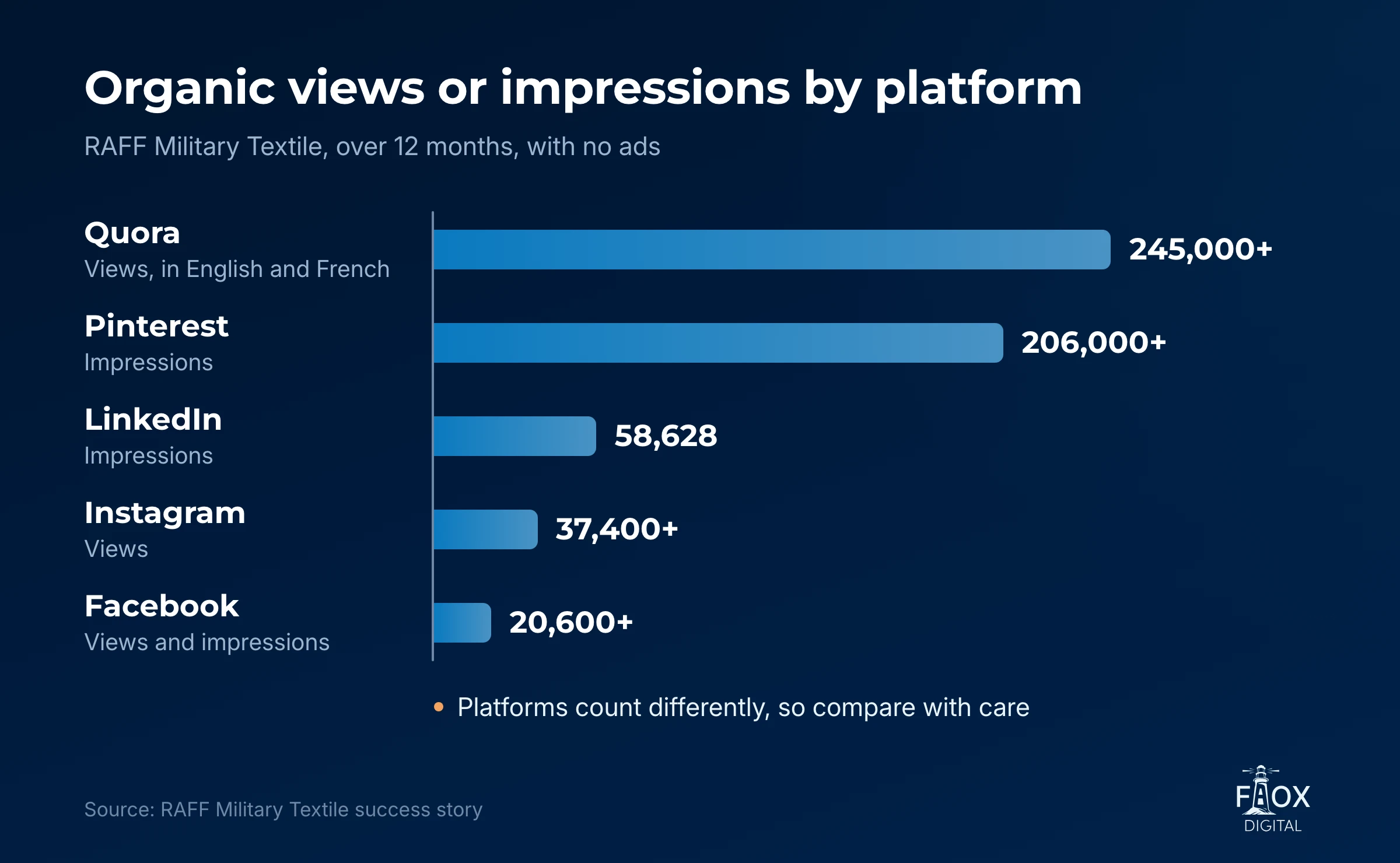
| Quora, in English and French | Views | 245,000+; the French account passed 200,000 within 3 months |
| Impressions | 206,000+ | |
| Views | 37,400+ | |
| Views and impressions | 20,600+ |
Those 12 months of LinkedIn data need one note on the engagement figure. At the time of writing (November 2026), LinkedIn’s Help Center defines engagement rate as the ratio of interactions to impressions, where interactions include clicks, reactions, comments and shares. On that definition, a high engagement rate reflects clicks that take readers onward as well as reactions.
The website shows where those readers went. Organic social traffic to the site is the visits that arrive through unpaid links on social platforms, which Google Analytics groups as the Organic Social channel. In the success story’s year-over-year comparison for 16 February to 15 March, organic social traffic to the site rose 374%.
Read these numbers with two cautions. Platforms count differently: Quora and Instagram report views, LinkedIn and Pinterest impressions, so the chart is not a like-for-like comparison. And social media was one part of a full program, so it cannot claim the whole website result: in the same comparison, active users on the site rose 169%, from 8,346 to 22,450, a result of the whole program rather than of social media alone.
A system instead of campaigns
If your social media runs as a series of campaigns, with a burst before a trade fair or a launch and then silence, RAFF’s setup worked the other way. Here is how the two approaches compare:
| Campaign approach | System approach | |
|---|---|---|
| Aim | A spike in reach around one event | Steady presence among the right buyers |
| Platforms | The same post everywhere | One job per platform |
| Rhythm | Bursts, then silence | A monthly calendar in every language |
| Voice | Company announcements | Experts and the CEO answering real questions |
| Reach | Bought with ads | Earned with content and time |
| Measurement | Reach during the campaign | Clicks and visits to the site, month after month |
Campaigns still have their place, for example around a product launch, but they work on top of a system rather than instead of one.
"Faox Digital didn’t just manage our digital channels. They built a system that works across markets, languages, and time zones. Our international visibility grew in ways we couldn’t achieve alone." Eray Yükseloğlu, CEO, Raff Military Textile
What it takes, and what to ask before you start
Organic does not mean free. RAFF’s program has run for 12 months and is still running; it needs content in eight languages, a CEO who takes part and a team to plan, publish and answer. The cost moves from ad budgets to people’s time and expertise. Our guide to social media management cost explains what drives the price.
Before you start, or before you hire help, get clear answers to these questions:
- Which job will each platform do, and which platforms will you leave out?
- Who writes in each language, and who checks it?
- Which of your experts will speak for the company, and how much time can they give?
- Where will each post send readers on your website?
- What will the monthly report show, and how will it connect to inquiries?
A clear monthly report keeps everyone honest; our social media reporting template shows what it should contain.
Is an organic approach right for your company?
An organic approach suits a manufacturer that has real expertise to share, can give its experts a few hours a month and is prepared to wait months rather than weeks. It suits less well a company that needs immediate reach for a single event, where paid promotion can help. RAFF’s published results cover 12 months of steady work, and the work continues.
Frequently asked questions
What should a social media marketing plan for a manufacturer include?
A goal, the buyer roles you need to reach, a job for each platform, a monthly content calendar for every language you sell in, the experts who will speak for the company and how results will be measured on your website and in inquiries. Keep it short enough that everyone who posts has read it.
How do you plan a social media content calendar in several languages?
Plan one monthly calendar with shared themes, then write or adapt each language version with a native speaker rather than translating word for word. Mark which posts go to which markets, and give each post a page on your site in the same language to link to.
How long does organic social media take to show results for a manufacturer?
Expect months rather than weeks. RAFF’s published LinkedIn figures cover 12 months, although its French Quora account passed 200,000 views within 3 months. Results depend on your expertise, your markets and how steadily you publish, so no one can promise a timeline.
Do manufacturers need to be on Quora and Pinterest?
Not necessarily. Quora suits companies whose experts can answer the questions buyers ask, and Pinterest suits products chosen by how they look, such as furniture, building materials or packaging. Add them only if they have a clear job and someone to run them.
Sources
- LinkedIn Help: Content analytics for your LinkedIn Page, accessed November 2026
- Google Analytics Help: Default channel group, accessed November 2026
Let’s talk
Want social media that reaches the right people?
Tell us who you want to reach. We will look at your channels and suggest a plan your team can keep up with.
Social media marketing for manufacturers: lessons you can apply
These decisions are not specific to RAFF’s sector. They apply just as well to a maker of valves, packaging or building materials:
RAFF’s social media also ran alongside a rebuilt multilingual website, search work, a CRM with follow-up after trade fairs and digital PR. For how those parts fit together, see our integrated marketing program example.