
International Keyword Research: Why Translated Keywords Miss Local Searches
A translated keyword can be correct and still miss the buyer. How search terms change by country, and how to research them market by market.
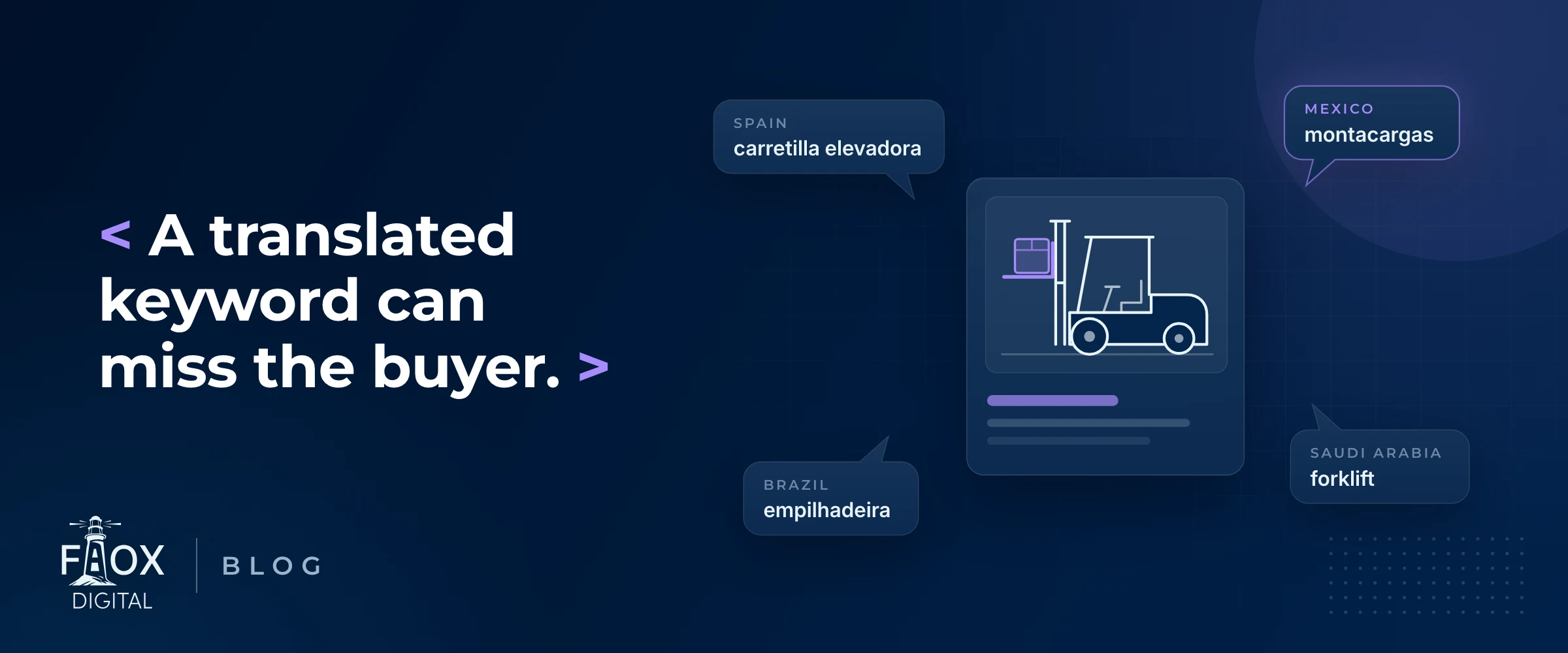
International keyword research means finding the words buyers actually search for in each market, in that market’s language and location, instead of translating your home-market list. Translated keywords miss local searches because the trade term is often not the literal translation, and the same language uses different words from country to country. Start from local sources, check demand market by market, have a native-speaking expert review the terms and record the result in a keyword map for each market.
Translate "forklift" into Spanish and you face a choice. Buyers in Spain search for carretilla elevadora. In Mexico that term barely registers, and buyers search for montacargas, a word that in Spain usually means a goods lift. A translator could defend either word, and your page could still miss the buyer.
This article covers why that happens and how to research each market. The general method of keyword research stays the same, so we focus on what changes with language and country. For how this fits with site structure, hreflang and measurement, see our international SEO guide.
Why translated keywords miss local searches
A translated keyword list starts from the wrong question. It asks how to say your term in another language, when the useful question is what buyers in that market type when they need the product. The answers differ for four reasons:
- Buyers use trade terms, not dictionary terms. In Google Trends for Turkey, küresel vana (ball valve) averaged 70 over the past 12 months, while the more literal top vana and bilyalı vana showed 0.
- One language splits across countries. Spain and Mexico use different words for the same machine, and so do Portugal and Brazil.
- The same word can mean different things. Montacargas is a forklift in one market and a lift in another.
- Buyers may not search in the local language. In Saudi Arabia, the English word forklift averaged 62, against 2 each for two Arabic terms.
We checked these figures in November 2026. Google Trends scales interest from 0 to 100 within one place and period, so compare terms within a market, not across markets. It gives no search counts, low-volume terms show as 0, and because it rests on a sample of searches, the same comparison can give slightly different values on different days.
Same language, different markets
Local search language differs even where the language is the same. These comparisons show average interest in Google Trends over the past 12 months (November 2026):
| Product | Market | Average interest |
|---|---|---|
| Forklift | Spain | carretilla elevadora 69, montacargas 44 |
| Forklift | Mexico | montacargas 74, carretilla elevadora 0 |
| Forklift | Portugal | empilhador 76, empilhadeira 8 |
| Forklift | Brazil | empilhadeira 77, empilhador 2 |
| Wall panel | United States | drywall 76, plasterboard 1, gypsum board 1 |
| Wall panel | United Kingdom | plasterboard 75, drywall 26, gypsum board 1 |
| Wall panel | United Arab Emirates | drywall 26, gypsum board 25, plasterboard 0 |
| Pallet mover | United States | pallet jack 71, pallet truck 18 |
| Pallet mover | United Kingdom | pallet truck 75, pallet jack 11 |
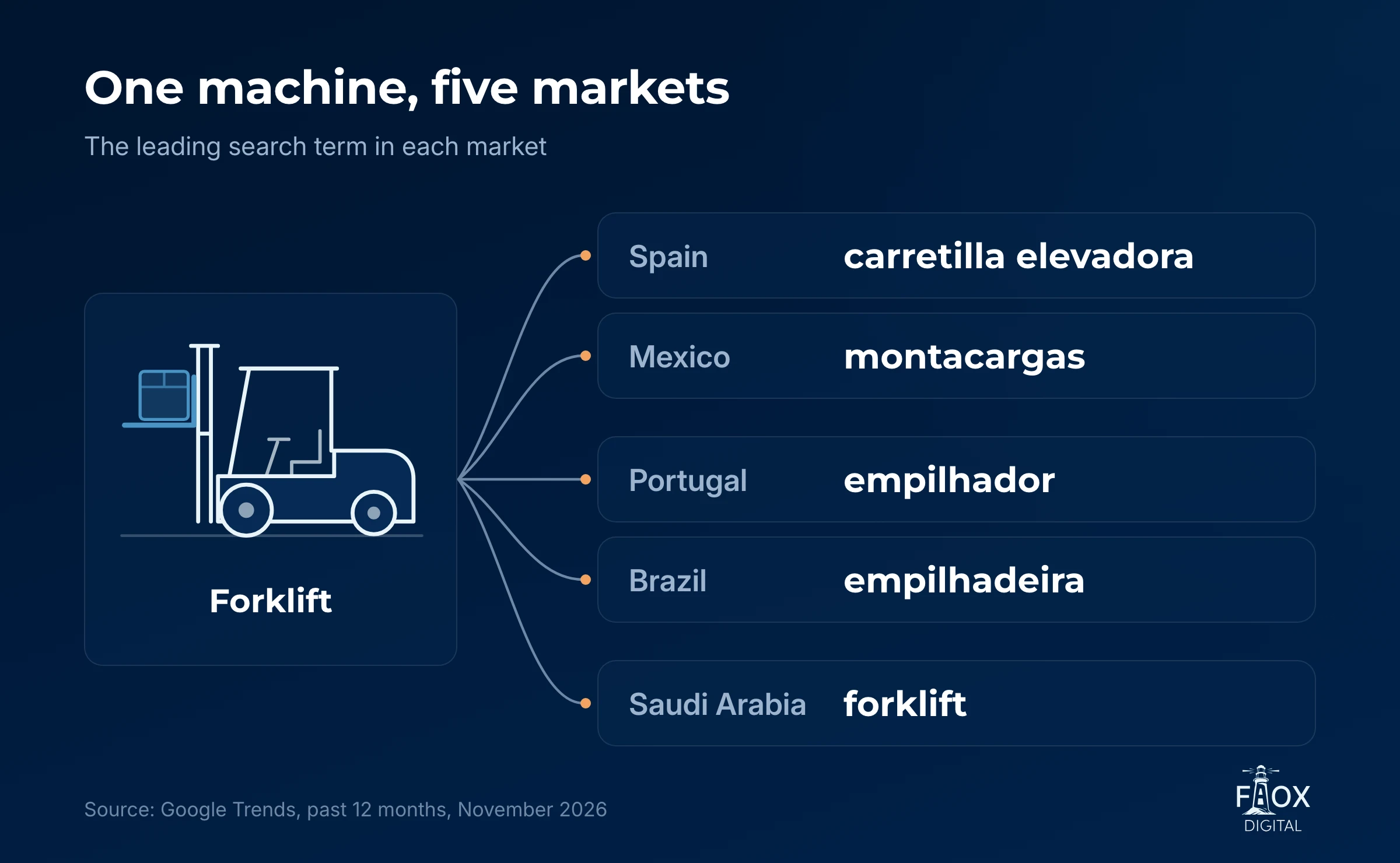
The Gulf needs its own check, not a copy of your UK or US list. In the UAE, drywall and gypsum board are almost level and the British plasterboard shows 0, so a page there may need both terms. For forklifts, English led in Saudi Arabia and in the UAE, where forklift averaged 72 against 0 for the Arabic terms (رافعة شوكية and فوركلفت). That does not mean you can skip Arabic pages. It means you cannot assume which language buyers search in, so test both.
Most exporters will not build a page for every English-speaking country. If you keep one English version, choose the main term from your largest market, use the others where they fit naturally, as in "plasterboard (drywall)", and say which markets you serve. Split the page only when the offer differs as well: prices, certificates or contacts. Separate pages then need clear signals, or you may end up with Google showing the wrong country.
Multilingual keyword research also runs the other way, because one country can search in several languages. Switzerland, Belgium and Canada each need a list per language, and Keyword Planner lets you set location and language separately.
Technical terms change by market
Technical terms go wrong in ways a general translator may not catch. Montacargas is a clear case. In Google Trends for Mexico, the top related searches name forklift makers such as Toyota, Yale and Hyster. In Spain, they are about lifts, such as montacargas ascensor and montacargas de obra, and the dictionary of the Real Academia Española defines the word as a lift for raising loads. A page for Spanish buyers built on the Mexican word would attract people who want a different machine.
Standards add another layer, because the same material or part can carry a different designation in each system. Abbreviations and older product names vary too. List every name a buyer in that market may use, and show them on the page where they are accurate.
Translation, localization and transcreation
These words are often mixed up, and the difference decides how your term list gets used:
| Approach | What it does | Suits | Role of the term list |
|---|---|---|---|
| Translation | Moves the text into another language | Manuals, data sheets, legal text | Tells translators which approved terms to use |
| Localization | Adapts content to the market’s language, culture and other requirements | Product, certificate and contact pages | Adds the local details and terms buyers look for |
| Transcreation | Writes new copy for the market from the source copy and a brief | Headlines, category introductions, campaign pages | Lets the page be written around the local term |
The W3C notes that localization is often thought of only as a synonym for translation but is often a substantially more complex issue. Transcreation goes further: translator Claudia Benetello argued in 2018 that it is a different practice from translation altogether.
Give the term list to whoever does the work before they start. The translation workflow itself is a separate topic. The same problem also appears outside your website: a press release translation needs the same list, or your news will use different words from your product pages.
International keyword research: where to find local terms
Local keyword research starts with people and local sources, then checks demand. Each source has limits:
| Source | What it gives you | Limits |
|---|---|---|
| Distributors, sales engineers, enquiries | The words buyers write | A small sample, sometimes from one region |
| Local competitors, trade press, catalogs | The words the market’s suppliers use | Shows suppliers’ language, not always buyers’ |
| Search Console | Queries you already appear for, by country | Only searches where you already appear |
| Keyword Planner | Search volume, with location and language settings | Needs a Google Ads account with billing details; very low-volume terms may not appear |
| Google Trends | Which of several terms leads in a country | Relative figures, no search counts |
| Google Autocomplete | Predictions based on real searches | Google says they reflect the language and location of the query, so results depend on your settings |
Search volume by market helps you set priorities within that market. Compare the terms first and the countries second, because a small number in a small market can still be a good target if you sell there. If a niche term shows nothing, that is not proof that nobody searches for it. Rely on what enquiries say, publish a page and use international SEO reporting to see which terms bring impressions in that country.
Related searches also show what buyers want there. In Google Trends for Mexico, the top related searches for montacargas include rental and price terms, such as renta de montacargas and montacargas precio. A company that only sells machines would plan its pages differently from one that rents them.
Local competitors and local search engines
Local competitors may not be the companies you meet at home. Google customizes results by region, and its search settings let you choose another one. Run your main terms there or, better, ask someone in the market. Note who ranks: local makers, distributors, marketplaces or directories. Then read their pages, because they show what the market calls the product. If the results show a different kind of product, the term is wrong.
Local search engines change the tools too. Statcounter’s data for October 2026 shows Baidu ahead of Google in China, Yandex ahead in Russia and Naver close behind Google in South Korea. Yandex’s Wordstat shows query statistics by region and needs a login. Bing’s Keyword Research tool filters by country and language. We could not check Baidu’s and Naver’s own tools, so use a local specialist if those markets matter to you.
Native-speaking expert review
A native-speaking expert speaks the language and knows the trade: a sales engineer, a distributor or a specialist translator in your sector. General fluency is not enough, and machine translation or AI tools can suggest candidates but cannot tell you what the market uses. Ask this person to confirm each term:
- A buyer in this market would write this word in an enquiry
- Searching for it shows the right kind of product
- It has no second meaning that would attract the wrong buyer
- The spelling and form are right for this country
- The market does not prefer an English term or a standard designation
A keyword map for each market
A keyword map records the decisions, with one row per page and market, so that writers, translators and developers work from the same list. Here is an illustrative example:
| Page ID | Market | Main term | Evidence | Checked by | Decision |
|---|---|---|---|---|---|
| F-01 | Spain | carretilla elevadora | Trends, enquiries | Sales engineer in Spain | Own page |
| F-01 | Mexico | montacargas | Trends, related searches | Distributor in Mexico | Own page, because the term differs |
| F-01 | UAE | forklift | Trends | Gulf sales team | English page, Arabic to test |
| W-02 | UK | plasterboard | Trends, enquiries | UK distributor | Own page |
| W-02 | US | drywall | Trends, enquiries | US distributor | Own page |
The shared page ID connects the versions of a page for hreflang. The decision column also feeds your site plan: how many markets need their own pages is one input to the ccTLD vs subdirectory choice.
How to do keyword research for different countries
- Start from products and buyers’ problems, not from your English keyword list. Begin with the product families that matter most in that market, not the whole catalog.
- Collect local terms. Ask distributors and sales engineers, and read enquiries, competitors’ pages and trade press.
- Check demand in each market. Use Keyword Planner with that market’s settings, compare terms in Google Trends and read Search Console by country.
- Check the results. Search each term in that region and confirm that it shows the right product.
- Have a native-speaking expert review the list. Remove terms that are correct but not used.
- Build the keyword map. Give each page and market one main term, and note the evidence.
- Brief the writers. Decide what gets translated, localized or transcreated, and hand over the term list first.
- Measure and revise. Compare the searches you planned for with those that appear in each market.
The hardest part of this work is checking it when nobody on your team reads the language. If you are bringing in help, our guide to choosing an international SEO consultant shows how to test a provider’s research.
How Faox Digital researches keywords for each market
Faox Digital builds the keyword map market by market, including the questions buyers ask AI tools in each language, rather than translating one list. We treat localization and translation as two different jobs, because a correct translation can still miss the term local buyers search for.
Key takeaways
- Translating a keyword list answers the wrong question. Research what buyers in each market actually type.
- One language splits by country: Spain and Mexico use different words for a forklift, and one word can mean another machine.
- Do not assume the search language. In Saudi Arabia and the UAE, the English forklift led the Arabic terms in Google Trends.
- Use several sources: local people, Search Console, Keyword Planner, Google Trends and the local results.
- Have a native-speaking expert check each term, and keep the result in one keyword map per market.
Frequently asked questions
Can I translate my English keywords and check their volume?
You can use that as one starting point, but it only tests the words you already thought of. It misses terms you would never have translated to, such as an English word the local market prefers. Start from local sources as well.
What if a local term shows no search volume?
It may still matter. Keyword Planner can leave out very low-volume terms and Google Trends shows them as 0, which is common for niche B2B products. If enquiries or distributors use the term, build the page and watch Search Console for that country.
Do English-speaking markets need separate keyword research?
At least check your main terms in each one. In Google Trends, plasterboard led in the UK and drywall in the US, while the UAE split between drywall and gypsum board. If the terms and the offer both differ, each market may need its own page.
Can AI or machine translation do this research?
They can suggest candidates quickly, but they do not show what buyers in a market search for. Check each suggestion against search data, the local results and a native-speaking expert.
Where does keyword research fit in international SEO?
Do it after you choose your markets and before anything is translated. The research shows which pages each market needs and which words those pages should use, so it shapes the site plan and the translators’ brief.
Sources
- Google Trends: carretilla elevadora and montacargas, Mexico, past 12 months, November 2026
- Google Trends Help: FAQ about Google Trends data, accessed November 2026
- W3C: Localization vs. Internationalization, accessed November 2026
- Benetello, C.: When translation is not enough, The Journal of Specialised Translation, 2018
Let’s talk
Where do you want to be found?
Tell us the searches that matter to your business. We will review your site and tell you plainly what to fix first, including what you can do yourself.