
Digital PR for SEO: How Media Coverage Turns Into Links and Authority
How coverage in trade and international publications turns into links, mentions and authority, how PR and SEO teams share the work, and how to measure it.

Digital PR for SEO means earning coverage in publications your buyers read, because you have news, data or expertise worth reporting. Google treats links and references from prominent sites as a sign of trustworthy content, and AI tools rely heavily on third-party sources. Measure the work by the links and mentions earned, how the linked pages perform in search, and the visits and enquiries that follow.
A trade magazine covers your new test results. The PR report counts one clipping, the SEO report counts one link, and nobody connects the two. Often nobody even checks whether the article linked to the right page, or to anything at all.
This article covers the link and authority side of digital PR, as one part of how authority is earned. It explains how coverage becomes links and credibility, what does not count as earned, how PR and SEO teams should share the work and how to measure the result. The examples come from a hypothetical pump seal manufacturer.
How digital PR for SEO builds authority
Earned media is coverage you did not pay for: an editor decided your news, data or expertise was worth reporting. Earned media links are the links that come with it. Google gives two reasons they matter. Its How Search works page (accessed November 2026) says one factor in judging quality is whether other prominent websites link or refer to the content. Its guide to ranking systems (updated December 2025) says link analysis, including PageRank, remains part of core ranking.
Notes from a February 2025 call with a Google engineer, published as a US Justice Department exhibit, describe PageRank as relating to distance from a known good source. We read that as one more reason a link from a respected trade title matters, though Google has not said so in those terms. John Mueller of Google also wrote in a personal post in January 2021 that digital PR can be as critical as technical SEO.
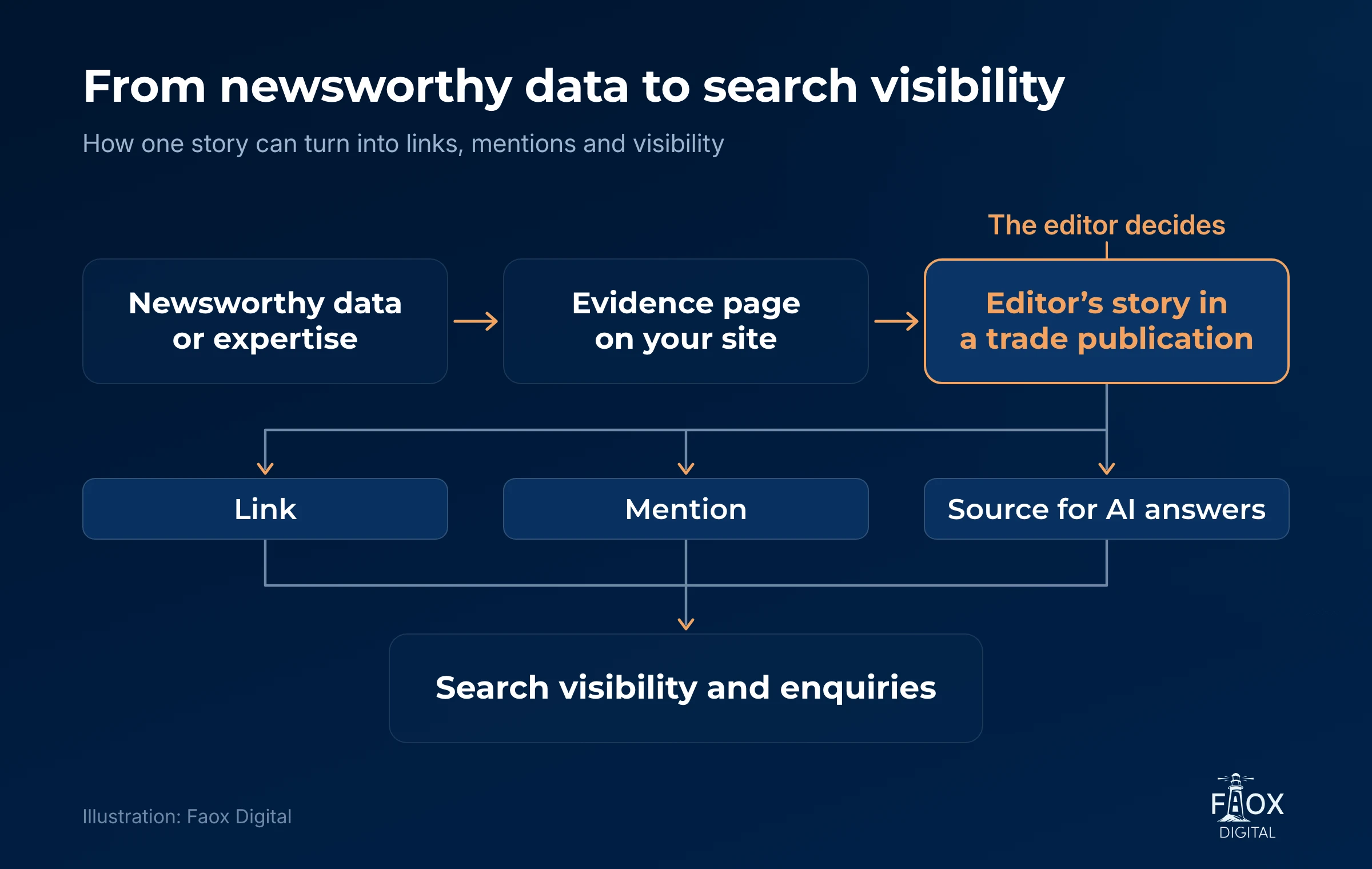
Digital PR link building differs from other link building strategies in one way: you do not place the link. The editor decides whether to write, what to say and whether to link. That gives the link its value, and it is why nobody can promise coverage.
| Route | Who decides | What to expect from links | Earned? |
|---|---|---|---|
| News or data story | The editor | A normal link, a nofollow link or none | Yes |
| Expert comment or byline | The editor | Sometimes a link in the author note | Yes |
| Press release on a wire service | You pay to distribute it | Google tries to ignore links in releases | No, until an editor writes a story |
| Sponsored content | You pay to publish it | Must be marked rel="sponsored" or rel="nofollow" | No |
Trade publications and international publications
Trade publications are the natural first target for a B2B company. In the 2026 State of Marketing to Engineers survey by GlobalSpec and TREW Marketing, 76% of 783 respondents said they routinely use online technical publications when researching a work-related purchase, and 53% use print ones. GlobalSpec’s reading is that buyers may form opinions about a supplier in these titles before ever visiting its site. A specialist title may have a small audience and a modest authority score and still be the page your buyer reads. Ask your sales team which titles customers mention, then check whether each one publishes its articles online and links to its sources.
International publications matter if you export. Google’s guidance on multi-regional sites (updated December 2025) lists links from other local sites among the signals of a site’s intended audience. So a story in a German trade title should link to your German page, not your English home page, and the pitch should come in German from someone who can read the reply.
Newsworthy data and research
Editors need a reason to write. Newsworthy data and research is the most common answer: BuzzStream’s 2026 State of Digital PR survey found that 95.9% of practitioners pitch data-led content. Pitching still works when it is relevant. In Muck Rack’s 2026 State of Journalism survey, 86% of the 897 journalists whose answers were analyzed, most of them based in the US, said at least some of their work began with a PR pitch. Both companies sell PR software, so read these figures with that in mind.
An industrial company often holds information nobody else has. Our pump seal manufacturer could report:
- Test results for a new seal material, with the method
- Trends in failure causes across several years of returned seals, anonymized
- A survey of maintenance engineers, with its sample size stated
- What a revised standard changes for buyers, explained by an engineer who worked on it
Whatever the story, publish the evidence on your own site first, with the method and a date. Editors then have something to check and cite, and you have a page that can earn links and send visitors on to the related products. Approaching editors is a craft of its own, and our media relations guide covers it.
What press releases and sponsored content can do
Press releases are not a link tactic. John Mueller said in 2018, as Search Engine Roundtable reported, that Google tries to ignore links in press releases because companies place them themselves, though they are nothing to worry about. Google’s spam policies (updated August 2026) go further and list optimized anchor text in press releases distributed on other sites as link spam. A release still has a job: telling editors about real news so that they write their own story. Our press release guide explains how to write one.
Labeling sponsored content is not optional. Google says buying and selling links for advertising and sponsorship is a normal part of the web’s economy, as long as the link is marked rel="sponsored" or rel="nofollow". Readers should also be able to see that the piece is paid for. Sponsored content can reach the right audience, but it is not earned media, so report it separately and do not count its links as earned. If a title offers coverage in return for an advertising booking, treat that as sponsored too, whatever the page calls it.
Linked and unlinked coverage
You do not control whether a story links to you, and linked and unlinked coverage both have value. Google’s wording covers sites that link or refer to content, and a mention still puts your name in front of the buyer. Google also said in 2019 that it treats nofollow as a hint, so a nofollow link from a respected title is not worthless.
When a story names you without a link, write to the editor only if a link would help readers, for example to the data the story cites. Our article on unlinked brand mentions explains how to find them and how to ask.
A successful story can also get copied onto low-quality sites. These odd links are usually nothing to act on, because Google says most sites do not need its disavow tool. Read about when to disavow links before you clean anything up.
Sources AI tools trust
Sources AI tools trust tend to be ones a company does not own. Muck Rack’s October 2026 study of AI citations found that nearly 99% of cited links came from non-paid sources and more than 84% from earned and third-party sources, with paid and advertorial content at 0.3%. Journalism made up 22% of citations in September, down from 27% in May. A 2025 preprint by Chen and colleagues also found a strong bias toward earned media over brand-owned content.
Read this with care. Muck Rack sells PR software, its definition of earned is broad and includes third-party corporate content, and its example prompts are consumer questions. Google also warns in its guide to generative AI features (July 2026) that seeking inauthentic mentions is not as helpful as it might seem. No one can promise a citation from a story. The practical point is that the same credible coverage serves readers, search and AI tools at once.
How PR and SEO teams should work together
In BuzzStream’s 2026 survey, 53.4% of digital PR practitioners said they work most closely with SEO teams and only 10.1% with PR teams, so the two sides of the work often sit apart. PR and SEO teams working together need only a simple routine:
- Agree on the pages that matter. SEO lists the pages and topics that need authority, and PR checks which have a story behind them.
- Share the calendar. PR says what is coming, such as launches, fairs and results, so the web page is ready before the pitch.
- Choose one target page per story. Give editors a stable web address in the right language, and keep it live after the campaign.
- Do not script the link text. Offer your company name and the web address, never a keyword phrase.
- Check each story when it appears. Confirm your name, the link and the destination page, and politely ask for any corrections.
- Keep one log. Record the title, date, link type, target page and referral visits in one place, so both teams report the same facts.
How to measure digital PR SEO performance
PR reports tend to count coverage and SEO reports tend to count links. Measuring links and mentions together, then following them through to search and enquiries, gives you the fuller picture:
| What to measure | Where to find it | What it tells you | Its limits |
|---|---|---|---|
| Links from target titles | Your log, a backlink tool, Search Console’s Links report | Whether the work reached the right sources | The Links report is a sample and does not show nofollow |
| Mentions, linked or not | Media monitoring, searching for your name | Whether your name is being repeated | Tools can miss print and paywalled articles |
| Referral visits and enquiries | Your analytics and CRM | Whether readers acted | Many readers search for you later instead of clicking |
| Searches for your name | Search Console | Whether recognition is growing | Other marketing affects it too |
| Search results of linked pages | Search Console, page by page | Whether those pages gain ground | Many other factors move rankings |
| AI answers | A fixed set of test questions | Whether AI tools mention you | Answers vary from run to run |
Practitioners in BuzzStream’s 2026 survey rank quality links first among their success measures (85.1%), then total mentions (72.3%), so tracking both is normal practice.
Give it time. In the same survey, 85.2% said measurable results take no more than six months, and 51.4% said three to six. That is their own view, and a small B2B site with low search volumes may take longer to show a clear trend.
Two numbers do not belong in the report. AMEC’s Barcelona Principles 4.0 (2025) say invalid measures such as advertising value equivalents should not be used, so ignore any figure that prices coverage as if it were advertising. And a third-party authority score is not a result in itself.
If you are thinking about outside help, read our guide to choosing a link building service, which shows how to tell earned coverage from risky link buying.
How Faox Digital connects digital PR and SEO
Digital PR at Faox Digital runs in five steps: map the field, find the story, build the materials, reach out and follow through, then measure. In SEO projects, the coverage it earns in the press buyers read becomes part of the content and authority step, and paid placements are labelled as sponsored.
Key takeaways
- Digital PR for SEO earns links and mentions because an editor found your news, data or expertise worth reporting. That is why nobody can promise it.
- Start with trade publications your buyers read, and in export markets link local stories to the local-language page.
- Publish the evidence on your own site first, so editors can check and cite it.
- Press release links do not build authority, and paid placements must be labeled and marked
rel="sponsored"orrel="nofollow". - Measure links, mentions, referral visits, enquiries and the search results of linked pages, in one shared log.
Frequently asked questions
What is digital PR for SEO?
It is PR work planned with search in mind: earning coverage in publications your buyers read, then making sure the links and mentions point to useful pages and get measured. The coverage comes first, because an editor has to find the story worth telling.
How is digital PR different from link building?
Link building is the wider work of earning links from any source, such as associations, certifiers or distributors. Digital PR earns them through media coverage, where the editor decides what to publish. A story with no link can still be a success.
Do press releases help SEO?
Not through their links, because Google has said it tries to ignore most of them. A release helps when it gets an editor to write a story of their own, and that story may then link to you.
What is a safe way to get backlinks for SEO?
Earn them. Give editors real news or data, publish pages people want to cite, and claim links from associations, certifiers and partners. Avoid paying for any link that is not marked as paid. In BuzzStream’s 2025 survey, over 90% of digital PR practitioners said client goals can be met without buying links.
Sources
Let’s talk
Where do you want to be found?
Tell us the searches that matter to your business. We will review your site and tell you plainly what to fix first, including what you can do yourself.