
llms.txt: What It Is, How to Write One and What It Won’t Do
What the llms.txt proposal is, how to write the file, and a realistic view of what it will and will not do for AI visibility.

llms.txt is a proposed Markdown file, placed at a site’s root, that gives AI tools a short summary of the site and links to its most useful pages. It is not a formal standard, Google says its Search ignores it, and large studies find no link with AI citations. It costs little to add and can help tools that read it, such as coding agents, but it does not replace crawlable, useful pages.
You may have been told you need an llms.txt file to appear in ChatGPT. The evidence does not support that, though the file is not useless either. This article explains what it is, how to write one, with an example, and what to expect from it. Treat it as a small item within generative engine optimization, not as a shortcut.
What is llms.txt?
llms.txt is a text file written in Markdown that sits at /llms.txt on a website. Jeremy Howard published the llms.txt proposal in September 2024 and revised it in August 2026. The reasoning is simple: web pages are built for people, with navigation, ads and scripts that get in the way of an AI tool working with limited context. A short, curated file gives that tool a guided path to the right pages.
It is a proposal and not an official standard. Its own site says the specification is open for community input, and you should read vendors’ references to an "industry standard" as shorthand.
The author says the file is used most heavily for software documentation, where coding agents follow it to find API references and tutorials. He adds that the same structure can work for a business outlining its structure and policies.
llms.txt vs robots.txt
The names look alike, but the jobs are different:
| Aspect | llms.txt | robots.txt | XML sitemap |
|---|---|---|---|
| Purpose | A curated guide for AI tools | Tells crawlers which URLs they may visit | Lists the pages you want search engines to find |
| Format | Markdown | Plain-text rules | XML |
| Status | Community proposal | IETF standards-track document (RFC 9309, 2022) | Widely supported protocol |
| Controls access? | No | Asks crawlers to stay out, but is not security | No |
| Contents | A summary and selected links | Allow and disallow rules | All indexable pages |
An llms.txt file controls nothing. A page blocked in robots.txt stays blocked whatever llms.txt says, so keep the two consistent.
What llms.txt will not do
- It will not help in Google Search. Google says Search does not use these files, including in its generative AI features, and that having one neither helps nor harms your visibility there.
- It has no measured effect on citations. SE Ranking found no correlation between having the file and being cited, and its model got more accurate when the file was removed as a factor. That is correlation data, and the authors say it may change.
- It is rarely read. Ahrefs counted only about 22,000 requests in total, and its authors treat their figures as a ceiling, because a fetch does not prove a tool used the file.
- It will not correct how you are described. AI tools draw on live search, third-party pages and training data, as we explain in our article on how AI assistants describe companies. What gets quoted depends on the pages themselves, which is the subject of answer engine optimization.
Which tools read llms.txt
The evidence is thin. At the time of writing (November 2026), this is what we can say:
- Coding agents are the clearest use. In Ahrefs’ data, GPTBot was the top named bot and Claude-Code came second, ahead of every AI search and assistant bot.
- AI companies publish their own. The proposal notes that OpenAI, Anthropic and Gemini have files for their developer documentation. That shows they see value for documentation. We found no statement from them or from Perplexity that the file affects which sources their answers cite.
- Audit tools ask for it. SEO audit tools were the largest group of requests in Ahrefs’ study, at 21.7%. Chrome’s experimental Lighthouse audit looks at the file as one part of testing for agent-ready websites. It is a simple check: a missing file counts as not applicable, and an existing file is checked for basic recommendations, such as an H1 and at least one link.
- One vendor reports more use. Mintlify, using Profound’s logs from 25 companies over 7 days in 2025, reported a median of 14 visits to llms.txt and 79 to llms-full.txt. Both firms have a commercial interest, and the sample is small.
So the file is reasonable if you publish technical documentation, API references or product data that developers and their tools use. For a typical B2B site it is an optional, low-cost extra.
How to write an llms.txt file
- Check for an existing file. Open yourdomain.com/llms.txt. Some plugins create one by default.
- Choose the pages. Pick what you would show a new buyer: products, industries served, certifications, key guides and how to enquire.
- Write the name and summary. Start with an H1 with your company’s name, then a blockquote saying what you do, for whom and where.
- Add the page links. Group them under H2 headings. Each line has a name, a URL and a short note on what the page contains.
- Mark secondary links. By convention, an "Optional" section holds links a tool can skip.
- Publish and test. Place the file at your site’s root and confirm that it loads. The proposal suggests asking an agent questions about your content while giving it only this file.
- Set a review date. Update the file when products, certifications or URLs change.
An llms.txt example
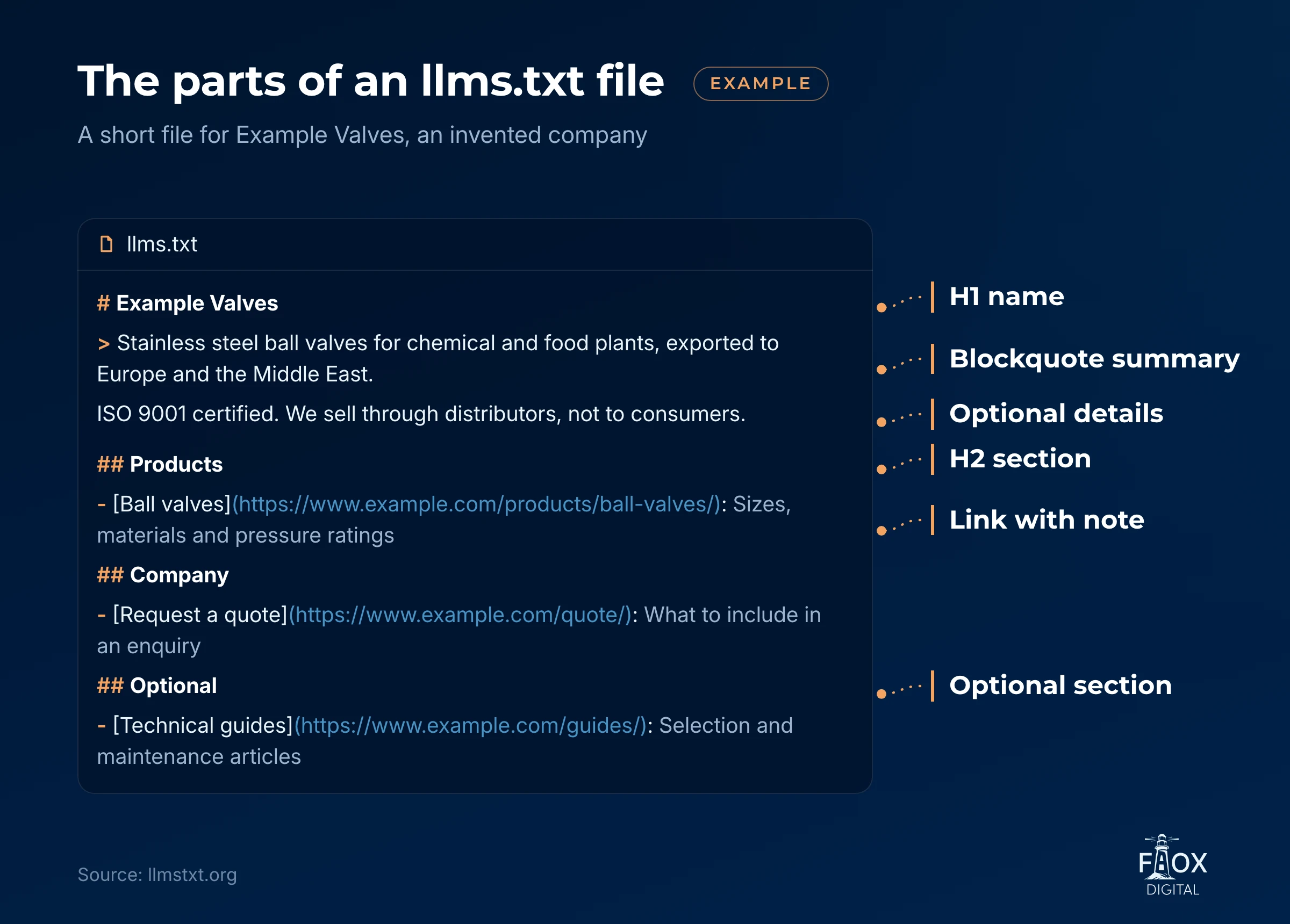
Here is a short file for an invented company, with one row for each line of the file. The symbols are part of the file: # marks the main heading, ## a section heading, > the summary and - a list item.
| Line in the file | What it is |
|---|---|
# Example Valves | An H1 with the name, the only required part |
> Stainless steel ball valves for chemical and food plants, exported to Europe and the Middle East. | A blockquote with a short summary |
ISO 9001 certified. We sell through distributors, not to consumers. | Optional details in plain text |
## Products | An H2 that starts a list of links |
- [Ball valves](https://www.example.com/products/ball-valves/): Sizes, materials and pressure ratings | A link with a name, a URL and a note |
## Company | A second list |
- [Request a quote](https://www.example.com/quote/): What to include in an enquiry | Another link |
## Optional | Secondary links a tool can skip |
- [Technical guides](https://www.example.com/guides/): Selection and maintenance articles | A secondary link |
The proposal prefers links to clean Markdown versions of pages, at the same URL with .md added. Ordinary page links are a practical start on a business site, and some plugins can create the Markdown versions.
Multi-language sites and llms-full.txt
Multi-language sites. The 2026 revision says a file covers the pages under its path, and that the most specific file applies. So a site with language folders can publish /llms.txt and /tr/llms.txt, each written in its own language. Keep the facts and product names the same in both. Check whether your plugin supports this before you plan around it.
llms-full.txt. This is a single file containing the full text of a site’s documentation. The current proposal does not mention it. Mintlify, a documentation platform, says it developed the format with Anthropic. It suits large documentation sites. On a B2B marketing site it mostly creates a second copy of your content that can go out of date.
WordPress plugins
Several WordPress plugins generate the file. The proposal’s site lists Yoast SEO and AIOSEO, and Rank Math documents its own module. At the time of writing (November 2026):
| Plugin | How it starts | Notes |
|---|---|---|
| Yoast SEO | Turned on in the site feature settings | Free; picks key content automatically, with a manual mode |
| AIOSEO | On by default, under Sitemaps | Also offers llms-full.txt and Markdown conversion; check which plan includes them |
| Rank Math | A module you enable; the file is empty until you configure it | Choose post types and a limit (100 by default); noindex posts are left out |
Whichever you use, read the output. A plugin knows what you published, not which pages matter to your buyers. Treat claims that the file reduces wrong answers about your brand with care, because we found no evidence for them.
llms.txt best practices
- The file is short, with a summary first and only your most useful pages
- The language is plain, with no unexplained jargon
- Every link works and points to a page that is not blocked or set to noindex
- The facts match your website, including names, markets and certifications
- Language versions state the same facts
- Nothing in the file is private, because anyone can read it
- Maintenance has an owner, and the file is reviewed when pages change
What to do first
If AI visibility is the goal, the file comes late on the list. Open your pages to crawlers, publish content worth quoting, keep your company facts consistent and test what AI tools say about you. Add llms.txt if it takes an hour or if your documentation warrants it.
Be careful with anyone selling the file as a way into AI answers. Our article on choosing a GEO agency explains what to ask.
How Faox Digital treats llms.txt
At Faox Digital, an llms.txt file is a small part of the foundations step of an SEO project, next to architecture, structured data and crawler access, and not a way into AI answers on its own. The audit before it checks whether AI tools can read the site at all, and our reports show whether they start to cite the company.
Key takeaways
- llms.txt is a proposed Markdown file that summarizes a site and links to its most useful pages. It is not a formal standard.
- Google says its Search ignores the file, and it neither helps nor harms visibility there.
- Studies found no correlation with AI citations, and most files received no requests in a month.
- The clearest real use is coding agents reading software documentation.
- It is a low-cost extra. Crawl access, useful pages and consistent facts come first.
Frequently asked questions
What is an llms.txt file?
It is a short Markdown file at the root of a website that summarizes the site and links to its most useful pages, so AI tools can find them. Jeremy Howard proposed it in 2024. It gives guidance only and does not control access to anything.
Is llms.txt an official standard?
No. It is a community proposal, and its site says the specification is open for input. Robots.txt, by contrast, is defined in an IETF standards-track document, RFC 9309. Google says its Search does not use llms.txt.
Do I need llms.txt to appear in ChatGPT or AI Overviews?
No. Google says no such file is needed for its AI features, and SE Ranking found no link between having one and being cited. Reaching ChatGPT search depends on crawler access through OAI-SearchBot, and on useful pages and third-party sources.
How can you check an llms.txt file?
Open it in a browser and compare it with the format on llmstxt.org: one H1, a summary and lists of links. Test that each link works. Then give the file to an AI tool and ask questions about your company, as the proposal suggests.
Is there an llms.txt generator?
Yes. Yoast SEO, AIOSEO and Rank Math generate one on WordPress, Wix generates one for sites on a paid plan with a connected domain, and documentation platforms such as Mintlify and GitBook do so for the documentation sites they host. Review the output, because a generator does not know which pages matter most to your buyers.
Sources
Let’s talk
Where do you want to be found?
Tell us the searches that matter to your business. We will review your site and tell you plainly what to fix first, including what you can do yourself.