
How to Write an SEO Content Brief (With a Template)
The fields a writer needs before the first draft, a template to copy, and how the brief and its approval decide the quality of the article.

An SEO content brief is the plan a writer receives before drafting: the target keyword and search intent, the reader, the main question, a heading outline, the concepts and sources to cover, internal links, expert input, a word count range and who approves what. It decides the quality of the article because it settles what a writer cannot decide alone: which search the page must answer, which facts only your experts know and what counts as finished.
Weak B2B articles are often not badly written. They answer the wrong question for the wrong reader, with facts any competitor could publish, because nobody made those decisions before the writer started. The brief is where they are made. This guide lists what an SEO content brief should contain, gives a template with a filled-in example and explains how to review and approve it. It belongs to our series on B2B content that gets cited, and its examples come from a hypothetical pump seal manufacturer.
What is an SEO content brief?
An SEO content brief, or SEO brief, is a short document for one page. It tells the writer which search the page must answer, for whom, with which facts and links, and who signs it off. The subject expert and the editor use the same document, so everyone judges the draft against one plan.
It is not a marketing brief for an agency, which sets goals, budget and scope for a whole project. Nor is it a list of words to repeat. A good brief is mostly decisions: what the page is for, what it must prove and what it leaves to other pages.
Why the brief decides the quality of the article
A writer can make a page clear. A writer cannot make it original or accurate alone. Google’s guidance on helpful content, updated in October 2026, says its quality raters assess four things in a page’s main content: the effort behind it, its originality, the skill it shows and its accuracy. The same page asks whether content drawn from other sources adds substantial value instead of simply rewriting them.
Three of those four depend largely on decisions made before writing starts: which expert supplies the facts, which sources prove them and what the page adds to what already ranks. If the brief leaves them open, the writer fills the gap with what is easy to find, which is what the competing pages already say.
Survey data points the same way. In Orbit Media’s 2026 survey of 1,042 content marketers, collaborating with influencers and experts was the strongest predictor of strong results: those who did it reported them 2.6 times as often as the average respondent. Only 7% still do it, down from 25% in 2017. The survey shows a correlation, not a cause, and it is not limited to B2B.
SEO content brief template: fields and an example
Copy the fields below into a document or spreadsheet. The right-hand column is a content brief example for an article the hypothetical manufacturer might commission; every detail in it is invented.
| Field | What to write | Example: mechanical seal article |
|---|---|---|
| Title options | Two or three working titles with the keyword | "Mechanical Seal vs Gland Packing: Which Suits Your Pump?" |
| Target keyword | The one search this page must answer best | mechanical seal vs packing |
| Supporting keywords | Related searches the same page can answer | gland packing vs mechanical seal; pump seal types |
| Search intent and page type | What the searcher wants and the page that fits | Comparing options; comparison guide on the blog |
| Reader profile | Role, what they know, what they must decide | Maintenance engineer at a water utility, planning pump upgrades |
| Main question | The question and a two or three sentence answer | When does a mechanical seal repay its higher price? |
| Heading outline | H2s in the order the reader asks | How each works; leakage; lifecycle cost; maintenance; when packing still fits |
| Concepts to cover | Terms and topics the page must explain | Leakage limits, shaft sleeve wear, flush plans, lifecycle cost |
| Competitor page review | What ranks, its format, what it leaves out | Seal makers’ guides and a distributor page; none shows cost assumptions |
| Sources | Primary sources for every claim that needs proof | Relevant standards, own test data, pump makers’ manuals |
| Expert input | Who, which questions, when | Application engineer, 30 minutes: three field cases, when to advise against a seal |
| Internal links | URL, anchor and place for each link | Cartridge seal product page, in the cost section |
| Word count range | A range with a reason | 1,500 to 2,000 words: two options and a cost comparison |
| Approval and dates | Who approves the brief and the draft, by when | Brief: marketing lead and engineer; draft: editor, engineer check, final sign-off |
Two fields are worth adding when they apply: the format and visuals (a comparison table, a checklist, a diagram) and how the piece will be reused. Planning reuse in the brief, such as LinkedIn posts drawn from the comparison table, saves a second round of work; our guide to B2B social media content covers repurposing.
How to fill in the key fields
- Start from the keyword map. Take the target keyword and supporting keywords from your plan, so the new page does not compete with an existing one.
- Read the results page. Note the page types, formats and questions that rank, and what they leave out. Record gaps, not text to copy.
- Describe one reader. Name the role, what they already know and what they must decide. Google’s SEO Starter Guide notes that experts and newcomers search with different words, so the reader profile also sets the vocabulary.
- Write the main question and its answer. If you cannot answer it in three sentences, the topic is too wide for one page.
- Outline the headings. Turn the reader’s follow-up questions into H2s and list the concepts to cover under each. Google’s title guidance asks for descriptive, concise titles, so test the title options against the outline.
- Name the sources and the expert. List a primary source for every claim that needs one, and book time with the person who knows what competitors do not.
- Add links, a range and dates. Give each internal link its URL, a descriptive anchor and its place, then set the word count range and the approval dates.
Word count range: a planning tool, not a target
A word count range helps plan time and budget, and it tells the writer how deep to go. It is not a quality target. Google’s helpful content guidance asks whether you are writing to a particular word count because you heard Google prefers one, and answers that it does not. Set the range from what the main question needs and what the ranking pages cover, and accept a shorter draft when the answer is complete.
The approval process: who signs off and when
Quality problems are cheapest to fix in the brief. Agree two approvals and write the names and dates into the brief:
- The brief, before writing. The content owner checks the keyword, reader and main question. The expert checks the outline and confirms the interview slot. Changes here take minutes.
- The draft, after writing. The editor checks it against the brief, the expert checks every technical claim, and one named person gives the final sign-off.
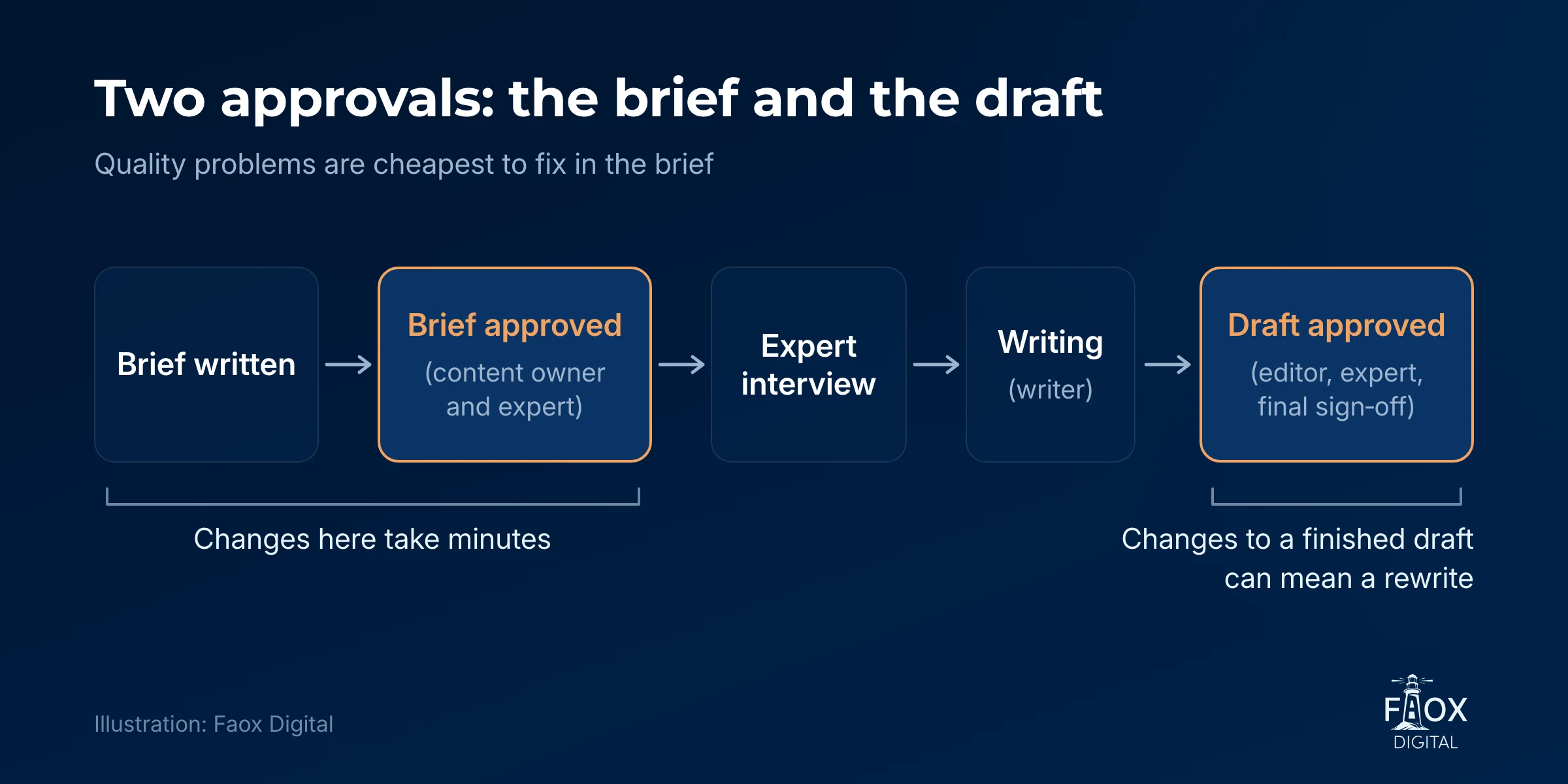
Changes to the brief take minutes; changes to a finished draft can mean a rewrite. Agree how many review rounds the writer should expect. When a draft misses, compare it with the brief first: a draft that follows a weak brief needs a better brief, not a different writer.
Before the brief goes to the writer
- One target keyword, not already assigned to another page
- One named reader and one main question, answered in three sentences
- A heading outline that follows the reader’s questions
- A primary source listed for every claim that needs proof
- An expert named, with questions and a date
- Internal links with URL, anchor and place
- A word count range with a reason
- Approvers and dates for the brief and the draft
Where the brief fits in your content process
A brief sits between the plan and the page. The plan decides which pages should exist; our guide to planning a content map covers that step. The writer then turns the brief into a page, and SEO content writing explains how. When a published page starts to slip, a short brief helps again: our guide to updating old blog posts shows what to check.
If your team lacks the time to write briefs or the pages behind them, the next question is what to buy. Our guide to B2B content writing services compares paying per article with paying for a strategy.
How Faox Digital plans a page before it is written
Faox Digital, a digital growth partner for B2B companies in complex and international markets, plans content inside an SEO project: after the audit, the keyword map is drawn up market by market, and pages are then built to rank and to be quoted. The client sees the priorities and the reasons before any work begins.
Key takeaways
- An SEO content brief settles what a writer cannot decide alone: the search, the reader, the question, the facts and the sign-off.
- Write the answer to the main question in the brief, before anyone drafts.
- Review the ranking pages for gaps, not for text to copy.
- Book the expert in the brief: originality and accuracy come from the people who do the work.
- Approve the brief before writing and the draft after it, with names and dates.
Frequently asked questions
Can I use AI to write SEO content from a brief?
AI can help, within limits. Google’s guidance on generative AI, updated in October 2026, says it can be useful for research and for adding structure, but its output must be fact-checked by hand, and generating many pages without adding value may break Google’s spam policies. The brief supplies what AI cannot: your expert’s knowledge and checked sources.
Will a good brief make content rank on Google?
No brief can promise a ranking. It makes the page a better answer to one search, with facts other pages lack, which is what Google’s guidance asks for. The site’s authority, the competition and its technical state decide the rest.
How does a content brief fit into an SEO content strategy?
The strategy decides which topics you cover, for whom and in what order. Each brief turns one of those topics into instructions for one page, so a strategy is only as good as the briefs that carry it out.
How long should an SEO content brief be?
Usually one or two pages. It needs every field in the template, but a writer should be able to read it in a few minutes; notes that only one section needs can go in an attachment.
Sources
Let’s talk
Where do you want to be found?
Tell us the searches that matter to your business. We will review your site and tell you plainly what to fix first, including what you can do yourself.