
Marketing for Manufacturers: What to Expect From an Integrated Program
What an integrated digital program for a manufacturer covers, in what order results arrive, what RAFF Military Textile’s program delivered and how to tell whether the model fits your company.

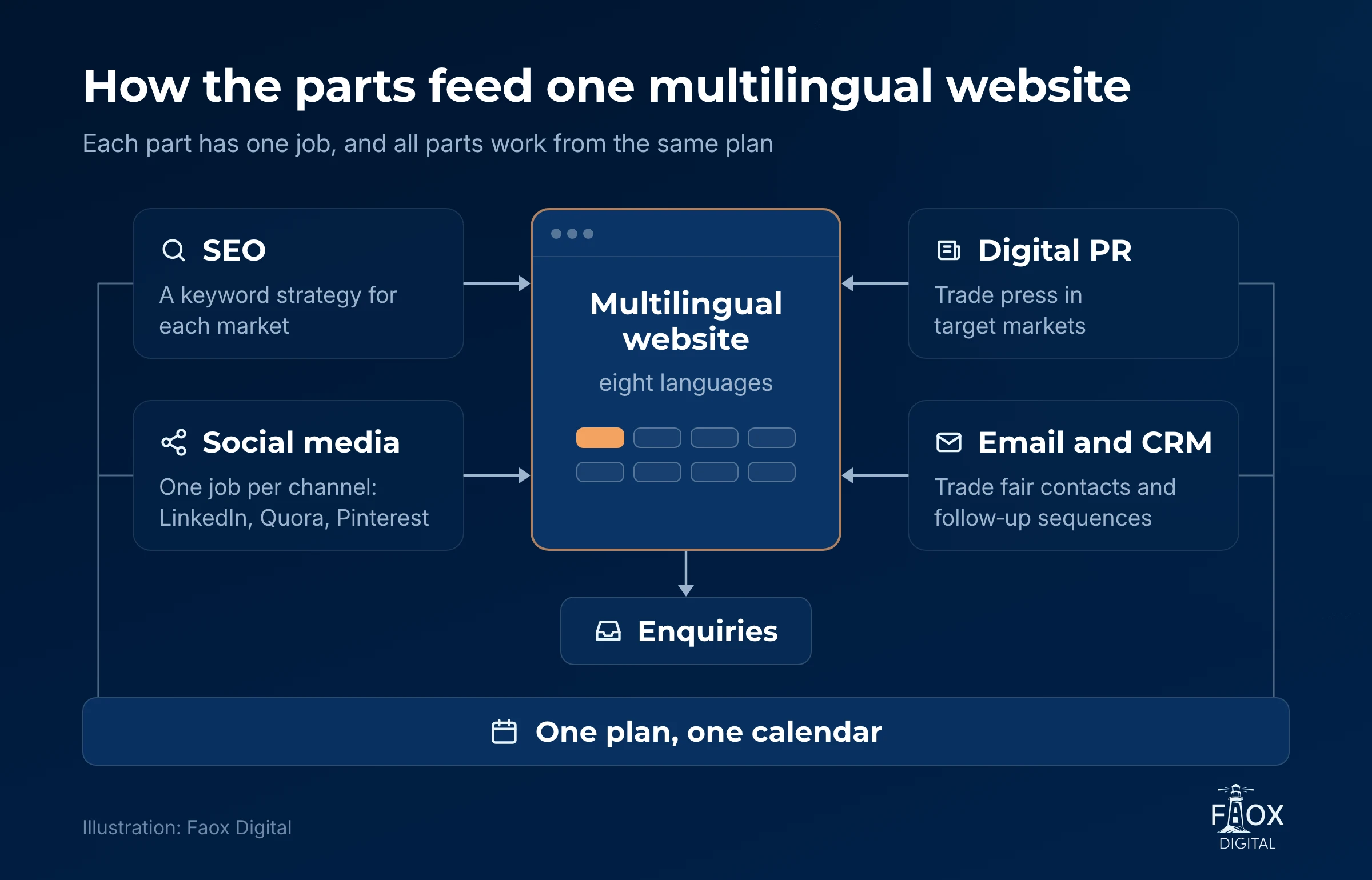
Marketing for manufacturers works best as one integrated program: a multilingual website, SEO for each market, a clear job for each social channel, a CRM that follows up every trade fair contact and digital PR in the trade press, all working from one plan. In RAFF Military Textile’s program, which ran across eight languages with $0 spent on ads, active users on the website rose 169% year over year for 16 February to 15 March. Expect foundations first, reach within months and search results later.
Many manufacturers are well known where it counts offline: at trade fairs, among distributors and with long-standing customers. Online, the same company can be hard to find, especially in the markets it wants to grow into. An integrated marketing program closes that gap by running the website, search, social media, email and CRM and digital PR as one system instead of as separate projects. If you want the basics first, our guide explains how B2B digital marketing works.
This article shows what such a program covers in practice, in what order results come and how to judge whether the model fits your company, using one real program as the example. RAFF Military Textile is our client, and we work as a B2B digital marketing agency, so we have a stake in this story. Every figure comes from the RAFF success story we published, with the period it refers to.
Marketing for manufacturers: what an integrated program covers
An integrated program gives each part one job and makes the parts work from the same plan. In RAFF’s program, which covered all six of our services over 12 months and is still running, the parts and their jobs were:
| Part | Its job | What RAFF’s program did |
|---|---|---|
| Multilingual website | One place for every market to land and ask | One platform for eight languages, with a restructured URL hierarchy |
| SEO | Be found in each market’s own searches | Technical SEO on every page and a keyword strategy for each market |
| Social media | Reach buyers before they need you | LinkedIn for B2B authority, Quora in English and French for CEO-led expertise, Pinterest for product visuals |
| Content | Give every channel something worth sharing | A monthly content calendar in eight languages and a brand documentary |
| Email and CRM | Turn contacts into conversations | Structured lead import after trade fairs and follow-up sequences by source, product interest and engagement |
| Digital PR | Earn proof in the press buyers read | PR focused on African markets and a media partnership with Military Africa, as Türkiye’s exclusive partner |
Where the program started
RAFF Military Textile is a defence manufacturer with decades of offline credibility. Of the problems its success story lists at the start, four will be familiar to many exporters:
- Seven disconnected websites in different languages, with no central brand control.
- No search presence in its priority African markets, although 60% of its target clients were located there.
- 600+ trade show leads every year with no systematic CRM or follow-up.
- Content only in Turkish and English.
None of these is a lack of credibility. Each is a gap between a good company and the buyers who could not find it, read it or hear from it again after a trade fair.
What the program did, part by part
One multilingual website. The website was rebuilt as one multilingual platform for eight languages, with a restructured URL hierarchy. A single structure means one place to update, one set of analytics and one brand, and it gives every other channel a page in the reader’s language to link to.
SEO for each market. Technical SEO ran on every page, and each market got its own keyword strategy. Buyers in different countries search in their own words, so a strategy per market targets what people there actually type rather than a translated keyword list.
A CRM for trade fair contacts. Contacts from trade fairs were imported in a structured way, and follow-up sequences ran by source, product interest and engagement. For a manufacturer with hundreds of trade fair contacts a year, this is often the fastest part of a program to pay off, because the demand is already there.
Social media with one job per channel. LinkedIn carried B2B authority, Quora in English and French carried CEO-led expertise and Pinterest carried product visuals, all fed by a monthly calendar in eight languages. Our article on social media marketing for manufacturers looks at this part in detail.
Digital PR in the right press. PR focused on the African markets that mattered most, with a media partnership with Military Africa that reached 15,000+ monthly readers across digital and print.
In what order results come
RAFF’s success story reports results over 12 months and in a year-over-year comparison, not month by month. So the order below is our planning view, with the published figure that belongs to each stage:
| Stage | What happens | What RAFF’s results show |
|---|---|---|
| Foundations | One website, tracking and a CRM; trade fair contacts start getting follow-up | The base for everything below |
| Reach | Social media and PR build an audience | The French Quora account passed 200,000 views within 3 months |
| Search | Pages start to rank in each market | First page for priority keywords across multiple languages and regions |
| Site-wide growth | Visits from all channels add up | Active users +169%, 16 February to 15 March, year over year |
Search is usually the slowest part. As a planning range for search work, we expect first movement in a few months and meaningful results in around six to eight months, depending on the site and the competition. Nobody can promise a ranking or a date.
What it delivered
RAFF’s success story publishes these results. Nothing was spent on ads, so this is growth without ads, and every figure is organic:
| Area | Published result | Period |
|---|---|---|
| Website | Active users from 8,346 to 22,450 (+169%); new users +166% | 16 February to 15 March, year over year |
| Website | Direct visits from 2,032 to 14,173 sessions | Same comparison |
| Website | 19,741 monthly active users; 1,816 peak users in a single day; 5,800+ organic sessions every month | As published |
| Search | First page for priority keywords across multiple languages and regions | As published |
| Social media | Organic social traffic to the site +374% | 16 February to 15 March, year over year |
| 58,628 organic impressions, 4,935 clicks, 116 posts, 11.9% average engagement, no sponsored content | 12 months | |
| Quora, Pinterest | 245,000+ Quora views in English and French; 206,000+ Pinterest impressions | As published |
| Digital PR | 15,000+ monthly readers across digital and print through the Military Africa partnership | As published |
Two notes help in reading these figures. Active users are the number of distinct users who visited the site, as Google Analytics defines them, so the +169% counts people from every channel, not only from search. And direct visits are those that arrive through a saved link or a typed address. Social media and PR alone cannot claim the website result; it comes from the whole program working together.
"Faox Digital didn’t just manage our digital channels. They built a system that works across markets, languages, and time zones. Our international visibility grew in ways we couldn’t achieve alone." Eray Yükseloğlu, CEO, Raff Military Textile
Separate projects or one program
Many manufacturers already do some of this work, but as separate projects with separate suppliers. Here is how the two approaches compare:
| Separate channel projects | One integrated program | |
|---|---|---|
| Message | Each supplier writes its own | One position, repeated everywhere |
| Website | Several sites or a translated copy | One structure with a version per language |
| Trade fair contacts | Kept in inboxes and spreadsheets | Imported into a CRM with follow-up |
| Content | Produced channel by channel | One monthly calendar for every channel and language |
| Reporting | One report per channel | One view from first visit to enquiry |
| Responsibility | Nobody owns the whole | One plan and one owner |
The integrated model is not about having more channels. It is about the channels passing the same buyer from one to the next.
Is an integrated program the right step for your company?
An integrated program fits best when most of these are true:
- You have products and expertise buyers value, but they cannot find you online in your target markets.
- You sell, or want to sell, in several countries and languages.
- Trade fairs and distributors bring contacts that nobody follows up systematically.
- Your experts or managers can give some time to content each month.
- You can wait months rather than weeks for search and reach to build.
It fits less well if your positioning is still unclear, if you could not serve new markets even with more enquiries, or if you need leads for a single event next month. Then a smaller first step, such as one market or one product line, is the honest start. Our guide to marketing budget allocation helps you size the investment, and our guide to marketing agency fee models explains how such programs are usually priced.
How to market a manufacturing company: five decisions to copy
Whoever does the work, these five decisions from RAFF’s program carry over to other manufacturers, from valve makers to packaging producers:
- Bring every language under one website. One structure, one brand and a real version for each market you sell in.
- Follow up every trade fair contact. Put them in a CRM the week after the fair, with a sequence that fits their interest.
- Give each channel one job. Decide what LinkedIn and any other platform is for, and leave out platforms without a job.
- Let your experts speak. Content from your CEO or engineers carries knowledge that buyers cannot get from a brochure.
- Report the path, not the parts. Measure how visitors move from first visit to enquiry, across every channel.
If you are comparing partners for such a program, our marketing agency selection questions help you test what each one would actually do.
How Faox Digital runs an integrated program for manufacturers
Faox Digital, a digital growth partner for B2B companies in complex and international markets, runs an integrated program as one system: the website, SEO, social media, email and CRM, digital PR and branding work from the same plan rather than as separate channels. Each part starts from what already exists, such as the current site, the contact list or the trade press that matters, and each language gets its own structure rather than a translate button. We suggest first steps that fit the company’s budget and stage, even if that means the company does some of the work itself.
Key takeaways
- Marketing for manufacturers works best when website, SEO, social media, email and CRM and digital PR run as one program from one plan.
- Expect foundations first, reach within months and search results later; nobody can promise a ranking or a date.
- RAFF’s program ran in eight languages with $0 in ads; active users rose 169% year over year for 16 February to 15 March.
- Follow up every trade fair contact through a CRM; the demand is already there.
- Start smaller, with one market or one product line, if your positioning or capacity is not ready yet.
Frequently asked questions
What does content marketing for manufacturers look like?
It starts from the questions buyers ask: application guides, technical articles, comparisons and case examples, written with your engineers and published in every language you sell in. One core piece a month, adapted for the website, LinkedIn and email, is a workable rhythm for most manufacturers.
How should manufacturers use email marketing?
Mostly for follow-up. Import contacts from trade fairs and enquiries into a CRM, group them by product interest and stage, and send useful material at a steady pace rather than one-off blasts. Check the rules on commercial email in each market you sell in.
Can AI help with marketing for manufacturing companies?
Yes, for drafts, translations to review, summaries and spotting patterns in your data. The facts, the technical accuracy and the final word in each language still need your experts and native speakers, because buyers in technical markets notice errors quickly.
What should a manufacturer look for in a marketing agency?
Experience with technical products and international markets, a plan that connects the channels instead of selling them one by one, named people who will do the work and honest answers about what takes time. Ask to see how the agency reports progress from first visit to enquiry.
Sources
- Google Analytics Help: Analytics dimensions and metrics, accessed November 2026
Let’s talk
Not sure where to start?
Tell us about your business and your goals. We will suggest first steps that fit your budget, even if that means doing some of it yourself.