
International Trademark Search: Can Your Current Brand Go Abroad?
What to check before taking your current brand name into a new market, which tools to use, and how to decide what to do if the name is already taken there.
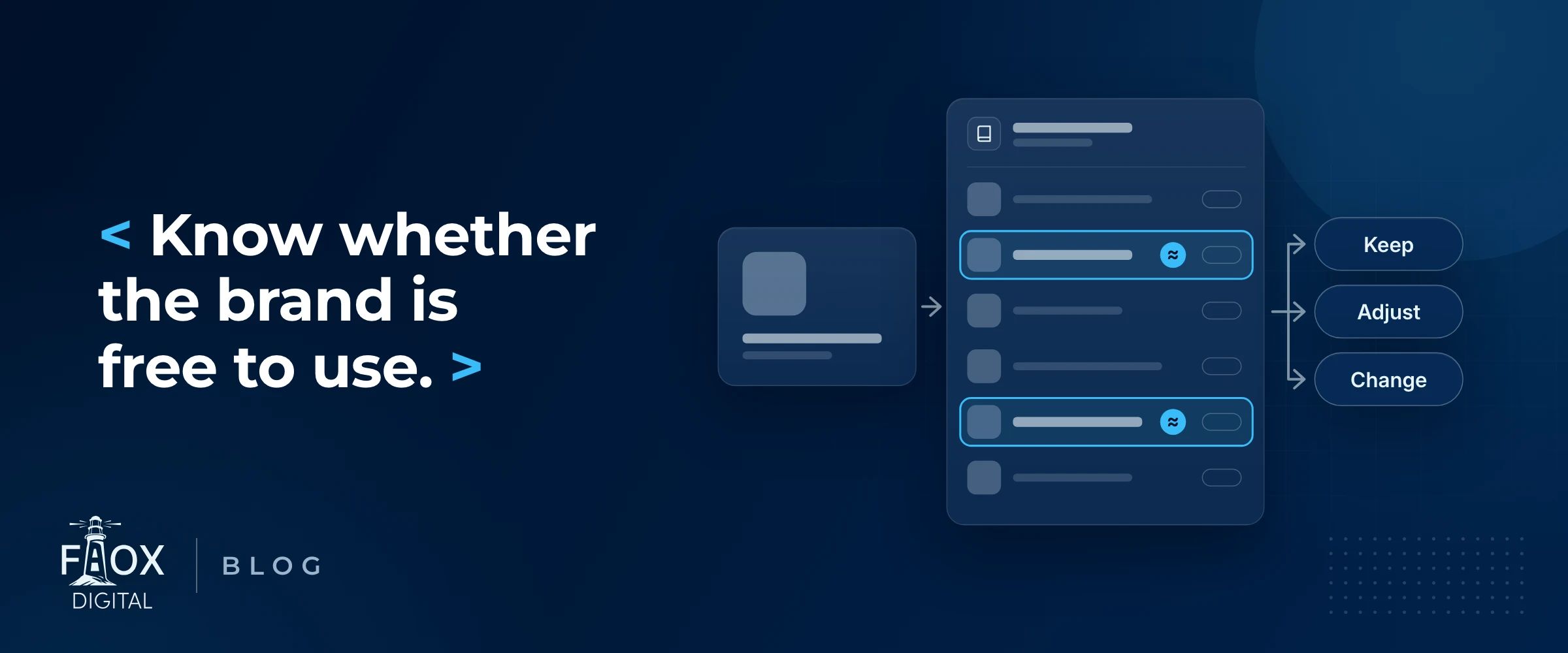
An international trademark search checks, before you enter a new market, whether your current brand name is free to register and use there. Search WIPO’s Global Brand Database, TMview and the national register of each target market, in the classes of goods and services you need, and look for similar marks as well as identical ones; check the language, domains and usernames too. Then ask a trademark attorney in each market for an opinion, and decide whether to keep, adjust or change the name before you invest in the launch.
A brand that works at home can be blocked abroad by a company you have never heard of: an earlier registration of a similar name, for similar goods, in the market you want to enter. Finding that out after the trade fair stand is printed is expensive. Finding it out before the market entry plan is approved costs a few hours of searching and an attorney’s opinion.
This guide covers what to check, where to search and how to decide if the answer is no. For the wider question of what stays fixed across markets, see our guide to international branding. We work as a brand strategy agency, not a law firm: this guide is not legal advice, and registration, oppositions and risk assessments need a trademark attorney or lawyer in each market.
What an international trademark search checks
An international trademark search answers three questions for each target market:
- Can the name be registered there? Is there an earlier mark that is the same or similar, for the same or related goods and services?
- Can you use it there safely? Earlier rights can block use even where you never planned to register.
- Does it work there in practice? Language, culture, domains and social media usernames.
The first two are legal questions. Your own search is a first filter that shows whether there is an obvious problem; the answer comes from a trademark attorney.
Where to search: databases compared
Three kinds of database cover most of what a first search needs:
| Tool | What it covers | Good for | Keep in mind |
|---|---|---|---|
| WIPO Global Brand Database | International marks under the Madrid System, plus trademarks from participating national and regional offices and other collections | A first worldwide look, including image similarity | WIPO says it may be prudent to search national or regional registers as well |
| TMview | Trade marks from the EUIPO, many national offices in and beyond the EU, and WIPO | Comparing many registers in one search | Not an official register, with no legal effect |
| National registers | The office of each target market, such as TÜRKPATENT in Türkiye | The most complete local picture | Each has its own search and language |
The WIPO Global Brand Database lets you search international trademarks under the Madrid System, trademarks from participating national and regional offices and other collections by keywords, names, goods and services and image similarity. TMview, maintained by the EU Intellectual Property Office (EUIPO) with its network partners, showed 144,057,209 trade marks across the European Union and beyond on 19 November 2026; its own disclaimer states that it is not an official register and has no legal effect.
International registrations recorded through WIPO’s Madrid System, which works under the Madrid Protocol, appear in these databases. Türkiye is a member of the Protocol, according to TÜRKPATENT, the Turkish patent and trademark office, which also offers its own trademark search.
Search in the right classes
Trademarks are registered for goods and services, sorted into classes. The Nice Classification, established by the Nice Agreement of 1957 and administered by WIPO, is the international classification of goods and services used for registering marks. Search the classes that cover what you sell, and the ones you plan to sell in: a valve maker should look beyond valves to related equipment, installation services and software it may add later. A mark in an unrelated class may be no obstacle; a mark in a related one may be.
Similar marks, not only identical ones
The similar mark risk is the bigger one: rarely an identical name, more often a similar mark for related goods. The US Patent and Trademark Office explains that if a trademark is confusingly similar to another and the goods and services are related, consumers are likely to believe they come from the same source. Marks do not have to be identical to be confusingly similar: they can be similar in sound, appearance or meaning, or create a similar commercial impression.
So search for variations as well: different spellings, the name with and without spaces or hyphens, translations of any meaningful part and names that sound alike when spoken. Note everything close, with its owner, its classes and its status, for the attorney.
The linguistic and cultural check
A name can be legally free and still fail in the market. Run a linguistic and cultural check with native speakers: how they pronounce it, whether they can spell it after hearing it, and what it means or suggests in their language, slang and industry. Do this before the legal work, because a name that fails here does not need an attorney’s opinion.
Domain names and usernames
Check the domain name and username situation in each market: the .com, the country domain and the social media usernames you would use. Someone else’s domain is not always a legal obstacle, but it can send your buyers elsewhere. How country domains fit your site is a separate decision, covered in our guide to ccTLD vs subdirectory.
When to bring in a trademark attorney
Bring in a trademark attorney as soon as your own search shows anything close, and in any case before you commit money to a market. An attorney judges what a database cannot: whether a similar mark really conflicts, whether it is still in use, how the local office and courts treat similar cases, and which classes and route fit your plans. Many offices publish who may act before them; TÜRKPATENT, for example, offers an attorney search on its website.
Give the attorney what you found: the marks you noted, the classes you need, the markets and dates you plan, and how you use the name today.
If the name is taken: the brand change decision
If the attorney sees a real conflict, the brand change decision comes down to a few options:
| Option | When it fits | Watch for |
|---|---|---|
| Go ahead with the name | The attorney judges the risk acceptable | Keep the opinion and your evidence of use on file |
| Agree coexistence with the earlier owner | The other company works in a different field | Needs negotiation and a written agreement drafted by lawyers |
| Use a different name in that market | One market is blocked, the others are clear | Two names to manage, and buyers who travel between markets |
| Change the brand everywhere | Several markets are blocked, or growth plans depend on them | The highest transition cost, and a full rebrand project |
| Delay or skip the market | The market is not important enough for the cost | Revisit when plans change |
The table is our summary. Every option except the last needs your attorney’s view in the market concerned.
The transition cost of a new name
The transition cost of changing a name is more than a new logo. Count the registrations and legal fees, domains and email addresses, the website and its search visibility, signage, packaging, labels and product markings, catalogues, data sheets and certificates issued in the old name, trade fair and distributor materials, and the time your team spends explaining the change to customers. The earlier you search, the fewer of these exist in the market you are entering.
How Faox Digital approaches a brand going abroad
Faox Digital, a digital growth partner for B2B companies in complex and international markets, builds a brand per market, so that it reads as local rather than translated. Its branding work starts with listening to how the company describes itself and what its buyers believe, and with agreeing where it sits in each market, before the identity is designed and rolled out. Whether a name can be registered and used in a market is a legal question, and it stays with a trademark attorney there.
Key takeaways
- Search before you invest: WIPO’s Global Brand Database, TMview and each target market’s national register.
- Search in the right classes, and look for similar marks as well as identical ones.
- Check language, domains and usernames as part of the same review.
- Treat your own search as a first filter; a trademark attorney in each market gives the answer.
- If the name is taken, compare the options and their transition cost before you decide.
Frequently asked questions
How do you protect a trademark internationally?
Protection is decided market by market, through national or regional offices or through WIPO’s Madrid System. Which route, which classes and which markets fit your plans is a question for a trademark attorney. The search described in this guide comes first, so that you know where the name is free.
Is a search in an online database enough?
No. Databases show registrations and applications, not every earlier right, and their data can lag behind the official registers; TMview states that it has no legal effect. Use them as a first filter, and ask a trademark attorney for an opinion in each market.
What if another company already uses our name abroad?
It depends on how similar the names are, how related the goods and services are, and the earlier owner’s rights in that market. An attorney can judge the risk and the options, from coexistence to a different name in that market.
Do we need a trademark attorney for every market?
For the legal opinion, in practice yes, because each market has its own law, its own earlier rights and its own office practice. One attorney can often coordinate the work with colleagues in other markets.
Sources
- WIPO: Global Brand Database, accessed November 2026
- EUIPO: TMview, accessed November 2026
- USPTO: Likelihood of confusion, 2023
- TÜRKPATENT: Trademark, accessed November 2026
Let’s talk
Does your brand say what makes you different?
Show us how you describe your business today. We will tell you where it is clear and where buyers may get lost.