
Brand Localization Strategy: How to Adapt Your Brand Market by Market
How a B2B brand stays recognizable abroad while sounding local: what to adapt, how transcreation and local proof work, and who checks the brand in each market.
A brand localization strategy decides how a brand stays recognizable in every market while sounding and looking natural to local buyers. Keep the core fixed (position, name, logo and promises) and adapt the rest: language, tone and form of address, taglines through transcreation, examples and cases, imagery, and the proof buyers expect, such as local certificates, standards and references. Run it with native writers, local teams and distributors, and record the rules in multi-market brand guidelines.
A brand that reads as translated tells buyers you are visiting, not staying. A brand that changes completely in every country stops being one brand. Brand localization is the work in between: the same company, recognizably, in words, examples and proof that fit each market.
This guide shows how to build a brand localization strategy for a B2B company, step by step. For the decision on what stays fixed across markets, see our guide to keeping a brand consistent abroad.
What is brand localization?
Brand localization is adapting how a brand speaks and what it shows, so that buyers in each market understand it and find it credible, while the core identity stays the same. It goes further than translation. Translation turns sentences into another language; localization changes examples, units, references, imagery and tone where the market needs it. Cultural adaptation goes deeper still, adjusting how claims are made and how directly the brand speaks.
Most companies meet the difference first on their website, and our guide to what localization adds covers it for web pages. A brand localization strategy applies the same idea to the whole brand: campaigns, sales materials, proposals, trade fair stands and social media.
English does not replace it. In the European Commission’s Eurobarometer on languages, published in May 2024, about half of Europeans (47%) speak English as a foreign or second language. Engineers and purchasers may read English well, but the buying group also includes people who do not.
From keep to replace: the levels of localization
Not everything needs the same treatment. Decide the level element by element:
| Level | What it means | Typical elements |
|---|---|---|
| Keep | The same in every market | Name, logo, core colors, position, promises |
| Translate | The same content, in accurate language | Technical specifications, instructions, legal texts |
| Adapt | The same purpose, with local details | Website, data sheets, presentations: units, standards, examples |
| Transcreate | The same intent, in new words | Taglines, headlines, campaign lines |
| Replace | Local content instead | Case studies, references, imagery of people and plants |
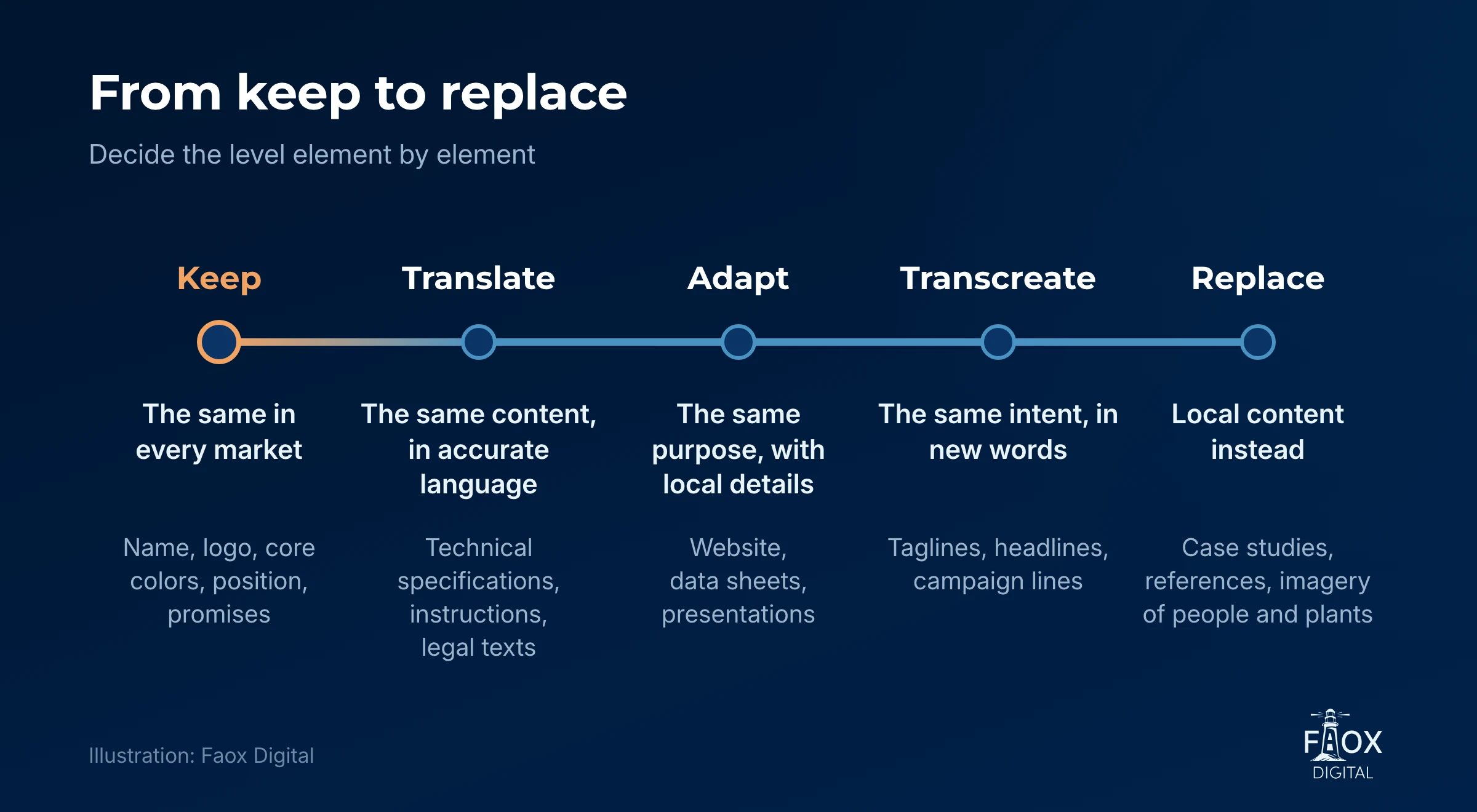
The table is our summary. Most of the cost and most of the mistakes sit in the middle columns, where someone has to judge what "local" means.
A brand localization strategy, step by step
- Fix the core. Agree what never changes: name, logo, core colors, position and promises.
- Choose the level for each element. Keep, translate, adapt, transcreate or replace.
- Set the voice for each language. Form of address, formality and directness.
- Transcreate the lines that carry the brand. The tagline, key headlines and campaign lines.
- Collect local proof. Certificates, standards, references and documents in the language.
- Choose local examples and imagery. Cases and pictures buyers recognize.
- Review with native speakers, the local team and distributors. Before anything goes live.
- Record the rules in the guidelines. What may change, who approves and where the files are.
Cultural adaptation: how claims are made
Markets differ less in what B2B buyers want than in how they expect to be told. Some expect direct claims and numbers up front; others trust understatement, detail and a supplier’s track record more than bold statements. In some business cultures the company speaks; in others, named experts carry more weight.
Cultural adaptation keeps the brand’s personality but adjusts the delivery: how strongly a claim is phrased, how much evidence comes first, how much humor is acceptable and how long the text is. Native writers who know the industry make these calls better than any rulebook, but write their decisions down so that they stay consistent.
Form of address and formality
Form of address and formality is the localization decision buyers notice first. Many languages have a formal and an informal "you": Sie and du in German, vous and tu in French, siz and sen in Turkish, Pan or Pani and ty in Polish. The formal form is the safe default in B2B, while an informal one can make a brand sound modern. Either way, decide it for each language and apply it everywhere, from the website to email templates and chat replies.
Decide also how to greet people in letters and emails, whether to use titles such as Dr. or Ing., and how formal the sign-off should be. A brand that is formal on its website and casual in its sales emails looks like two companies.
Transcreation and tagline adaptation
Transcreation recreates a text in another language with the same intent and effect rather than the same words. It is the right method for the few lines that carry the brand: the tagline, key headlines and campaign lines.
Tagline adaptation works best as a small project:
- Brief a native copywriter on the intent, the tone, the position and the words to avoid.
- Ask for several options, each with a back translation and a note on how it sounds.
- Test the best two with a few local buyers or your local team.
- Check that the line makes no claim you cannot prove or are not allowed to make in that market.
Sometimes the best decision is to keep the original tagline in English, or to drop it in one market. Take that decision on purpose, and record it.
Local proof: certificates, standards and references
Buyers trust what they recognize, and that differs by market. Local proof has three parts:
- Certificates: the approvals buyers there expect. In the EU, many products require CE marking before they can be sold, according to the EU’s Your Europe portal. In the United States, OSHA’s Nationally Recognized Testing Laboratory program recognizes private organizations, such as UL, to certify certain products, including some electrical equipment, so that they meet the requirements of OSHA’s construction and general industry electrical standards.
- Standards: the national or international standards your products meet, named the way buyers in that market know them, with the units and documentation formats they use.
- References: customers in the same country, or at least the same region or industry, named with their permission.
Put the proof where buyers look: on the localized website, in data sheets, proposals and trade fair materials.
Choosing examples and cases
The choice of examples and cases decides whether a buyer thinks "this is about us". Use applications from industries that matter in the market, plants and projects of the size buyers there run, local units and currencies, and case studies from the country or a similar one. If you have no local case yet, say where the example comes from rather than presenting a foreign project as local.
Images and color meanings
The meanings of images and colors change more quietly. Photographs of people, plants and workwear should look plausible to local buyers: the kind of site, the equipment and the protective gear they know from their own work. Colors and symbols can carry meanings you did not intend, so test key visuals with people in the market rather than relying on general lists of color meanings.
The core brand colors stay. What you combine them with, and the pictures around them, can change.
Feedback from local teams and distributors
The people closest to buyers notice first when the brand sounds wrong. Build local team and distributor feedback into the process:
- A native reviewer for each language, with the authority to stop a text
- A shared glossary of product names and technical terms, agreed with local sales staff and distributors
- A simple way to report what buyers misunderstand or keep asking about
- A review of each market’s materials at least once a year
Distributors also need the localized brand: templates, approved texts and images, and the rules for using your name next to theirs.
Multi-market brand guidelines: the localization section
Multi-market brand guidelines make localization repeatable. Add a section that records, for each market or language, the level for each element, the form of address and formality, the tagline version, approved proof and references, image guidance, the glossary and who approves local materials. Without it, every new agency, distributor or employee starts the localization again from scratch.
Brand localization example: one valve maker, three markets
A hypothetical valve maker selling in Germany, Poland and the United States keeps its name, logo, steel-blue color, its position on complete documentation and its promise of a test record with every valve. This is what changes:
| Element | Germany | Poland | United States |
|---|---|---|---|
| Form of address | Formal (Sie) | Formal (Pan or Pani) | Direct, first names in emails |
| Tagline | Transcreated by a German copywriter | Transcreated by a Polish copywriter | The English original |
| Certificates shown | CE marking where it applies | CE marking where it applies | NRTL certification where required |
| References | German plants | Polish plants, then neighboring markets | US plants |
| Examples | Chemical and food plants | Dairy plants | Process plants in the buyer’s region |
Localization, naming and identity
Brand localization builds on decisions made earlier. The name should be checked before any of this, as our guide to choosing a name that travels explains. The visual system has to be built to flex across languages and scripts, which is part of the brand identity process. And the localization rules belong in the brand guidelines; our guide on how to create brand guidelines covers the whole document.
If you are taking an existing brand into a new market, the next question is whether you can use it there at all, which our guide to international trademark search answers.
How Faox Digital approaches brand localization
Faox Digital, a digital growth partner for B2B companies in complex and international markets, builds a brand per market, so that its story reads as local rather than translated, and rolls it out in the right order across the channels that matter in each market. In search work, each language gets its own structure and localization and translation are treated as two different jobs, and international press outreach happens in each market’s own language.
Key takeaways
- Keep the core fixed, and choose a level for everything else: translate, adapt, transcreate or replace.
- Decide the form of address and formality for each language, and apply it everywhere.
- Transcreate the few lines that carry the brand, with native copywriters and local tests.
- Show the proof each market recognizes: certificates, standards and local references.
- Let native reviewers, local teams and distributors check the brand, and record the rules in the guidelines.
Frequently asked questions
What is an example of brand localization?
A hypothetical valve maker keeps its name, logo, colors and promise in every market, but writes formally in German and Polish, transcreates its tagline for each language, shows CE marking in the EU and NRTL certification in the United States where required, and uses references from each country.
Is brand localization the same as translation?
No. Translation changes the language. Brand localization also adapts tone, form of address, examples, imagery and proof, and transcreates the lines that carry the brand. Technical content is translated; brand content is localized.
What is a global brand strategy?
A global brand strategy decides how one brand works across all its markets: what stays fixed everywhere, what each market may adapt and who decides. Brand localization is how that strategy is carried out in each market.
What is a brand positioning strategy?
It is the decision about where a brand stands in buyers’ minds compared with the alternatives, and why they should choose it. In international branding the position usually stays the same, while localization changes the emphasis and the proof for each market.
Sources
- European Commission: Eurobarometer, Europeans and their languages, May 2024
- OSHA: Nationally Recognized Testing Laboratory Program, accessed November 2026
- Your Europe: CE marking, last checked July 2026
Let’s talk
Does your brand say what makes you different?
Show us how you describe your business today. We will tell you where it is clear and where buyers may get lost.