
B2B Go-to-Market Strategy: How to Prepare for a New Market
What a go-to-market strategy is for a B2B company and which decisions to make before entering a new market, from the ideal customer profile to the sales model, sequence and measurement.
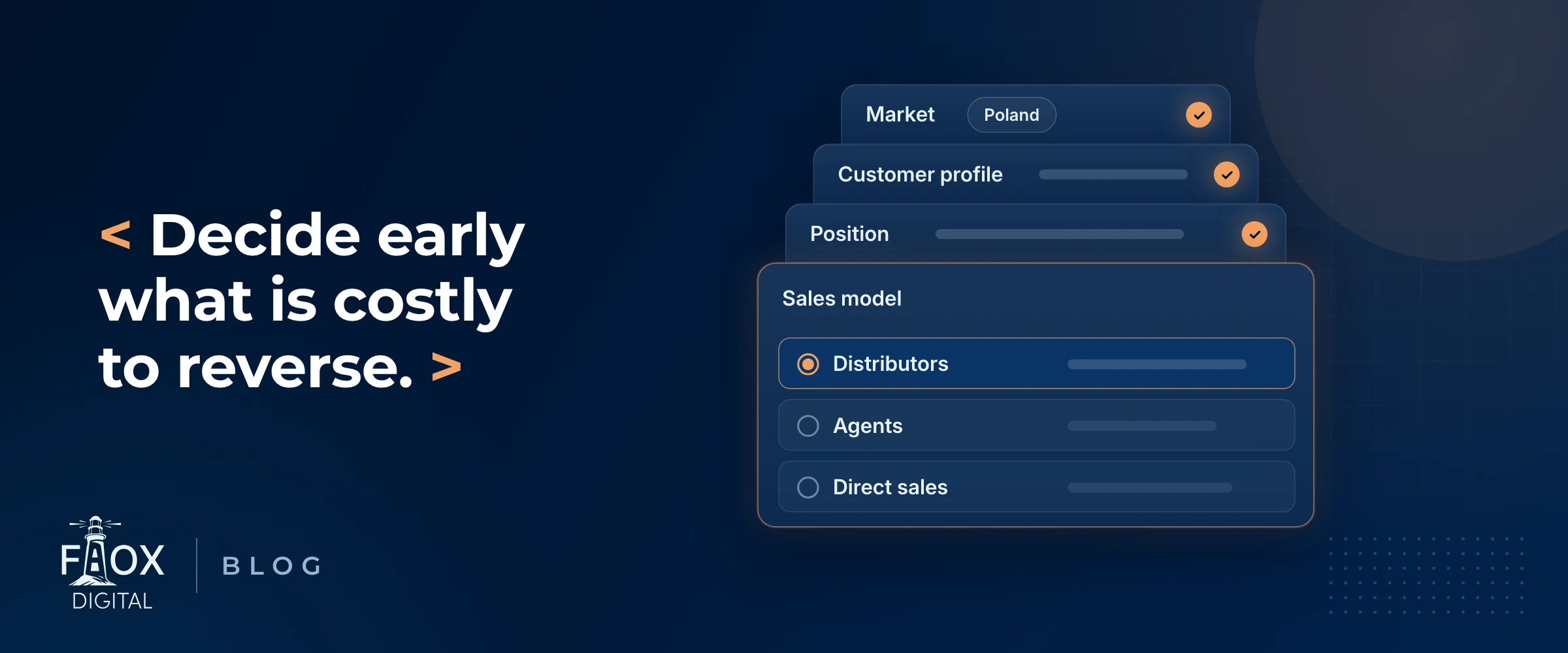
A B2B go-to-market strategy is the set of decisions for how a company will win customers in a new market: which market and which customers to target first, how to position and explain the offer there, which channels and which sales model (distributors, agents or direct sales) to use, in what order, with what resources and how to measure progress. Prepare it before you enter, because most of these decisions are slow and costly to reverse.
Entering a new market is one of the biggest bets a B2B company makes. It usually means new buyers, new competitors, a new language and often a new sales partner, all at once. A B2B go-to-market strategy turns that bet into a set of decisions you can make, test and adjust, instead of a trade fair stand and a hope.
This guide explains what a go-to-market strategy is, how it differs from a plan, which decisions it contains and how to prepare each one before you enter a new market. It opens our series on go-to-market strategy; you can find all Branding & Strategy articles on the category page.
What is a go-to-market strategy?
A go-to-market strategy is the set of decisions that determines how a company brings an offer to a specific market and wins customers there: who it sells to, what it promises them, how it reaches them, how it sells and in what order it does all of this. It is often shortened to GTM.
It applies whenever something is new: a new country, a new customer segment, a new product or a new sales channel. A company entering Germany with a proven product needs one; so does a company bringing a new product line to its existing customers.
A go-to-market strategy is narrower than a marketing strategy. The marketing strategy covers how all channels work together across the business, as our guide to building a B2B marketing strategy explains; the go-to-market strategy covers one entry, with a beginning and a point at which it becomes business as usual.
Go-to-market strategy vs go-to-market plan
The go-to-market strategy is the set of decisions; the go-to-market plan turns them into actions, owners, budgets and dates. The strategy says "we will enter Poland through two distributors, targeting food processing plants, positioned on documentation for audits"; the plan says who signs the distributors, which trade fair comes first, which pages are translated by when and what the first quarter should deliver.
Make the decisions before you write the plan. A detailed plan built on unclear decisions produces a lot of activity in the wrong direction. Once the decisions are made, our template for a B2B go-to-market plan covers message, channels and sequence in one document.
When a B2B company needs a go-to-market strategy
You need one whenever you are about to spend money reaching buyers who do not yet know you:
- A new country or region: different buyers, competitors, language, regulations and sales customs.
- A new customer segment: the same country, but an industry or company size you have not served before.
- A new product or service: something existing customers have not bought from you, or that competes in a different category.
- A new channel: selling through distributors for the first time, or moving from distributors to direct sales.
The bigger the change, the more of the strategy you need to rethink. A new product for existing customers may need new positioning and messages but the same sales model; a new country usually needs everything.
The decisions in a B2B go-to-market strategy
A practical go-to-market strategy framework for B2B groups the decisions into three questions: where, what and how.
| Group | Decision | The question it answers |
|---|---|---|
| Where | Target market | Which country, region or segment first? |
| Where | Ideal customer profile | Which companies and which buyers within them? |
| What | Positioning | Why should these buyers choose you over local alternatives? |
| What | Messages | What do you say, in their language and terms? |
| What | Market-specific proof | Why should they believe you in this market? |
| How | Channels | Where and how will buyers find and hear about you? |
| How | Sales and distribution model | Distributor, agent, direct sales or a mix? |
| How | Price and terms | At what price, in which currency and on which delivery terms? |
| How | Sequencing | What happens first, second and third? |
| How | Resource plan | Who does the work, with what budget and time? |
| How | Measurement | How will you know it is working, and when? |
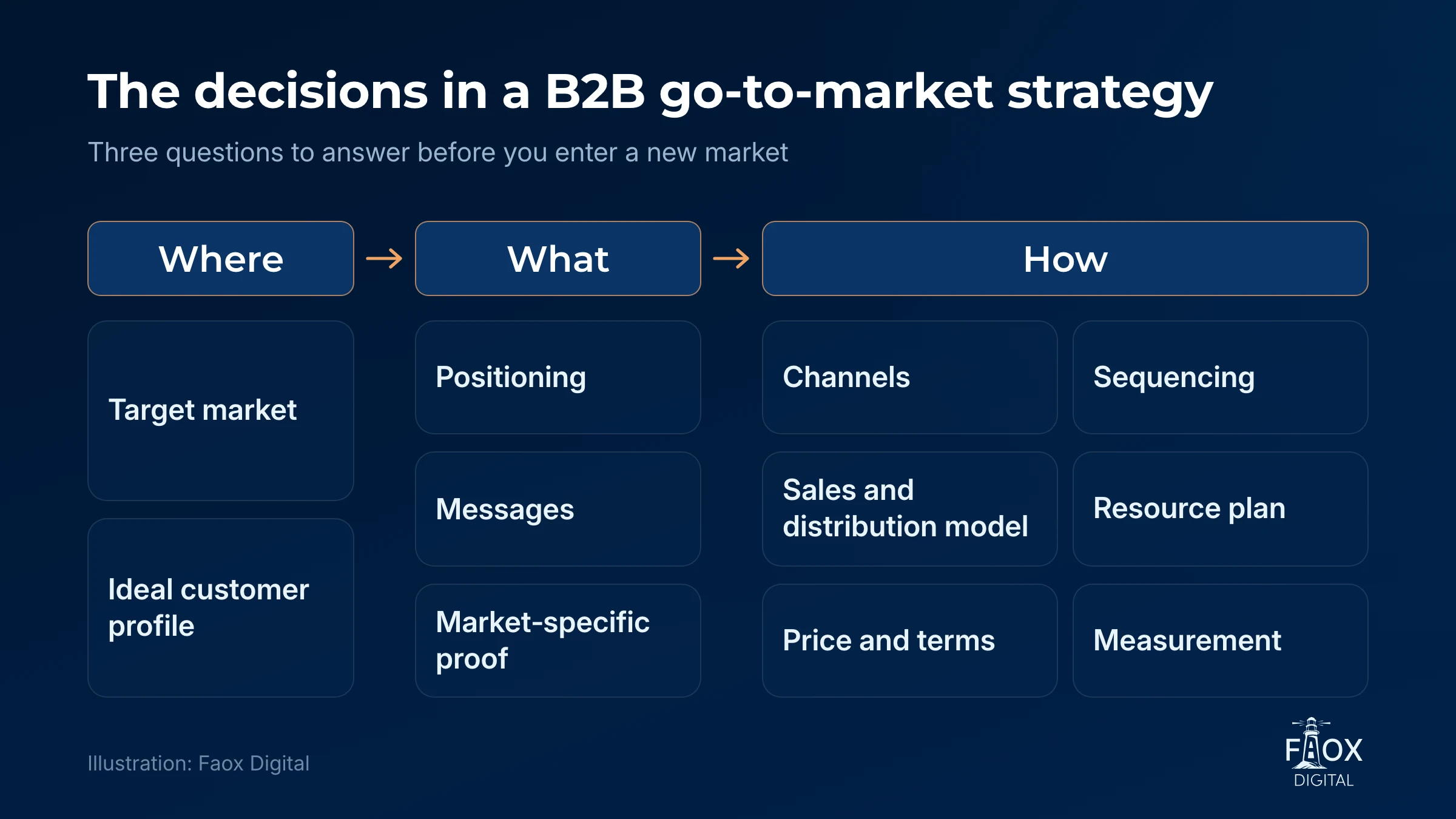
The sections below take each decision in turn.
Choose the target market
The target market decision comes first because every other decision depends on it. Compare candidate markets on a few criteria: how much demand exists for what you sell, how strong the local competition is, how close the market is to your existing customers and operations, which regulations and certifications apply, and whether you can serve buyers in their language.
Resist the urge to enter several markets at once. One market done properly teaches you more, and costs less, than three done halfway. Our guide to prioritizing your next market shows how to compare and rank candidates.
Define the ideal customer profile
Within the market, the ideal customer profile describes the companies you want first: industry, size, type of operation, the trigger that makes them buy, and the buying group that decides. Be specific. "Food manufacturers in Poland" is a market; "mid-sized dairy plants in Poland expanding capacity or facing a new audit" is a profile your sales team can find.
The profile should also describe how these customers buy: who starts the search, who specifies, who approves and what each person needs to see. Our guide to the B2B buyer journey explains how buying committees choose a supplier.
Position the offer for that market
A position that works at home may not work abroad, because the alternatives are different. At home you may be the specialist against large generalists; in the new market you may be the foreign supplier against well-known local companies. Ask what buyers there compare you with and what reason they would have to switch.
Often the core position stays the same and the emphasis changes: a documentation strength may matter more where audits are strict, delivery speed more where you compete against importers. Our guide to B2B brand positioning covers how to decide a position and test it.
Write the messages in the market’s language
Messages turn the position into words for each member of the buying group: the engineer, the purchaser, the manager. In a new country, they have to be written in the buyers’ language, by people who know the industry, with local units, standards and examples. A translated brochure tells buyers you have not really arrived.
Decide also how the company should sound there. Formality and directness differ between markets, and a voice guide for each language keeps every writer, agency and distributor consistent; our guide to what brand voice means covers how to set one up.
Gather market-specific proof
Buyers in a new market do not know your reputation at home. Market-specific proof gives them reasons to trust you anyway:
- References from customers in the same market, or at least in a similar one
- The certifications and approvals buyers there expect
- Documentation, data sheets and manuals in their language
- A local contact, warehouse, service partner or distributor
- Coverage in the trade publications they read
Collect what you have before you launch and plan how to get what you lack. The first local reference is often worth more than any campaign, so some companies offer their first customers in a new market extra support to earn it.
Choose the channels
Channel selection decides where buyers will find and hear about you: trade fairs and their visitor lists, trade publications, search engines, LinkedIn, email to qualified contacts, associations and partners. Choose the channels your ideal customers actually use in that market, not the ones that worked at home.
Search deserves special attention, because buyers in each market search in their own language and with their own terms. A website section built for that market’s searches is often the first sign of seriousness a buyer sees; our guide to international SEO explains what that takes.
Choose the sales and distribution model
The sales and distribution model decides who sells, who holds stock and who owns the customer relationship. The main options:
| Model | How it works | Suits | Watch for |
|---|---|---|---|
| Distributors | They buy from you and resell, often with stock and local service | Standard products, many small customers, a need for local stock | Less control over price and message; they also sell other brands |
| Agents | They find customers and negotiate on your behalf, for commission | Technical or project sales where you deliver directly | Legal protections for agents in some markets, especially the EU |
| Direct sales | Your own people or office sell in the market | Large accounts, complex projects, strategic markets | Higher fixed cost and slower start |
| Hybrid | A mix, for example agents for projects and distributors for spare parts | Broad portfolios | Clear rules on who owns which customer |
Agents deserve a legal check before you sign. In the EU, Council Directive 86/653/EEC (1986) covers self-employed commercial agents with continuing authority to negotiate the sale or purchase of goods on behalf of a principal: for contracts of indefinite duration, it sets minimum notice periods of one month in the first year of the contract, two in the second and three from the third year onward, and entitles the agent, after the contract ends, to an indemnity or compensation under conditions the directive defines. Have a lawyer in the market review the contract before you sign it.
Distributors need the same care in a different way: agree the territory, the price policy, the stock and service levels, who handles marketing and which messages and materials they may use. Give them the market’s messages, proof and templates, or they will describe you in their own words.
Set the price and terms
Price is a positioning decision as much as a financial one. Compare your price with what buyers in the market pay local suppliers and other importers, and decide deliberately whether you are the premium specialist, at par or the value option. A price that contradicts your position confuses buyers and distributors alike.
Decide also the currency you quote in, who carries the exchange-rate risk, the payment terms and the delivery terms. For delivery, the International Chamber of Commerce’s Incoterms rules, whose 2020 edition came into force on 1 January 2020, clarify the tasks, costs and risks involved in delivering goods from seller to buyer, so naming one in every quote avoids costly misunderstandings. With distributors, agree the price structure too: their discount, any recommended resale prices where local law allows them, and how you handle large projects that both of you might quote.
Sequence the launch
Sequencing decides what happens first. Doing everything at once spreads the budget thin and makes it impossible to learn what works. A typical B2B sequence:
- Confirm the basics. Market, customer profile, position, sales model and any certifications you need.
- Prepare the proof and materials. Website pages, data sheets and presentations in the market’s language, plus references.
- Make yourself findable. Search, trade directories and the trade press, so buyers who look can find you.
- Reach the first customers. Direct outreach, partner introductions or a first trade fair with a prepared visitor plan.
- Learn and adjust. Review the first quarter’s conversations, quotes and lost deals, and adjust the position, messages or channels.
- Scale what works. Add channels, partners or people only once the first ones show results.
Building awareness early matters because B2B buyers decide much of their choice before they talk to suppliers. In 6sense’s 2026 B2B Buyer Experience Report (6sense sells B2B marketing software), the eventual winner was already on the buyers’ first-day shortlist in 92% of buying journeys. A supplier nobody in the market has heard of starts behind.
Give the market an owner
A new market needs one person who owns it: someone who knows the customer profile, talks to partners every week, sees every quote and lost deal, and can change course. Without an owner, the market becomes everyone’s side project, and early signals go unnoticed.
In a smaller company the owner may be the export manager or a founder; in a larger one, a country or market manager. Give the owner a clear mandate for the first year: the target customers, the channels, the budget and the measures to report.
Plan the resources
The resource plan covers people, budget and time. List who does what: who owns the market, who sells, who supports partners, who writes and translates, who answers technical questions in the market’s language. Then estimate the budget for each part: materials and translation, website and search, trade fairs and travel, partner support and samples.
Be honest about time. B2B buying cycles are long, so a new market rarely produces significant orders in its first months. Plan the budget for long enough to see real results, and agree in advance what you will review, and when.
Measure progress
Measurement in a new market needs early signals, because orders come late. Track three levels:
- Activity: pages published, partners signed, fairs attended, outreach sent.
- Interest: qualified conversations, quote requests, samples requested, distributor pipeline.
- Results: orders, repeat orders, margin and customer references gained.
Review interest and early results each quarter. If interest is weak after the first round, revisit the customer profile, position or channels before adding budget.
Why new-market entries go wrong
The same mistakes recur:
- Entering several markets at once, with too little attention for any of them.
- Copying the home-market approach, including messages and channels that do not fit.
- Translating instead of localizing, so buyers read that you are a visitor.
- Signing the first distributor who asks, without checking their customers, focus and other brands.
- Underestimating time, and cutting the budget just before the first results arrive.
- Measuring only orders, so problems in the customer profile or messages show up too late.
If you want outside help with any of this, our guide to go-to-market support explains what the first 90 days with an agency should deliver.
How Faox Digital approaches go-to-market strategy
At Faox Digital, a digital growth partner for B2B companies in complex and international markets, preparing a market entry follows the same order as building a brand: listening to how the company and its buyers in that market see it, agreeing its position there, finding the voice in the market’s own language, and rolling the identity out in the right order across the channels that matter. Branding is built per market, so the company reads as local rather than translated.
Key takeaways
- A B2B go-to-market strategy is the set of decisions for winning customers in a new market; the plan turns them into actions.
- Decide where (market and customer profile), what (position, messages, proof) and how (channels, sales model, sequence, resources, measurement).
- Localize messages and gather market-specific proof; translated materials and home-market references are not enough.
- Choose distributors, agents or direct sales deliberately, and check agent contracts against local law, such as the EU directive on commercial agents.
- Sequence the launch, measure early signals as well as orders, and give the market enough time.
Frequently asked questions
What is an example of a B2B go-to-market strategy?
A hypothetical valve maker entering Poland might target mid-sized dairy and food plants facing audits, position itself on complete documentation, write its messages in Polish with local references, use two specialist distributors for stock and service, and launch in sequence: website and data sheets first, then the trade press, then a regional trade fair.
What is a go-to-market strategy framework?
It is a structure for making the decisions in order. A simple one groups them into where (target market and ideal customer profile), what (positioning, messages and proof) and how (channels, sales model, sequence, resources and measurement), so nothing important is left out.
Is there a template for a go-to-market plan?
Yes. Once the strategy decisions are made, a plan template lists the messages for each buyer, the channels and their order, owners, budgets, dates and the measures you will review. Keep it to a few pages, so the team can actually work from it.
What is the difference between market entry and market penetration?
Market entry is about getting into a new market: choosing it, positioning there and winning the first customers. Market penetration means growing your share in a market you already serve, usually by winning more customers like your existing ones or selling more to them.
Sources
Let’s talk
Does your brand say what makes you different?
Show us how you describe your business today. We will tell you where it is clear and where buyers may get lost.