
How to Do Brand Positioning: Steps and a Positioning Statement Template
The steps a B2B company takes to decide its positioning, from interviews and won and lost bids to a one-sentence statement based on Geoffrey Moore’s template.
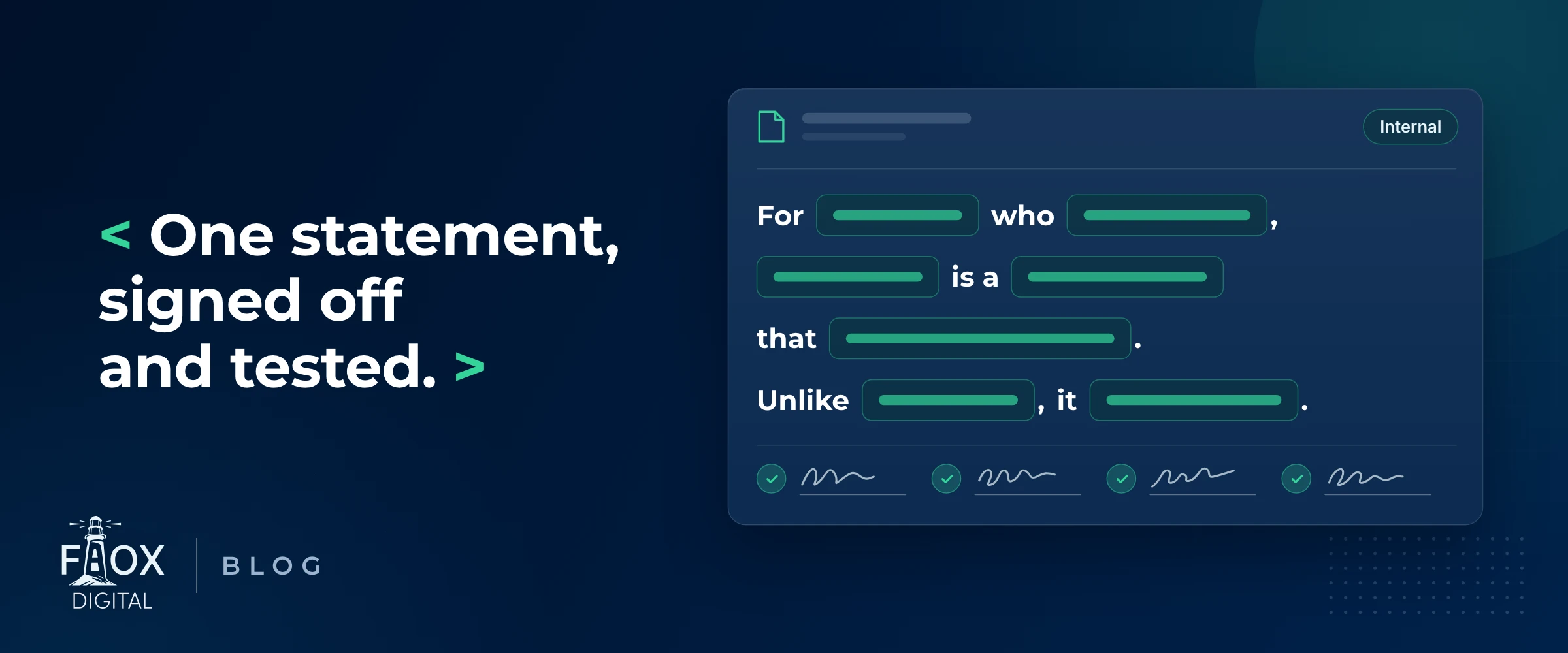
Do brand positioning in four stages: research where you stand (your materials, buyer and sales interviews, won and lost bids, competitor messages), decide (category, target customer, point of difference and proof), write it down in one internal sentence using Geoffrey Moore’s positioning statement template, and get it signed off and tested before anything public changes.
This guide shows how to do brand positioning in a B2B company, step by step, and how to turn the result into one sentence your whole team can use. If you want the concepts first, such as what a position includes and why it matters to a buying group, start with our guide to brand positioning for B2B.
Positioning is a management decision, not a copywriting exercise. The steps below are about collecting the evidence for that decision, making it and checking that it holds.
How to do brand positioning: the steps at a glance
| Step | What you do | What you have at the end |
|---|---|---|
| 1. Current-state review | Collect how you describe yourself and where your business comes from | A picture of today’s position and customers |
| 2. Buyer interviews | Ask customers and lost prospects why they chose as they did | Their words for your value and your weaknesses |
| 3. Sales team interviews | Ask the people who sell what wins and loses deals | The arguments that work in practice |
| 4. Won and lost bids | Analyze recent tenders and quotes | The real decision factors, including price |
| 5. Competitor messages | Collect what competitors claim | The claims already taken |
| 6. Category choice | Decide which frame buyers should compare you in | Your category |
| 7. Target customer profile | Describe who you are for, and who not | Your target customer |
| 8. Point of difference and proof | Choose what sets you apart and prove it | Your difference and proof points |
| 9. Positioning statement | Write it in one sentence | A draft statement |
| 10. Internal sign-off | Agree it with management | An approved position |
| 11. Testing | Try it with customers and in sales | A position ready to use |
Steps 1 to 5 can run in parallel. Steps 6 to 11 depend on each other and should run in order.
Who should be involved
Keep the deciding group small: the managing director or owner, the heads of sales and of the main business line, and someone who knows the product deeply, such as the technical director. Others contribute through interviews and reviews, but a position decided by a large committee usually ends up claiming everything.
Name one person to run the process, collect the material and keep the schedule. An outside facilitator helps when internal views are strongly divided or when buyers will speak more openly to someone who is not from the company.
Step 1: Review where you stand today
The current-state review collects how the company presents itself now: the website, the company presentation, recent proposals, catalogue introductions and the "about us" text sales staff paste into emails. Read them side by side and write down the claims they make.
Then add the facts behind the business: which customers, industries and markets bring most of your revenue and margin, which products they buy, and where you grew or shrank in recent years. Positioning has to fit the business you actually have, or the one you are deliberately building, not the one the brochure describes.
Step 2: Interview buyers
Buyer interviews are the most valuable part of the research, because they replace your assumptions with your customers’ words. Talk to a handful of current customers, a few who left and a few prospects who chose a competitor. Include different roles where you can: the engineer who specified you, the purchaser who negotiated and the manager who approved.
Useful questions:
- What problem were you trying to solve when you started looking?
- Which suppliers did you consider, and how did you compare them?
- Why did you choose us, or why not?
- What almost stopped you?
- How would you describe us to a colleague in one sentence?
Ask for stories, not ratings, and write down the exact words people use. Those words often become the best proof points and the language of your messages later.
Step 3: Interview your sales team
Sales team interviews add what buyers rarely say directly: the objections that come up, the competitor names that appear in every deal and the arguments that close business. Ask sales staff, distributors and application engineers separately, because each group hears different things.
Listen for disagreement. If two salespeople describe the company’s strengths differently, the position is not yet clear inside the company, and buyers are hearing two stories.
Step 4: Study won and lost bids
Interviews tell you what people remember; won and lost bids show what they did. Take a sample of recent tenders and quotes, both won and lost, and record for each: the customer type, the competitors involved, who made the decision, the price difference and the reason given.
Patterns appear quickly. You may find that you win almost every bid where documentation matters and lose most where the buyer compares purchase price only, which already says a lot about where your position is.
Step 5: Collect competitor messages
List the main competitor messages: the claims on their websites, in their catalogues, on their trade fair stands and in their proposals if customers share them. Note the words, the proof they offer and who they seem to target.
Mark which claims are already taken and which are crowded. A position built on a claim three competitors already make will be hard to own. To see the open ground visually, a positioning map helps, and our guide to finding room to stand apart shows how to draw one.
Step 6: Choose the category
Category choice decides what buyers compare you with. Al Ries and Jack Trout described buyers ranking brands on ladders in the mind, one ladder per category, and a company has to find its place on one. In practice you have three options:
- Join an existing category and compete on a clear difference, which is simplest when buyers already know the category well.
- Define a subcategory, such as "valves documented for audited process plants" instead of "industrial valves", which narrows the field to competitors you can beat.
- Create a new category, which only works when your offer is genuinely new and you can afford to teach buyers what it is.
The second option is often the most practical: it uses words buyers already understand while giving them a reason to look at you separately.
Step 7: Define the target customer profile
A target customer profile describes the customers you serve best. In B2B it has three layers:
- The company: industry, size, region, the kind of operation (for example continuous process plants rather than workshops).
- The situation: the trigger that makes them buy, such as a new plant, a failed audit, a supplier problem or a regulation.
- The buying group: the roles that decide and what each one needs to see.
Write down who you are not for as well. If your won and lost bids show that pure price buyers rarely choose you, say so. Leaving them out of the profile is what makes the position sharp.
Step 8: Pick the point of difference and its proof
The point of difference is the one thing you do differently that your target customer values. Test each candidate against four questions: Does the target customer care about it? Can you deliver it every time? Do competitors not already claim it? Can you prove it?
Then collect the proof points: test reports, certificates, delivery records, references, the experience of named experts, the size of your installed base. A difference without proof is a hope; with proof, it becomes an argument a buyer can repeat inside the buying group.
Step 9: Write the positioning statement
The best-known positioning statement template comes from Geoffrey Moore’s book Crossing the Chasm, first published by HarperBusiness in 1991 and written for technology products. In our own words, its structure is:
For [target customer] who [need or opportunity], [your company or product] is a [category] that [key benefit]. Unlike [the main alternative], it [main difference].
Moore calls the key benefit the buyer’s "compelling reason to buy." The third edition of the book, published in 2014, words the template slightly differently, but the parts are the same.
For a hypothetical valve maker, it could read: For chemical and food plants that cannot afford a leak or a failed audit, [company] makes industrial process valves that arrive engineered and fully documented for inspection. Unlike catalogue suppliers, every valve ships with its own pressure test record and material certificates from our in-house lab.
A positioning statement is an internal decision document, not a tagline. It will never appear on the website in this form; turning it into headlines and messages is a separate step. Keep it specific enough that it would be false for your main competitor.
A brand positioning framework on one page
A one-page brand positioning framework keeps the statement and its evidence together, so that anyone using it later can see why it says what it says:
| Field | What to write | Example for the hypothetical valve maker |
|---|---|---|
| Target customer | Company, situation, buying group | Process plants in chemicals and food facing audits |
| Need | The problem that starts the search | Leaks stop production; audits demand full records |
| Category | The frame of comparison | Industrial process valves for audited plants |
| Main alternative | What buyers would choose instead | Catalogue suppliers and local workshops |
| Point of difference | What you do that they do not | Complete documentation with every valve |
| Proof points | Why it is believable | In-house pressure tests, certificates, delivery records |
| Value by role | What each member of the buying group gains | Engineer: reliability; quality manager: audit-ready records; purchaser: fewer claims |
| What we will not do | The choices the position rules out | Compete on price for undocumented standard valves |
Step 10: Get internal sign-off
Internal sign-off means the managing director and the heads of sales, operations and product agree to the position and to what it rules out. Present the statement together with the research behind it, so the discussion is about evidence rather than taste.
Ask each leader one question: what will you do differently because of this position? Sales may stop chasing certain tenders; operations may need to protect a delivery promise; product management may drop a line that does not fit. If nobody has to change anything, the position is probably too vague.
Step 11: Test the position
Testing shows whether the position works outside the meeting room. Practical tests for a B2B company:
- Read it back to customers. Ask a few interviewed customers whether it describes why they chose you, and what is missing.
- Use it in live sales conversations. Let two or three salespeople open with the new argument for a few weeks and report what happens.
- Rewrite one proposal around it. See whether the proposal becomes clearer and whether the buyer responds differently.
- Check the language against searches. Compare your category words with the terms buyers type, so your pages can be found.
- Adjust and confirm. Fix what the tests reveal, then confirm the final version with the deciding group.
Putting the position to work
Once approved, the position becomes the brief for everything that follows. The brand identity expresses it in values, voice and design; our guide to the brand identity process covers that sequence. The messages, from website headlines to sales presentations, are written from it.
The website needs a structure that matches it: one page for each main offer and audience, each with a clear search target, which is what keyword mapping organizes. And when you take the position into a new country or segment, it becomes the starting point of a B2B go-to-market plan for that market.
If you are weighing whether to run this process yourself or with outside help, the next question is what a brand positioning agency does, how long the work takes and what you should receive.
How Faox Digital runs brand positioning
When Faox Digital works on positioning with a B2B company, it follows the first two of its five working sessions with the client: listening to how the company describes itself and what its buyers believe, then agreeing where it sits in its market and the single reason to choose it, in plain words. The voice, the visual system and the rollout follow from that position, adjusted for each market.
Key takeaways
- Research first: your own materials, buyer and sales interviews, won and lost bids and competitor messages.
- Decide in order: category, target customer profile, point of difference and proof points.
- Write one internal positioning statement using Geoffrey Moore’s template, specific enough to be false for your main competitor.
- Get sign-off on what the position rules out, not only on what it says.
- Test it with customers, in sales conversations and in proposals before changing anything public.
Frequently asked questions
How long should a positioning statement be?
One or two sentences. If it needs a paragraph, it usually contains more than one position. Keep the supporting detail, such as proof points and value by role, in a one-page framework next to it.
How do you make a brand positioning map?
Choose two attributes your target buyers genuinely weigh, such as degree of customization and speed of delivery, draw them as axes and place each competitor based on evidence from their materials and from buyer interviews. Empty areas are candidates for your position if buyers actually want what they represent.
Is a positioning statement the same as a tagline?
No. The positioning statement is an internal decision that guides everything you say and do. A tagline is a short public phrase that may express part of it. A company can do well without a tagline, but not without a clear position.
Can a small company do brand positioning without an agency?
Yes. A small team can run the interviews, review won and lost bids and write a first statement in a few working sessions. Outside help is most useful when internal opinions are strongly divided, when buyers will speak more openly to a neutral interviewer or when several markets are involved.
Sources
Let’s talk
Does your brand say what makes you different?
Show us how you describe your business today. We will tell you where it is clear and where buyers may get lost.