
What Is a B2B Value Proposition? How It Works When a Whole Team Buys
What a value proposition is in B2B, why it must work for each member of the buying group, what each role values, how Bain’s B2B Elements of Value and Osterwalder’s value proposition canvas help, and fictional examples labeled as such.
A B2B value proposition is a clear statement of the value a company delivers to a business customer: the problem it solves, the gain or lower risk it brings, and the proof behind it. Because a whole team buys, it has to work for each role: the technical decision-maker who checks performance, procurement who compares total cost and terms, and senior management who weighs risk and return. The strongest B2B value propositions focus on the few things each role values most and back every claim with evidence.
Many B2B websites promise "quality, reliability and service". Every competitor promises the same, and no single buyer reads it as an answer to their own question. The problem is that B2B buying is a group decision. Forrester’s report on the state of business buying, published in January 2026, found that a typical buying decision now involves 13 internal stakeholders and nine external influencers. Positioning decides where your company stands in its market, as our guide to B2B brand positioning explains; the value proposition spells out what each of those people gains by choosing you.
What is a value proposition in B2B?
A value proposition describes the value a customer gets from an offering: the problem it solves or the gain it creates, compared with the alternatives, and why the customer should believe it. In business markets the term is often customer value proposition, the phrase James Anderson, James Narus and Wouter Van Rossum used in their 2006 Harvard Business Review article, which found that there was no agreement on what one should contain and that most made claims of savings and benefits without backing them up.
A value proposition is not a slogan and not the positioning statement. Positioning names the market and the single reason to choose you; the value proposition works out what that reason is worth to each buyer. Differentiation connects the two: the value you offer only persuades if it is better than, or different from, what the buyer can get elsewhere.
Why a whole team buys, and what each role values
The buying group is everyone who shapes the decision. Its members judge the same offer by different measures, so one statement rarely convinces all of them. Forrester’s 2026 research adds that procurement professionals are decision-makers in 53% of business buying cycles, engage from the start and look beyond price at features and functions.
| Role | What they need to see | Proof that convinces |
|---|---|---|
| Technical decision-maker | Performance, fit with the process, standards met | Test data with the method, specifications, references in similar plants |
| Procurement | Total cost of ownership, terms, security of supply | Cost calculations, delivery records, contract terms |
| Senior management | Strategic fit, risk and return | A business case, risk reduction, the supplier’s stability |
| Users and operations | Ease of use, maintenance, training | Demonstrations, trials, service plans |
| Quality and compliance | Certifications, documentation, traceability | Certificates, audit reports, declarations |
A strong B2B value proposition has one core and a version for each role: the technical decision-maker hears about performance, procurement about cost and supply, senior management about risk and return.
Three ways to write a value proposition
Anderson, Narus and Van Rossum described three approaches. The first lists all benefits the offering might deliver, which risks claiming advantages the customer does not care about. The second stresses favorable points of difference against a competitor, which risks what they called value presumption: assuming every difference matters to the customer. The third, which they recommend, is a resonating focus: being superior on the few elements that matter most to the target customer, demonstrating and documenting the value of that superiority, and communicating it in terms of the customer’s business priorities.
That last step is where proof points come in: test results with the method, certifications, references a customer has agreed to give, delivery and quality records, and calculations the buyer can check. A claim without proof reads as marketing.
Total cost of ownership and risk reduction
Two kinds of value matter in almost every B2B purchase. Total cost of ownership is the full cost over the life of a purchase: price, installation, energy, maintenance, spare parts, downtime and disposal. A higher price can still be the better offer when the lifetime cost is lower, but only if you show the calculation.
Risk reduction matters because buyers have to justify their choice. Forrester’s 2026 research calls trials a critical risk-reduction strategy and reports that more than 60% of business buyers now use one to evaluate potential solutions. Pilot installations, references in the same industry, clear terms and documented support all lower the risk a buyer takes by choosing you.
The B2B elements of value
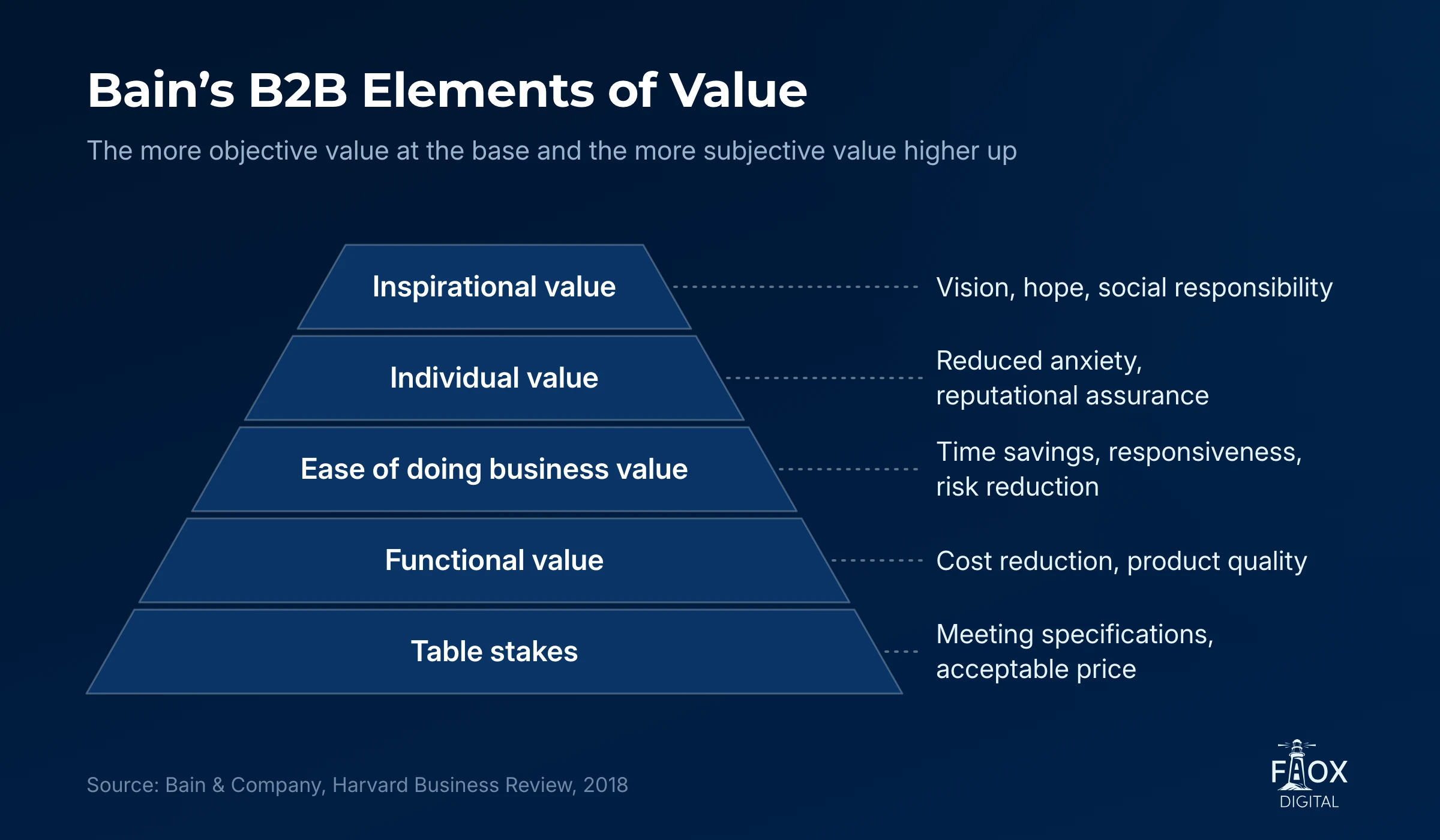
Bain & Company’s B2B elements of value, published in Harvard Business Review in 2018, list 40 kinds of value in five levels, arranged as a pyramid with the more objective value at the base and the more subjective value higher up:
- Table stakes: meeting specifications, acceptable price, regulatory compliance and ethical standards
- Functional value: economic elements such as cost reduction, and performance elements such as product quality
- Ease of doing business value: for example time savings, responsiveness, expertise and risk reduction
- Individual value: personal and career concerns such as reduced anxiety and reputational assurance
- Inspirational value: vision, hope and social responsibility
Bain’s authors note that procurement teams run total cost-of-ownership models, but that with some purchases, subjective concerns, such as whether a product can enhance the buyer’s reputation or reduce anxiety, play a large role. Use the pyramid as a checklist: which elements does each role in the buying group care about, and which can you prove?
Using the value proposition canvas in B2B
Alexander Osterwalder’s value proposition canvas, published by Strategyzer, has two parts: a customer profile with the customer’s jobs, pains and gains, and a value map with the products and services, the pain relievers and the gain creators you offer. Strategyzer warns against mixing several customer segments, such as payers and users, in one customer profile, because each has different jobs, pains and gains. In B2B that means one canvas per role in the buying group. Here is a fictional example for a procurement manager:
| Customer profile (example: procurement manager at a dairy plant) | Value map (example: a hypothetical pump maker) |
|---|---|
| Jobs: compare offers on total cost, keep supply secure | Products and services: hygienic pumps with a service contract |
| Pains: hidden costs after purchase, unplanned stops, too many suppliers | Pain relievers: a lifetime cost calculation per line, spare parts held locally |
| Gains: predictable costs, fewer suppliers to manage | Gain creators: one contract covering every line in the plant |
The engineer’s and the plant manager’s canvases would look different, even though the pump is the same.
B2B value proposition examples
The examples below are fictional and show the structure, not real companies. The core of each is one sentence; the role lines show how it adapts.
- Example: a hypothetical pump maker. For dairy and food plants, pumps built for daily cleaning cycles that cut unplanned stops, with a lifetime cost calculation for each line. Technical: tested on [your cleaning cycle data]. Procurement: one service contract, spare parts held locally. Management: fewer stoppages on the lines that carry the most volume.
- Example: a hypothetical electronics contract manufacturer. For makers of industrial equipment, one plant from prototype to series production, with every component traceable. Technical: documented process capability. Procurement: one supplier instead of two. Management: less risk at the moment of scaling up.
Square brackets mark the proof a real company would add.
From value proposition to messages
A value proposition is an internal tool before it is a text. It shapes the website, proposals, sales conversations and the way the company tells its story, as our guide to B2B storytelling explains, and the look that carries it, covered in our guide to visual identity. Check it against the words buyers actually use: B2B keyword research shows whether they search for "lifetime cost" or "cost of ownership", "downtime" or "unplanned stops". Before you finalize it, map where competitors already stand; our guide to the brand positioning map shows how.
How Faox Digital works on value propositions
Faox Digital, a digital growth partner for B2B companies in complex and international markets, works out the value proposition in the positioning session with the client: where the company sits in its market and the single reason to choose it, in plain words. The voice session then turns it into a messaging framework the team can write inside, adjusted for each market.
Key takeaways
- A B2B value proposition states the value a company delivers, compared with the alternatives, with proof.
- A whole buying group decides, so keep one core and adapt it for the technical decision-maker, procurement and senior management.
- Focus on the few elements each role values most, and document them, rather than listing every benefit.
- Total cost of ownership and risk reduction matter in almost every B2B purchase.
- Use Bain’s B2B Elements of Value as a checklist and one value proposition canvas per role.
Frequently asked questions
What is a value proposition in B2B?
It is a statement of the value a supplier delivers to a business customer: the problem it solves, the gain or lower risk it brings and the proof behind it. In B2B it has to persuade several people in the buying group, each with different priorities.
What is a B2B value proposition canvas?
It is Osterwalder’s value proposition canvas used for business customers: a customer profile of jobs, pains and gains matched with a value map of products and services, pain relievers and gain creators. In B2B, fill in one canvas for each role in the buying group.
What is the B2B value proposition pyramid?
It usually refers to Bain & Company’s B2B Elements of Value, 40 kinds of value arranged in five levels, from table stakes such as meeting specifications at the base to inspirational value such as vision at the top.
How is a value proposition different from a positioning statement?
The positioning statement names your market and the single reason to choose you; it is an internal decision. The value proposition works out what that reason is worth to each buyer and proves it.
Sources
- Forrester: Forrester’s 2026 Buyer Insights (press release on The State Of Business Buying, 2026), January 2026
- Bain & Company: The B2B Elements of Value, February 2018
- Harvard Business Review: Customer Value Propositions in Business Markets, March 2006
- Strategyzer: 5 common mistakes to avoid when using the Value Proposition Canvas, February 2015
Let’s talk
Does your brand say what makes you different?
Show us how you describe your business today. We will tell you where it is clear and where buyers may get lost.