
Brand Positioning for B2B: Why Should a Buyer Choose You?
What brand positioning means for a B2B company, which elements a clear position needs and how it helps a buying group choose you for reasons other than price.

Brand positioning is the place your company holds in buyers’ minds compared with the alternatives, and the reason they should choose you. In B2B, a clear position names the target customer, the category you compete in, what makes you different and the proof behind it, so that a whole buying group, procurement included, can explain why you are worth choosing for reasons other than price.
Most B2B suppliers can describe what they make. Saying in one sentence, the way a buyer would repeat it, why someone should choose you over the next supplier on the list is much harder. That sentence is what brand positioning is about.
This guide explains what positioning means and where the idea came from, what a B2B position includes, which positioning strategies work in B2B and how a clear position holds up when procurement asks for a lower price. It opens our series on strategic positioning; you can find all Branding & Strategy articles on the category page.
What is brand positioning?
Brand positioning is the place your company holds in the minds of the buyers you want, relative to the alternatives they consider, and the reason they should prefer you. It is not a slogan and not a logo. It is a decision about where you compete and why you win, which everything else then expresses.
The idea was first published in a B2B magazine. Al Ries and Jack Trout first wrote about it in an article titled "Positioning is a game people play in today’s me-too marketplace," published in the June 1969 issue of Industrial Marketing, a trade magazine. Their three-part series "The Positioning Era Cometh" followed in Advertising Age in April and May 1972, and their book Positioning: The Battle for Your Mind appeared in 1981.
Their core argument still holds. Buyers cope with too many offers by ranking brands on what Ries and Trout called ladders in the mind, one ladder per product category. A newcomer cannot simply claim the top step; it has to relate itself to what buyers already believe. Their 1972 example was a B2B one: computers meant IBM to most people, so a competitor announcing that it "means computers" would not be believed, and had to find a position relative to IBM’s.
That is why positioning is about perception. What counts is not what your brochure says but what buyers believe about you and your competitors, and how they would describe the difference to a colleague.
Why positioning matters more in B2B
Every company benefits from a clear position, but four things make it more important when you sell to businesses.
The buying group needs one shared reason. B2B decisions are made by groups: engineers, users, managers, finance and procurement, each with their own questions. If each member hears a different reason to choose you, the group has nothing to agree on. A clear position gives them all the same sentence.
Procurement is at the table early. Forrester’s State of Business Buying 2026 report found that procurement professionals are decision-makers in 53% of business buying cycles and engage from the start of the process. Forrester adds that they look beyond price at features and functions, which is exactly where a clear position helps them argue for you.
Buyers know your category before they talk to you. In 6sense’s 2026 B2B Buyer Experience Report (6sense sells B2B marketing software), 96% of buyers said they keep up with their category between evaluations. They arrive with opinions already formed, so your position is either in their minds before the project starts or it has to fight its way in late.
Without a difference, the comparison falls to price. When two suppliers look alike on paper, the purchase price is the easiest thing left to compare. Price pressure is often a positioning problem in disguise.
The elements of a B2B position
A complete position answers six questions. Here they are with an example for a hypothetical industrial valve maker:
| Element | The question it answers | Example for a hypothetical valve maker |
|---|---|---|
| Target customer | Who is it for, and who is it not for? | Process plants in chemicals and food, where a leak stops production |
| Category | What do buyers compare it with? | Industrial process valves, against large catalogue suppliers and local workshops |
| Differentiation | What does it do that the alternatives do not? | Valves engineered and documented for audits, with test records for every unit |
| Value proposition | What does the buyer gain? | Fewer unplanned stops and faster audits |
| Proof points | Why should anyone believe it? | Pressure test reports, material certificates, delivery records and references |
| Brand promise | What can every buyer count on, every time? | Complete documentation that passes inspection, shipped with the valve |
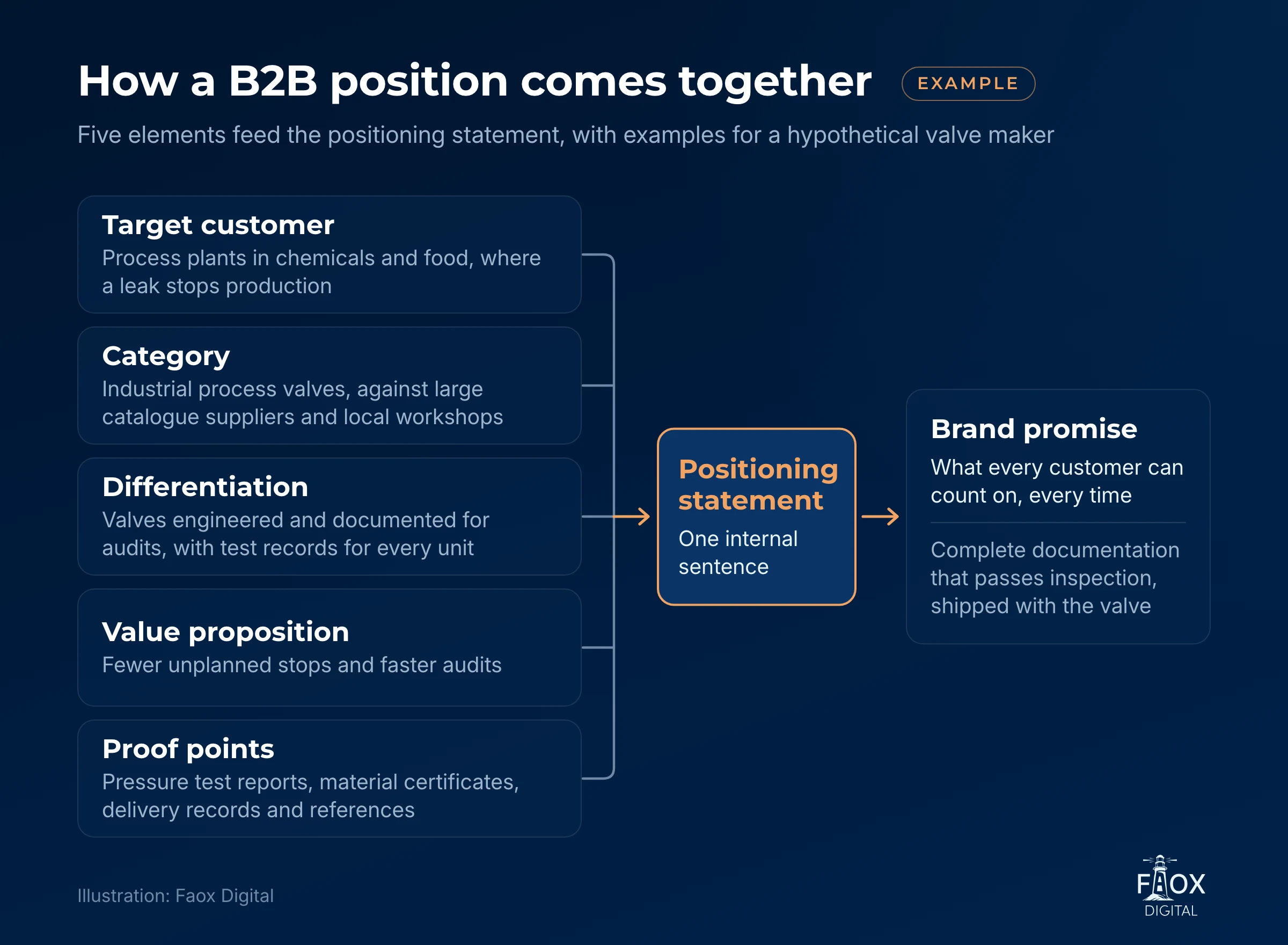
The target customer comes first because a position that tries to fit everyone fits no one. Naming who you are not for is part of the work.
The category is the frame buyers use to compare you. Choose it deliberately: competing as "a valve supplier" puts you next to every catalogue, while "valves for audited process plants" puts you next to far fewer.
Differentiation is what you do differently that the target customer cares about. A competitive advantage is the capability underneath it that is hard to copy, such as an in-house test lab or decades of application data. Positioning makes that advantage visible.
The value proposition translates the difference into what each buyer gains, and in a buying group that gain differs by role. Our guide to the value proposition in B2B shows how it works when a whole team buys.
Positioning, brand promise and brand identity
These terms describe one chain of decisions, and it helps to keep them apart:
- Positioning decides where you compete and why you win.
- The value proposition says what each buyer gains from that difference.
- The brand promise is what every customer can count on, every time; it is the part of the position you commit to in operations, not only in words.
- Brand identity expresses all of this in values, voice and a visual system. Our guide to what brand identity includes covers that side.
The order matters. A visual identity designed before the position is settled has nothing particular to express, and a promise that operations cannot keep does more harm than no promise at all.
Brand positioning strategy: common routes in B2B
A brand positioning strategy chooses the ground you compete on. Most strong B2B positions take one of these routes. The examples are hypothetical, to show the logic rather than any company:
| Route | What you claim | When it works | Hypothetical example |
|---|---|---|---|
| Specialist | The best fit for one industry or application | Buyers face a specific technical problem | A pump maker that serves only abrasive slurries in mining |
| Engineering depth | You solve what others cannot | Specifications are complex or custom | A drive maker known for custom solutions for difficult loads |
| Service and speed | Fast response and local support | Downtime is expensive | A distributor with same-day spare parts in its region |
| Documentation and compliance | Paperwork that passes audits | The industry is regulated | The valve maker above |
| Total cost | Lower cost over the life of the product | Buyers measure lifetime cost | A compressor maker that sells on energy use over ten years |
| Price | The lowest purchase price | Your cost base truly supports it | A volume producer of standard fasteners |
These brand positioning examples share one feature: each gives up something. The specialist turns away work outside its niche; the price leader does not promise custom engineering. A position that claims every route at once is not a position.
Ries and Trout described one more route in 1972: positioning against the leader. When one competitor clearly owns the top of the ladder, a challenger can define itself in relation to it, as the smaller, faster or more specialized alternative, instead of pretending the leader does not exist.
Writing a positioning statement
A positioning statement puts the elements into one internal sentence. A common form is:
For [target customer] who [need], [company] is the [category] that [difference], because [proof].
For the valve maker: For process plants in chemicals and food that cannot afford a leak or a failed audit, [company] makes industrial process valves that arrive engineered and fully documented for inspection, because every unit is pressure-tested in our own lab and shipped with its test record.
The statement is a tool for the team, not a tagline for the website. It should be clear enough that sales, engineering and management can repeat it and test their decisions against it. Our positioning statement template walks through each part step by step.
Testing a position before you commit
Before you rewrite the website, test the position against a few plain questions:
- Could your main competitor put the same sentence on its website? If so, it is not a position yet.
- Do customers recognize it? Read it to a few and ask whether it describes why they chose you.
- Can you prove every claim today, not after a future investment?
- What does it rule out? Name the customers, projects or requests you would now decline.
- Can a salesperson say it in a meeting without a slide?
- Will operations keep the promise in delivery, service and quality, every week?
A position that passes these questions is ready to shape your messages, your identity and your sales material. One that fails them is still a useful draft: the failed question shows where the work is.
Finding room to stand apart
A position only works if it is different from what competitors already claim. Collect their websites, catalogues and trade fair messages and list their main claims. You may well find the same words everywhere: quality, reliability, innovation, customer focus.
A positioning map helps you see the gaps. Pick two attributes buyers genuinely weigh, such as degree of customization and speed of delivery, and place each competitor on them. Empty space is a candidate for your position, but check why it is empty: sometimes no buyer wants what it represents. Our guide to finding room to stand apart shows how to build the map.
Proof points: what makes a position believable
Without proof points, a position is an opinion. B2B buyers check claims, and a buying group shares what it finds. Proof that works in B2B includes:
- Certifications, approvals and audit results relevant to the buyer’s industry
- Test data, measured performance and published technical documentation
- References and case studies from comparable customers, with their permission
- Delivery, quality and service records you can show
- The experts who will actually work on the buyer’s project
- The installed base: how long and where your products have been in use
Choose proof that matches the position. A service position needs response times and service coverage; a documentation position needs sample records and audit outcomes.
Positioning under price pressure
Price pressure tests every position. When procurement asks for a lower price, a company with a clear position can move the conversation to what the price buys: lower risk, less downtime, faster audits, a lower total cost. It can also put those arguments in writing, so the purchaser can defend the choice internally.
A clear position also tells you when to walk away. If a buyer only wants the lowest purchase price and your position rests on engineering depth or documentation, that buyer is outside your target customer. Losing those deals is part of the position working, not failing.
The exception is a company whose position really is price. That can be a strong position, but only with a cost base to match; claiming it without one leads to shrinking margins rather than a better place in the buyer’s mind.
Positioning for smaller B2B companies
A small company often has an easier job than a large one. It can be the specialist in a narrow field without disappointing a large existing customer base, and its managers usually know exactly why customers choose it.
The first version of a position does not need a large project. A written answer to the six questions above, tested with a handful of customers and the sales team, is a good start, and many owners can draft it themselves in a few working sessions. What a small company cannot afford is a position it cannot keep, so promise only what the team delivers every week.
Positioning across markets and channels
Markets. Competitors, buyers and expectations differ between countries, so a position that is distinctive at home may be ordinary abroad. Before entering a new market, check which alternatives buyers there compare you with and adjust the proof and the wording to that market.
Search. The words buyers type show how they frame your category. If your position says "documented valves for audited plants" but buyers search for "valve test certificates," your pages should use their words. Our guide to the searches that bring quote requests explains how to find them.
AI answers. AI assistants increasingly summarize what is published about suppliers. A clear position, stated the same way on your site and in independent sources, gives them one consistent story to repeat; how to prepare for that is the subject of generative engine optimization.
When to revisit your positioning
A good position lasts for years, partly because buyers’ perceptions change slowly. Revisit it when the ground moves under it:
- A new competitor takes your claim, or a cheaper alternative makes your difference matter less
- Technology or regulation changes what buyers value
- You add products, markets or customer groups that the old position does not cover
- A merger or acquisition brings together companies with different positions
Change what the position says only when the business has changed. Rewording it every year confuses buyers who are still learning the old version.
Signs your positioning needs work
Your positioning likely needs attention if:
- Sales, management and marketing describe the company in different ways
- You lose on price more often than on anything else
- Your answers to tenders read like your competitors’ answers
- Your website could belong to any competitor if you swapped the logo
- You serve "all industries" and cannot name the ones you serve best
- New products or markets do not fit the way you describe the company
Reworking a position is a project of its own, with research, workshops and decisions that management has to own. Our guide to what a positioning project involves covers the process, timeline and deliverables.
How Faox Digital approaches brand positioning
At Faox Digital, a digital growth partner for B2B companies in complex and international markets, positioning is the second of five working sessions with the client: after listening to how the company describes itself and what its buyers believe, we agree where it sits in its market and the single reason to choose it, in plain words. That position then guides the voice, the visual system and the rollout, and it is adjusted for each market, so that it reads as local rather than translated.
Key takeaways
- Brand positioning is the place you hold in buyers’ minds compared with the alternatives, and the reason they should choose you.
- A B2B position names the target customer, the category, the difference, the value, the proof and the promise.
- It matters more in B2B because buying groups need one shared reason and procurement is involved from the start.
- Strong positions give something up; a position that claims everything is not a position.
- Proof points make a position believable, and a clear position moves price discussions toward what the price buys.
Frequently asked questions
What is brand positioning, and why is it important?
Brand positioning is the place your company holds in buyers’ minds compared with the alternatives, and the reason they should choose you. It matters because it guides every message and decision, gives a buying group a shared reason to pick you and keeps the comparison from falling to price alone.
How do you define your brand positioning?
Answer six questions in writing: who your target customer is, which category they compare you in, what you do differently, what they gain, what proves it and what you promise every time. Then test the answers with customers and your sales team, and keep only what both recognize.
How do you write a brand positioning statement?
Use one internal sentence: for [target customer] who [need], [company] is the [category] that [difference], because [proof]. Keep it specific enough that it would be false for your main competitors, and use it to test decisions rather than as a slogan.
How do you explain your positioning to your team?
Start with the buyer’s problem, then the difference and the proof, in plain words and with real examples from projects. Give sales a short version they can say in a meeting, and show how the position changes daily decisions, such as which tenders to answer and which to decline.
Sources
Let’s talk
Does your brand say what makes you different?
Show us how you describe your business today. We will tell you where it is clear and where buyers may get lost.