
Can You Create a Brand Identity With AI? What It Handles and What It Misses
What generative AI can do for a B2B brand identity, what it misses, the originality, copyright and trademark questions to check, how an AI tool compares with a designer and a branding agency, and when an AI-made logo is enough.
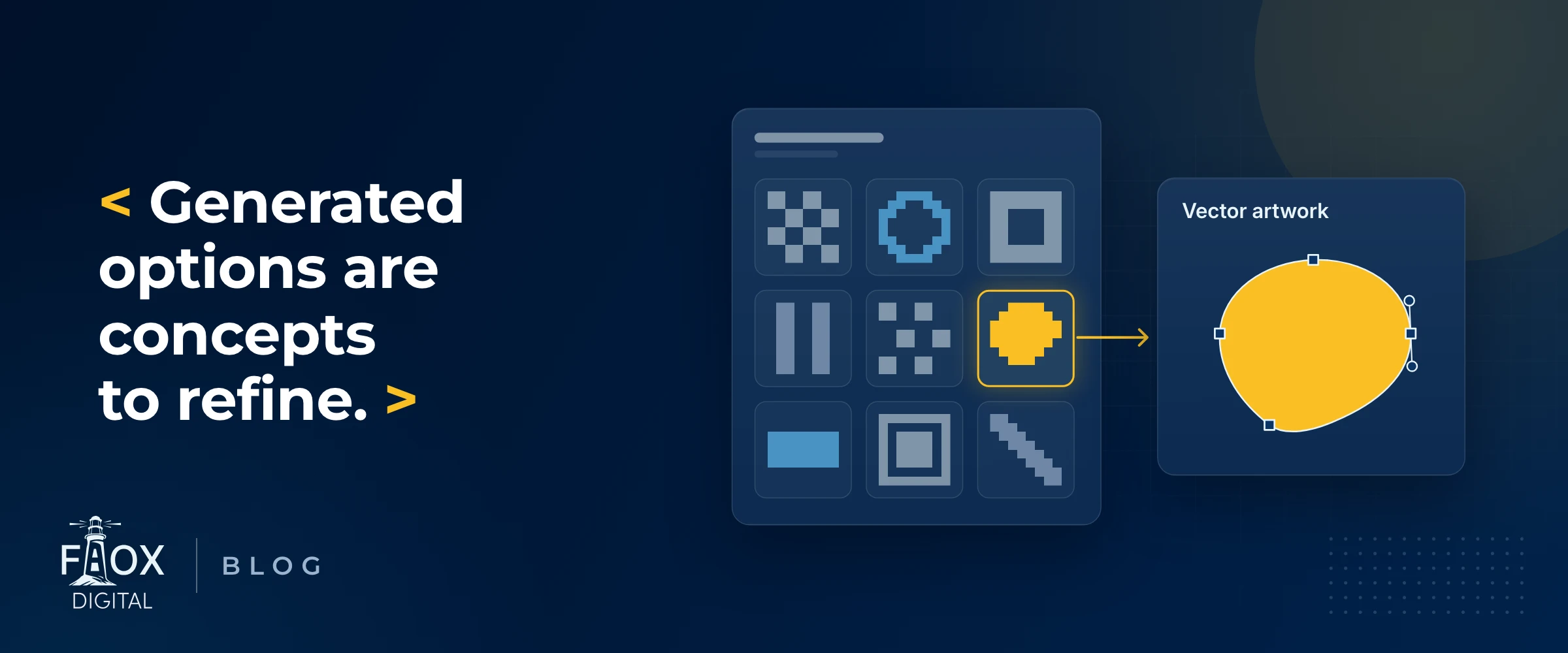
If you are working out how to create brand identity with AI, start from what it can and cannot do. Generative AI produces logo ideas, color and type options, mock-ups and first drafts of copy quickly, but it cannot supply the positioning, story and judgment behind an identity, and its logos can come with gaps: pixel files where a tool gives no vector artwork, a risk of resembling other marks and, in the US, no copyright for what the machine alone produced. For a B2B company, AI output works best as material for a designer or branding agency, not as the finished identity.
AI tools now produce a logo in less time than it takes to write a brief, and many companies wonder whether that is enough. For a small local business it may be. For a B2B company whose logo has to work on catalogues, product labels and trade fair stands, in several countries, the answer depends on what you expect a B2B brand identity to do. This guide sets out what generative AI handles well, what it misses, the legal questions to check and when a designer or agency is worth the cost. We work as a B2B branding agency, so we have a stake in the answer; the comparison applies whoever does the work.
What generative AI can do for a brand identity
Generative AI creates new images and text from a written prompt. AI logo tools, whether general image generators or logo features inside design platforms, are good at the early, exploratory jobs:
- Exploring directions: many visual routes, styles and color moods in an afternoon
- Moodboards and mock-ups: a concept shown on a stand, a vehicle or a product before anyone commits
- Color and type options: palettes and pairings to react to and discuss
- First drafts of words: taglines, descriptions and naming ideas to test, with names still to be checked
Used this way, AI speeds up exploration. Its output is a starting point for decisions, not the decisions themselves.
What it misses: strategy, a system and judgment
A brand identity is more than a logo. It starts from positioning, what the company stands for and why buyers should choose it, and ends in a visual system: logo versions, colors with codes, typography, imagery and the rules that tie them together, written down in brand guidelines so that a distributor abroad or a stand builder can apply them correctly.
An image generator produces images on request. It does not know your buyers, your competitors or your markets, and it cannot decide which of fifty options says the right thing about your company. The same goes for the story behind the identity: if the message is the hard part, a B2B storytelling agency will help more than another round of images.
Originality and similarity risk
Generative tools are built on existing images, and their terms are open about the consequences. OpenAI’s terms of use, effective January 2026, give users ownership of the output as far as the law allows, but add that output may not be unique and that other users may receive similar output.
For a logo, that is a real originality and similarity risk: the mark you choose could resemble another company’s, or someone else could generate something close to yours. Search the registers before you commit, in every market you sell in, as our guide to checking your brand abroad explains.
Copyright and trademark registration: general information
Two legal questions decide whether an AI-made logo can be protected. What follows is general information, not legal advice; confirm it with a lawyer or trademark attorney for your markets.
Copyright. In the US, the Copyright Office concluded in January 2025 that the outputs of generative AI can be protected only where a human author has determined sufficient expressive elements, for example through creative changes to the output, but not through prompts alone. A logo generated from a prompt and used as it is may therefore have no copyright protection in the US, while the parts a designer adds or changes creatively can be protected. Other countries apply their own rules.
Trademark registration. A trademark is judged on different questions: is it distinctive, and is it likely to be confused with an existing mark? The USPTO calls likelihood of confusion the most common reason for refusing registration, notes that marks do not have to be identical to be confusingly similar, and advises a comprehensive clearance search before you apply. It also describes descriptive and generic marks as weak, so a generated symbol that simply shows what you make can be hard to protect.
Vector output and scalability
A logo has to work from a favicon to a trade fair stand, so it needs vector output: artwork drawn as shapes, which keeps clean edges at any size. If an AI tool returns PNG or JPEG files, the logo is a picture made of pixels and must be redrawn as vector artwork before it goes on a catalogue or a laser-marked part.
Redrawing is also the moment to remove fine detail, even out lines and make sure any lettering stays readable when small. Test scalability in black and white at the smallest size you need before you look at color.
AI tool, designer or branding agency compared
| AI logo tool | Freelance designer | Branding agency | |
|---|---|---|---|
| What you get | Images to choose from | A logo and agreed files, sometimes a small system | Strategy, verbal identity, visual system, guidelines and rollout |
| Strategy and positioning | None, beyond what you write in the prompt | Depends on the designer and the brief | Part of the scope |
| Vector files and versions | Depends on the tool; check the format | Agreed in the brief | Part of the deliverables |
| Similarity checks | Your job | Agreed in the brief | Part of the process, with a trademark attorney for the legal view |
| Time | Minutes to generate, then hours to choose and fix | Weeks | Weeks to months |
| Cost | A subscription or free tier, plus your time | A project fee | A larger project fee |
| Best for | Early ideas, tests and temporary needs | A clear brief with the strategy already done | A new or changed identity across markets |
The time and cost comparison is less simple than it looks. The tool is cheap and fast, but someone still has to choose, redraw, check, document and roll out the result. A designer can do the design work well when the strategy is settled; a branding agency covers the strategy, the system and the rollout. Our guide to rebrand cost explains what drives agency prices.
When an AI-made logo is enough, and when it is not
An AI-generated logo can be enough when the stakes are low and its life is short: an internal project, an event, a test of a new product line, or a very young company that needs something now and plans a proper identity later.
It is not enough when the logo will go on products and packaging, travel to several markets, carry a trademark you need to defend, or anchor an identity that sales teams, distributors and stand builders must apply the same way for years. In those cases, use AI for exploration and let a designer or agency turn the chosen direction into a system.
How to create brand identity with AI, step by step
- Write the strategy first: positioning, buyers, personality and key messages.
- Use AI to explore: generate routes from that strategy, not from the company name alone.
- Choose with your buyers in mind, and test the shortlist with people outside the project.
- Have the chosen direction redrawn as vector artwork, with one-color and reversed versions.
- Search for similar marks in every market where you sell.
- Confirm copyright and trademark questions with a lawyer or trademark attorney.
- Write the brand guidelines and roll the identity out channel by channel.
How Faox Digital builds brand identities
Faox Digital, a digital growth partner for B2B companies in complex and international markets, builds brand identities in five working sessions with the client: listen, position, find the voice, design the system and roll it out. The visual system, identity, type and color with rules for using them, comes after positioning and voice. The rollout follows in the right order across the channels that matter, and branding is built per market, so that it reads as local rather than translated.
Key takeaways
- Generative AI is useful for exploring logo, color and type directions, mock-ups and first drafts of words.
- It cannot supply positioning, a coherent visual system or brand guidelines on its own.
- AI output may not be unique, so search for similar marks in every market before you commit.
- In the US, prompts alone do not create copyright, and trademark registration depends on distinctiveness and confusion with existing marks; confirm both with a lawyer.
- Use AI for exploration, then let a designer or agency turn the chosen direction into vector artwork and a system.
Frequently asked questions
How do you create a brand identity with AI?
Set the strategy first, use AI tools to explore visual and verbal directions, choose with your buyers in mind, then have the chosen logo redrawn as vector artwork, search for similar marks, confirm the legal questions and write the guidelines.
How do you define a brand identity?
By deciding what the company stands for and how it wants to be recognized: positioning, values, personality and voice first, then the visual system that expresses them, written down in guidelines that others can follow.
What is the difference between brand identity and brand image?
Brand identity is what the company chooses and controls: its values, voice and visual system. Brand image is what buyers actually think of the company; identity is the plan, image the result.
Can a logo made with AI be protected?
Partly, and it depends on the country. In the US, material generated from prompts alone is not protected by copyright, while creative human changes can be, and a trademark depends on distinctiveness and on not being confusingly similar to existing marks. A lawyer or trademark attorney should confirm this for your markets.
Sources
- U.S. Copyright Office: Copyright Office Releases Part 2 of Artificial Intelligence Report, January 2025
- OpenAI: Terms of Use, effective January 2026
- USPTO: Likelihood of confusion, accessed November 2026
Let’s talk
Does your brand say what makes you different?
Show us how you describe your business today. We will tell you where it is clear and where buyers may get lost.