
Sponsored Content in B2B Media: A Guide to Clearly Labeled Placements
What sponsored content is, how it differs from editorial coverage, advertorials and native advertising, why clear labeling matters to readers and regulators, and when a paid placement in B2B media makes sense.
Sponsored content is material a company pays a publication to publish, usually in the publication’s own style, with a clear label that tells readers it is paid. It differs from editorial content because the sponsor pays for it and shapes it, while editorial coverage is chosen and written by the publication’s journalists. For a B2B company it can be the right choice when you need to reach a specific readership at a set time with a longer story, as long as it is clearly labeled, genuinely useful and treated as advertising, not as earned media.
Sooner or later, a trade publication offers you a feature: an article about your company, written to look like the rest of the magazine, for a fee. Sometimes the offer is labeled clearly as sponsored content. Sometimes it is called an interview, a profile or an "editorial package", and arrives soon after you booked an advertisement. For a buyer reading the magazine, the difference matters, and for you, so does the risk.
This guide explains what sponsored content is, how it differs from editorial content, advertorials and native advertising, why clear labeling protects both your credibility and your legal position, and when a paid placement makes sense for a B2B company. It covers placements in publications, not sponsored posts on social media. You can find all Digital PR articles on the category page.
What is sponsored content?
Sponsored content is content a company pays a publication to publish, in a format that resembles the publication’s own articles, newsletters or videos, and that is labeled so readers can see it is paid. The sponsor may write it, or the publication’s content team may write it for the sponsor; either way, the sponsor pays and has a say in what it says.
In B2B media it takes several forms:
- A sponsored article on the publication’s website, often in a separate "partner" or "sponsored" section
- An advertorial in the print edition: a page or spread designed like an article
- A sponsored slot or article in the publication’s e-newsletter
- A sponsored webinar, white paper or report produced with the publication
- A special supplement around a theme or a trade fair
What makes all of them sponsored content is the payment, not the format. A well-written technical article is still sponsored content if a company paid for its publication.
Sponsored content, advertorials and native advertising
The terms overlap, and publishers use them loosely. These are the meanings that matter:
| Term | What it means | Who decides the content |
|---|---|---|
| Sponsored content | Paid content in the publication’s format, labeled as paid | The sponsor, within the publisher’s rules |
| Advertorial | The older print term for an advertisement designed like an article | The advertiser |
| Native advertising | Paid content that matches the form of the material around it | The advertiser or publisher’s content team |
| Editorial content | Articles, news and interviews chosen and written by journalists | The editor |
| Earned media | Coverage you did not pay for, because an editor chose to publish it | The editor |
The US Federal Trade Commission describes native advertising as content that bears a similarity to the news, feature articles, product reviews and other material that surrounds it online. That similarity is what makes it effective, and also what makes clear labeling necessary.
How sponsored content differs from editorial content
Editorial content is the publication’s own journalism. The editor decides what to cover and how, the sponsor of a nearby advertisement has no say, and readers trust it because they believe it was written for them. Earned media is the coverage your company gets in that journalism: a news story, an interview or a quote that an editor chose to publish.
Sponsored content is a paid placement. You pay for the space, you shape the message, and the publication’s journalists normally stand apart from it. That is not a problem in itself; advertising has long paid for trade media. The problem starts when the line blurs, and paid content is presented as if it were the publication’s own reporting. That is covert advertising: promotion disguised as editorial content, which many countries prohibit.
The same distinction should guide your own reporting. Treat sponsored content as advertising, measure it as advertising, and keep it apart from the coverage you earn through working with journalists.
Why clear labeling matters
Reader trust is the first reason. Readers of trade publications rely on the editorial pages for independent information about suppliers and technology. If they find out that an article they took for journalism was paid for, the sponsor and the publication both lose credibility.
Labels only work if readers notice and understand them. In a study by University of Georgia researchers, published in the Journal of Advertising in December 2015, only 7% of 242 readers in the first experiment identified a native ad as advertising. Readers were seven times more likely to recognize it when the label said "advertising" or "sponsored content" than when it said "brand voice" or "presented by". The participants read online news as consumers, not as professional buyers, but the lesson on wording applies to any audience.
Regulators set the second reason. Clear labeling is required by law or by advertising codes in many markets:
- United States: the Federal Trade Commission’s guide to native advertising (December 2015) starts from the principle that an ad should be identifiable as an ad, and says disclosures should appear in front of or above the headline.
- European Union: Annex I of the Unfair Commercial Practices Directive lists using editorial content to promote a product, where the trader has paid for the promotion without making that clear, among the practices that are always unfair. The directive calls this an advertorial.
- United Kingdom: the CAP Code requires marketing communications to be obviously identifiable as such, and says marketers and publishers must make clear that advertorials are marketing communications, for example by heading them "advertisement feature".
- Türkiye: Article 61 of the Consumer Protection Law No. 6502 treats the promotional presentation of a company, brand or product in articles, news or programmes, without clearly stating that it is an advertisement, as covert advertising, and prohibits it in every medium. The article also binds advertisers, agencies and media organizations.
Several of these rules are written for consumer markets, and how they apply to B2B media can vary. This guide explains the principles; check the rules for your market and medium with a lawyer before you publish.
How to label sponsored content
A label works when readers see it before they read and understand what it means. In practice:
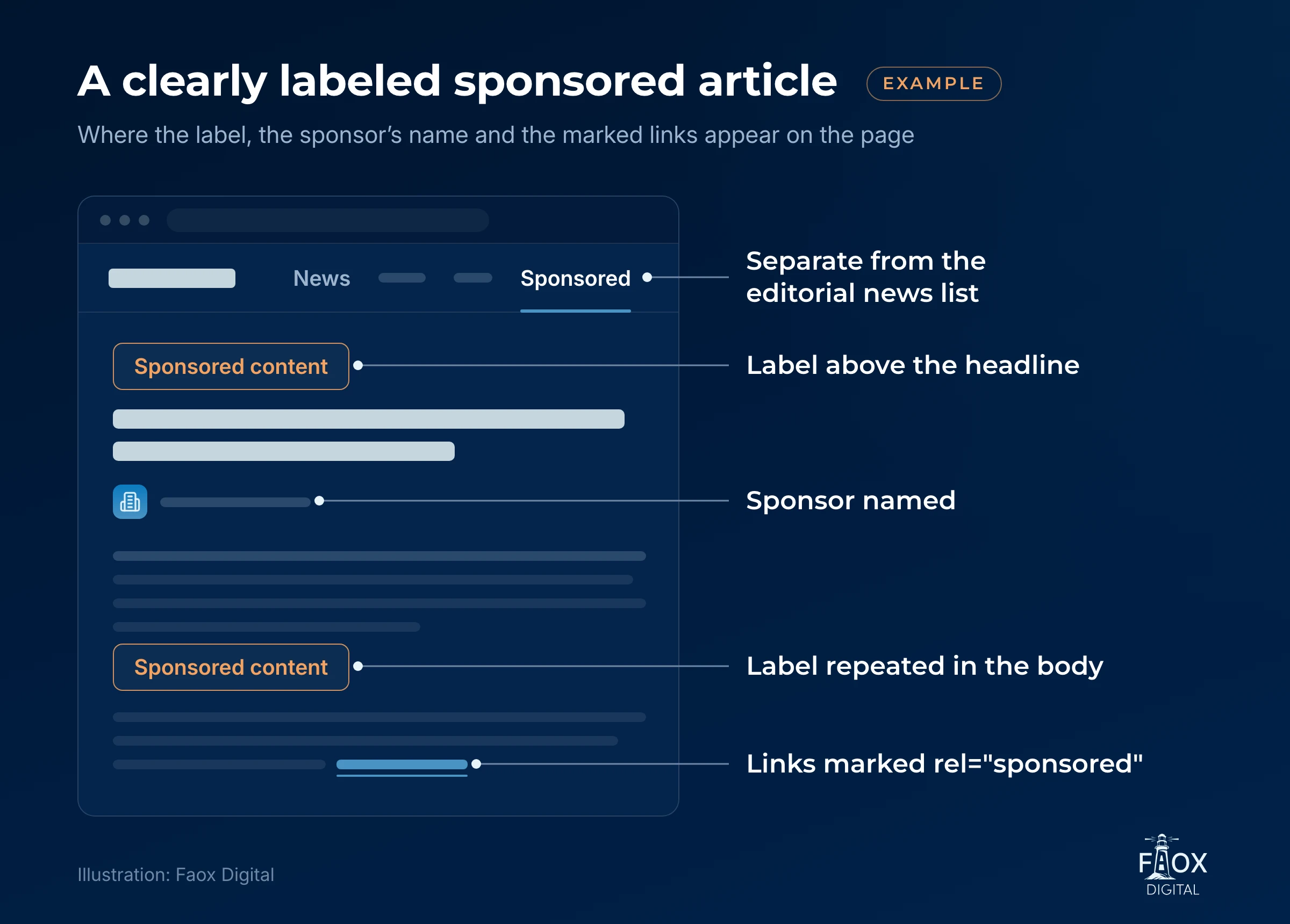
- Use plain label wording. The FTC lists "Ad", "Advertisement", "Paid Advertisement" and "Sponsored Advertising Content" as terms likely to be understood, and warns that "Promoted" is at best ambiguous. Terms such as "Sponsored by [company]" may be read as funding only, not as content shaped by the sponsor.
- Put it where readers look first. The FTC asks for the disclosure in front of or above the headline. The University of Georgia’s eye-tracking experiment found that labels in the middle of the page were noticed more often than those at the top, so repeating the label in the body helps.
- Name the sponsor. Readers should know who paid, not just that someone did.
- Write the label in the reader’s language. A German page needs a German label, a Turkish page a Turkish one.
- Keep it on every copy. The label belongs on the newsletter teaser, the web page, the print page and any share of the article.
- Mark the links. Links in paid placements should carry
rel="sponsored"orrel="nofollow", as explained below.
Our guide to advertorial examples shows how to write and lay out one that readers recognize as paid at first glance.
When sponsored content is the right choice for a B2B company
Sponsored content earns its place when earned coverage cannot do the job:
- You need a set date and a set audience. A launch, a trade fair or a new market where you want to be in front of one publication’s readers at a known time.
- You have a longer story than news. An application guide, test results with their method, or a case study with your customer’s approval, which an editor would not run as news.
- You are new in a market. In a country where editors do not know you yet, a well-made sponsored piece can introduce the company while you build relationships.
- The publication offers distribution you cannot reach otherwise. A newsletter, a webinar audience or a fair supplement aimed at exactly your buyers.
It is the wrong choice when you need the credibility only independent coverage gives, when you mainly want links for search, when the title’s readers are not your buyers, or when the publication is vague about how it labels paid content.
Choosing the publication
Choosing the publication for sponsored content follows the same logic as choosing where to earn coverage, with a few extra questions:
- Readership: do its readers match your buyers by industry, job function and region?
- Labeling practice: look at its existing sponsored pieces. Are they clearly labeled, with the sponsor named, on every page and in the newsletter?
- Separation: does the editorial team stay out of sponsored work, and does the publication keep its news decisions apart from advertising?
- Distribution and data: where will the piece appear, for how long, and what will you learn about who read it?
- Terms: price, deadlines, approval rights, who writes it, and whether you may reuse it.
A clear answer on labeling is a good sign about a publication’s standards. Our guide to partnering with a publication covers how to agree the terms of a longer arrangement.
Making sponsored content worth reading
Readers can skip a sponsored article as easily as an advertisement, so it has to earn their time. Write for the publication’s readers, not for your brochure: explain how to solve a problem they have, share data or test results with the method, or let an engineer explain an application in plain terms. Name the author and their role, keep superlatives out, and end with a useful next step, such as a guide or a data sheet on your website. Sponsored content that teaches something is read; sponsored content that only praises the sponsor is ignored, however well it is labeled.
Sponsored content, search and AI
Paid placements are not a route to search authority. Google’s guidance on qualifying outbound links, updated in December 2025, asks publishers to mark links in advertisements and paid placements with rel="sponsored", with rel="nofollow" still acceptable. Its site reputation policy, last updated in August 2026, addresses third-party content published on a host site mainly to benefit from that site’s ranking signals, so a sponsored article placed only to rank is a risk for the publisher and a poor investment for you.
AI tools rarely cite paid content either. In Muck Rack’s study of AI citations, published in October 2026, paid and advertorial content made up 0.3% of the links AI tools cited in September 2026, while nearly 99% came from non-paid sources. Muck Rack sells PR software, but the direction is clear: credibility in AI answers, as in search, comes from coverage you did not pay for.
Keeping paid and earned separate
Report sponsored content as advertising: what it cost, how many relevant readers it reached, what they did next. Keep it out of your coverage reports, so that the earned coverage your team won is not inflated by placements you paid for. Our guide to tracking press coverage explains what belongs in a coverage report.
Keep the relationships separate too. Never suggest to an editor that an advertising booking should earn editorial coverage, and decline offers that tie the two together. Serious trade publications keep that line, and companies that respect it are easier for editors to work with.
How Faox Digital approaches sponsored content
Faox Digital, a digital growth partner for B2B companies in complex and international markets, treats sponsored content as one option within digital PR, used when earned coverage cannot do the job. Paid placements are arranged only when they make sense, and they are labeled as sponsored, in publications chosen after mapping the market, the buyers and the outlets that matter to them.
Key takeaways
- Sponsored content is paid content in a publication’s format; editorial content and earned media are chosen and written by the publication’s journalists.
- Clear labeling protects reader trust and is required by law or advertising codes in many markets, including the US, the EU, the UK and Türkiye.
- Use plain words such as "Advertisement" or "Sponsored content", place the label before the headline and name the sponsor.
- Choose sponsored content when you need a set audience at a set time or a longer story than news, and keep it separate from earned coverage in your reports.
- Paid placements do not build search authority, and their links should be marked rel="sponsored".
Frequently asked questions
What is sponsored content?
It is content a company pays a publication to publish, in a format that resembles the publication’s own articles, newsletters or videos, with a label that tells readers it is paid. The sponsor pays for it and shapes it, unlike editorial content, which journalists choose and write.
Is sponsored content the same as native advertising?
They overlap. Native advertising is the wider term for paid content that matches the form of the material around it, such as articles, feed items or videos. Sponsored content is one kind of native advertising, usually an article or similar piece published by a media outlet and labeled as paid.
How should sponsored content be disclosed?
With a clear label in plain words, such as "Advertisement" or "Sponsored content", placed before or above the headline and repeated where readers look, naming the sponsor and written in the reader’s language. Links should be marked as sponsored. Rules differ by country, so check them for each market.
Does sponsored content help SEO?
Not through its links. Google asks for links in paid placements to be marked rel="sponsored" or rel="nofollow", and its site reputation policy addresses third-party content placed on a site mainly to borrow its ranking signals. Sponsored content can bring readers to your site, but authority comes from coverage you earn.
Sources
- Federal Trade Commission: Native Advertising, A Guide for Businesses, December 2015
- EUR-Lex: Directive 2005/29/EC (Unfair Commercial Practices Directive), consolidated text, Annex I, point 11, 2022
- University of Georgia, UGA Today: Despite growth, native advertising is still difficult for consumers to recognize, December 2015
- Google Search Central: Qualify your outbound links to Google, updated December 2025
Let’s talk
Have a story worth telling?
Tell us what is new in your business. We will tell you honestly whether it is news and where it could be published.