
Advertorial Examples for B2B: How to Write One That Is Clearly Labeled
How to write an advertorial for a trade publication and label it so readers recognize it as paid at first glance, with a template, fictional examples, label wording, layout, publication rules and measurement.
Good advertorial examples in B2B trade media share three things: a plain label such as "Advertisement" at the top of the page that readers see before the headline, a design that sets the page apart from the magazine’s own articles, and content that teaches the reader something, such as an application guide or test results with their method. Name the company that paid, keep to claims you can prove, and follow the publication’s rules for labels and layout.
A trade magazine offers you two pages in its next issue, "in the style of the magazine". Done well, that is an advertorial: a paid article that readers recognize as advertising at first glance and still read because it is useful. Done badly, it is covert advertising, which costs you and the publication credibility and can break the law in some markets.
This guide explains what advertorial content is, how it differs from editorial content, how to label and lay it out, and gives a template and fictional advertorial examples. For the wider picture of paid placements, start with our guide to clearly labeled sponsored content. The rules below are summaries, not legal advice: check the labeling rules for each market with a lawyer before you publish.
What is advertorial content?
An advertorial is an advertisement written and designed like an article, in a space the company pays for. The word joins "advertisement" and "editorial", and the law uses it too: the EU’s Unfair Commercial Practices Directive calls paid editorial content that does not make its commercial purpose clear an "advertorial" and lists it among the practices that are always unfair.
In a trade magazine, an advertorial usually takes one or two print pages, a sponsored article on the website or a slot in the newsletter. It works when it gives the magazine’s readers something they want anyway, under a label they cannot miss.
Advertorial vs editorial: what changes
Editorial content is the publication’s own journalism. An advertorial borrows its form, but almost everything behind it is different:
| Editorial content | Advertorial | |
|---|---|---|
| Who decides it runs | The editor | The company, within the publisher’s rules |
| Who pays for the space | Nobody | The company |
| Who writes it | The publication’s journalists | The company, its agency or the publisher’s content team |
| Who approves the text | The editor only | The company |
| Label | None | "Advertisement" or similar, at the top |
| Design | The magazine’s own style | Set apart from the editorial pages |
| Links | Ordinary links | Marked as paid with rel="sponsored" |
The approval row matters most: the American Society of Magazine Editors’ guidelines say editorial content should not be submitted to advertisers for approval. If you want to approve the text, you are buying an advertorial, not coverage. If your story is genuine news, a release may earn coverage instead; our guide to writing a press release covers it. If it is an expert view, try the earned route of getting an op-ed published first.
Label it so readers know at first glance
Regulators and publishers agree on the principle and differ on the words. These are the advertisement and sponsored labels you will meet, and how they read:
| Label | How it reads |
|---|---|
| Advertisement, Ad, Paid Advertisement | Clear; listed by the FTC and accepted by the UK’s ASA |
| Advertisement feature, Ad feature | Clear; the UK’s CAP Code names "Advertisement Feature" |
| Special Advertising Section | Recommended by ASME for print sections |
| Sponsored Advertising Content, Sponsor Content, Paid Post | Listed by the FTC or recommended by ASME for online pieces; the UK’s ASA advises against "sponsored" because it is open to varied interpretation |
| Promoted, Sponsored by, Presented by | Ambiguous: readers may take them as endorsement or as funding only, the FTC warns |
| A company logo or name on its own | Not enough without a clear text label, the FTC says |
The plain word "Advertisement", in the reader’s language, is the safest choice. Wording changes recognition: in a University of Georgia study published in 2015, readers were seven times more likely to identify an article as advertising when the label said "advertising" or "sponsored content" than when it said "brand voice" or "presented by".
Position matters as much. The US Federal Trade Commission asks for the disclosure in front of or above the headline, and ASME recommends printing the label horizontally and centered at the top of each advertising unit, in readable type. Put it on every page of a spread, on the web page, on the newsletter teaser and on any page readers reach directly from a link.
Headline and visual layout
The headline and visual layout should tell readers at a glance that this page is different. The UK’s advertising regulator, the ASA, says advertisement features should be designed and presented so that they stand out from the surrounding content, and ASME advises against advertisements that mimic the look and feel of the publication. The FTC adds that the more an ad resembles the publisher’s content in format and topic, the more likely a clear disclosure is needed.
In practice:
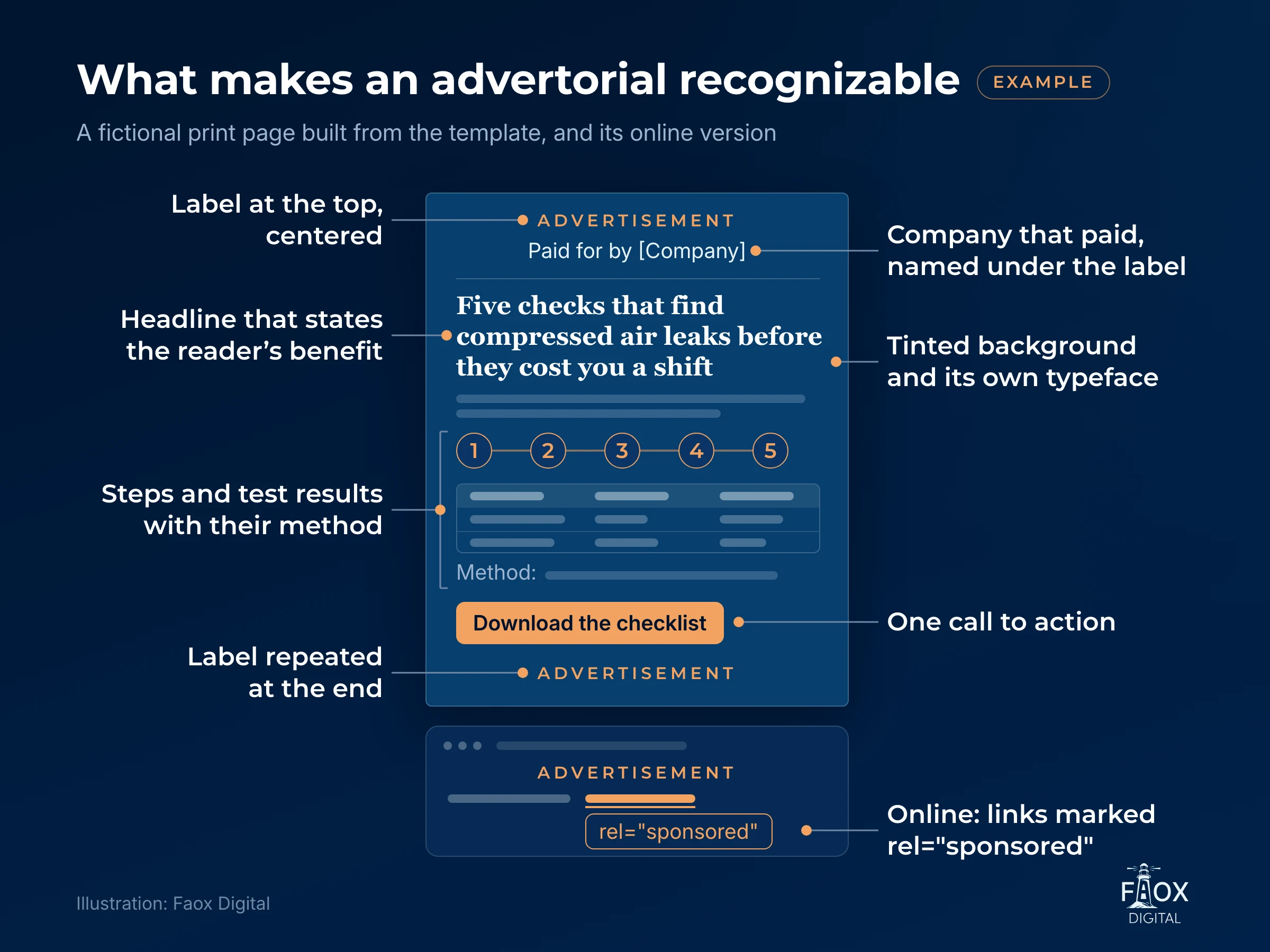
- Use a tinted background, a border or a typeface the magazine does not use for its articles.
- Do not copy the magazine’s section names, author lines or masthead style.
- Name the company that paid in a line under the label.
- Write a headline that states the reader’s benefit, not a slogan.
- Give every image a caption and a credit.
Lead with reader benefit
Reader benefit decides whether anyone reads past the label. A plant engineer turns the page for something useful: how to solve a problem, what a test showed, what another plant learned. So build the advertorial around one of these, and keep the company’s history to a closing line.
Keep every claim provable. Use test results with their method, figures with their source and customer stories only with the customer’s written approval. The rules can be strict: in Türkiye, Article 61 of Consumer Protection Law No. 6502 obliges advertisers to prove the claims in their advertisements.
An advertorial template
This advertorial template follows the order readers meet the page. The examples are fictional, for a hypothetical compressor maker, with placeholders in square brackets:
| Part | What it does | Example |
|---|---|---|
| Label | Says the page is paid | ADVERTISEMENT |
| Company line | Names who paid | Paid for by [Company] |
| Headline | States the benefit | Five checks that find compressed air leaks before they cost you a shift |
| Standfirst | Says what the reader will learn | A maintenance routine any plant can run in one morning, with the figures from [number] audits |
| Body | Teaches, step by step | The five checks, the tools for each and what the audits found, with the method |
| Images | Show the real work | A technician with an ultrasonic leak detector, captioned and credited |
| Call to action | Offers one next step | Download the checklist at [address] |
| Closing line | Repeats the label | This article was paid for by [Company] |
Advertorial examples for B2B
These three advertorial examples are fictional and labeled as examples. Each would run under the label "Advertisement" and a line naming the company:
| Type | Example headline (fictional) | Why it works |
|---|---|---|
| Application guide | How to size a heat exchanger for a dairy plant that cleans in place | Teaches a task the reader faces, with the company’s know-how inside it |
| Customer case | How [Customer] cut changeover time on its filling lines by [figure] | A real result, published with the customer’s approval and its method |
| Test data | What [number] pump audits show about energy use in food plants | Original data the reader cannot find elsewhere, with the method stated |
A weak version of the same idea: "[Company]: [number] years of excellence in heat transfer". It tells the reader nothing, and the label will make it look even more like an advertisement.
Publication rules to check before you sign
Every publication sets its own publication rules for paid content. Ask for them in writing, and check:
- The label wording and where it appears in print, online and in the newsletter
- How the advertorial page will look different from the editorial pages
- Who writes the text, who approves it, and that the editorial team stays out of it
- Length, image formats and the closing date in the media kit
- How links are marked and how long the online version stays up
- Whether you may reuse the piece on your own website
- What data you will receive afterwards
Outside your home market, use the label and language of that market and check its rules with a local lawyer. Choosing titles abroad follows the same research as international media outreach.
Covert advertising: what to avoid
Covert advertising is paid promotion presented as if it were the publication’s own reporting. It is prohibited in many markets. Türkiye’s Law No. 6502 treats promotional content in articles, news, broadcasts and programs that is not clearly identified as advertising as covert advertising, prohibits it in every medium and binds advertisers, agencies and media organizations alike. In the United States, federal law (18 U.S.C. § 1734) requires editors and publishers of periodicals mailed in the second class, now called Periodicals, to mark paid reading matter "advertisement". Several of these rules come from consumer protection law, and how they apply to B2B media is a question for your lawyer.
Avoid the offers that blur the line: an "interview" or "profile" sold together with an advertising booking, paid text without a label, or a label so small or so far down the page that readers miss it.
Measurement: treat it as advertising
Measurement of an advertorial belongs with your advertising, not with earned coverage. Agree before booking what the publication will report, such as views and reading time online, newsletter clicks and audited print circulation. Tag every link with campaign parameters: Google Analytics reads utm_source, utm_medium and utm_campaign, and utm_content tells two calls to action apart in the Traffic acquisition report. Then count what matters: downloads, enquiries and the sales conversations that follow. Mark the links themselves as paid, too: Google asks for rel="sponsored" on advertisements and paid placements.
If one advertorial works, the next question is a longer arrangement with the same title; our guide to media partnerships covers choosing a publication and setting terms.
How Faox Digital handles advertorials
Faox Digital, a digital growth partner for B2B companies in complex and international markets, arranges paid placements such as advertorials only when they make sense, and always clearly labeled as paid. The publication is chosen after mapping the market, the buyers and the outlets and writers who matter to them, and what one placement brings shapes the decision on the next.
Key takeaways
- An advertorial is a paid article, and readers should see that at first glance, from a label at the top and a design that differs from the editorial pages.
- Plain words work best: "Advertisement" or "Advertisement feature"; "Sponsored by" or "Presented by" can read as funding only.
- Write for the reader: an application guide, test data with its method or an approved customer case, not a company profile.
- Check the publication’s rules on labels, layout, approval, links and reuse before you sign, and the law in each market with a lawyer.
- Measure it as advertising, with tagged links and enquiries, and keep it apart from earned coverage.
Frequently asked questions
What are some advertorial examples in B2B?
An application guide paid for by an equipment maker, a customer case published with the customer’s approval, or test results with their method, each labeled as advertising and designed apart from the magazine’s own pages. The fictional examples above show how each can be framed.
Is an advertorial an advertisement?
Yes. It reads like an article, but it is an advertisement, and that is why it needs a clear label. The EU’s Unfair Commercial Practices Directive treats unlabeled paid editorial content as always unfair, and US federal law requires paid reading matter in periodicals mailed in the Periodicals class to be marked "advertisement".
How do you place an advertorial in a newspaper or trade magazine?
Ask the publication’s advertising team for its media kit and its rules for paid content, choose the issue, page or newsletter that reaches your buyers, and agree the label, layout, approval and closing date in writing. Then deliver the text and images on time, and check the proof for the label before it goes to print.
Sources
- Federal Trade Commission: Native Advertising, A Guide for Businesses, 2015
- ASA and CAP: Recognising ads, Advertisement features, 2023
- American Society of Magazine Editors: ASME Guidelines for Editors and Publishers, 2015
- EUR-Lex: Unfair Commercial Practices Directive, consolidated text, Annex I, point 11, 2022
Let’s talk
Have a story worth telling?
Tell us what is new in your business. We will tell you honestly whether it is news and where it could be published.