
How to Pitch Journalists: A B2B Guide to Story Pitches Editors Can Use
How a B2B company pitches a story to a journalist or trade editor, from research and the subject line to exclusives, embargoes, the press kit, timing and follow-up, with a labeled example pitch.

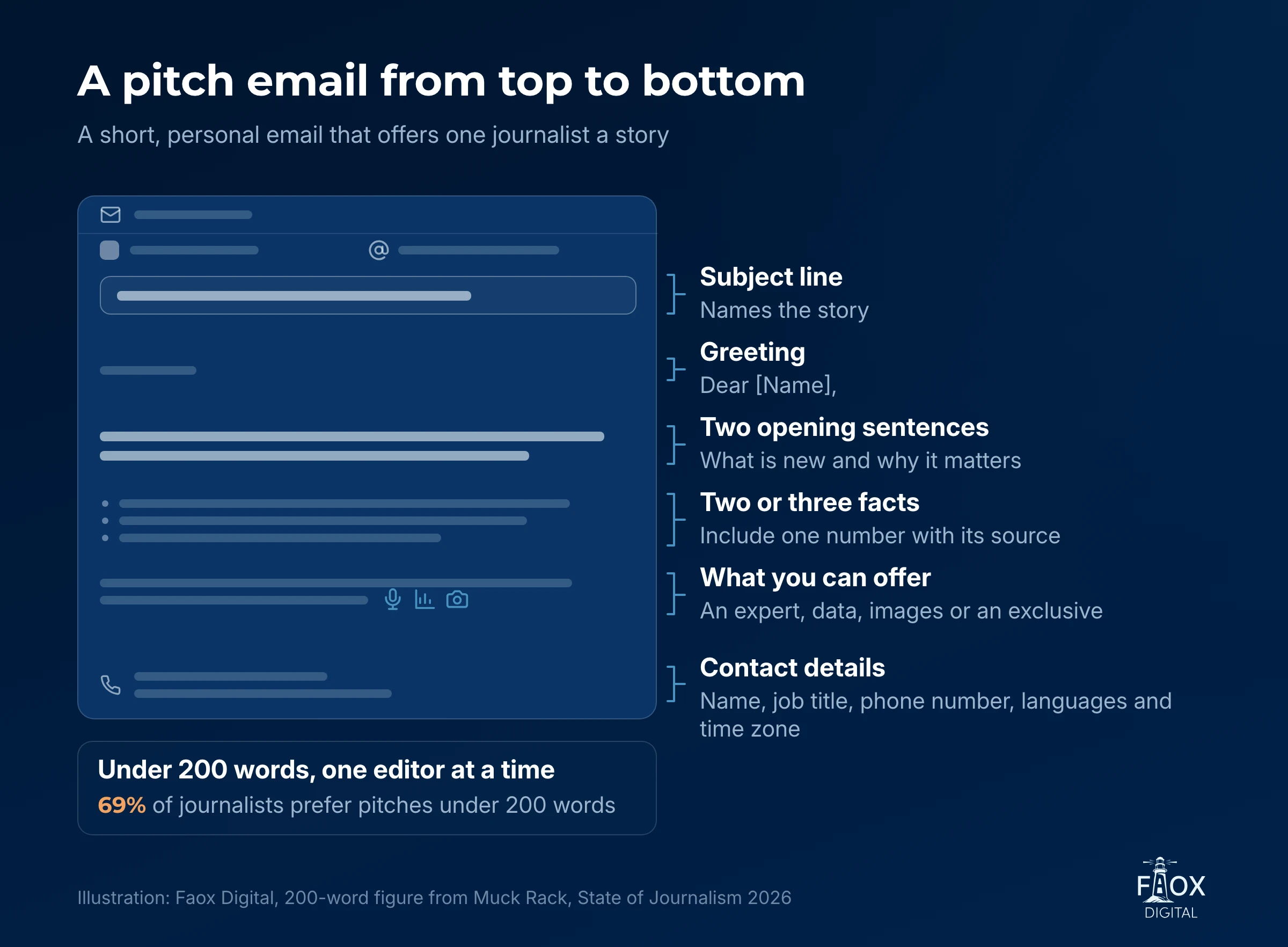
Knowing how to pitch journalists starts with their readers. Write to one editor at a time in a short, personal email: a subject line that names the story, two opening sentences on what is new and why it matters to that publication’s readers, the key facts, and what you can offer, such as an expert, data, images or an exclusive. Send it in time for the publication’s schedule and follow up once, a few days later, with something useful.
Editors receive far more pitches than they can use. In Cision’s 2026 State of the Media survey of 1,899 journalists, most said they get 50 or more pitches a week, and 72% said fewer than a quarter of them are relevant. Pitches still work when they fit: in Muck Rack’s 2026 State of Journalism survey of 897 journalists, 86% said at least some of their published stories started with one. Both companies sell PR software, and Muck Rack’s respondents mostly work in the US, so read the figures as a guide to editors’ habits rather than as rules.
This guide shows how to pitch a story to a journalist or trade editor as a B2B company: the research, the pitch itself with a labeled example, exclusives and embargoes, the press kit, timing and follow-up. Our media relations guide covers the longer relationship with editors around it.
What is a pitch?
A pitch is a short, personal email that offers one journalist a story and explains why it suits their readers. It is not a press release. The release is the document with the facts, written as a news story any editor can use; the pitch is the note to one person that says why the story matters to their publication, with the release below it or linked. Many stories need no release at all: an expert comment, a data story or an interview offer can be pitched on its own.
Research the journalist before you write
Many pitches fail because they go to the wrong person. In Muck Rack’s 2026 survey, 88% of journalists said they immediately delete a pitch that is irrelevant to their coverage.
Journalist research starts with the editor’s beat, the subjects a journalist covers for their publication, and then turns to the person:
- Read their recent articles and note the angle they take and the sources they quote.
- Check the masthead or staff page; at a trade magazine, news, products and features often go to different editors.
- Read the publication’s submission guidelines and editorial calendar. Control Design’s guidelines, for example, invite companies to name the calendar topics they want to take part in.
- Look at their LinkedIn profile. In Cision’s 2026 survey, 62% of journalists said they use LinkedIn for their work, more than any other platform.
- Note their language and time zone. Editors abroad need their own list, as our guide to international media outreach explains.
Then test the story itself: does it change something for this editor’s readers, now? Our article on what makes a story newsworthy sets out the criteria editors use.
How to pitch journalists, step by step
These steps show how to pitch stories to journalists at trade and business publications:
- Choose one editor and one angle. The same news may need one angle for a plant engineering title and another for a business paper. Write each pitch for one person.
- Open with the news and why it matters. The first two sentences say what is new and what it changes for that publication’s readers.
- Give two or three facts. Include one number with its source, such as a test result or a delivery date, and leave out adjectives: 71% of journalists in Muck Rack’s 2026 survey delete pitches that are overly promotional.
- Say what you can offer. In the same survey, 58% wanted interview access to relevant sources, 40% original data or research and 37% high-resolution images.
- Close with your contact details. Name, job title, phone number, languages and time zone, so the editor can reach you before their deadline.
- Keep it short, then write the subject line. Muck Rack’s 2026 report, summing up eight years of its surveys, says 69% of journalists prefer pitches under 200 words and 62% prefer one-to-one email.
Write a subject line that names the story
The subject line decides whether the email is opened. Write it last, when you know the story, and make it say what the story is, not that you have one. Keep it short enough to read on a phone, and avoid all capitals, exclamation marks and labels such as "exclusive" unless they are true.
| Weak | Better | Why |
|---|---|---|
| Press release from [Company] | Field data: oversized pumps in [number] dairy plants | Names the story |
| Exciting news! | [Company] opens pump test center in [city] | Facts, not adjectives |
| Story idea | Expert for your [month] feature on energy audits | Fits the editorial calendar |
| Following up | Audit chart and photos for the pump story | The follow-up adds something |
A journalism pitch example
This example is fictional: a hypothetical pump maker pitches a data story to the editor who covers fluid handling at a process engineering magazine. Names, dates and figures are placeholders in square brackets.
| Part | Example |
|---|---|
| Subject line | Field data: oversized pumps in [number] dairy plants |
| Greeting | Dear [Name], |
| Why their readers care | Your [month] article on energy audits asked where food plants can still save quickly. Our engineers found one: in [number] dairy plants we audited, [share] of the pumps were larger than their duty required. |
| Key facts | The audits ran from [month] to [month] in [countries]. An oversized pump used on average [figure] more energy than a correctly sized one. We can share the anonymized data and the method. |
| Offer | [Name], our head of application engineering, can explain how plants can check their own pumps. We also have photos from two audits and a chart. |
| Exclusive | We are offering the data to [Publication] first and will hold it for you until [date]. |
| Contact | [Name], [job title], [Company], [phone], [time zone] |
Note what is missing: no company history, no adjectives and no attachment the editor has to open to understand the story.
Personalize without a template
Personalization means the pitch could only have been written to this editor. The name is the least of it: refer to something they wrote, say what their readers gain, and use their publication’s terms. Shortcuts are punished: in Muck Rack’s 2026 survey, 50% of journalists said they delete a pitch that looks like a mass email, and 35% one sent to the wrong name or outlet.
Trade editors are stricter still, because their readers are specialists. MoldMaking Technology’s press release guidelines, published in 2018, warn that generic, one-size-fits-all submissions fail to show moldmakers why a product suits their processes. AI tools can help with research and checking, but a generic draft shows: in Cision’s 2026 survey, 53% of journalists said they oppose AI-generated pitches, citing accuracy and personalization.
Exclusives and embargoes
An exclusive offers a story to one publication first. Choose the title whose readers matter most, say how long you will hold the story, and pitch the next title only when the first declines or the time runs out. Never offer the same exclusive to two editors. A journalist quoted in Muck Rack’s 2026 report put it in one line: "Don’t pitch widely; pitch selectively, and then widen as needed."
An embargo gives several journalists the news early, on the condition that they do not publish before a stated date, time and time zone. It is an agreement, not a law, so ask before you send embargoed details and send them only to journalists who accept. Not every title takes them: Control Design’s submission guidelines, published in 2025, state that it does not accept embargoed news.
Both are worth offering when they are real. In Muck Rack’s 2026 survey, 33% of journalists named exclusive or embargoed content among what a pitch should offer, and in Cision’s, 45% wanted embargoed or early-access information.
The press kit and visual material
Editors decide faster when the material is ready to use, and Cision’s release on its 2026 report lists ready-to-use assets among what works. Keep a press kit in your online newsroom: the company description, key facts, spokespeople’s bios and photos, product images and recent releases.
For visual material, send photos of the real thing: the product in use, the plant, the test, the people who did the work. Give each one a caption, a credit and the right to publish. Then follow each title’s rules, because they differ: Control Design asks for photos as separate attachments, no PDF files and no links to information that must be downloaded or accessed on a website. Where a title sets no rule, a link to an image folder keeps the email small.
When to send a pitch
Timing depends on how the publication works. A news site can publish the same day, while a monthly trade magazine plans its issues months ahead: Modern Machine Shop’s guidelines, last updated in 2021, ask for story ideas about six months before the issue and set editorial deadlines three months ahead. Pitch features and data stories early, and news once it is final and approved.
On the day, the hour matters more than the weekday. Muck Rack’s eight-year summary says 78% of journalists want pitches before noon, while 50% do not mind which day. For editors abroad, that means noon in their time zone. Avoid public holidays and the day an issue closes. Trade fairs need their own calendar, because show issues close weeks before the doors open; our article on trade show press releases gives the timing for each stage.
Follow up once, with something new
A follow-up email is a short second message to an editor who has not replied. Muck Rack’s eight-year summary says 50% of journalists consider one follow-up ideal, and 51% want it three to seven days after the pitch. Add something useful in two or three sentences, such as the audit chart, a new data point or a time when your expert is free.
Then stop. Silence is common, since 54% of journalists in Muck Rack’s 2026 survey said they seldom or never respond to pitches, and it usually means the story does not fit now, not that the editor will never read you again. If you offered an exclusive, tell the editor when you plan to offer the story elsewhere.
Track what your pitches bring
Keep a log of every pitch: the editor, the angle, the date, the reply and the result. After a few months it shows which angles and titles work. Count the stories that ran, check that they carry your facts correctly and link to the right page, and compare your presence in your key titles with your competitors’; our guide to the share of voice formula shows how. Expect the results to build slowly, as our article on the first 90 days of PR explains.
The next question is which publications deserve your pitches at all. Our guide to B2B trade media shows how to judge readership, reach and fit.
How Faox Digital pitches trade editors
Faox Digital, a digital growth partner for B2B companies in complex and international markets, pitches trade and business editors directly, writing each pitch for its outlet and its readers. We first map the publications and writers a company’s buyers read and look for what is genuinely newsworthy; outreach abroad happens in each market’s own language, with no bulk sends and no bought lists. What lands in one round shapes the next.
Key takeaways
- A pitch is a short, personal email that tells one editor why a story matters to their readers; the press release is the document with the facts.
- Research the editor’s beat, recent work, guidelines and calendar first, because irrelevance is the main reason pitches are deleted.
- Lead with the news and what it changes for the readers, give two or three facts, offer an expert, data or images, and stay under 200 words.
- Offer exclusives and embargoes only when they are real, and check that the title accepts them.
- Pitch to the publication’s schedule, before noon in the editor’s time zone, and follow up once with something new.
Frequently asked questions
How do you pitch a story to a journalist?
Find the journalist who covers your subject, read their recent work and send a short personal email: a subject line that names the story, two sentences on what is new and why their readers should care, the key facts and what you can offer. If you hear nothing, follow up once, three to seven days later.
What is an example of a good journalism pitch?
It reads like a note from one professional to another. It opens with something the editor’s readers need, gives the facts behind the story, offers an expert, data or images, and ends with contact details, all in under 200 words. The example above shows each part for a fictional data story.
Should you pitch journalists by email, phone or social media?
Email is the default: Muck Rack’s 2026 report, summing up eight years of surveys, says 62% of journalists prefer one-to-one email. Call only when you know the editor or the news cannot wait. LinkedIn helps with research and with keeping in touch.
Sources
Let’s talk
Have a story worth telling?
Tell us what is new in your business. We will tell you honestly whether it is news and where it could be published.