
How Long Does PR Take? The First 90 Days, Step by Step
What happens in each month of the first 90 days of B2B PR, from discovery and the media list to the first press release, pitches and editor replies, when coverage can appear, why no agency can promise it, and how PR continues after the first quarter.

How long does PR take? In a typical first 90 days, the first month goes into discovery, key messages and a media list, the second into the first press release and pitches to editors, and the third into follow-up, first results and a plan for what comes next. Online news can follow within weeks when you have real news, but monthly trade magazines plan issues months ahead, and steady coverage takes several months of regular work; no agency can promise when, or whether, an editor publishes.
"How long does PR take?" is one of the first questions a company asks before it starts, and the honest answer depends on what you have to say, who you want to reach and how often you can say it. This guide walks through the first 90 days of a B2B PR program month by month: what the work is, what you need to provide, when coverage can appear and what nobody can promise. If you are new to PR, our guide to what a PR agency does explains the role and its limits.
How long does PR take to show results?
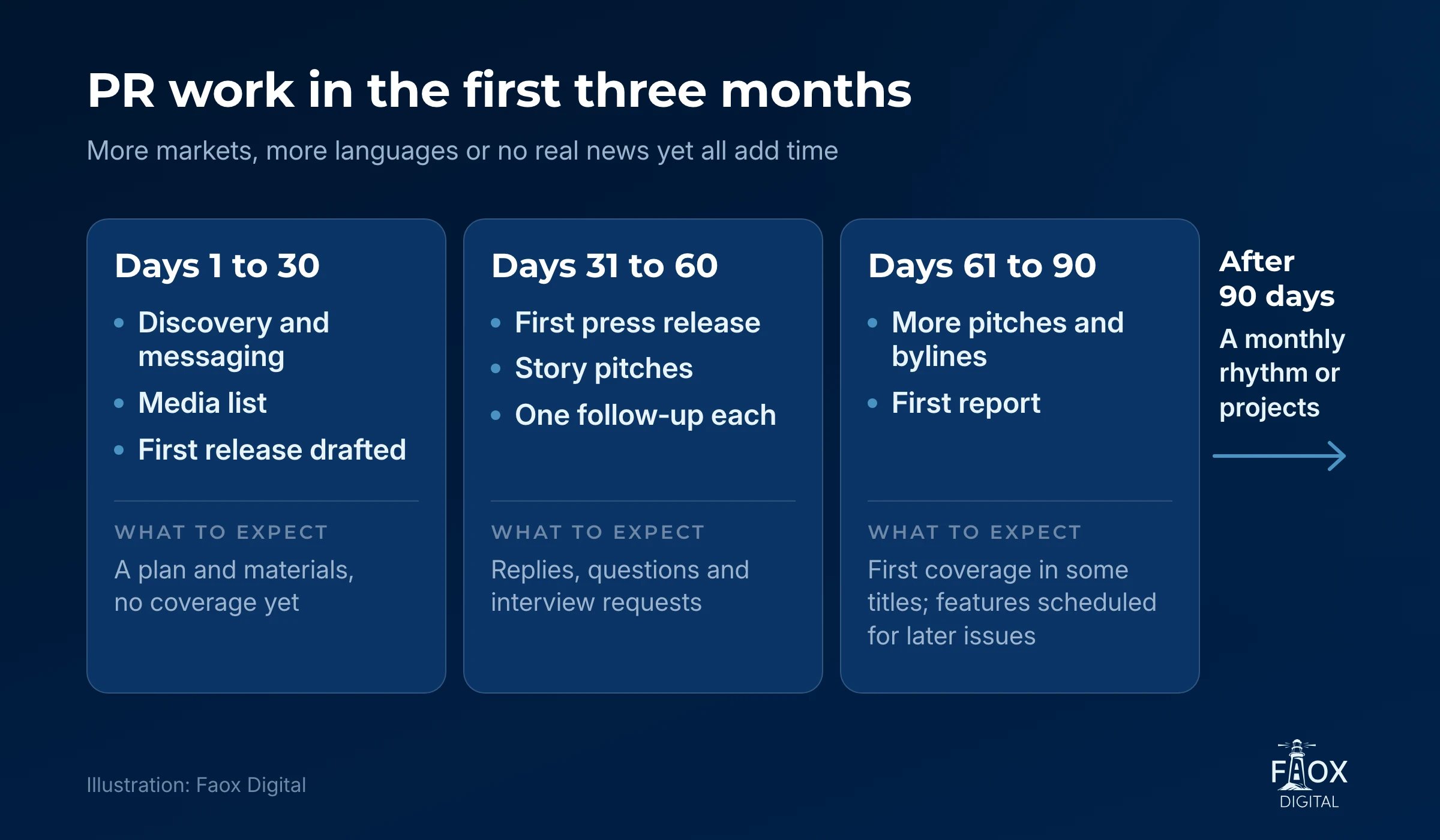
Every program is different, but the first quarter follows the same order: preparation, outreach, then first results. The table is our planning outline for a company starting with one market; more markets, more languages or no real news yet all add time.
| Period | Main work | What you provide | What to expect |
|---|---|---|---|
| Days 1 to 30 | Discovery and messaging, media list, first release drafted | Interviews, facts, photos, approvals | A plan and materials, no coverage yet |
| Days 31 to 60 | First press release, story pitches, one follow-up each | Spokespeople available, quick approvals | Replies, questions and interview requests |
| Days 61 to 90 | More pitches and bylines, first report | The next stories, data and events | First coverage in some titles; features scheduled for later issues |
| After 90 days | A monthly rhythm or projects | A steady flow of news and expertise | Coverage that builds over several months |
Days 1 to 30: discovery and messaging
The first month is discovery and messaging: interviews with management, sales and engineers to find what is genuinely newsworthy, two or three key messages, the people who will speak for the company, and a look at past coverage. It is also when the working arrangements are set, as in any case of working with a marketing agency: who approves what, and how quickly.
The media list is built in the same weeks: the titles your buyers read, the editors who cover your field, and their deadlines and rules, with a separate list for each country, as our guide to market-by-market media lists explains. Have these ready in the first two weeks:
- Company facts, product information and recent photos
- Two or three spokespeople, and their availability
- Upcoming news: launches, trade fairs, contracts or results you can share
- Data or field experience that could support a byline
- Who approves releases and quotes, and how fast
- Past coverage and the editors you already know
Days 31 to 60: the first press release and story pitches
The first press release goes out when there is real news: a launch, an investment, a contract you may name or a trade fair. A fair is often the easiest first story, and our event press release examples show what to send before, during and after one. Alongside it, the story pitch offers individual editors a story written for their readers, as our guide on how to pitch journalists explains.
Expect more silence than replies. In Muck Rack’s State of Journalism 2026, a survey of 1,044 journalists with 897 responses analyzed, mostly in the US, 86% said PR pitches inspire at least some of their stories, yet 54% said they seldom or never respond to them. Muck Rack’s summary of eight years of its journalist surveys adds that 50% consider one follow-up ideal and 51% want it within three to seven days. Muck Rack sells PR software, but the lesson holds: silence is normal, and one polite follow-up is enough.
Editor replies and the editorial decision
An editor reply can be a question, a request for data or images, an interview slot or a polite no. Response times vary by title: IndustryWeek says it typically answers unsolicited pitches within two to four weeks, and Manufacturing Dive contacts the authors of opinion pieces within three weeks, and only if it accepts them. After acceptance, publication can take longer still: T&D World aims to publish contributed articles within six to eight weeks of receiving them, once the author agreement is signed.
Throughout, the editorial decision stays with the editor: whether the story runs, when, at what length, under which headline and with which quotes. Your work shapes the odds; it never makes the decision.
Days 61 to 90: first coverage and the first report
By the third month, the first results can show: news items online, a quote in someone else’s story, an interview, a byline accepted for a later issue. Print features take longest. Modern Machine Shop’s guidelines, for example, set editorial deadlines three months before the issue date and ask for story ideas about six months ahead, so a feature agreed in month two may appear well after day 90.
End the quarter with a short report: what was sent, who replied, what ran, what is scheduled and what to change for the next round.
What makes PR faster or slower
The outline above stretches or shrinks with a few factors that are partly in your hands:
- Real news: a launch, an investment, a contract you may name or new data moves faster than a company profile.
- Approvals: a release that waits two weeks for sign-off can miss the moment it was written for.
- Spokespeople: editors need someone who can talk when they call, not next month.
- Markets and languages: each market needs its own media list, materials in its language and its own editor contacts.
- Publication schedules: monthly titles and trade fair issues close months before they appear.
Why no agency can promise coverage
There is no promise of coverage in honest PR, because the agency does not decide what is published. Editors do, for their readers, and paying them for a story would turn it into advertising. What an agency can commit to is the work: a real story, the right media list, materials written for each outlet, and outreach and follow-up done properly.
The profession’s own codes say the same. The Global Alliance for Public Relations and Communication Management, whose code was updated in 2018 and formally adopted by its General Assembly in May 2026, lists expertise without promising results beyond one’s capacity among its principles, and asks members to define what PR can and cannot accomplish and to "manage expectations, targets, and contracts accordingly". An offer of a fixed number of articles usually means paid space or a distribution network, not coverage an editor chose.
Managing expectations in the first quarter
Managing expectations starts before the contract: agree what progress looks like in each month, not only the coverage you hope for. Useful signs in the first quarter are concrete: the media list approved, the first release out, replies from editors, interview requests, a byline accepted, the first stories online. Judge the first quarter by these signs, and judge the program over several quarters by coverage in the titles that matter and what it leads to.
After 90 days: a monthly rhythm or project-based work
After the first quarter, PR continues in one of two ways. A monthly rhythm keeps a steady flow of news, pitches and bylines, builds relationships with editors and makes it possible to plan around editorial calendars and trade fairs months ahead. Those relationships count: in the same Muck Rack survey, 53% of journalists said relationships with PR professionals are important or very important to their success. Project-based work suits a single launch, a fair or a market entry, with a clear start and end; it can work well, but the attention it earns fades unless something follows.
With a small budget, you can run the basics yourself: a media list, a release when there is real news, and a few well-researched pitches each quarter. When you compare outside help, our guide to what PR agencies charge explains how monthly, project and hourly fees work.
How Faox Digital runs the first months of PR
Faox Digital, a digital growth partner for B2B companies in complex and international markets, runs digital PR in five steps: map the field, find the story, build the materials, reach out to editors directly and measure what landed, so that each round feeds the next. We suggest a first step that fits the company’s budget and stage, even if that means doing some of the work in-house.
Key takeaways
- The first 90 days follow one order: discovery and a media list, then the first release and pitches, then replies and first results.
- Online news can follow within weeks of real news; monthly print titles plan issues months ahead.
- Most pitches get no reply; one follow-up within about a week is enough.
- No agency decides what is published, so no honest agency promises coverage; it commits to the work.
- After the first quarter, a monthly rhythm builds steady coverage, while projects suit single launches and fairs.
Frequently asked questions
How long does PR take to work?
Expect a month of preparation, then outreach, with first results possible in the second or third month if you have real news. Coverage that builds into a steady presence takes several months of regular work, and features in monthly titles are planned months ahead.
Can a PR agency guarantee coverage?
No. Editors decide what they publish, when and how, so an agency can only commit to the work: a real story, the right media list and outreach done properly. A promise of a fixed number of articles usually means paid space or a distribution network.
What should happen in the first month of PR?
Discovery and messaging: interviews to find what is newsworthy, two or three key messages, chosen spokespeople, a media list for each market and the first release drafted. You provide the facts, photos, people and approvals.
Is PR better as a monthly service or a one-off project?
A monthly rhythm suits companies with a steady flow of news and expertise, because relationships and editorial calendars reward continuity. A project suits a single launch, fair or market entry, but its effect fades unless something follows.
Sources
- Muck Rack: State of Journalism 2026, 2026
- Global Alliance for Public Relations and Communication Management: Ethics guidelines, accessed November 2026
- Modern Machine Shop: Editorial submission guidelines, updated January 2021
- IndustryWeek: Contributors’ Guidelines, updated June 2026
Let’s talk
Have a story worth telling?
Tell us what is new in your business. We will tell you honestly whether it is news and where it could be published.