
Media Relations for B2B Companies: Working With Journalists and Editors
What media relations is, where it sits in public relations and digital PR, who decides what the media publishes, and how a B2B company builds lasting, trust-based relationships with journalists and editors.

Media relations is the part of public relations that deals with journalists and editors: offering them stories, facts and experts they can use, answering their questions quickly and honestly, and keeping in touch between stories. In digital PR it is the main route to earned media, the coverage you do not pay for because an editor chose to publish it. A B2B company builds trust with editors by being relevant to their readers, accurate, available and patient, one useful story at a time.
In Muck Rack’s 2026 State of Journalism survey of 897 journalists, 54% said they seldom or never respond to PR pitches. Yet 86% of the same journalists said at least some of their published stories started with one. Muck Rack sells PR software and most respondents work in the US, but the logic is not tied to one market: editors answer the people who have sent them useful stories before, who know what their readers care about and who pick up the phone when a deadline is close.
This guide explains what media relations is, how it differs from public relations and where it sits in digital PR, then shows how a B2B company builds a working relationship with the journalists, editors and reporters its buyers read. It opens our series on media relationships; you can find all Digital PR articles on the category page.
What is media relations?
Media relations is the work of building and keeping relationships with the people who decide what the media publishes: journalists, editors, reporters and producers. It is the part of public relations aimed at the press, rather than at employees, neighbors, investors or customers directly.
In practice, media relations covers:
- Offering stories to the publications whose readers care about them, through a pitch or a press release
- Answering journalists’ questions and requests for information, quickly and accurately
- Preparing spokespeople, the people who speak for the company
- Keeping a press kit and an online newsroom that give editors facts and images
- Correcting errors, and keeping in touch between stories
The US Bureau of Labor Statistics describes the same core in its handbook entry for public relations specialists: writing press releases, responding to information requests from the media and arranging interviews for executives. It also draws the line that matters most: PR specialists get their stories covered by the media instead of buying advertising space.
Media relations vs public relations
Public relations is the wider discipline. The Public Relations Society of America defines it as a strategic communication process that builds mutually beneficial relationships between organizations and their publics. Those publics include customers, employees, neighbors, regulators and investors. The media is one of them, and an influential one, because journalists reach all the others.
So media relations is a part of public relations, not another name for it. A company can run events, a newsletter and a LinkedIn page without speaking to a single journalist. And media relations without the rest of PR soon runs dry, because editors need news, and news comes from what the company does.
| Public relations | Media relations | Digital PR | Advertising and sponsored content | |
|---|---|---|---|---|
| Aim | Relationships with every public that matters | Coverage and trust with journalists and editors | Earned coverage and mentions online, with search and AI tools in mind | Reach on terms you control |
| Who decides what appears | Depends on the channel | The editor | The editor or site owner | You, within the publisher’s rules |
| What it costs | A mix of time and spending | Time and expertise | Time and expertise | You pay for the space |
| Labeling | Not needed | Not needed | Not needed | Must be labeled as paid |
Media relations, digital PR and earned media
Earned media is coverage you neither own nor pay for: a story, an interview, a quote or a mention that exists because a journalist decided it was worth publishing. Your website, online newsroom and newsletter are owned media; advertising and sponsored articles are paid media. Media relations is the craft that produces earned media.
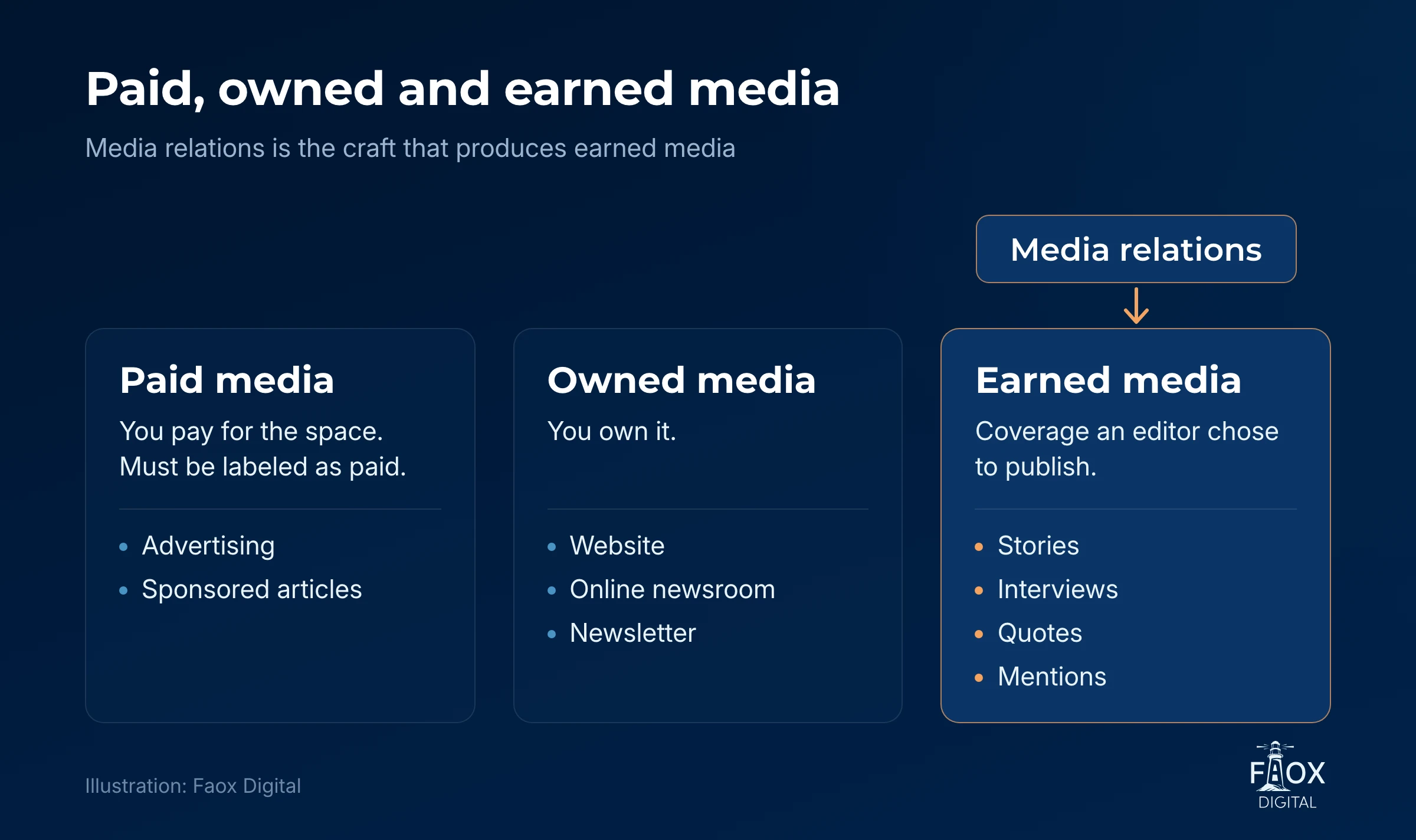
Digital PR applies the same craft to online coverage and follows what happens next: whether a story links to the right page, shows up in search and is picked up by AI tools. A story in a trade magazine’s online edition can bring readers, a link and a mention at once, and our article on turning coverage into links explains the link side.
Coverage also shapes how AI tools describe companies. In Muck Rack’s study of AI citations, published in October 2026, journalism accounted for 22% of the sources AI tools cited in September 2026, down from 27% in May. Our guide to generative engine optimization explains how AI tools choose their sources and what a company can prepare.
Journalists, editors and reporters: who decides what runs
Newsrooms differ, but the roles repeat:
| Role | What they do | What they need from you |
|---|---|---|
| Editor-in-chief | Sets the publication’s direction and agenda | Rarely your first contact; respect for their decisions |
| Section or news editor | Chooses and assigns stories, plans issues | Relevant news, early, with facts and images |
| Reporter or staff journalist | Researches and writes stories | Quick answers, data and access to experts |
| Freelance journalist | Writes for several titles and pitches ideas to their editors | Story ideas an editor will buy |
| Technical editor at a trade magazine | Covers products and engineering in depth | Precise data, test results and an engineer to talk to |
Journalists have more say over their work than many companies assume. In Muck Rack’s 2026 survey, 40% said they pitch and choose their own stories and 55% said it is a mix of pitching and assignments; only 3% said their editor or manager assigns all their stories. That is why the relationship is with a person, not with a masthead.
For most B2B companies, the most important people work at trade magazines and their websites and newsletters: the titles that cover your industry and your customers’ industries. A national business paper may matter for an investment or a new plant, but week to week, the technical and trade press is where buyers read about suppliers.
Why third-party credibility matters in B2B
Third-party credibility is the weight a claim gains when someone independent makes it. Your website says your valves are reliable; a trade magazine that reports your test results says it with the authority of an editor who could have ignored you. Our article on why people trust others explains the evidence behind that instinct.
B2B buyers look for the independent view. In the 2026 State of Marketing to Engineers survey by GlobalSpec and TREW Marketing, 76% of 783 technical buyers said they routinely research work-related purchases in online technical publications, slightly more than the 74% who use supplier websites. The editors of those publications shape what your buyers read about your market, and that is why the relationship with them is worth years of patience.
What journalists and editors need from you
Relevance comes first, and it means more than matching a beat. In Muck Rack’s 2026 survey, 78% of journalists said a pitch feels genuinely relevant when it directly affects the community their audience belongs to. For a trade magazine, that community is an industry: plant managers, design engineers, the buyers of a component.
Beyond relevance, editors need:
- Accuracy: facts, figures and names that hold up, with sources they can check
- Speed: answers within their deadline, not after it
- Access: an expert who can explain the subject and is available for a call
- Evidence and images: data, test results, photos and drawings they can publish
- Honesty: a clear "we cannot say yet" rather than a vague answer that wastes their time
- Respect for their independence: they decide what to write, and how
Ways to work with journalists
Media relations is more than sending news. These are the main formats, and when each one fits:
| Format | When it fits | What you provide |
|---|---|---|
| News story | A launch, an investment, a certification or a new market | A pitch and a press release with facts and images |
| Interview or profile | A spokesperson with a view on the industry | Access to the person and background facts |
| Expert comment | An editor writing about a trend, a regulation or a market shift | A quick, quotable view from someone who knows the subject |
| Data story | You hold figures nobody else has, such as test results or survey data | The data, the method and a chart |
| Bylined article | An expert can teach the publication’s readers something useful | An article under the expert’s name, written for that title |
| Site or factory visit | A new plant, a production process or a test center | A guided visit and people to interview |
| Trade fair briefing | A launch or demonstration at a fair | A short meeting at the stand, with the product there |
Expert comment is easy to overlook. Editors writing about a new standard or a supply problem need someone who can explain it in plain words, and the company that answers well becomes the one they call next time.
How to build a long-term relationship with editors
A long-term relationship with an editor is built between stories as much as through them. Most journalists value it: in Muck Rack’s 2026 survey, 53% said their relationships with PR professionals are important or very important to being successful at their job.
- Map the titles and the people. List the publications your buyers read in each market, then the editors and reporters who cover your field. Our guide to trade publications helps you decide which deserve the effort.
- Read their work. Know what they have written recently and what their readers expect before you get in touch.
- Introduce yourself without asking for anything. In Cision’s 2026 State of the Media survey, 84% of journalists said the best way to start a relationship is to introduce yourself by email, even without a story to pitch.
- Offer stories that fit their readers. Send one relevant story at a time, written for that publication; our guide to pitching editors shows how.
- Be useful when they need you. Answer quickly, meet their deadlines, make your experts available, and say so when you cannot help.
- Keep your word. Honor embargoes and exclusives, correct your own mistakes, and never promise what you cannot deliver.
- Stay in touch. Meet at trade fairs, share data that may help a story even when it does not feature you, and thank editors when a story runs.
Relationships take time. The first story may come after months of useful contact, and a good relationship survives a story the editor decides not to run. For a hypothetical valve maker, the first year with one trade magazine might look like this:
- First, a short introduction to the editor who covers process equipment, with a link to the online newsroom.
- A few months later, test bench data offered for a feature the editor is planning on hygienic design.
- At the launch, the story pitched to that editor first, with an engineer available for questions.
- At the trade fair, a short briefing at the stand, with the new product there to see.
- Later in the year, a call from the editor asking for comment on a new regulation, because they know who can explain it.
None of these steps can force a story. Together they make the company a source the editor knows and trusts.
Spokespeople and the press kit
A spokesperson speaks for the company in interviews and in quotes. Most B2B companies need two kinds: a manager who can talk about strategy, investment and markets, and an engineer or product manager who can explain the technology. Choose people who know the subject, can explain it simply and can be reached at short notice.
Prepare them before their first interview:
- Agree the two or three points the company wants to make, and the facts behind each
- Rehearse the difficult questions, including the ones you would rather not hear
- Agree the ground rules with the journalist in advance, such as whether the conversation is on the record
- Check what may be said about customers, prices and plans, and what may not
A press kit gives editors the material to write without chasing you: the company description, key facts, short biographies and photos of spokespeople, product images and drawings with captions, recent press releases and a press contact. Keep it in your online newsroom, current and in each language you work in. Our press release basics explain how releases and the newsroom fit together.
Handling requests from journalists
Media relations also runs the other way: a journalist gets in touch with a question. How you answer decides whether they come back.
- Ask what the story is about, what they need and when their deadline is.
- Find the right person, not the most senior one. An engineer who knows the answer beats a director who has to check.
- Answer within the deadline, even if the answer is that you cannot comment. If you say nothing, the story usually runs without you.
- Give facts you can stand behind, and say when a figure is an estimate.
- Send the promised data, images or contacts straight after the conversation.
- Record the request, your answer and the outcome, so that the next colleague who deals with that journalist knows the history.
Agree inside the company who may speak to the media on which subjects, and make sure reception, sales and whoever reads the website’s contact form know where to send a journalist’s call.
Media relations across several markets
Editors write in their own language for their own market. A Turkish, a German and an American trade magazine have different readers, deadlines and expectations, so each market needs its own media list, materials written in the local language rather than translated word for word, and a spokesperson or contact who can answer in that language and time zone. Trade fairs abroad are often the best place to meet foreign editors in person. Our guide to global PR strategy explains how to plan coverage across markets.
What to avoid
Some habits damage relationships with editors quickly:
- Linking advertising to coverage. Serious publications keep editorial and advertising decisions apart. If you want space you control, buy it and label it as sponsored.
- Demanding to approve the article. Offer to check technical facts; the text belongs to the journalist.
- Mass emails and repeated chasing. One relevant note and one follow-up are enough.
- Exaggeration. A claim you cannot prove costs credibility that takes years to rebuild.
- Silence between announcements. Getting in touch only when you want coverage looks like exactly that.
- Ignoring mistakes. Correct errors in your own material at once, and ask for a correction only when a fact is wrong.
How to tell whether media relations is working
Coverage counts are only the start. Over a year, look at:
- Stories, interviews and quotes in the titles on your media list
- Whether those stories carry your key facts correctly and quote your spokespeople
- How often editors come to you for comment or for an expert, rather than the other way round
- Links and mentions that point to the right pages, and the visits and enquiries they bring
- How often you appear in those titles compared with your competitors
Leave out figures that price coverage as if it were advertising; they say nothing about whether your buyers read it.
How Faox Digital approaches media relations
At Faox Digital, a digital growth partner for B2B companies in complex and international markets, media relations starts with mapping the market, the buyers and the outlets and writers who matter to them. We then look for what is genuinely newsworthy in a company, write each pitch for its outlet and reader, and reach editors directly, in their own language, with no mass sends and no bought lists.
Key takeaways
- Media relations is the part of public relations that works with journalists and editors, and it produces earned media: coverage an editor chose to publish.
- Public relations covers all of a company’s publics; digital PR extends media relations to online coverage, links and AI answers.
- Journalists choose much of their own work, so relationships with people matter more than distribution lists.
- Editors need relevance to their readers, accuracy, speed, access to experts and respect for their independence.
- Build the relationship between stories: introduce yourself, be useful, keep your word and stay in touch.
Frequently asked questions
What is media relations in PR?
It is the part of public relations that deals with the media: offering stories and experts to journalists and editors, answering their questions and keeping in touch over time, so that the company earns accurate coverage in the publications its audiences read.
What is the difference between media relations and public relations?
Public relations manages an organization’s relationships with all its publics, such as customers, employees, neighbors, regulators and the media. Media relations is the part focused on journalists and editors. Every media relations task is PR work, but much PR work, such as internal communication or events, involves no journalist at all.
What does a media relations manager or specialist do?
They write press releases and pitches, keep media lists, answer journalists’ requests, prepare spokespeople, arrange interviews, maintain the press kit and track coverage. The US Bureau of Labor Statistics lists writing press releases, responding to media requests and arranging interviews among the core duties of PR specialists. In smaller companies one person often does this alongside other marketing work, or an agency does it.
Sources
- Muck Rack: The State of Journalism 2026, 2026
- Cision: 5 PR Lessons to Shape Your Media Relations Strategy (2026 State of the Media findings), 2026
- Public Relations Society of America: About public relations, accessed November 2026
- GlobalSpec and TREW Marketing: 2026 State of Marketing to Engineers, 2026
Let’s talk
Have a story worth telling?
Tell us what is new in your business. We will tell you honestly whether it is news and where it could be published.