
Localization vs Translation: What Your Website Really Needs
What separates translation, localization and transcreation, where a B2B buyer notices the difference on real pages and which treatment each page of your site needs.
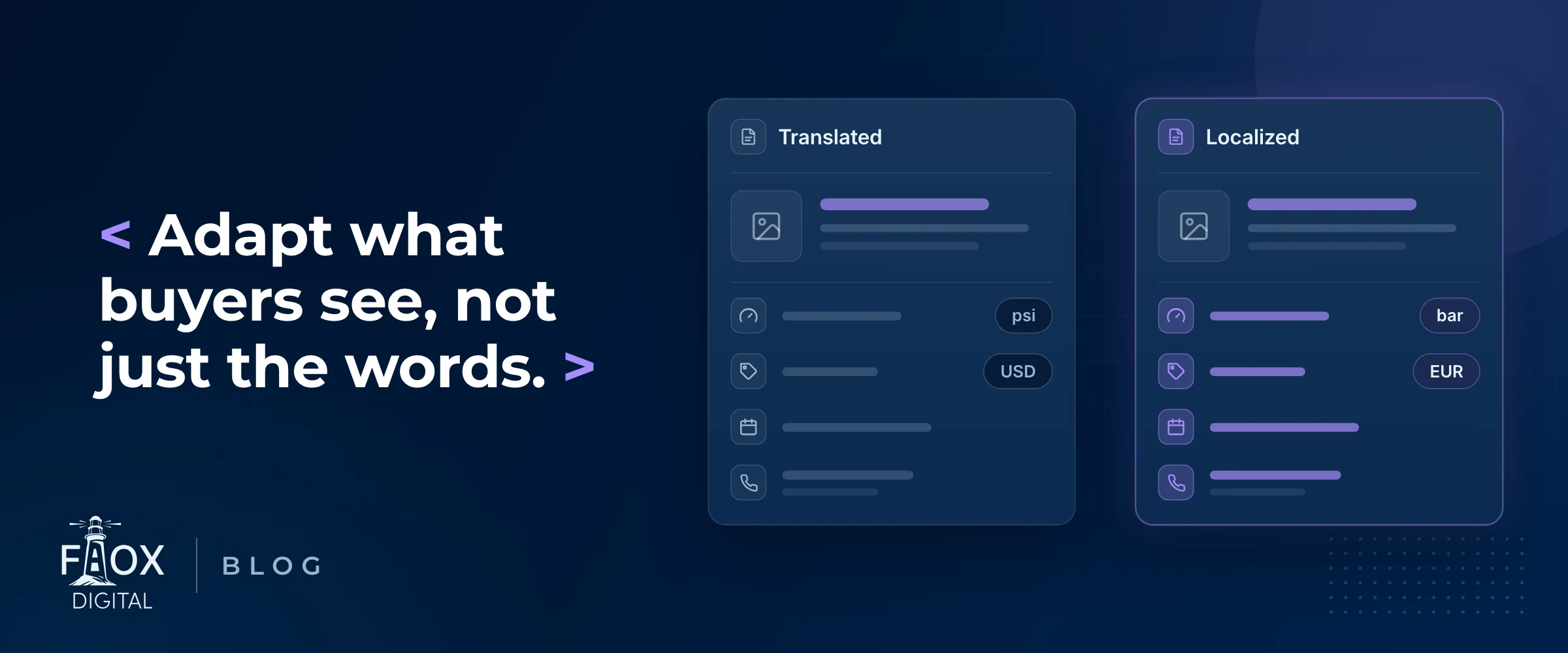
The difference in localization vs translation is scope: translation moves your text into another language, while localization also adapts what a buyer in that market needs to see, such as trade terms, units, currency, dates, examples, images, legal texts and tone. A B2B buyer feels the gap at the specifications, the price and delivery terms, the references and the legal pages. Most sites need a mix: careful translation for documents, localization for pages that sell and new copy for the few pages that must persuade.
A translated page can be correct in every sentence and still tell a buyer it was not written for them. The pressure is in psi, the price is in dollars, the only phone number is in another country and the references come from a market the buyer has never sold in. Nothing is wrong with the translation, yet the buyer wonders whether you really work in their market.
This article explains the difference, shows where a B2B buyer notices it on real pages and helps you decide what each page needs. For URLs, language switchers and CMS choices, see our multilingual website guide.
Localization vs translation: the difference
The localization and translation difference comes down to how much of the page changes. Translation moves text from one language into another. Localization adapts content to the language, culture and other requirements of a specific market, as the W3C, the web’s standards body, defines it, and the W3C adds that it is often mistaken for a synonym of translation. A third term completes the picture: transcreation writes new copy for the market from your source copy and a brief.
| Approach | What changes | Starts from | The test |
|---|---|---|---|
| Translation | The language | Your text | Is it accurate? |
| Localization | The language, plus what else the market expects | Your text and facts about the market | Does it work for a buyer there? |
| Transcreation | The copy itself | Your text and a brief: aim, audience and tone | Does it read as if it began there? |
Buyers say the difference matters. CSA Research reported in 2022 that 66% of business users in its Can’t Read, Won’t Buy research said they would pay up to 30% more for a localized product, while 34% of consumers said they would also pay more. That is a survey answer about products, from a firm that studies the language industry, so treat it as a signal and not a forecast.
What is website localization?
Website localization means adapting a whole site for one market, not only its words. The W3C’s list of what localization can cover includes number, date and time formats, currency, symbols, address and contact formats, and legal requirements, and it notes that a different way of doing business can force a rethink of logic and presentation. Search engines read some of these details too: Google’s documentation (updated December 2025) names local addresses and phone numbers, and local language and currency, among the signals of a site’s intended audience.
Where a B2B buyer feels the difference
To see this in practice, we compared one product on the US and German sites of two manufacturers in November 2026: Rittal’s VX 8806000 enclosure and igus’s GSM-0810-08 sleeve bearing.
| Detail | US page | German page |
|---|---|---|
| Product name (igus) | iglide G | iglidur G |
| Material (Rittal) | Carbon steel, 1.5 mm | Stahlblech (sheet steel), 1,5 mm |
| Height (Rittal) | 2,000 mm, plus 78.7 in | 2.000 mm |
| Temperature in the text (igus) | +266 °F | +130 °C |
| Price line (igus) | USD, shipping charges extra | EUR, plus VAT and shipping |
| Tender text (Rittal) | Not on the page | Included (Ausschreibungstext) |
| Company in the footer (Rittal) | Rittal LLC | Rittal GmbH & Co. KG |
Only part of this is language. Follow a buyer through one visit and the rest falls into place.
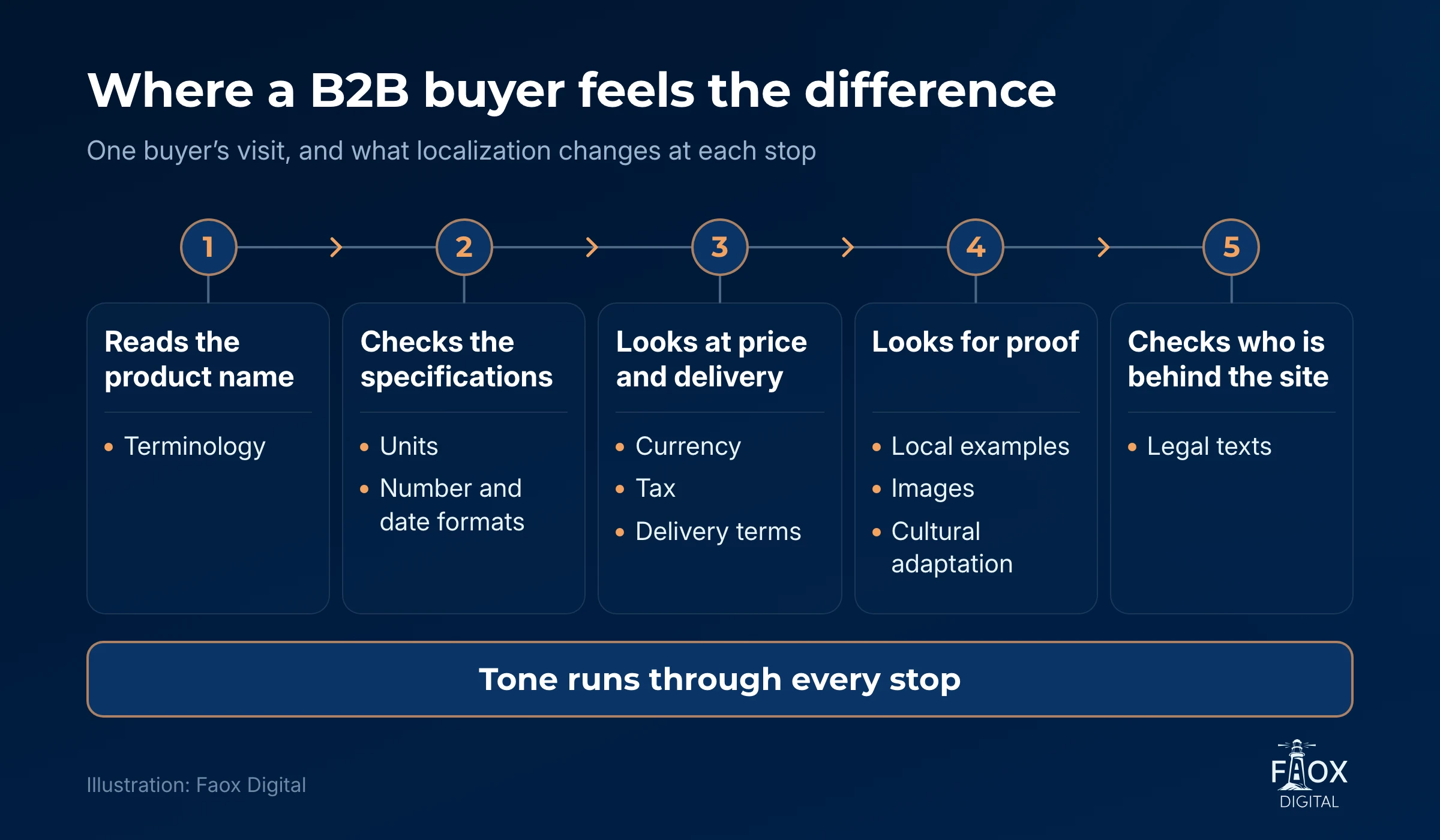
Terminology. A buyer starts with the product name. For the same enclosure, Rittal’s international English page says sheet steel, its US page carbon steel and its German page Stahlblech. A dictionary cannot make that choice: someone who knows the trade in that market has to, and a glossary keeps it consistent. Names can change too, as igus shows. Whether your brand name or core message should change is a branding question, covered in our article on brand localization strategy.
Units of measurement. Next, the buyer checks the specifications, and an engineer wants figures they can use without converting. Rittal’s US page adds inches, igus gives the same temperature in °F or °C, and Rittal lists IP and NEMA ratings on both pages. In the EU, units are also a legal matter: Directive 80/181/EEC sets the legal units for expressing quantities and allows others beside them, in characters no larger. So for pressure, a European page should lead with bar and can add psi in brackets.
Number and date formats. Separators can change what a figure means. Rittal’s height is 2,000 mm in the US and 2.000 mm in Germany, and on a US page the German figure would read as 2 mm. Dates carry the same risk. The W3C notes that the United States writes the month first and most of Europe the day, so a quote valid until 06/07/2027 means two different days. Write the month as a word and the year in four digits.
Currency and commercial terms. Then the buyer looks at price and delivery. On its US page, igus shows USD and says shipping is extra. On its German page, it shows EUR with "zzgl. MwSt. und Versand" (plus VAT and shipping), and each page gives its own shipping time. If you publish no prices, the same questions land on your quote form: which currency, which delivery terms, what about tax and who answers in that language?
Local examples. Then the buyer looks for proof, which works best when they can picture it. Rittal’s German page, called Referenzen, opens with customers in Poland, Austria and Germany. Its US page, Customer Success Stories, opens with a project involving its North American team. With no reference in a market, use the closest thing you can honestly claim: the same industry, the same standard or a nearby country.
Images. The W3C’s list also covers graphics that a culture may misread. On a B2B site the problems are usually plainer: a control panel labelled in another language, a safety sign or plug from another market, or words baked into a diagram that nobody can translate. Check them as carefully as text.
Cultural adaptation. Some differences come from how business is done. Rittal’s German and international English pages carry a ready-written tender text and its US page does not, so that gap is not about language. Ask distributors and sales staff what buyers expect to find on a supplier’s page, then add it.
Legal texts. Last, the buyer or their purchasing team checks who is behind the site. Here a correct translation can still be the wrong document. Three EU examples show the range:
- Company details: under the e-Commerce Directive (2000), online service providers must make their name, address, email and register details easy to reach. German sites usually call that page the Impressum.
- Privacy notices: the transparency guidelines of the EU’s privacy regulators (WP260, 2018) say a notice should be translated where you target speakers of another language, and that the translation has to read properly.
- Product documents: the Machinery Regulation, which applies from 20 January 2027, allows digital instructions, but requires them and the safety information in a language users can easily understand, as each member state decides.
These are examples and not legal advice, so have a lawyer in that market check your pages.
Tone. Tone runs through every stop. The English "you" hides a choice: German has Sie and du, French vous and tu, Turkish siz and sen. The German pages of Rittal and igus both use the formal Sie. Decide this for each language before translation starts, or different translators will decide it differently on different pages.
When a page needs transcreation
Some copy loses its point in translation. Copywriter Claudia Benetello argued in The Journal of Specialised Translation in 2018 that transcreation is a different service from translation. The writer works from a creative brief on intent, tone and audience, and often delivers several versions to choose from. In global campaigns, clients may also want a back translation and a rationale explaining the approach, so that head office can approve what it cannot read.
Her paper is about advertising and marketing copy, and that is where the idea fits on a B2B site: a home page headline, a campaign page, a slogan. It does not fit a data sheet, where an inventive sentence is a wrong sentence.
What your website really needs, page by page
A site rarely needs one treatment throughout. Spend the effort where a buying decision depends on it:
| Content | What it usually needs | Why |
|---|---|---|
| Home page, campaign pages | Transcreation | They have to persuade, and a translated slogan rarely does |
| Product and category pages | Localization | Terms, units and standards decide whether the page is usable |
| Certificates and references | Localization | Buyers need what applies and who bought in their market |
| Contact page, quote form | Localization | Local formats, a named contact and someone who can answer |
| Data sheets, manuals | Careful translation with approved terms | Accuracy matters more than style, so check units and formats |
| Legal pages | Local legal review | A translation does not make them valid there |
| Blog posts | Only where there is demand | Not every post needs a version in every language |
Logged-in areas count too: if you run dealer and customer portals, partners rely on them for prices, orders and documents. The layout has to carry all of this, because translated text often runs longer and a broken button is as visible as a wrong unit. If you are unsure what responsive design means, start there.
Plain translation can be the right first step. If you are testing a market, careful translation of your key pages, with a clear statement of where and how you deliver, shows whether it responds before you spend more. Localization will not rescue a site that does not sell at home, either: if your main language brings few enquiries, read about why sites get no enquiries before you copy the problem into other languages.
To test a page, ask a distributor or someone who buys in that market to read it and show you where it stops working for them. If you sell in Arabic or Hebrew, the next question is the layout itself, and our article on right-to-left layouts covers that.
How Faox Digital separates translation from localization
Faox Digital, a digital growth partner for B2B companies in complex and international markets, treats translation and localization as two different jobs. On a website, each language gets its own structure rather than a translate button, is designed language by language and is tested on every device before anyone outside sees it.
Key takeaways
- Translation changes the language, localization also changes what a buyer in that market needs to see, and transcreation writes new copy from your source copy and a brief.
- A B2B buyer feels the difference in terms, units, number formats, prices, references, images, legal pages and tone.
- Decide page by page: transcreation for pages that must persuade, localization for pages that sell, careful translation for documents and legal review for legal pages.
- Localization will not fix a site that does not sell at home, so test a market with your key pages first.
Frequently asked questions
What does website localization mean?
It means adapting a website for one market, not only translating it. Trade terms, units, formats, currency, examples, images, legal pages and tone all change to suit the buyer there.
What is website translation?
Website translation moves a site’s text into another language, including pages, menus, forms and metadata. The facts, formats and examples stay as they were. For manuals and similar documents it can be enough, if the terms are approved and someone checks the result.
Can a translator localize a website alone?
A good translator handles language and tone and often flags local problems. Trade terms still need a subject expert, proof needs your sales team or distributors, legal pages need a lawyer and forms need your web team.
Is a translation website good enough for a business site?
A translation website or tool is useful for a quick draft or for reading a foreign page. It does not know your approved terms, your market’s standards or your legal duties, so treat its output as a draft that a person checks.
Sources
Let’s talk
Planning a new website or a fix?
Send us your current site and what you need it to do. We will tell you whether it needs a rebuild or a few focused changes.