
Commercial Search Intent: Which B2B Searches Lead to Quote Requests
How to tell which searches sit closest to a quote request, which page each one needs, and how to decide where your SEO budget goes first.
Commercial search intent means the searcher is comparing suppliers, products or solutions before deciding. In B2B, the searches most likely to lead to quote requests are supplier and manufacturer searches, exact product and application searches, price and quote searches and service searches. Put SEO investment there first, match each search to the right page, and judge the work by quote requests per page, not by search volume.
An SEO report can show traffic going up while sales asks where the quote requests are. Both can be true, because a visit from a student and a visit from a purchaser count the same. Your keyword research for B2B gives you a long list of searches. This guide shows which of them sit closest to a quote request, which page each one needs, how to measure the result and where to spend first. We offer this work as part of our B2B SEO services, so we have a stake in the answer; you can run most of it in-house. The examples come from a hypothetical valve manufacturer.
What is commercial search intent?
Commercial search intent means the searcher is evaluating options before deciding. Searches like this are often called commercial intent keywords. Next to them sit transactional keywords, where the searcher is ready to act. Marketers call the two together bottom of funnel keywords. The difference matters, because each needs a different page:
| Commercial investigation intent | Transactional intent | |
|---|---|---|
| What the buyer is doing | Comparing and shortlisting | Asking for a price, a sample or a quote |
| Typical words | manufacturer, supplier, certified, vs, alternatives | quote, price, RFQ, sample, a part number |
| Example | "API 6D ball valve manufacturers" | "ball valve DN50 RFQ" |
| Page that usually fits | Category, service or comparison page | Product page, or a category page with a route to a quote |
| What the page must prove | You are a credible option | You have it, and asking is easy |
| Path to a quote | Often later, and often from a colleague | Often in the same visit |
Comparison searches count even though they rarely end in a request the same day. 6sense’s 2025 survey of more than 4,000 B2B buyers found that 94% of buying groups had ranked their preferred vendors before first contact. The quote request often comes after the shortlist is made, so the searches that build the shortlist matter too.
Which B2B searches lead to quote requests
We found no reliable public figure for how often each kind of B2B search turns into a quote request, so treat this as a map to test against your own data. One survey does show that industrial buyers look for new suppliers in search. Paperless Parts, a quoting software company, surveyed more than 600 US manufacturing professionals with a research firm in 2022:
These are custom-part buyers in one country, so read the figures as a signal. Six kinds of search can lead to a quote request, the first five most directly:
| Search type | Example | Page that should answer it | What the page must show |
|---|---|---|---|
| Supplier and manufacturer searches | "ball valve manufacturer ISO 9001" | Category page | Range, capabilities, certificates, export markets, a route to a quote |
| Product searches | "ball valve DN50 PN40 316" | Product page | Full specifications, datasheet, quote form |
| Application searches | "valves for hydrogen service" | Application or category page | Operating conditions, suitable products, limits |
| Price and quote searches | "ball valve price", "valve RFQ" | Product or category page with a quote form | What drives the price, what you need from the buyer, when you reply |
| Service searches | "valve repair service Germany" | Service page | Scope, process, region covered, who to contact |
| Comparison searches | "floating vs trunnion ball valve" | Comparison guide | A point of view, and links on to the range |
Three of these need extra care:
- Product and application searches often show little or no volume, because buyers add sizes, grades and conditions. That detail is the clearest sign of a real need.
- Price and quote searches are hardest for companies that do not publish prices. A page that says only "contact us" gives the searcher nothing, so say what drives the price and what you need in order to quote. Not every price search is a buyer: an engineer may be estimating a project.
- Comparison searches ask why a buyer should choose you. If your pages can only answer "high quality" and "customer focus", the gap is in your B2B brand positioning, not your SEO.
Matching searches to service and category pages
Commercial searches need commercial pages. A blog post can rank for a supplier search and bring no requests, because the buyer came for a range, not an article. Most of the fixes are simple:
- Send supplier searches to category pages, not the home page or a post.
- Give each service its own page, and name a region only where you really serve it.
- Give every commercial page a next step: a short form or a named contact. Say when you will reply, then keep to it.
- Consider directories. If marketplaces and directories hold the first page, a listing may reach those buyers sooner than a new page.
Value over volume
Value over volume means ranking searches by what they could bring, not by how many people type them. "Ball valve" gets far more searches than "API 6D ball valve manufacturer", but its visitors include students, competitors and people who only want a definition. Compare searches using your own records:
- Would this searcher buy what we sell, in a market we serve?
- What is a typical order worth, and how often do we win when we quote?
- How many quote requests would make this page worth building?
The last answer is often small. If one order can pay for a page, a search that tools show as zero can still be a good bet, as long as customers really use those words.
Finding commercial intent keywords in your own data
Four sources show which of these searches are already reaching you:
- Search Console. A query filter with a custom regex such as
(manufacturer|supplier|rfq)lists the commercial searches you already appear for. Many impressions and few clicks point to a page worth fixing. - Google Ads. If you run ads, the search terms report shows the real searches behind them and how they performed. Google Ads Help (accessed November 2026) says terms without enough query activity are left out for privacy.
- Keyword Planner. Its top of page bid ranges show what advertisers have historically paid for a keyword (Google Ads Help, accessed November 2026). A high bid suggests others find the click worth paying for, though niche terms may show no data.
- Your enquiries. Read recent RFQs and ask new enquirers what they searched for. It is the one source that ties a search to a real buyer.
Then check the results page. Supplier sites and "top manufacturers" lists confirm commercial intent. A page full of guides suggests the words mislead.
Measuring quote requests
Measuring quote requests takes three systems, because none sees the whole path. Search Console knows the query and the page. Google Analytics knows the page and the request. Your CRM knows the request and the order. The landing page connects them.
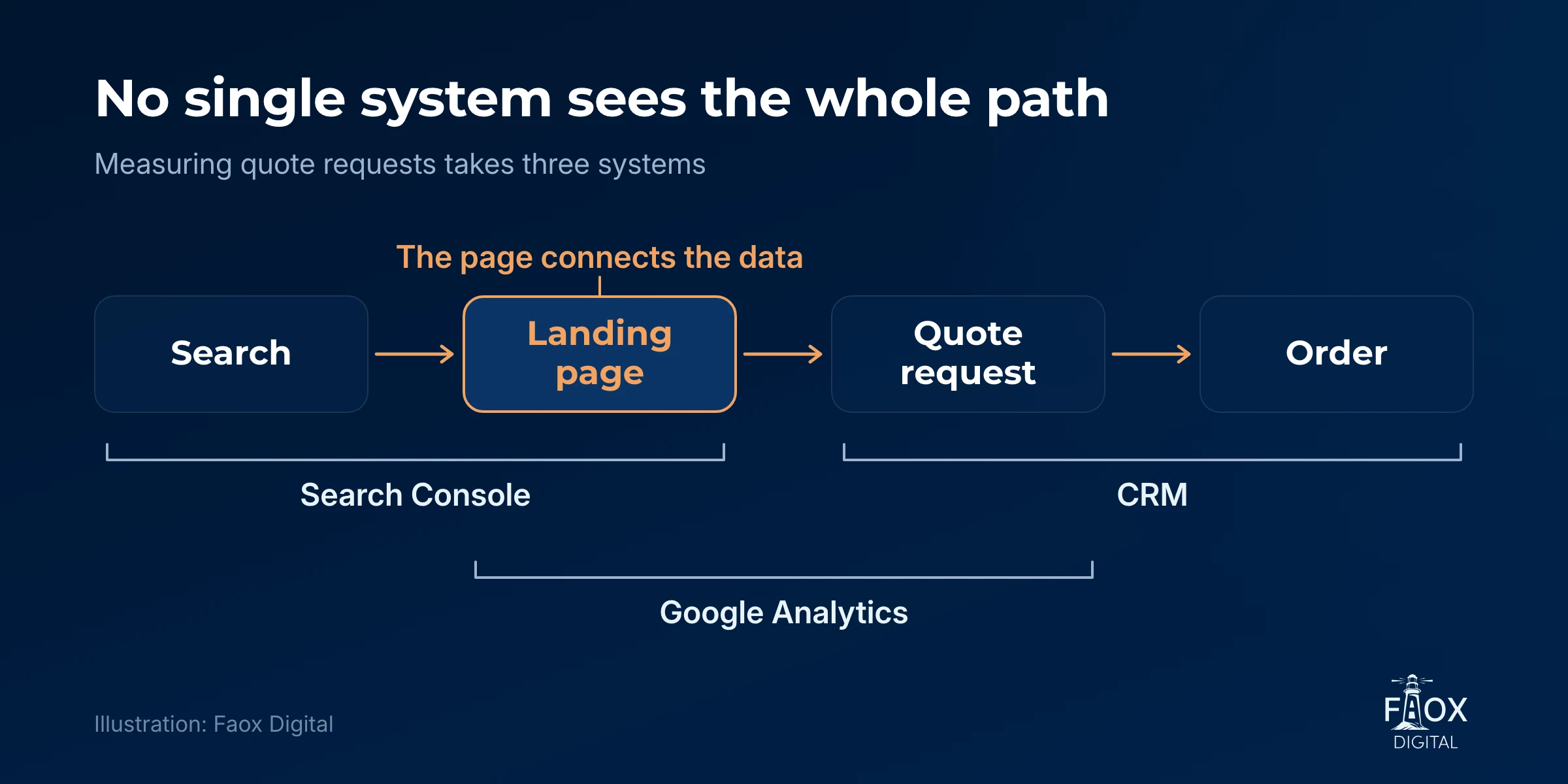
Analytics Help (accessed November 2026) says its Queries report cannot be broken down by Analytics dimensions, so do not expect a clean list of quote requests per search. With Search Console linked, its Google organic search traffic report does show each landing page with clicks, impressions and key events. So measure by page:
- Mark the quote form submission as a key event in Google Analytics.
- Count email and phone requests too. Record how each one found you when it comes in.
- Pass the landing page to your CRM with each request, and record which quotes became orders. How sales follows up those requests is a separate job.
- Allow for time. 6sense’s 2025 survey puts the average buying cycle at about 10 months, so judge pages over months, not weeks.
Then ask to see quote requests per page next to the usual SEO report metrics. Positions and traffic show that you are visible; requests show whether it counts.
What AI Overviews change
AI answers are moving into comparison searches. Semrush’s 2026 study of more than 600,000 US desktop keywords across 10 industries found that, from November 2025 to April 2026, the share of commercial results pages with an AI Overview grew 71%, while the share of transactional ones fell 5%. Google’s 2025 guide to AI features says AI Mode is particularly helpful for complex comparisons.
None of the 10 is a B2B category, but the direction is useful. Comparison pages may earn fewer clicks even when they do their job, while searches ready for action are so far less affected. Keep the facts buyers compare in plain text on the page, and count requests, not only clicks.
Prioritizing investment: where the budget goes first
Prioritizing investment gets easier once you sort the work by how close it sits to a quote request. This is the order we would start from:
| Work | Effort | Distance from a quote | It comes first when |
|---|---|---|---|
| Improve commercial pages you already have | Low to medium | Closest | Search Console shows commercial searches with impressions but few clicks or requests |
| Build missing category, service and application pages | Medium | Close | You sell it, buyers search for it and no page answers |
| Write comparison guides | Medium | Further | You have a real point of view and the range pages exist |
| Publish informational guides | Medium per article, high in total | Furthest | Commercial pages are in place, or buyers need help defining the problem |
Informational content is not wasted, because it reaches engineers early and can shape the shortlist. It should not take the budget while your product pages have no specifications. Check too that Google can crawl and index these pages, since a technical block comes before all of this.
Commercial pages are hard to write without product knowledge. If you buy writing, B2B content writing services that include research and expert input suit them better than paying by the article. A sensible plan starts from your data and these priorities, not from content volume; our guide to how an SEO engagement starts shows what that looks like.
Questions to ask before you pay for this work
Whether you hire a provider or brief your own team, these answers show whether the plan is built around quote requests:
- Which searches do you expect to bring quote requests, and why?
- Which searches would you leave out, even with high volume?
- Which existing pages would you fix first?
- How will you count quote requests per page and report them?
- What do you need from our sales team?
No provider can promise a ranking or a number of quote requests, and that includes us.
How Faox Digital prioritizes commercial searches
Faox Digital builds the keyword map market by market with commercial and informational intent side by side, so the searches closest to a quote request are visible next to the rest. The map follows an audit of what the site ranks for and who it competes with, and you see the priorities and the reasons before any work begins. Our reports then show rankings and organic traffic, so you can judge which searches deserve more investment.
Key takeaways
- Commercial intent means comparing and transactional intent means ready to act; together they sit closest to a quote request.
- Supplier, product, application, price and service searches each need their own kind of page.
- Judge searches by value, not volume: one order can justify a page for a search that tools show as zero.
- Measure quote requests per landing page, because no report ties them cleanly to a single search.
- Spend first on the commercial pages you have, then on missing ones, then on comparison and informational content.
Frequently asked questions
How do I identify commercial intent in a search?
Look at the words, then at the results. "Manufacturer", "supplier", "certified" and "vs" are clues. If the first page shows supplier sites, directories and category pages, the intent is commercial. If it shows guides, it is not, whatever the words suggest.
How do I optimize a page for commercial search intent?
Give buyers what they need to shortlist you: the range, specifications, capabilities, certificates and markets served, in plain text. Use the search term in the title and main heading, add a clear route to a quote, and say who replies and when.
Is navigational search intent commercial too?
A search for your company name often comes from someone close to buying, but they already know you. Count those searches separately, or they will make your commercial pages look stronger than they are.
Sources
Let’s talk
Where do you want to be found?
Tell us the searches that matter to your business. We will review your site and tell you plainly what to fix first, including what you can do yourself.