
The First 90 Days of SEO: What a B2B Company Should Expect
A week-by-week view of the first three months of an SEO engagement: what you should receive, what your team provides and what is realistic by day 90.

The first 90 days of SEO are mostly groundwork. Expect a kickoff meeting and account access in the first two weeks, an audit and baseline by about week six, a keyword map, technical priority list and content plan by week eight, then quick wins, the first fixes and the first new pages, with a report each month. By day 90, judge the work delivered and early signals such as more impressions, not enquiries, which usually come later.
Signing an SEO contract starts a slow process, and the first three months shape much of what follows. This is when the provider learns your business, finds what holds the site back and agrees priorities with you. It is also when many engagements lose time, waiting for access, approvals or a developer’s release slot.
This guide sets out what a 90-day plan contains, what you should receive and what your own team needs to provide. It follows the five steps of our B2B SEO services: audit and baseline, strategy and keyword map, foundations and on-page work, content and authority, and measurement. We have a stake in the answer, so use it as a yardstick for any provider, including us.
The first 90 days of SEO at a glance
This is the plan for a typical B2B site. The steps overlap, and the timings shift with the size of the site and with how quickly access and approvals arrive:
| When | Step | What you receive | What your team provides |
|---|---|---|---|
| Weeks 1 to 2 | Kickoff and access | Agreed goals, named contacts and an access checklist | One owner, your goals and access to your accounts |
| Weeks 2 to 6 | Audit and baseline | An audit report and the baseline figures | Answers from your developers and sales team |
| Weeks 5 to 8 | Strategy and keyword map | A keyword map, a technical priority list and a content plan | Time from product experts, and approval |
| Weeks 7 to 13 | Quick wins, fixes and first content | Released fixes, a change log and the first new or updated pages | Developer releases and expert reviews |
| Every month | Measurement | A report each month, then the 90-day review | Decisions at each review |
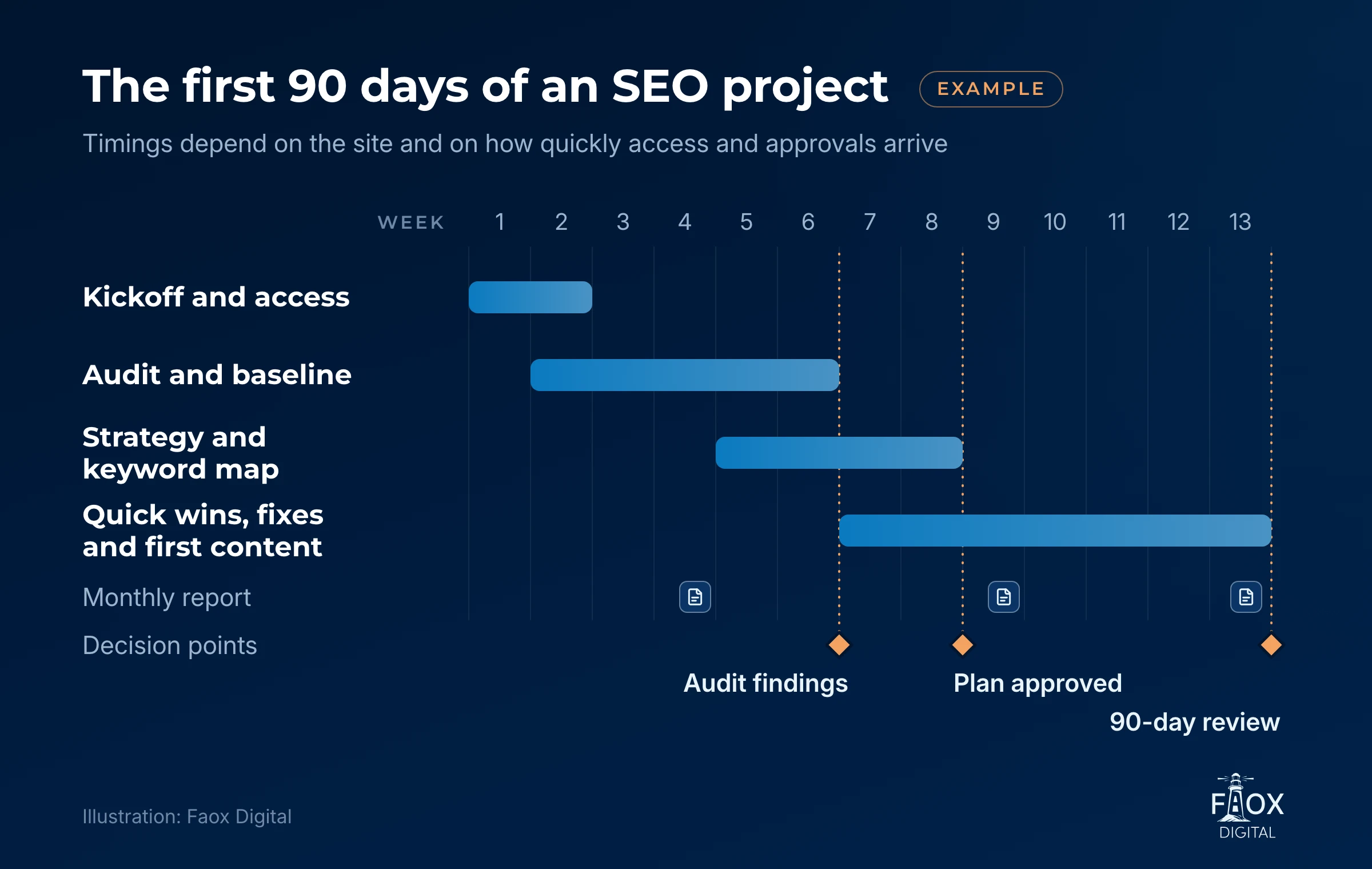
Authority work, such as digital PR and outreach to trade publications, starts in our plans toward the end of this period or after it, once there are pages worth linking to.
Weeks 1 to 2: kickoff meeting and access
The kickoff meeting sets the direction for everything after it. Expect questions about:
- Which products, markets and languages matter most, and which bring the best margins
- What counts as a qualified enquiry, and how long your sales cycle is
- Past SEO work, site migrations and anything Google has flagged
- Your competitors, and the words your buyers use
- Who on your side releases changes and who checks content
Name one owner inside your company. Without one, questions wait, fixes wait and the plan slips.
Access comes next, because a provider cannot judge your site without your data:
- Search Console: keep a verified owner in your company and add the provider as a full user. Full users can inspect URLs, submit sitemaps and validate fixes, but cannot add users or owners.
- GA4: keep the Administrator role in your company. The Marketer role can create key events, and the Editor role gives full control of property settings without managing users.
- Also: your website platform, your tag manager and, if your developers can export them, server logs.
If SEO is one part of a wider engagement, our guide to working with a marketing agency explains how agency work is organized across channels.
Weeks 2 to 6: audit and baseline
The audit reviews crawling and indexing, site structure, page content, authority, competitors and your tracking setup. It also checks whether AI crawlers can reach your pages, in robots.txt and in your firewall or CDN settings. It should end in findings ranked by impact and effort, not in a tool export.
The baseline records where you start, before anything changes, so later reports have an honest point of comparison:
- Clicks, impressions and average position in Search Console, for the page groups that matter
- How many of your important pages are indexed, from the Page indexing report
- Enquiries and quote requests from organic search, from GA4 and your CRM
- A short list of buyer questions tested in AI tools, with the date and the answers
Measurement may need fixing first. If quote requests are not tracked as key events in GA4, that becomes the first job, because without it no later report can show whether search brings enquiries. Save the baseline in a place your company owns, so it survives a change of provider.
Weeks 5 to 8: strategy, keyword map and content plan
The audit turns into a plan in three documents:
- Keyword map: each important page with its main search target and the intent behind it, for each market and language, plus the searches that have no page yet.
- Technical priority list: the audit findings as work items, ranked by impact and effort, each with an owner and a target release.
- Content plan: the pages to update or write first. In B2B, start with product, category and application pages before blog articles, because they answer the searches closest to a purchase.
Our SEO proposal checklist describes what each of these should contain. The plan should also explain why each priority comes first, so you can challenge it. Approving it is your first real decision point: once you sign off, the next weeks follow this plan.
Weeks 7 to 13: quick wins, fixes and first content
Quick wins are changes with clear value and little effort. Some can be made as soon as they are found, even during the audit:
- Track quote and contact forms as key events
- Remove an accidental noindex or robots.txt block on important pages
- Fix broken links and redirects that lead to priority pages
- Rewrite titles and descriptions on pages that get impressions but few clicks
- Add internal links from strong pages to the pages you want found
- Submit a clean XML sitemap in Search Console
Then the larger work starts. Technical fixes go out in your developers’ release cycle, on-page changes improve the priority pages, and the first pages from the content plan are updated or written, each checked by someone who knows the product. Plan developer time and review rounds before this phase, because work that waits for a release slot cannot show results.
Ask for a change log of what changed, where and when. It turns later reports from guesses into evidence, because each movement can be traced back to a change.
First reports and decision points
The first reports arrive at the end of each month. The first is mostly about work: what was delivered, what the baseline shows and what is blocked. The second and third add early signals by page group. Each should end with what the provider needs from you next.
The 90-day review is the main decision point. Compare the work delivered with the plan, and the early signals with the baseline, then decide:
- Which priorities continue, and which change
- Whether the scope fits what the audit found, or the budget needs to follow it
- Whether to add a market, a language or a product line, or to narrow the focus
If the review shows that the plan needs more work than the fee covers, our guide to what SEO costs per month helps you size the next quarter. Narrowing the focus is often better than spreading a fixed budget thin.
What to expect by day 90
Expectations are easier to manage when both sides agree on them in writing. Our planning ranges are first movement within a few months, meaningful results in around six to eight months and a competitive position in a year or more. Day 90 sits at the start of that path:
| Area | Realistic by day 90 | Usually later |
|---|---|---|
| Technical | Priority fixes released and recrawled, fewer indexing errors | A clean report across the whole site |
| Search Console | More impressions for the pages you worked on, better positions on some specific searches | Steady positions on contested terms |
| Enquiries | Every quote request tracked and counted | A steady flow of qualified enquiries from search |
| Content | The first pages updated or published | A library that answers your buyers’ questions |
| AI answers | Crawler access checked and a baseline of test questions | Regular mentions, which no one can promise |
None of this is a promise: a new domain or strong competitors slow everything down. Google’s SEO Starter Guide (2025) says some changes take effect in a few hours and others in several months, and that you will likely want to wait a few weeks before judging a change. So read day 90 by trends and groups of pages, not by one keyword.
Warning signs in the first 90 days
Some problems show early. Look closer if you see these:
- No audit or plan after six weeks, only updates on activity
- Requests to own your Search Console or Analytics accounts, instead of using them as a user
- Reports that show rankings for a few chosen terms and nothing else
- Content published without anyone on your side checking it
- A fixed number of new links each month; Google’s spam policies treat buying links for ranking purposes as link spam
- Promises of a position, or of a date for results
Raise them at the next review. If they persist, the questions in our guide to selecting an SEO agency are worth asking again.
How Faox Digital runs the first steps of an SEO project
The first steps of an SEO project at Faox Digital follow the same order as this guide: an audit and baseline, then a strategy and keyword map, then foundations and on-page work. You see the priorities and the reasons before any work begins, and content and authority build on those foundations. From then on, our reports track rankings, organic traffic and citations in AI tools.
Key takeaways
- The first 90 days of SEO are mostly groundwork: kickoff, access, audit, baseline, a plan, and the first fixes and pages.
- Name one owner on your side, give the provider access as a user rather than ownership, and plan developer time early.
- Record a baseline before anything changes, and make sure quote requests are tracked as key events.
- Use the plan approval and the 90-day review as decision points for priorities, scope and budget.
- By day 90, judge the work delivered and early signals, not enquiries or the ranking of one term.
Frequently asked questions
What should an SEO 90-day plan include?
It should include a kickoff meeting and access in the first two weeks, an audit and baseline, a keyword map, a technical priority list and a content plan, then quick wins, the first fixes and the first new or updated pages. It should also set the dates of the monthly reports and of the 90-day review.
What should I expect from SEO in the first 3 months?
Expect deliverables and early signals: an audit, a plan, released fixes, the first pages and possibly more impressions for the pages you worked on. A steady flow of enquiries usually comes later; as a planning range, meaningful results take around six to eight months.
What does SEO onboarding involve?
Onboarding covers the first one or two weeks: a kickoff meeting about goals, markets and buyers, access to Search Console, GA4 and your website platform, and agreement on who does what on each side. A good provider also checks that enquiries are tracked before the main work starts.
How do you create a winning B2B SEO campaign?
Start from your buyers, not from keywords: learn what they search at each stage, map those searches to pages, fix what stops Google from reading those pages and publish content your experts would sign. Then measure qualified enquiries, not traffic, and adjust every quarter. No campaign can promise a position.
Sources
- Google Search Central: SEO Starter Guide, 2025
- Search Console Help: Managing owners, users, and permissions, accessed November 2026
- Analytics Help: Access and data-restriction management, accessed November 2026
- Google Search Central: Spam policies for Google web search, 2026
Let’s talk
Where do you want to be found?
Tell us the searches that matter to your business. We will review your site and tell you plainly what to fix first, including what you can do yourself.