
How to Read an SEO Report: The Numbers That Show Real Progress
Which numbers in an SEO report show that the investment is working, which ones only flatter it, and what a good report should explain each time.
Here is how to read an SEO report: start with business results, meaning qualified quote requests from organic search, then check the priority pages that sell, then the search data behind them: impressions, clicks, ranking distribution, branded and non-branded searches and visibility in AI answers. Compare each figure with the same period last year, and treat totals, tool scores and single rankings as context, not proof. A good report also explains in words what changed, why and what happens next.
An SEO report can look busy and still not answer the question you pay it to answer: is the investment bringing more of the right buyers? Total traffic, keyword counts and authority scores can rise while enquiries stay flat. This guide shows which numbers show real progress, which ones flatter the work and what a report should explain. We provide B2B SEO services and write reports ourselves, so we have a stake in the answer; read ours with the same questions.
How to read an SEO report, from the top down
Read the report in the order that matters to the business, not the order a tool exports it:
- Business results. Qualified enquiries and quote requests that started with an organic search.
- Priority pages. Clicks and positions for the product, category and service pages that sell.
- Search visibility. Impressions, clicks, ranking distribution, branded and non-branded searches, AI answers.
- Work and next steps. What was done, what changed and what comes next.
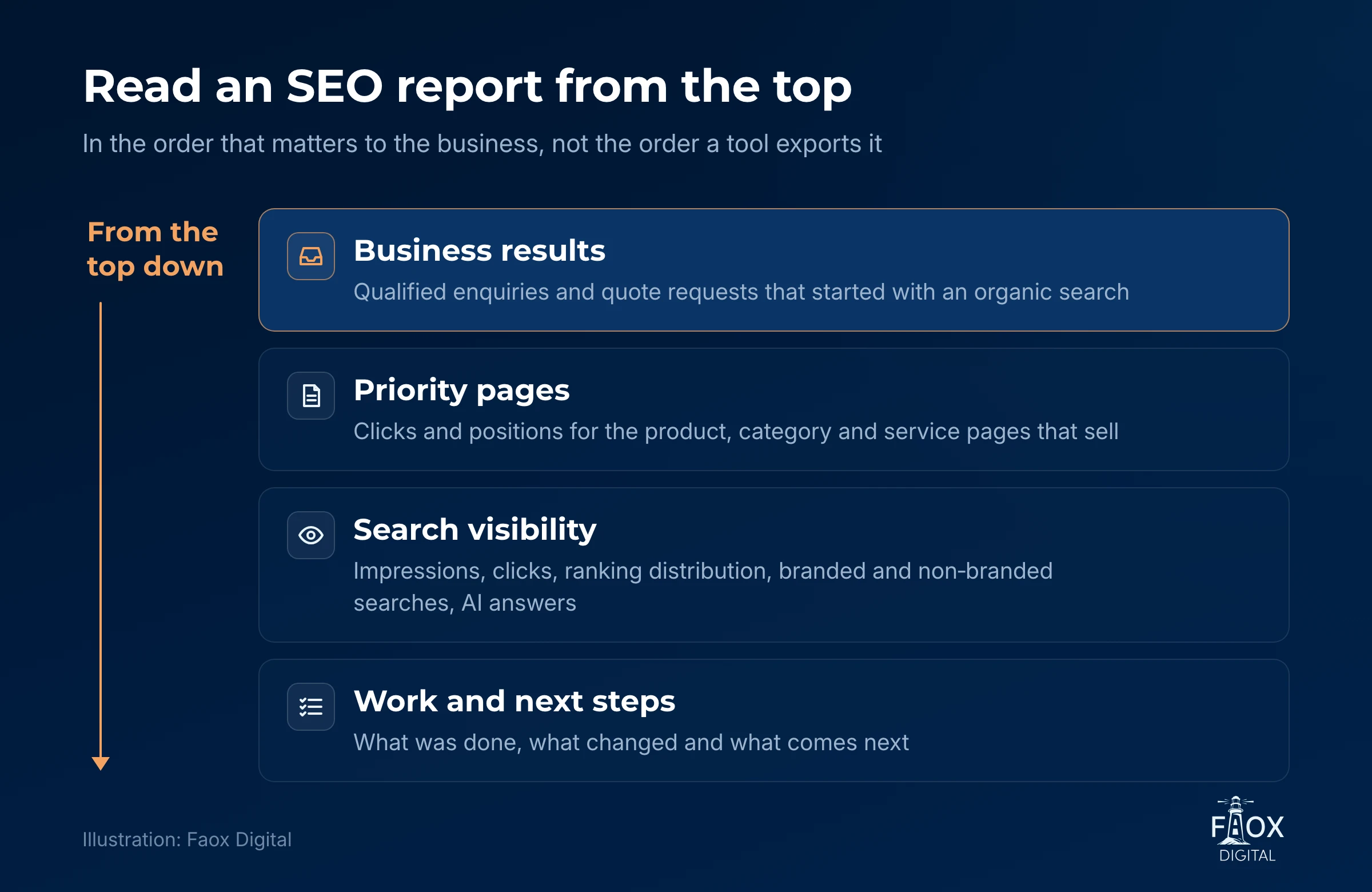
If the first layer is missing, ask why before you read the rest. In the first months the lower layers move first, which is normal as long as the report says so.
Metrics that show real progress and vanity metrics that mislead
Most numbers in an SEO report are useful in context and misleading alone. Vanity metrics are the ones that can rise while nothing improves for the business:
| Metric | Shows real progress when | Misleads when |
|---|---|---|
| Organic traffic | Visits from non-branded searches land on pages that sell | It grows on pages that never lead to an enquiry |
| Impressions and clicks | Both rise for the searches in your keyword map | Impressions grow from searches you do not want |
| Ranking distribution | More target searches reach the top 10 and the top 3 | It counts every keyword a tool finds, relevant or not |
| Priority pages | Their clicks and positions improve | They are missing, hidden inside a site total |
| Quote requests | Qualified enquiries from organic landing pages grow | Every form fill counts, including spam and job seekers |
| Branded searches | They are reported apart from non-branded searches | Demand from your brand is credited to SEO alone |
| AI answer visibility | Impressions in AI features grow on priority pages | One screenshot from one AI tool stands in for a trend |
| Authority scores and link counts | They give context to authority work | They are shown as results, though they are tool estimates |
Google’s 2026 guidance on third-party SEO tools makes the last point itself: those tools have no access to Google’s internal ranking data, and their predictions are their own.
Impressions and clicks in Search Console
Search Console is the only source of Google’s own search data for your site. Search Console Help says an impression is counted when a link to your site appears on the results page a person loads, whether or not they scroll to it, and position is an average across those appearances. Read the two together:
- Impressions and clicks both up: visibility is turning into visits.
- Impressions up, clicks flat: the pages appear lower down, for less relevant searches or next to an AI summary. Pew Research Center’s analysis of March 2025 browsing data from 900 US adults found that people clicked a traditional result on 8% of visits to a results page with an AI summary, against 15% without one.
- Both down: check seasonality and technical problems before anything else.
Ranking distribution and priority pages
A ranking distribution groups your tracked searches into position bands, such as the top 3, positions 4 to 10 and positions 11 to 20, and shows how many move between bands. It is more honest than one average. The average position can even fall while things improve, because a site that starts to appear for many new, broader searches adds low positions to the average. Search Console Help also notes that results depend on the time, place, device and recent history of the person searching, so one ranking screenshot proves little.
Ask for the priority pages as their own group: the product, category, application and service pages that lead to enquiries. A site total can rise on the strength of a few popular blog posts while the pages that sell stand still.
Quote requests and form conversions
For most B2B companies this is the number that matters: quote requests and other enquiries that started with an organic search. They appear in Google Analytics once each form submission is tracked as a key event; our guide to GA4 setup for B2B explains how. Ask for two figures, not one:
- Form conversions: form submissions from visits that began with organic search, by landing page.
- Qualified enquiries: the share of those your sales team accepted, taken from the CRM.
The second figure removes spam, job applications and supplier pitches, and it lets you set SEO against the B2B marketing metrics the rest of the business already uses.
Branded searches and visibility in AI answers
Branded searches include your company or product names. Search Console’s branded queries filter separates them, and Search Console Help says branded traffic often comes from people who already know your site, while non-branded traffic can show new audience growth. The filter is AI-assisted, can misclassify some queries and is not available for sites with few impressions. SEO’s main job is usually the non-branded side.
AI answer visibility is new in most reports. Since 31 August 2026, every site has had Search Console’s Generative AI performance report, which shows impressions in AI Overviews and AI Mode by page, country, device and date, but not the queries. Google Analytics’ AI Assistant channel counts visits from tools such as ChatGPT, Gemini and Copilot, and excludes Google’s own AI features. A fixed list of buyer questions, tested the same way each month, adds the rest. None of these can be promised in advance.
Period comparison and seasonality
Month-on-month comparisons mislead in B2B, where holidays, budget cycles and trade fair seasons move demand. Google’s guide to debugging traffic drops suggests viewing the last 16 months to see whether a dip happens every year, comparing the last three months with the same months a year earlier, and checking key queries in Google Trends to see whether demand fell across the web or only for your site. Ask for a period comparison with the same period last year by default, and for any seasonality to be named in the commentary.
What the report should say in words
Numbers need commentary and next steps. Each report should answer, in plain sentences:
- What changed since the last report, and since the same period last year
- Why it probably changed, with the evidence
- What was done, and what was planned but not done
- What happens next, in order of priority
- What the provider needs from you, such as developer time or expert input
- Which risks and open questions remain
A report that only shows charts leaves you to do the analysis you are paying for.
Before and during an SEO engagement
A report is easier to judge when you agreed on it at the start. Our checklist of what SEO services include covers success metrics and a baseline in the proposal, and our guide to the first 90 days of SEO shows what early reports can show. If a report or proposal leans on promised positions, read our article on SEO ranking guarantees. Companies selling abroad should read each market separately, because a total can hide markets that stall; our guide to international SEO for manufacturers covers measuring by country.
How Faox Digital reports on SEO progress
At Faox Digital, a digital growth partner for B2B companies in complex and international markets, measurement is the last of five steps in an SEO project and continues for as long as the work does: reports follow rankings, organic traffic and whether AI tools start to cite the company. The client sees the priorities and the reasons before any work begins. We do not promise rankings, because Google decides positions; for AI search we build the conditions and show where the company starts to appear.
Key takeaways
- Read an SEO report from the top: qualified enquiries first, then priority pages, then search visibility.
- Impressions, clicks and positions show progress only for the searches and pages you agreed on.
- Separate branded from non-branded searches, and form fills from qualified enquiries.
- Compare with the same period last year, and expect seasonality to be named.
- Every report should say what changed, why and what happens next.
Frequently asked questions
How long does SEO take to show results in a report?
Plan for first movement, such as more impressions and better positions on specific searches, within a few months; clicks on commercial searches and first enquiries around six to eight months; and a competitive position on contested terms after a year or more. These are planning ranges, not promises, and an audit of your site should refine them.
How long does it take for a change to show on Google?
Google’s SEO Starter Guide says some changes take effect in a few hours and others take several months, and suggests waiting a few weeks before judging a change. Read single changes over weeks and the whole programme over quarters.
How long does SEO take to rank a new page?
There is no fixed time. A new page first has to be crawled and indexed: Google says crawling after a request can take from a few days to a few weeks, and a request does not ensure the page will appear. Its position then depends on the competition for the search and on your site’s standing.
Sources
Let’s talk
Where do you want to be found?
Tell us the searches that matter to your business. We will review your site and tell you plainly what to fix first, including what you can do yourself.