
SEO for Chemical Manufacturers: Product and Grade Pages Buyers Can Find
How chemists, formulators and purchasers search for chemicals, and the product, grade, document and regulatory pages that bring their enquiries and sample requests.
SEO for chemical manufacturers means making each product findable by the identifiers and terms technical buyers search: names and synonyms, CAS numbers, grades, applications and documents such as safety data sheets. Give each substance a product page with its identifiers, grades and specifications in text, keep SDS and TDS documents readable and current in every language you sell in, add application and regulatory pages, and make sample requests easy.
A chemist looking for a supplier rarely searches for your company name. They search for a substance, a CAS number, a grade or a function, often with "SDS" added. If your website shows those details only in PDF catalogs or behind a contact form, the search goes to a distributor, a marketplace or a competitor that put them on the page.
This guide covers what changes for chemical companies: identifiers, grades, safety and technical documents, regulatory content, sample requests and distributors. We offer this work as part of our B2B SEO services. The regulatory points below describe how rules shape your content; they are not legal advice.
SEO for chemical manufacturers: how technical buyers search
Technical buyers in chemicals include formulators and R&D chemists, purchasers, quality managers and EHS or regulatory staff. Each searches with different words, and many search with identifiers rather than names. These examples use glycerol, which PubChem lists as CAS 56-81-5, also known as glycerin and glycerine, and as E422:
| Search | Example | Page that should answer it |
|---|---|---|
| Identifier | "56-81-5 supplier" | Product page with the CAS number in text |
| Name and grade | "glycerine USP grade" | Product page with a grade table, or a grade page |
| Safety document | "glycerin SDS" | Document library page and the SDS itself |
| Function | "humectant for toothpaste" | Application page |
| Regulation | "glycerol REACH registration" | Regulatory section on the product page |
| Local supply | "glycerine distributor Poland" | Distributor page for that country |
Formulated products add trade names and product codes, which buyers search once they know you. New buyers start with the substance, the function or the application. For the general approach to quote pages, measurement and choosing support, start with our guide to SEO for manufacturers; this article covers what is specific to chemicals.
CAS numbers and other identifiers
A CAS number (CAS Registry Number, or CAS RN) is the identifier that CAS, a division of the American Chemical Society, assigns to a chemical substance. CAS describes it as an unambiguous way to identify a substance that has many systematic, generic, proprietary or trivial names. It is the same in every language, which makes it one of the most reliable search terms you have.
Put the identifiers in visible text on each product page: the CAS number, the EC number for the EU, the chemical name, common synonyms and the molecular formula. A number that appears only in an image cannot be read as text, and one that appears only in a PDF sends buyers to a document instead of your product page.
One caution before you build a "search by CAS number" feature. CAS says a license is required whenever an organization publishes CAS Registry Numbers to the public, or uses them to support features of a publicly available platform, and it asks organizations to contact it about their licensing requirements. Check this with CAS and your legal team before you publish a large catalog.
Product and grade pages
Many chemicals come in several grades, such as technical, food, pharmaceutical (USP or Ph. Eur.), cosmetic or electronic, and each has its own specifications, documents and regulations. That raises the main structural decision for a chemical catalog:
| Setup | Fits when | Watch for |
|---|---|---|
| One page per substance, with a grade table | Grades share most of their content, and buyers search mainly by substance | Grade specifications hidden in tabs or PDFs |
| One page per grade | Each grade has its own specifications, documents and searches, such as "USP grade" | Near-identical pages that differ only in one word |
For duplicate or very similar pages, Google picks the version to show unless you state a preference with a redirect or a rel="canonical" link (Google Search Central, 2026). So either make grade pages genuinely different, with their own specifications and documents, or bring the grades together on one page.
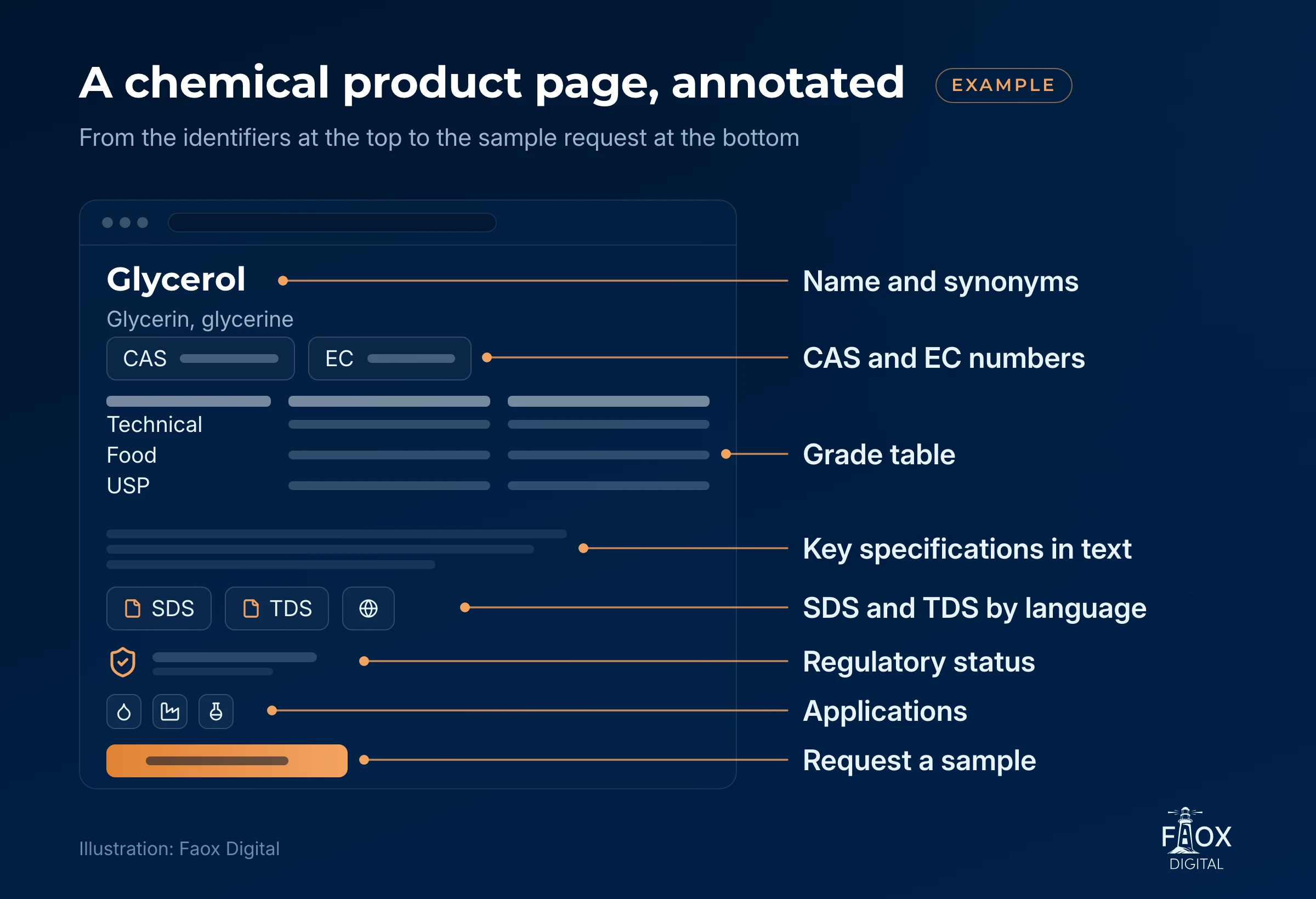
Whichever setup you choose, product and grade pages should carry the name and synonyms, the CAS and EC numbers, a grade table, key specifications in text (assay, key impurities and physical form), packaging sizes, the SDS and TDS by language, the regulatory status, the main applications and a button to request a sample.
Structured data helps search engines read a page, within limits. Schema.org has a ChemicalSubstance type, still in its "new" area, but Google’s list of supported structured data (October 2026) includes no chemical type. Use Product, Organization and BreadcrumbList markup where it fits, and keep the identifiers in visible text. Google’s product snippets need reviews, ratings or offers, which many B2B chemical pages do not have.
SDS, TDS and other PDF documents
SDS and TDS documents are central in chemicals. A safety data sheet is a regulated document: under REACH it must be dated and follow 16 set headings, from identification to other information (Regulation (EC) No 1907/2006, Article 31), and in the US, OSHA’s Hazard Communication Standard sets a 16-section format. A technical data sheet is your own description of performance and use. A certificate of analysis belongs to one batch.
If buyers search for your product with "SDS" added, the result should be your current sheet, not an old copy on another site. Treat your document library as a set of landing pages:
- An HTML library page where documents can be found by product name, CAS number and language
- One stable URL per document and language, with the file replaced at the same URL when it is revised
- The revision date shown on the page and in the document
- Text-based PDF files with clear titles and file names, not scans
- Batch certificates of analysis kept out of search results with an X-Robots-Tag noindex header, which Google supports for PDF files
Language matters here. REACH requires the SDS in an official language of each Member State where the product is placed on the market, unless that Member State provides otherwise (Article 31(5)). Each language version is also a page that buyers in that country can find. Whether you publish SDSs openly or send them on request is a regulatory and commercial decision, but a document behind a form cannot be found in search.
Application and industry pages
Application and industry pages catch buyers who start with a problem or a function: a defoamer for water-based coatings, a corrosion inhibitor for cooling water or a plasticizer for cable compounds. Give each application its own page, covering the function, the products and grades that fit, starting points from your TDS, compatibility notes and the regulatory points for that use, such as food contact or cosmetics. Add a page for each industry you serve, linking to its applications. Named authors with real experience, such as your application chemists, make these pages more credible.
Regulatory content: REACH and GHS
Regulatory content answers real searches, and it has to be right. This section describes how the rules shape your pages; your regulatory team decides what applies to each product.
- REACH: the EU regulation requires manufacturers and importers to register substances made or imported in quantities of one tonne or more per year (Article 6). State each product’s registration status on its page, with any statement on substances of very high concern that your regulatory team provides, and date both.
- GHS: the UN’s Globally Harmonized System sets how chemical hazards are classified and communicated. The EU applies it through the CLP Regulation, and OSHA’s Hazard Communication Standard is aligned with it in the US. Show hazard information that matches the current SDS, and update both together.
A short regulatory page for each region, explaining how you handle these rules and where buyers find each document, helps procurement teams and gives your sales team a link to send. Keep it factual and current, because an outdated compliance statement does more harm than none.
Sample requests and distributor searches
Before a chemical is ordered, it usually has to pass the buyer’s own tests, so the sample request is a key action to design for. Put a request button on every product and application page. Ask only for what technical sales needs (product, grade, quantity, application, company and country), and track each request as a key event in Google Analytics and in your CRM, with the product it came from.
Distributor searches show buying intent, so a manufacturer needs a distributor finder by country and product. SEO for chemical distributors is a different job: a page for each manufacturer represented, product pages that name the manufacturer, grade, packaging and local stock, SDSs in the local language and a contact who answers. Copying the manufacturer’s text word for word gives search engines no reason to show the distributor’s page over the manufacturer’s.
Multilingual product terminology
Multilingual product terminology is harder in chemicals than in most sectors. One substance can carry a common name, an IUPAC name, trade names and regional spellings, such as glycerol, glycerin and glycerine, and different words again in German, French or Turkish. Research each market’s terms with local sales staff and distributors instead of translating your English list. Keep the CAS number on every language version, because it does not change, and keep the hazard wording on each page identical to the SDS in that language.
Where to start
Start with one product family that matters to sales:
- List the searches. Collect CAS numbers, grades, functions and the words used in recent enquiries.
- Fix the product pages. Put identifiers, grades and specifications in text, with the documents linked.
- Clean up the document library. Give each SDS one stable URL per language, with a visible revision date.
- Add application pages for the uses that bring the most enquiries.
- Track sample requests by product and by source.
If your website platform cannot hold structured product data, documents by language or filters by grade, the fix may be a rebuild rather than SEO work; our guide to B2B website cost explains what drives the price. Other sectors have their own patterns, which our guides to SEO for packaging companies and heavy equipment SEO cover.
How Faox Digital works on SEO for chemical manufacturers
For a chemical manufacturer, Faox Digital starts with an audit and baseline: what the site ranks for, who it competes with and what technical buyers search. We then fix the foundations, including structured data and crawler access, and plan product and grade pages market by market, with each language in its own structure. The priorities, and the reasons behind them, are shared with you before any work begins.
Key takeaways
- Chemical buyers search by substance, CAS number, grade, function and document, so each of these needs a page that answers it.
- Put identifiers, grades and specifications in visible text, and check CAS’s licensing terms before you publish CAS numbers at scale.
- Treat SDS and TDS documents as landing pages: one stable URL per document and language, with visible revision dates.
- Keep regulatory statements accurate, dated and consistent with the SDS, and let your regulatory team own them.
- Make sample requests easy, and track them by product.
Frequently asked questions
What is SEO for chemical manufacturers?
It is the work of making a chemical company’s products findable by the people who specify and buy them: formulators, chemists, purchasers and EHS teams. It covers product and grade pages with identifiers in text, findable safety and technical documents, application and regulatory pages, and sample requests tracked to their source.
How is SEO for chemical distributors different?
A distributor competes with its own suppliers for the same product searches. It wins with what the manufacturer’s page lacks: local stock, packaging sizes, delivery times, SDSs in the local language and a contact nearby. A page for each manufacturer it represents also helps buyers who search by brand.
What should an SEO agency for manufacturers know about chemicals?
It should know how identifiers, grades and documents work, and where regulation sets limits: SDS formats and languages, REACH status, and hazard information that must match the SDS. Ask how the agency checks technical accuracy and who on your side signs off regulatory content.
Does international SEO for chemical manufacturers need separate pages?
In most cases, yes. Each market has its own product names, SDS language and distributors, and REACH requires the SDS in an official language of each EU country where you sell. Keep the CAS number on every version and research each market’s terms instead of translating them.
Sources
- CAS: CAS Registry Number Verified Partner Program, accessed November 2026
- EUR-Lex: Regulation (EC) No 1907/2006 (REACH), consolidated text, 2023
- OSHA: Hazard Communication, accessed November 2026
- Google Search Central: How to specify a canonical URL, 2026
Let’s talk
Where do you want to be found?
Tell us the searches that matter to your business. We will review your site and tell you plainly what to fix first, including what you can do yourself.