
Email Marketing Cost in 2026: What B2B Companies Actually Pay For
What a B2B company actually pays for in email marketing, from platform and CRM licenses to setup and monthly work, with published price points and what moves the budget.
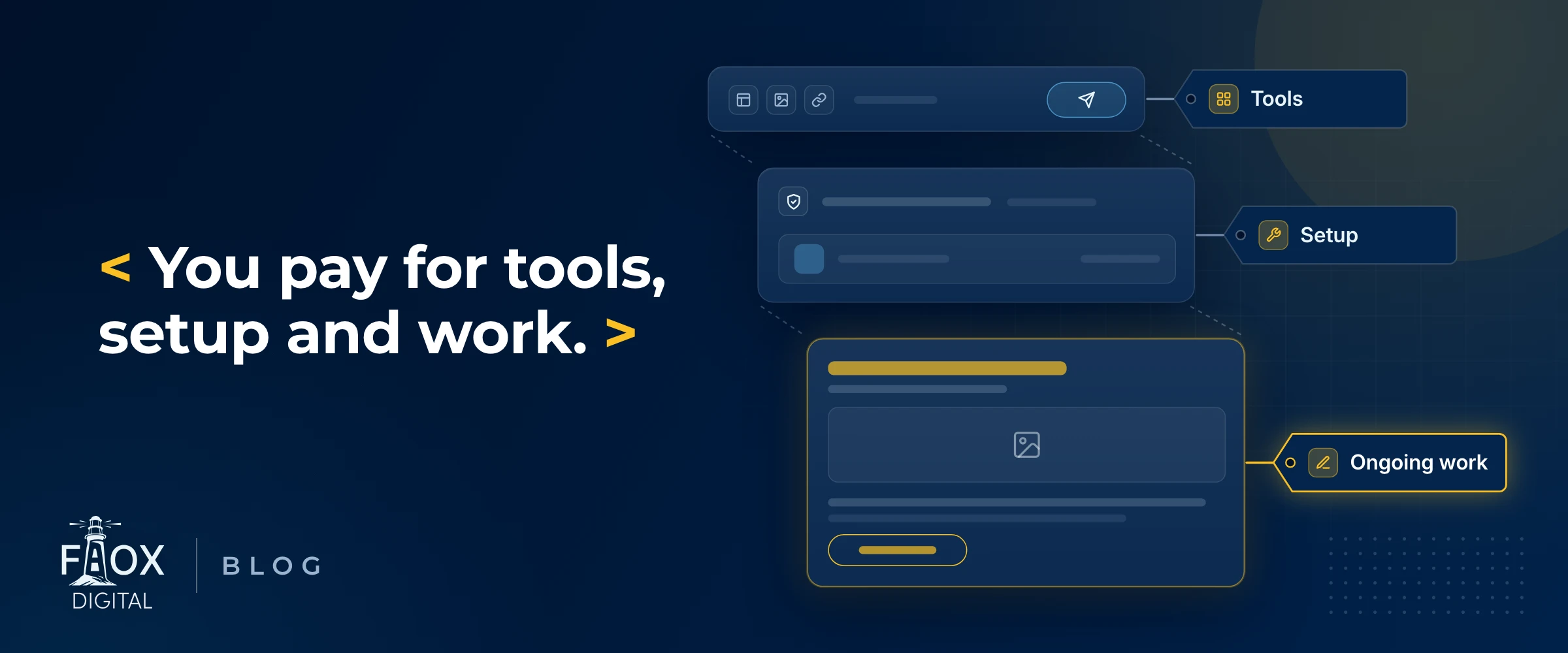
Email marketing cost for a B2B company has three parts: the tools (an email platform priced by contacts or sending volume, and a CRM licensed per user), the setup (configuration, data migration, domain authentication and templates, sometimes with a one-time onboarding fee) and the ongoing work (content, design, translation, sending and reporting), done in-house, by a freelancer or by an agency on a project or monthly basis. List size, the number of languages and how much content you create decide most of the budget.
"How much does email marketing cost?" has no single answer, because the price depends on what you buy: software, a setup project, monthly work, or all three. This guide breaks the cost into its parts, gives the published price points we could verify in November 2026 and explains what makes the budget rise or fall.
We offer this work as part of our B2B email marketing services, so we have a stake in the answer. The figures below come from vendors’ and marketplaces’ own pages, not from our price list.
What email marketing cost includes
For a B2B company, the cost usually falls into three groups:
- Tools: an email marketing platform, a CRM and sometimes add-ons for forms, automation or reporting
- Setup: configuring the tools, cleaning and migrating the contact list, authenticating the sending domain, building templates and connecting website forms
- Ongoing work: planning, writing, design, translation, sending, list care and reporting
On top of these comes your own team’s time: approving emails, supplying technical content and following up the replies. It is easy to forget and often the largest item.
Email marketing platform subscription
An email marketing platform subscription is usually the smallest line in the budget, but it grows with your list. Platforms price in three main ways:
- Pricing by number of contacts: the fee rises with the size of your list, whether or not you email everyone.
- Sending volume: the fee depends on how many emails you send each month.
- Seats and contact tiers: you pay per user and for a tier of contacts you can email.
These are examples from the vendors’ own pages in November 2026, in US dollars as displayed to us:
| Platform | Pricing basis | Free option | Paid examples |
|---|---|---|---|
| Mailchimp | Contacts | A free plan for fewer than 250 contacts | Standard: $20 a month for up to 500 contacts, $100 for 2,501 to 5,000, $135 for 5,001 to 10,000 |
| Brevo | Emails sent per month | Up to 300 emails a day | Starter: $9 a month for 5,000 emails and 500 contacts; Standard: $18; Professional: $499, from 150,000 emails |
| HubSpot Marketing Hub | Seats and marketing contacts | Free tools for up to 2 users | Starter: $20 per seat, with 1,000 marketing contacts; Professional: from $800 a month on an annual plan, with 3 seats and 2,000 marketing contacts |
Prices change often, and several vendors run discounts for new customers, so check the pricing page on the day you decide. For what matters beyond price, our guide to B2B email marketing platforms sets out the criteria.
CRM license
A B2B email program depends on a CRM, and the CRM license is usually charged per user per month. At the time of writing (November 2026), HubSpot’s Starter costs $20 per seat, Salesforce’s Starter Suite $25 per user and Microsoft Dynamics 365 Sales Professional $65 per user, paid yearly; several vendors also offer free plans for one to three users. If your contacts are spread across spreadsheets and inboxes, the CRM setup may be a project of its own; our article on what a CRM consultant does explains when outside help makes sense.
Setup costs
Setup is a one-time cost, but it decides how well everything after it works:
- Platform onboarding: some vendors charge a setup fee. HubSpot, for example, lists a required one-time onboarding fee of $3,000 for Marketing Hub Professional and $7,000 for Enterprise.
- List cleanup and migration: removing dead and duplicate contacts, mapping fields and importing the data, which takes longer the messier the starting point.
- Domain authentication: setting up SPF, DKIM and DMARC for your sending domain. It is usually a small piece of work, but it needs someone with access to your domain settings.
- Templates: a newsletter template and a campaign template that work on phones and in every language you use.
- Connections: website forms, the CRM and the email platform linked, so that contacts and consent stay in one place.
Ongoing work: content, design, languages and reporting
Most of the long-term cost is work, not software:
- Content and design: planning, writing and designing each email. Technical B2B content takes longer, because engineers need to supply and check the facts.
- Multilingual content: every language adds writing or translation and a native speaker’s review, so a program in four languages costs much more than one in a single language.
- Sending and list care: scheduling, testing, segment upkeep, bounce handling and unsubscribes.
- Reporting: a monthly review of clicks, replies, conversations and pipeline, with recommendations.
When an agency or freelancer does this work every month, it becomes a monthly service fee, or retainer.
Three common setups
Most B2B companies end up in one of three setups:
- In-house with entry tools: one person runs a newsletter and a few campaigns on a free or entry plan, with the CRM the sales team already uses. The cost is mainly that person’s time.
- In-house with outside help: the company keeps the planning and the content, and pays a freelancer or an agency for the setup, the templates and the first automated sequences.
- An agency program: a setup project first, then a monthly fee for planning, writing, sending and reporting, with the company supplying technical input and approvals.
The right one depends less on budget than on whether someone inside has the time and skills to keep a steady rhythm.
Who does the work: in-house, freelancer or agency
The biggest choice is who does the work. Here is how the options compare, with the published reference points we could verify:
| Model | How it is priced | Published reference points | Fits when |
|---|---|---|---|
| In-house | Salaries, training and tools | Depends on your market | You send often and someone has the time and skills |
| Freelancer | Per hour or per piece | Email marketers on Upwork: $15 to $40 an hour, typical historical contracts worldwide | Clear, limited tasks such as templates or one sequence |
| Agency, project | A fixed price per project | Email marketing projects reviewed on Clutch: typically $10,000 to $49,999 | Setup, migration or a defined campaign |
| Agency, monthly | A monthly fee for agreed work | Clutch: packages from $200 to nearly $10,000 a month; average agency rate $100 to $149 an hour | An ongoing program with a steady rhythm |
Clutch’s figures come from projects reviewed on its platform and its pricing guide (updated September 2026); Upwork’s come from contracts on its marketplace. Treat both as reference points, not quotes. Project-based and monthly models often combine: a setup project first, then a smaller monthly fee. Our article on marketing agency cost explains these fee models across all marketing services.
What raises or lowers the budget
The budget rises with:
- A larger list, on platforms that charge by contacts
- More languages and markets, each needing its own content and review
- Content written from scratch for every email, especially technical content
- More segments and automations to build and maintain
- A messy starting point: duplicates, missing fields and contacts in many places
- Integrations with the ERP, the website or other systems
It falls when you:
- Clean the list, so that you do not pay for contacts who will never read your emails
- Reuse content you already have, such as application notes, articles and product updates
- Start with one flow, such as trade fair follow-up or a newsletter, before building more
- Pay annually where the platform offers a discount for it
- Keep approvals simple, so that work does not wait for a week of reviews
How to compare quotes
Two quotes for "email marketing" can describe very different work. Ask each provider to list the number of emails, languages and segments, what content it writes and what you supply, the setup work, the tools and who pays for them, the reporting and the notice period. Our list of questions for an email agency helps you compare proposals beyond price.
How Faox Digital approaches the cost of email work
Faox Digital starts email work with an audit of the list, the CRM and past sends, and plans the work from what that audit finds; starting from trade fair contacts or a spreadsheet is fine. The CRM, emails and automations are built in the client’s own tools and signed off by the client, and the work is measured by replies, qualified conversations and pipeline. On a smaller budget, we suggest a first step that fits the company’s stage, even if the team does part of the work itself.
Key takeaways
- Email marketing cost has three parts: tools, setup and ongoing work, plus your own team’s time.
- Platforms charge by contacts, sending volume or seats; a clean list keeps contact-based prices down.
- Setup can include onboarding fees, list cleanup, domain authentication, templates and connections.
- Content, languages and the number of segments drive most of the ongoing cost.
- Compare quotes on scope, not on the monthly figure alone, and treat published rates as reference points.
Frequently asked questions
How much does email marketing cost per month?
It depends on what you buy. Platform plans run from free for small lists to a few hundred dollars a month for larger ones, and a CRM adds a per-user fee. Agency packages listed on Clutch range from $200 to nearly $10,000 a month, depending on the scope.
What is the average cost of email marketing services?
On Clutch, email marketing projects typically cost $10,000 to $49,999, and agencies average $100 to $149 an hour, according to its 2026 pricing guide. Email marketers on Upwork charge $15 to $40 an hour. These are marketplace figures, so ask for a quote based on your own scope.
How much does email marketing cost for a small business?
A small B2B company can start with a free or entry plan: HubSpot’s free tools for up to two users, Mailchimp’s free plan for fewer than 250 contacts or a Brevo Starter plan at $9 a month, as listed in November 2026. The main cost is then the time it takes to write good emails and follow up replies.
Is email marketing cost-effective for B2B companies?
It usually is, because the tools cost little compared with trade fairs or advertising and the emails reach people who already know you. Judge it by the replies, conversations and pipeline it produces against what you spend on tools, setup and work.
Sources
- Clutch: Email Marketing Pricing Guide 2026, updated September 2026
- Upwork: Email Marketer Hourly Rates, accessed November 2026
- Mailchimp: Pricing plans, accessed November 2026
- HubSpot: Marketing Hub pricing, accessed November 2026
Let’s talk
Have contacts you never follow up with?
Tell us about the list you already have. We will show you how email and CRM can turn it into conversations.