
B2B Marketing ROI: How to Calculate It When Sales Take Months
How to work out what marketing returns when a sale takes months, which data you need from the CRM and finance, and how to read the result.
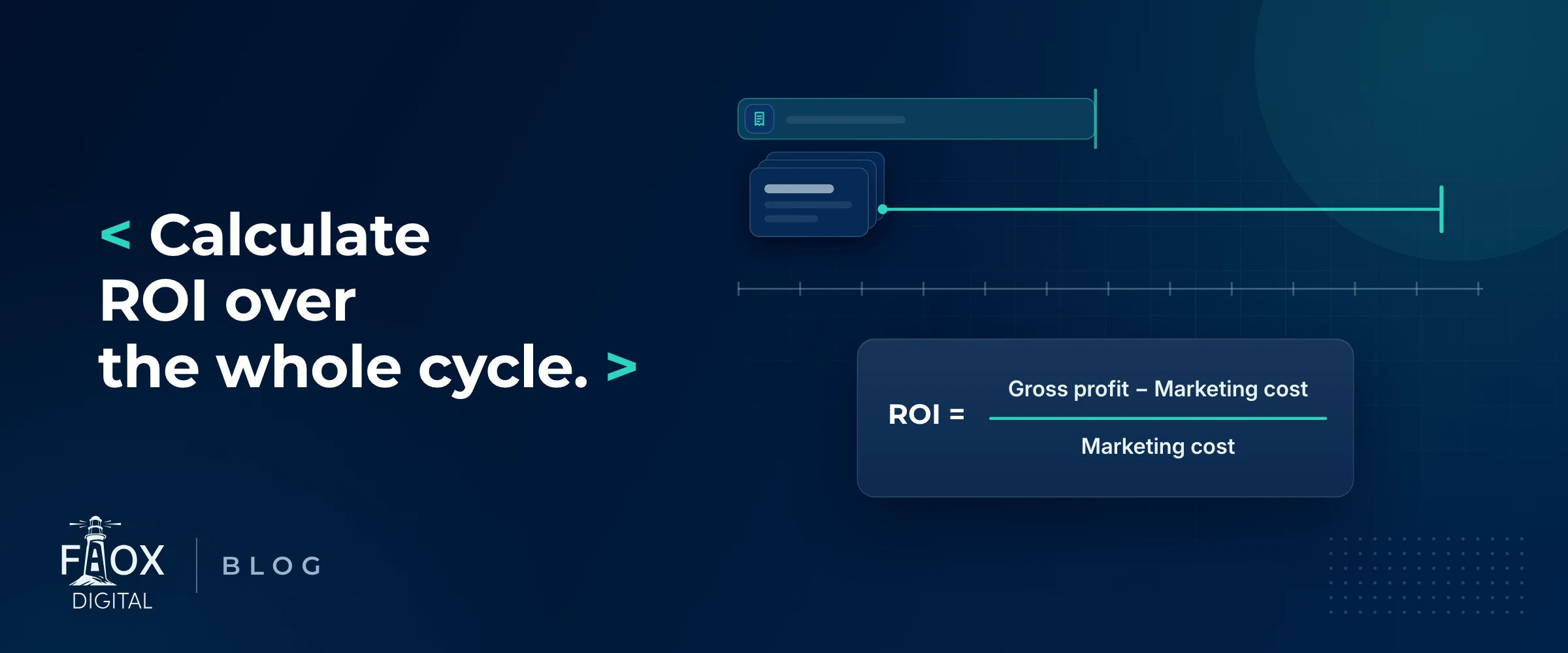
B2B marketing ROI compares the gross profit from the deals marketing helped to win with what the marketing cost: gross profit minus marketing cost, divided by marketing cost. When sales take months, measure over a period at least as long as your sales cycle, follow each group of opportunities until it closes, and add repeat orders through customer lifetime value. The data comes from your CRM, your finance team and your marketing cost records.
Most marketing reports stop where the money starts. They show visits, leads and campaign results, but not whether marketing paid for itself, because the deals arrive months after the spend and the figures sit in different systems.
This guide shows how to calculate B2B marketing ROI step by step, which data you need, and how lifetime value and the payback period complete the picture, with a worked example. It goes deeper into one of the measures in our guide to measuring marketing’s contribution to sales.
What B2B marketing ROI measures
The ROI formula is simple:
ROI = (gross profit from deals marketing contributed to − marketing cost) ÷ marketing cost
Use gross profit, not revenue. A deal worth €100,000 at a 30% margin returns €30,000 to pay for the marketing behind it, not €100,000. And count all of the marketing cost: agency fees, advertising, trade fairs, content production, tools and the time of your own marketing staff.
The result tells you whether marketing returned more than it cost, and it matters for budgets. In The CMO Survey’s 2026 edition, which polled 308 US marketing leaders, the partnership between marketing and finance scored only 4.5 out of 7 for building a business case for marketing spending, and when profits fell short of expectations and executives focused on cutting costs, marketing expenses were cut 45.4% of the time, more often than other costs. A credible ROI figure, agreed with finance, is the best protection against that.
Why ROI is hard when sales take months
Three things make B2B marketing ROI harder than measuring an online campaign:
- The time lag. In 6sense’s 2026 study (6sense sells B2B marketing software), buying journeys took 10.3 months on average. Money spent this quarter mostly produces deals in later quarters, so a quarterly ROI compares this quarter’s costs with last year’s work.
- Shared credit. A sale usually follows several touches by several people, so you have to decide which deals count as marketing’s.
- Repeat orders. A good B2B customer buys again for years. Counting only the first order understates what marketing won.
The data you need
ROI needs three kinds of data, and they usually live in different places:
| Data | Where it lives | What you need from it |
|---|---|---|
| Marketing cost | Finance and invoices | All costs per month, by channel where possible |
| Opportunities and deals | The CRM | Source, creation date, value, stage, close date, won or lost |
| Gross margin | Finance or the ERP | The margin per deal or per product line |
| Repeat orders | The ERP or the CRM | Orders per customer over the years |
CRM data is the backbone. Every opportunity needs its source, the date it was created and its value, and every won deal needs its close date; our B2B CRM guide explains how to set that up. On the website side, enquiries can only be traced to their source if they are measured correctly, which our guide to tracking quote requests in GA4 covers.
How to calculate B2B marketing ROI step by step
- Fix the period and the cohort. Choose a period of marketing spend, such as a year, and follow the opportunities created in that period until they close, even if that takes another year.
- Total the marketing cost for the same period, including people’s time, tools and events.
- Find marketing’s deals. Mark the won deals that marketing sourced and, separately, those it influenced. Report both, so nobody mistakes the generous figure for the conservative one.
- Turn revenue into gross profit with the margin finance gives you for each deal or product line.
- Apply the formula to each group: sourced deals first, then sourced and influenced together.
- Add what is still open. For opportunities not yet closed, multiply their value by your historical win rate and margin, and show the result separately as expected, not earned, profit.
- Review it with finance and agree the definitions before the figure goes into a board report.
A worked example
The figures below are hypothetical, for an invented industrial supplier, and serve only to show the arithmetic:
| Line | Hypothetical figure | Source or calculation |
|---|---|---|
| Marketing cost in the year | €150,000 | Finance |
| Opportunities sourced by marketing in that year | 40, worth €2,000,000 | CRM |
| Deals won from them within 18 months | 10, worth €600,000 | CRM |
| Gross margin | 35% | Finance |
| Gross profit from those deals | €210,000 | €600,000 × 35% |
| ROI on first orders | 40% | (€210,000 − €150,000) ÷ €150,000 |
| Repeat gross profit per customer | €15,000 a year, for 4 more years | Order history |
| ROI including repeat orders | 440% | (€210,000 + €600,000 − €150,000) ÷ €150,000 |
The first-order ROI of 40% looks modest; the lifetime figure looks spectacular. Both are true, and they answer different questions. Show the first, and show the second only with its assumptions.
Customer lifetime value
Customer lifetime value is the gross profit a customer brings over the whole relationship: the first order plus the repeat orders, spare parts and service that follow. In the example, ten customers each bring €15,000 of gross profit a year for four more years, which adds €600,000 to the €210,000 from first orders.
Estimate it from your own order history, not from hope: how long customers stay on average and what they buy each year. Be careful with the future. Money in five years is worth less than money today, and customers leave, so it is safer to count only a few years and to discount the later ones.
Customer acquisition cost and payback period
Customer acquisition cost (CAC) is what it costs to win one new customer: marketing and sales costs in a period, divided by the new customers won. If the example company’s sales costs for these deals were €100,000, its CAC would be (€150,000 + €100,000) ÷ 10 = €25,000.
The payback period is how long it takes for a new customer’s gross profit to cover that cost. In the example, the first order brings €21,000 of gross profit on average, and repeat orders bring about €1,250 a month after it, so the remaining €4,000 is covered a little over three months later. A short payback period means growth funds itself; a long one means you need cash to grow.
Opportunity value: a leading view of ROI
Final ROI arrives late, so track a leading view in between. Opportunity value, multiplied by your historical win rate and your margin, gives the expected gross profit in the pipeline that marketing created. If it grows quarter by quarter, ROI usually follows later.
This matters most for channels with long lead times. Search work, for example, needs months before it moves, as our guide to how long SEO takes explains, and judging it on this quarter’s sales would end it too early. The same applies to measuring social media ROI, where most of the value comes through other channels later.
Comparing ROI by channel
To compare channels, split both sides of the formula: the cost of each channel, including its share of people’s time, and the gross profit from the deals it sourced. Use the same period, the same rule for giving credit and the same margins for all of them, or the comparison means nothing.
Keep shared costs, such as the website and the CRM, in a separate line rather than dividing them arbitrarily between channels. And compare over at least two sales cycles, because channels with long lead times can look weak in their first year and much stronger in their second.
What is a good marketing ROI?
There is no reliable public benchmark for B2B marketing ROI. Figures that circulate online rarely say whether they use revenue or gross profit, which costs they include or how long they waited for deals to close, so they cannot be compared with yours. A result calculated on gross profit will always look lower than one on revenue.
Use three comparisons instead. Above zero over a full sales cycle means marketing paid for itself. Your own trend shows whether it is getting better. And channel against channel, with the same rules, shows where the next euro should go.
Common ROI mistakes
- Using revenue instead of gross profit, which inflates the result.
- Measuring by quarter when the sales cycle runs for most of a year.
- Leaving out people’s time and tools, so the cost looks smaller than it is.
- Mixing sourced and influenced deals in one figure.
- Ignoring repeat orders, which hides the real value of a new customer.
Putting ROI to work
ROI is most useful when the plan was built to be measured. Our guide to building a B2B marketing strategy shows how to set goals you can check later, and if you work with an agency, write your ROI definition into the marketing agency brief, so that proposals are judged on the same basis. Once you know what each channel returns, the next question is how much to invest and where: our guide to the B2B marketing budget takes that up.
How Faox Digital approaches marketing ROI
Faox Digital, a digital growth partner for B2B companies in complex and international markets, runs its six services as one system and suggests first steps that fit a company’s budget and stage. In email and CRM work, we measure replies, qualified conversations and pipeline, the figures an ROI calculation starts from.
Key takeaways
- B2B marketing ROI is gross profit from marketing’s deals minus marketing cost, divided by marketing cost.
- Measure over a period at least as long as the sales cycle, and follow each group of opportunities until it closes.
- Report sourced and influenced deals separately, and agree the definitions with finance.
- Add customer lifetime value and the payback period, with their assumptions stated.
- Judge ROI against zero, your own trend and other channels, not against figures found online.
Frequently asked questions
How do you calculate marketing ROI?
Subtract the marketing cost from the gross profit of the deals marketing contributed to, then divide by the marketing cost. In B2B, use a period at least as long as your sales cycle, and count sourced and influenced deals separately.
How do you calculate marketing ROI in Excel?
Keep two sheets: monthly marketing costs, and an export of CRM opportunities with source, creation date, value, status, close date and margin. Total the gross profit of won deals by source and period with SUMIFS, total the costs for the same period, and compute (profit − cost) ÷ cost in one cell.
What is a good marketing ROI for a B2B company?
Anything above zero over a full sales cycle means marketing paid for itself. There is no reliable public benchmark for B2B, because published figures use different definitions, so compare your own results over time and between channels instead.
How do you calculate the ROI of a marketing campaign?
Collect the campaign’s full cost, then follow the opportunities it sourced or influenced for at least one sales cycle. Convert the won deals into gross profit and apply the same formula, and report open opportunities separately as expected value.
Sources
Let’s talk
Not sure where to start?
Tell us about your business and your goals. We will suggest first steps that fit your budget, even if that means doing some of it yourself.