
How a Digital Marketing Agency Works: A Guide for B2B Companies
What a digital marketing agency takes on for a B2B company, how the work is organized and paid for, and what your own team has to provide for it to work.

In short, this is how a digital marketing agency works: it plans and carries out marketing work for a company, such as strategy, content, the website, SEO, social media, email and PR, and reports on the results. It works from a brief and an agreed scope, usually for a monthly retainer or a project fee. For it to work in B2B, your side has to supply clear goals, expert knowledge, quick approvals, access to your accounts and one person who owns the relationship.
Most B2B companies hire an agency for some part of their marketing at some point: a new website, a year of search work, a product launch or support across every channel. Yet the way agencies actually work, from the first brief to the monthly report, is rarely explained, and many disappointing relationships fail on the client’s side as much as the agency’s.
This guide explains how a digital marketing agency works with a B2B company: what it takes on, how it is organized and paid, and what your team needs to provide. We are a digital marketing agency ourselves, so we describe the work from the inside; the points apply to any agency. The guide is part of our B2B Growth series, and you can browse all B2B Growth articles for related topics.
What a digital marketing agency does for a B2B company
A digital marketing agency is a company that plans and carries out online marketing for its clients and measures the results. A B2B marketing agency is one that specializes in companies selling to other companies, where buying groups decide over months, products are technical and most sales end in a conversation rather than a checkout.
The work usually spans these areas:
| Area | What the agency does | What it needs from you |
|---|---|---|
| Strategy and positioning | Defines goals, audiences, messages and priorities | Business goals, sales input, customer insight |
| Website | Plans, designs, builds and maintains the site | Product information, decisions, sign-offs |
| SEO and AI search | Makes the site findable and answers buyers’ questions | Access to the site and Search Console, expert review |
| Content | Writes articles, guides, case studies and pages | Time with your engineers and sales team |
| Social media | Plans and publishes posts, mainly on LinkedIn | Approvals, experts willing to take part |
| Email and CRM | Builds lists, sequences and newsletters | Contact data, a CRM, rules for follow-up |
| Digital PR | Finds stories and approaches trade media | News, spokespeople, quick answers to journalists |
| Analytics and reporting | Sets up tracking and reports results | Access to GA4 and the CRM, sales outcomes |
Not every agency does all of these, and not every company needs all of them. How the channels fit together is explained in our B2B digital marketing guide.
Full-service or specialist agency
A full-service digital marketing agency covers most channels under one roof, from strategy and the website to search, content, social media, email and PR. A specialist agency does one discipline in depth, such as SEO, PR or web development. Both can work well; the choice depends on what you need most:
| Full-service agency | Specialist agency | |
|---|---|---|
| Strength | One plan, one message, one point of contact | Depth and experience in one discipline |
| Risk | Uneven quality across services | Gaps and overlaps between several suppliers |
| Coordination | Done by the agency | Done by you |
| Fits when | You want channels to work as one system | You have a clear need in one area, or a team that coordinates |
If you hire specialists, each discipline has its own questions to ask: see our guides to choosing a web design agency, an SEO agency, a social media agency, an email marketing agency and a branding agency.
Agencies, freelancers and consultants
An agency is not the only kind of outside help. A freelancer works alone in one discipline, often at a lower rate, but your work depends on one person’s time and skills. A consultant advises and plans, and leaves the execution to your team or to others. An agency brings a team, processes and several disciplines, at a higher price and with more to coordinate.
Many B2B companies combine them: an agency or a consultant for the strategy and the larger projects, freelancers for specific tasks such as translation or photography, and one person in-house who keeps everything together. Whatever the mix, the same rules apply: a clear brief, a written scope and accounts that stay in your company’s name.
Scope of services: what is in and what is out
The scope of services is the written list of what the agency will deliver. A useful scope names the deliverables and their quantities, the markets and languages covered, the meetings and reports included, who pays for tools and licenses, and whether advertising budgets are part of the fee or paid separately.
Just as important is what is out of scope, and what happens when you ask for it. Agree how extra work is requested, priced and approved, for example in writing at an agreed hourly rate. Without that rule, small favors pile up, the agreed work slips and both sides feel short-changed.
How agencies charge: retainer, project or hourly
Agencies use three main fee models, often in combination:
- Monthly retainer: a fixed monthly fee for an agreed scope or number of hours, suited to continuous work such as SEO, content, social media and PR. Check the minimum term, the notice period and what happens to unused hours.
- Project-based work: a fixed price for a defined result, such as a website, a brand identity or a campaign. Check what counts as finished and what extra rounds of changes cost.
- Hourly billing: payment for time used, suited to advice, audits and irregular tasks, but harder to budget.
A common pattern is a project to build the foundations, followed by a retainer for continuous work. The same logic applies within each discipline; our guide to what PR agencies charge shows how retainers and project fees work in PR, for example.
The brief and the proposal
A brief is the document in which you tell the agency what you need: your goals, buyers and markets, what you have done so far, the budget range, the timing, who decides and how you will judge success. It is the cheapest way to improve the work, and often the most neglected. In BetterBriefs’ 2022 survey of 508 marketers and agency staff in the UK, three in four agencies said the briefs they receive from clients are not good enough, and marketers estimated that over a quarter of their marketing budget is wasted on poor briefs and misdirected work.
The proposal is the agency’s answer. A good one restates your problem in its own words, explains its approach and sequence, lists the scope and the named team, and states the fees, the timeline and how results will be reported. Send the same brief to two or three agencies, so that their proposals can be compared line by line.
Onboarding: the first weeks
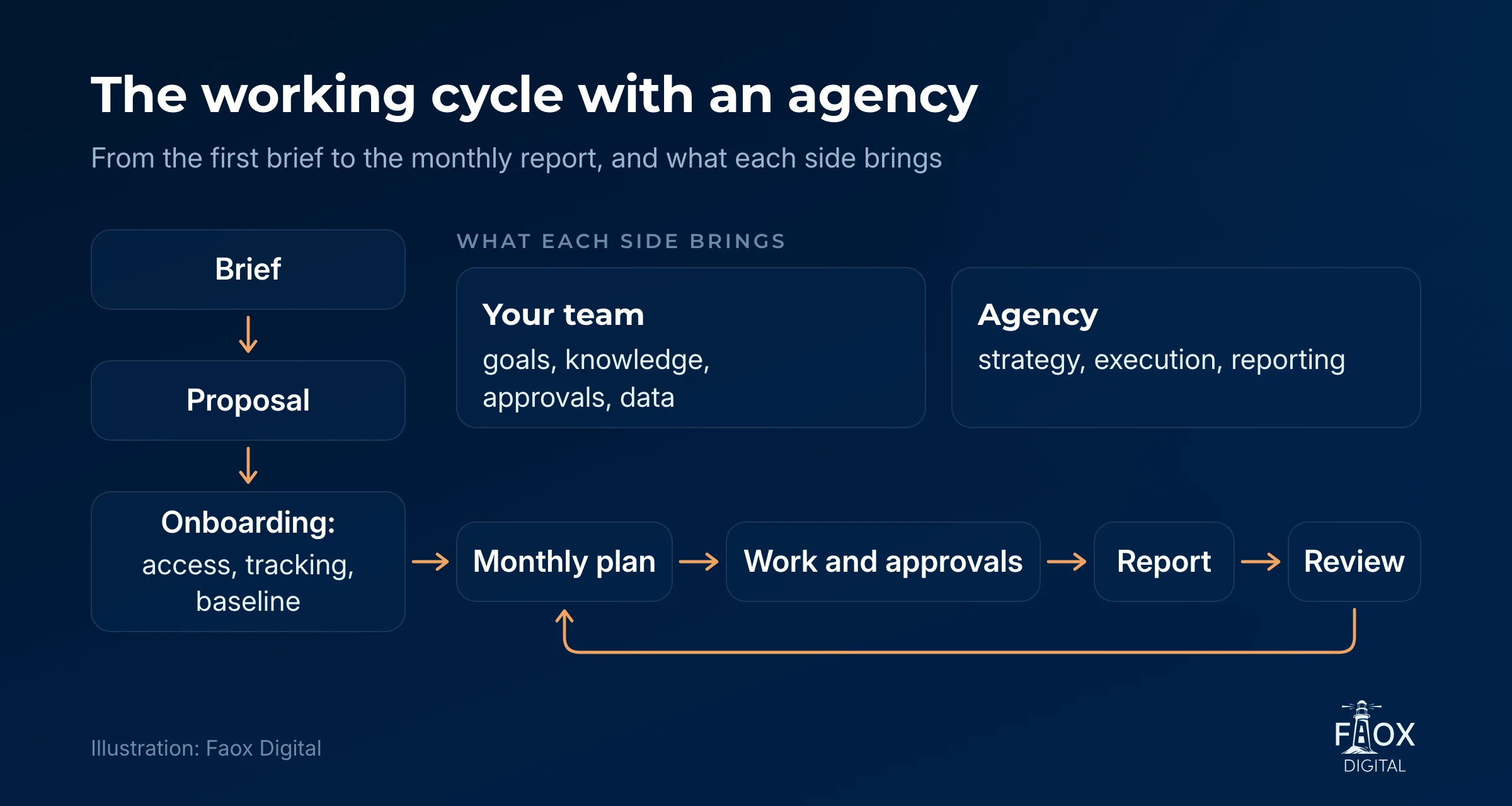
The first weeks set the tone. A typical onboarding includes:
- Kickoff meeting. Goals, contacts, the approval process and the first priorities are agreed.
- Access and tracking. The agency gets the access it needs, and tracking is checked before any work is measured.
- Audit and baseline. The agency reviews the website, search visibility, content and data, and records where things stand.
- Plan for the first 90 days. Priorities, deliverables and owners for the first quarter, signed off by both sides.
- First deliverables. Usually fixes and quick improvements, while longer work such as content and search builds up.
Expect the agency to ask for a lot of time in this phase: product information, brand assets, customer insight and interviews with your experts. That investment pays back in work that sounds like your company rather than like any company.
How a digital marketing agency works month to month
After onboarding, most retainers settle into a monthly cycle:
- Plan the month. Content topics, campaigns and technical tasks are agreed, based on last month’s results.
- Supply input. Your experts answer questions, provide product details and review technical points.
- Produce and approve. The agency drafts; your named approvers check the facts and sign off within the agreed time.
- Publish and run. Pages and articles go live, emails are sent, outreach starts and technical fixes are made.
- Measure and report. The agency collects results from your accounts and prepares the monthly report.
- Review and adjust. Together you decide what to keep, stop or change next month.
Projects such as a new website follow their own plan of phases and sign-offs instead, and often hand over to a retainer when they end.
Access and approvals
Access is where many relationships go wrong, months later. The rule is simple: your company owns its accounts, and the agency works in them with a role you assign. Never share your own passwords, and never let an agency register your accounts or domains in its own name.
The main platforms are built for this. In Search Console, an owner has full control and can add or remove users, a full user can see all data and take some actions, and a restricted user can see most data. Google Analytics assigns roles such as Administrator, Editor, Marketer, Analyst and Viewer. A LinkedIn Page can have super admins, who can add and remove other admins, content admins, who create and manage posts, and analysts, who see the analytics. Give each person the lowest role that lets them do the job, keep at least one owner or super admin inside your company and remove access when someone leaves.
Approvals need the same clarity. Decide who approves which kind of work, how quickly, and who checks technical claims before anything is published. In B2B, an engineer should review technical content, and someone should check legal and compliance points. Slow approvals are among the most common reasons agency work stalls, so agree response times at the start.
Communication rhythm
A steady communication rhythm keeps the work moving without endless meetings. Many relationships settle on three kinds of meeting:
| Meeting | How often | Who takes part | Purpose |
|---|---|---|---|
| Check-in | Weekly or fortnightly | The contact on each side | Tasks, blockers and approvals due |
| Monthly review | Monthly | Contacts, plus a manager on your side | Results against goals and the next month’s plan |
| Strategy review | Quarterly | Management and the agency lead | Priorities, budget and what to change |
Name one contact on each side, keep requests and decisions in one shared place, such as a project tool or a shared document, and record what was agreed in each meeting. When several people on your side give the agency different instructions, the agency follows the last one, and the plan drifts.
Reporting: what a useful report shows
Reporting is where you see whether the work pays off. A useful monthly report shows what was done, what it achieved against the goals you set, what did not work and what comes next. It connects marketing activity to business results, such as qualified enquiries, meetings and pipeline, instead of stopping at impressions and clicks.
Ask for the same structure every month, so that you can compare, and make sure the figures come from accounts you own, such as your GA4 property, your Search Console and your CRM. Our guide to B2B marketing metrics explains which numbers show what marketing contributes to sales.
Your in-house team: what stays with you
Even with an agency, most marketing work stays in the company. In The CMO Survey 2026 of US marketing leaders, B2B product companies said external agencies, partners and services perform about 28% of their digital marketing activities, and B2B services companies about 25%. They expected little change over the next two years.
Some things should stay with your in-house team whatever you outsource: ownership of the strategy and the budget, product and market knowledge, the link to sales, approvals and the relationships with customers. Name one person who owns the agency relationship; in a small company this may be the managing director or the sales manager, in a larger one the marketing manager. The agency can do a great deal, but it cannot know your products and customers as well as you do, so the best results come when your experts take part.
Common mistakes on the client side
Agencies make mistakes too, but these client-side habits undermine even a good agency:
- No owner. Nobody in the company has the time or the authority to decide, so the agency waits.
- A vague brief. "More leads" is not a brief; without goals, buyers and markets the agency has to guess.
- Slow or crowded approvals. Drafts wait for weeks, or several people rewrite them in different directions.
- New priorities every month. Search and content need months to build, and switching focus resets the clock.
- Keeping sales out. If the agency never hears which enquiries became business, it optimizes for the wrong thing.
- Judging by activity. Counting posts and pages instead of enquiries and pipeline rewards busy work.
Signs the relationship is working
After the first three to six months, you should be able to tick most of these:
- The agency asks about your business, buyers and sales, not only about tasks
- Work arrives when agreed, and changes are discussed before they happen
- The same people work on your account as were introduced at the start
- Reports connect activity to enquiries and sales, and explain what did not work
- You can see your data in accounts your company owns
- The plan changes when the results say it should
- Nobody promises rankings, coverage or results that no agency controls
If several are missing, raise them in the monthly review before deciding to change agency. Many problems come from an unclear brief, slow approvals or a missing owner on the client side, and those follow you to the next agency.
Working with a marketing agency: the guides in this series
This guide covers the whole relationship. The articles in this series go deeper into each decision:
- The brief: how to write a marketing agency brief that gets comparable proposals.
- Agency or team: when an agency, an in-house team or a mix fits best, in our comparison of marketing agency vs in-house.
- The choice: the questions to ask when choosing a marketing agency.
- The price: what drives marketing agency cost, and how fee models compare.
How Faox Digital works with B2B companies
Faox Digital, a digital growth partner for B2B companies in complex and international markets, runs its six services as one system, from the website and SEO to social media, email and CRM, digital PR and branding. Clients see the priorities and the reasons before SEO work begins, sign off each step of a website project before the next one starts and approve a monthly social media calendar rather than every post. We suggest first steps that fit the company’s budget and stage, even if that means the company does some of the work itself.
Key takeaways
- A digital marketing agency plans and carries out marketing work and reports on it, working from a brief and an agreed scope.
- Choose a full-service agency to run channels as one system, or specialists for depth in one discipline, and plan who coordinates.
- Agree the scope, the fee model, the approval process and the communication rhythm in writing at the start.
- Keep ownership of your accounts and data, and give the agency roles rather than passwords.
- Most marketing work stays in-house, so name an owner and involve your experts.
Frequently asked questions
How do you choose a digital marketing agency?
Write a short brief, send it to two or three agencies and compare their proposals line by line on scope, team, approach, reporting and fees. Ask for examples of similar B2B work, meet the people who will work on your account and call a reference before you sign.
How much does a digital marketing agency cost?
It depends on the scope, the markets and languages, the seniority of the team and the fee model. Compare quotes only on the same written scope, turn monthly fees into hours, and keep advertising budgets, tools and licenses as separate lines.
How do you write a marketing brief for an agency?
Keep it to a few pages: your goals, buyers and markets, what you have done so far, what must not change, the budget range, timing, decision makers and how you will judge success. Add examples of work you like and dislike, and offer time with your experts.
What makes an agency a B2B specialist?
Experience with long sales cycles, buying groups and technical products, shown in work for similar companies. A B2B specialist asks about your sales process and measures results in enquiries and pipeline, not only in reach.
Sources
- The CMO Survey: Firm and Industry Breakout Report 2026, 2026
- IPA: New better briefing best practice guide (BetterBriefs UK data), 2022
- Search Console Help: Managing owners, users, and permissions, accessed November 2026
- LinkedIn Help: LinkedIn Page admin roles, accessed November 2026
Let’s talk
Not sure where to start?
Tell us about your business and your goals. We will suggest first steps that fit your budget, even if that means doing some of it yourself.