
How to Build a B2B Marketing Strategy Where Every Channel Works Together
A step-by-step way to turn goals, buyers, markets and positioning into one plan in which the website, SEO, social media, email and PR each have a job.

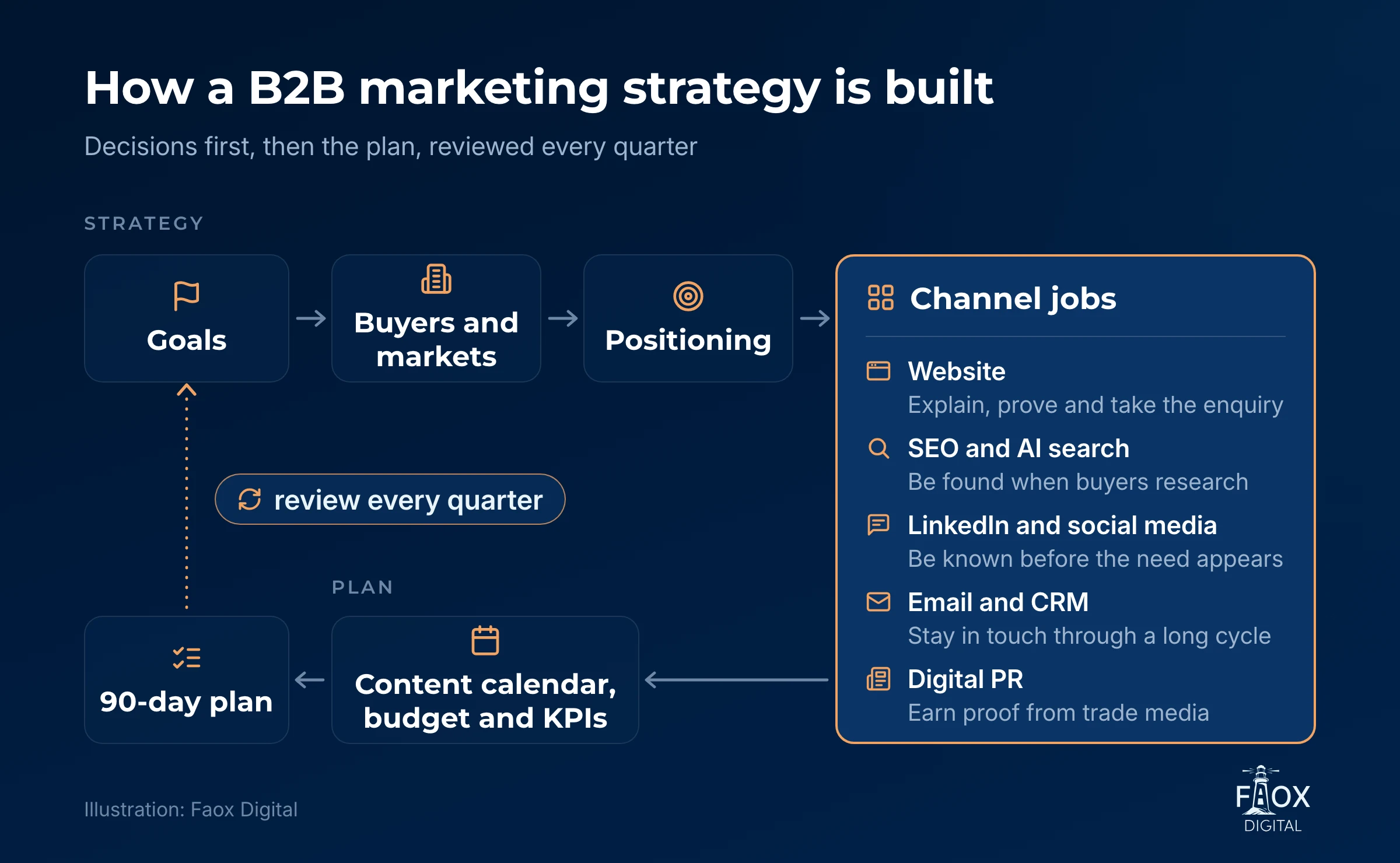
A B2B marketing strategy connects what the business wants to achieve with the buyers and markets that can deliver it, one clear position and a few channels that each have a defined job. Build it in that order: goals, buyers, markets, positioning and channel roles, then a shared content calendar, budget and KPIs, and turn it all into a 90-day plan that you review every quarter.
In many B2B companies, marketing grows channel by channel. One agency built the website, another runs the search work, someone in sales posts on LinkedIn, and the trade fair budget sits in another department. Each part may work on its own, yet buyers meet several versions of the company, and nobody can say which spending leads to sales.
A B2B marketing strategy fixes that by deciding, before any channel work, what each channel is for and how the channels hand buyers to each other. This guide walks through the steps. If you need the basics of the channels first, our B2B digital marketing guide explains how they work.
What is a B2B marketing strategy?
A B2B marketing strategy is a set of decisions about where a company will grow, which buyers it will win, what it will say to them and which channels will carry that message. It is not a list of activities. Three terms are often mixed up:
| Term | What it answers | Example |
|---|---|---|
| Strategy | Where to grow, for whom, with what message, through which channels | Win food plants in Germany with hygienic valve expertise |
| Plan | What happens when, who does it and with what budget | A 12-month calendar of content, campaigns, fairs and owners |
| Tactics | The individual actions | An application guide, a LinkedIn post, a follow-up email |
A B2B marketing plan turns the strategy into dates, owners and budgets. An integrated marketing strategy adds one condition: every channel repeats the same position, works from the same calendar and is measured against the same goals, so a buyer who meets you in search, on LinkedIn and at a trade fair meets one company. A B2B digital marketing strategy is the online part of the whole, and it works best when trade fairs and sales follow the same plan.
Set goals the business cares about
Start from the business plan, not from the channels. Which products, customer groups and markets should grow over the next one to three years, and what does sales need from marketing to get there? Turn each business goal into a marketing goal you can count, such as qualified quote requests per quarter for one product line, meetings with target accounts in one market or repeat orders from existing customers.
Keep it to three or four goals. More goals mean thinner budgets for each, and channels start competing for attention instead of working together. Agree the goals with sales, including what counts as a qualified enquiry, before any channel work starts; otherwise the two teams will judge success by different numbers.
Define the target audience and the buying group
The target audience in B2B means two things: the companies you want and the people inside them. Describe the companies by industry, size, application and buying trigger, such as a new plant, a new regulation or a supplier that keeps failing. Then list the roles in the buying group: the engineer who specifies, the purchaser who compares, the manager who approves and the people who will use what you sell.
Each role needs something different. Engineers want specifications, test results and application examples; purchasers want certificates, delivery terms and references; managers want low risk, a clear total cost and a supplier they can trust. Write down the three or four questions each role asks before buying. Those questions become your content plan, your page structure and the brief for every channel.
Choose your target markets
Target markets decide the languages, channels and budget you need. Rank your markets by what you can actually win: existing customers and references, distributor coverage, certification and regulation, competition, and how buyers search there. Choose one or two priority markets for the first year and serve the rest at a lower level.
Each priority market needs its own keyword research, its own trade press and often its own proof, such as local references or certificates. A translated website alone is rarely enough. Our guide to a B2B go-to-market strategy covers entering a new market step by step.
Write the positioning before the channels
Positioning is the decision every channel repeats: who you are for, what you do better than the alternatives and the proof. Without it, each channel invents its own message, and the strategy turns into a set of unrelated campaigns. Keep it to one page, test it with your sales team and a few customers, and give it to everyone who writes for the company, including agencies. How to work it out is covered in our guide to brand positioning for B2B.
Channel selection: give each channel one job
Channel selection starts from the buyer journey, not from what competitors do. Give each channel one main job, and choose the two or three that matter most for your goals before adding more:
| Channel | Main job | Put it first when | First thing to measure |
|---|---|---|---|
| Website | Explain, prove and take the enquiry | Visitors arrive but few ask for a quote | Quote requests by page |
| SEO and AI search | Be found when buyers research | Buyers search for your product or application | Impressions and clicks for key topics |
| LinkedIn and social media | Be known before the need appears | Your buyers are hard to reach through search | Engagement from target companies |
| Email and CRM | Stay in touch through a long cycle | You have contacts but no follow-up | Replies, meetings and pipeline |
| Digital PR | Earn proof from trade media | Buyers do not know or trust you yet | Coverage in the titles they read |
The website is where the other channels lead, so fix it first if it cannot convert. SEO works over months, so start early if search matters in your market. Social media in B2B works best through your own experts; our guide to building a social media strategy covers it in detail. Email and CRM turn contacts from the website and trade fairs into conversations, and digital PR adds proof from people other than you.
How the channels work together
Channels work together when they pass the same buyer from one to the next. A trade article sends an engineer to an application page; the page offers a data sheet; the download starts a short email sequence; sales calls when the account shows interest; and the CRM records what led to the deal. Plan these handoffs on purpose:
- One message: every channel uses the positioning and the same key terms.
- One calendar: launches, fairs and campaigns appear in every channel at the same time.
- One journey: each piece of content points to the next step.
- One owner: one person is responsible for the whole, even when several agencies do the work.
- One view of results: every channel reports into the same KPIs and the same CRM.
Build a content calendar
A content calendar turns the strategy into a rhythm. Plan by quarter: pick one or two themes that answer your buyers’ main questions, and anchor them to dates you already know, such as trade fairs, product launches and seasonal demand.
Then work from one core piece a month, such as an application guide, a case study or a technical article written with your engineers, and adapt it for each channel: a page on the website, a few LinkedIn posts from the expert, a newsletter and, if the story is newsworthy, a pitch to a trade editor. Name an owner and an approval step for each piece, and leave room for news you cannot plan. A modest calendar that runs every month beats an ambitious one that stops in March.
Set the budget
There is no correct share of revenue for marketing, but surveys give a range. Gartner’s 2026 CMO Spend Survey, of 401 marketing leaders mostly at companies with more than $1 billion in revenue, put average marketing budgets at 7.8% of company revenue. The CMO Survey 2026, sponsored by Duke University’s Fuqua School of Business, Deloitte and the American Marketing Association, asked US marketing leaders in January 2026: marketing expenses averaged about 7% of revenue at B2B product companies and about 10% at B2B services companies, with a wide spread between firms.
Use such figures as a sense check, and build the budget from the strategy instead: price the jobs you have chosen, such as fixing the website, a year of search work, the content calendar and PR in two markets. Keep fixed costs, such as the website, tools and the CRM, apart from project work, and keep a reserve for what the first quarter teaches you.
Balance matters as well. Gartner’s 2026 survey found that awareness and conversion take 62.6% of media spend, while loyalty and retention fell to less than 15%. In B2B, where existing customers reorder and recommend you, cutting the work that keeps you in touch is a false saving. If agencies will do part of the work, a clear brief keeps their quotes comparable; our guide on how to brief an agency shows what to include.
Choose KPIs at three levels
KPIs should follow the jobs you gave each channel and add up to the business goals. Use three levels:
- Business results: qualified enquiries, pipeline value, won deals and revenue from target markets and products.
- Channel jobs: the first measure for each channel in the table above, such as quote requests by page or coverage in target titles.
- Health checks: site speed, search visibility, email deliverability and the time it takes to answer an enquiry.
Agree the targets with sales, review the first two levels every month and the whole set every quarter. Set up tracking before campaigns start: our guide to GA4 setup for B2B shows how to track forms and quote requests, and our guide to calculating marketing ROI explains how to judge the return when sales take months.
Check the strategy before you start
Before the first campaign, check that the strategy holds together:
- The goals are agreed with sales and can be counted
- Each priority market has its own language, proof and trade press
- The positioning fits on one page, and the sales team repeats it
- Each channel has one job and one first measure
- The calendar names a core piece of content for every month
- The budget covers fixed costs, project work and a reserve
- One person owns the whole strategy, not only a channel
- Tracking works before the first campaign starts
Your first 90-day plan
A strategy proves itself in the first quarter. A typical 90-day plan:
- Weeks 1 and 2: agree the basics. Goals, target accounts, priority markets and positioning on one page, signed off by management and sales.
- Weeks 3 and 4: set up tracking and the CRM. Key events in GA4, sources in the CRM and a rule for who answers enquiries and how fast.
- Weeks 3 to 6: fix the pages that convert. Main product pages, proof and the quote request form, in your priority languages.
- Weeks 5 to 8: start the first theme. One core piece of content, adapted for the website, LinkedIn and email.
- Weeks 7 to 10: follow up. Contact recent trade fair visitors and enquiries with something useful, and pitch one story to the trade press.
- Weeks 11 and 12: review. Compare results with the KPIs, keep what works and adjust the next quarter’s calendar and budget.
Small teams can run this plan with one market and one product line, and add more once the first quarter shows what works. If you make physical products, our integrated marketing program example shows what such a program looks like for a manufacturer.
How Faox Digital builds a B2B marketing strategy
Faox Digital, a digital growth partner for B2B companies in complex and international markets, plans its six services, from the website and SEO to social media, email and CRM, digital PR and branding, as one system rather than as separate channels. We suggest first steps that fit the company’s budget and stage, even if that means the company does some of the work itself.
Key takeaways
- A B2B marketing strategy decides where to grow, for whom, with what message and through which channels.
- Agree goals with sales, then define the buying group, priority markets and positioning before choosing channels.
- Give each channel one job, and plan the handoffs with one message, one calendar and one owner.
- Build the budget from the jobs you chose, and use benchmarks only as a sense check.
- Measure business results, channel jobs and health checks, and review the plan every quarter.
Frequently asked questions
What are the main B2B digital marketing strategies?
Most combine five channels: a website that converts, SEO and AI search for buyers who research, LinkedIn and expert content to be known before the need, email and CRM to stay in touch, and digital PR for proof from trade media. Which channels lead depends on your goals and buyers; the strategy is the decision about how they work together.
What is the difference between a marketing strategy and a marketing plan?
The strategy decides where to grow, for whom, with what message and through which channels. The plan turns those decisions into a calendar, owners, budgets and deadlines. The plan can change every quarter, while the strategy should hold for a year or more.
Is there a template for a B2B digital marketing strategy?
The sequence in this guide works as one: a page each for goals, buyers and markets, positioning and channel jobs, followed by the content calendar, budget, KPIs and a 90-day plan. Keep the whole document short enough that sales and every agency will read it.
How does a B2B marketing strategy differ for manufacturers?
The steps are the same, but the proof is more technical: specifications, certificates, test data and application examples carry more weight, and trade fairs, distributors and technical publications sit next to the digital channels. The buying group usually includes engineers, so content written with your own engineers matters most.
Sources
Let’s talk
Not sure where to start?
Tell us about your business and your goals. We will suggest first steps that fit your budget, even if that means doing some of it yourself.