
The B2B Buyer Journey: How Buying Committees Choose a Supplier
How a buying committee moves from noticing a need to choosing a supplier, how long that takes and where marketing can help at each stage.
The B2B buyer journey is the path a company follows from noticing a need to choosing a supplier: need recognition, supplier research, a shortlist, requests for quotation, reference checks and a final decision. A buying committee of decision makers, technical evaluators and purchasing staff moves through it together over months, and does most of the work before it contacts any supplier. Marketing comes in at every stage, long before the first sales conversation.
Most suppliers meet their buyers late. By the time a quote request arrives, a group of people at the customer has usually agreed on the problem, compared the options and ranked a favorite. The sales conversation then tests a choice that is already taking shape.
This guide follows the B2B buyer journey, also called the B2B customer journey, stage by stage, and shows where marketing can help. It builds on our overview of how B2B digital marketing works.
What is the B2B buyer journey?
The B2B buyer journey is the series of steps an organization takes to buy a product or service, from the first sign of a need to a signed contract. It is the buyer’s side of the sales cycle and the B2B version of the customer journey, with one big difference: a group decides, not a person.
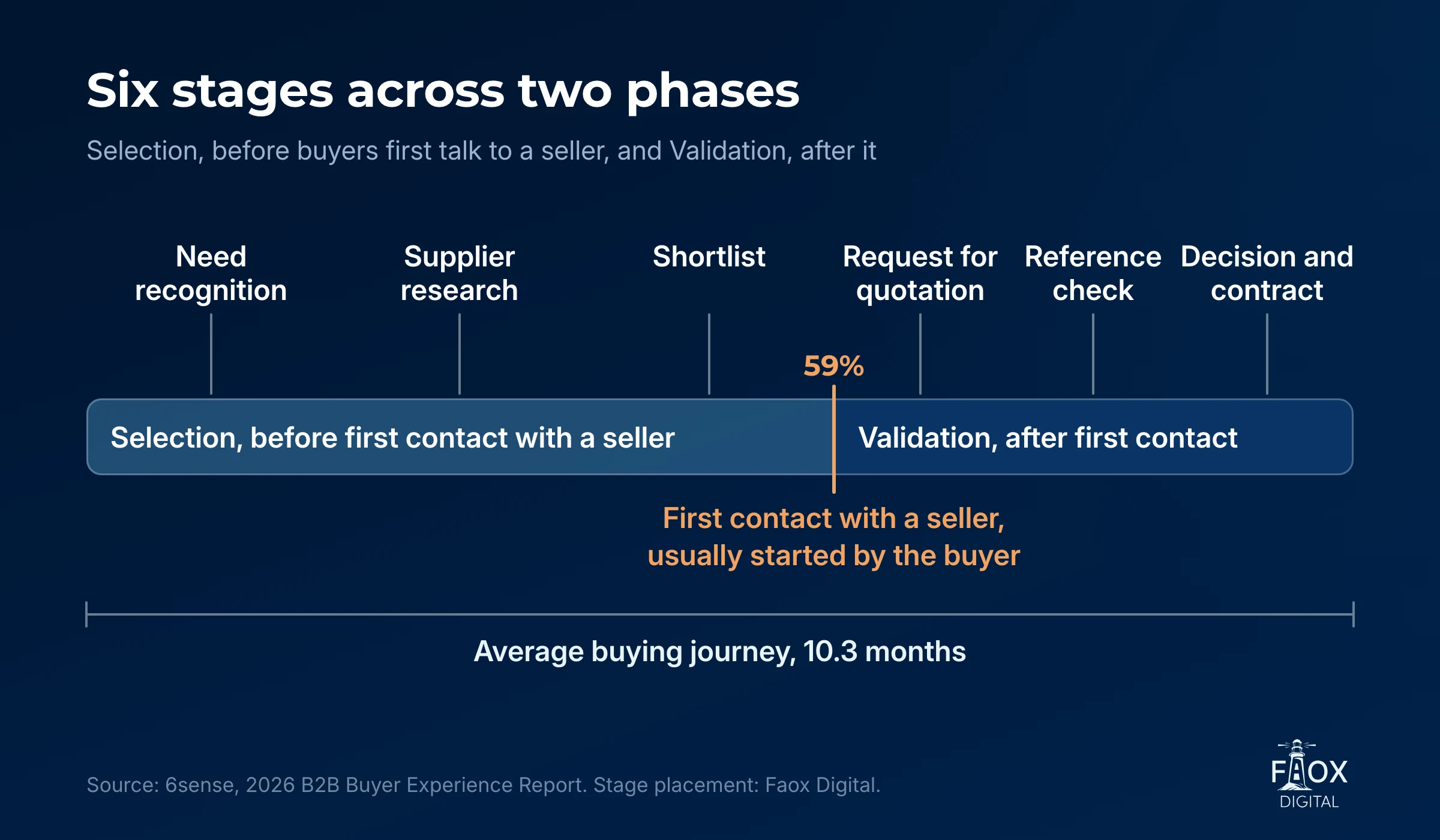
Two research models help. Gartner describes six "buying jobs", and its 2018 research found that most buyers revisit nearly every job at least once, so the path looks more like a maze than a line. 6sense, which sells B2B marketing software, splits the journey into two phases in its 2026 study of 3,596 completed purchases: Selection, before buyers first talk to a seller, and Validation, after it. On average, that first contact came 59% of the way through a 10.3-month journey.
The six stages of the B2B buyer journey
Most journeys pass through six stages, which often overlap or loop back.
| Stage | What the buying committee does | Who usually leads | Where marketing helps |
|---|---|---|---|
| Need recognition | Notices a problem and agrees it is worth solving | The department with the need | Being known before the need appears |
| Supplier research | Explores solutions and suppliers, mostly online and alone | Technical evaluators | Complete answers in search and AI tools |
| Shortlist | Narrows the field to a few suppliers and ranks them | The whole committee | Proof on the website, in the trade press, from peers |
| Request for quotation | Sends the specification and compares offers | Purchasing, with technical evaluators | An easy quote request and a fast, complete reply |
| Reference check | Checks references, certificates and outside opinions | Purchasing and the decision maker | References and documents ready to share |
| Decision and contract | Agrees, gets budget approval and signs | The decision maker | Consistent information the champion can pass on |
The table is our summary of a typical purchase.
Who sits on the buying committee
A buying committee, or buying group, is everyone who shapes the decision. The mix varies, but the same roles come back:
- Decision maker: owns the budget and signs off, often a general or plant manager.
- Technical evaluators: engineers and specialists who check that a product meets the specification.
- Purchasing department: compares suppliers, prices and terms, and usually runs the request for quotation.
- Users: the people who will work with the product every day.
- Champion: the person who argues for the purchase inside the company.
- Outside influencers: consultants, analysts, distributors and peers at other companies.
How many people that adds up to depends on who is counted. 6sense’s 2026 study puts the average buying group at about 10 people, while Forrester’s 2026 research, based on nearly 18,000 buyers, counts 13 internal stakeholders and nine external participants in a typical decision, more for complex purchases. Forrester also finds procurement professionals acting as decision makers in 53% of buying cycles, involved from the start and judging specifications as well as price.
Need recognition: the journey starts before the search
Every journey begins with a trigger: a machine that keeps failing, a new regulation, a plant expansion, a supplier that let the company down. In 6sense’s 2026 data, advances in available technology and the need to grow or scale were the most common triggers. Gartner calls this first job problem identification.
The committee rarely starts from zero. In the same study, 96% of buyers said they keep up with their category between evaluations, most often through vendor websites, industry events, review sites and industry publications. Marketing’s job here is to be known before the need appears: content that helps a reader name the problem, a presence in the trade press and at events, and experts whose posts people remember.
Supplier research and the shortlist
Next comes supplier research. Technical evaluators explore solutions, write down requirements and look for suppliers, mostly on their own: in search engines and AI tools, on supplier websites, in the trade press and through peers. Gartner calls these jobs solution exploration, requirements building and supplier selection.
The shortlist forms early. In 6sense’s 2026 study, buyers considered about five vendors and started their evaluation with a shortlist of about three, and the eventual winner was on that first shortlist in 92% of journeys. By the time buyers first spoke to a seller, 91% had ranked their shortlist, and the buyer’s team, not the vendor, started 82% of those first contacts.
So your website has to sell while nobody from your company is in the room: a technical evaluator should find specifications, application examples, certificates and a clear next step without calling. Our guide to how buyers move through a B2B website covers the paths that matter.
Request for quotation and evaluation
With a shortlist in hand, the committee contacts suppliers, usually through a request for quotation (RFQ) or, for larger projects, a request for proposal. Technical evaluators check each offer against the specification, while purchasing compares price, total cost, delivery and payment terms. For many products, the committee also asks for samples, a test run or a trial.
Here, speed and completeness count. Marketing helps by making the quote request easy, keeping data sheets and certificates ready, and using email automation workflows to follow up a sent quote or a sample request on time.
Reference checks and the final decision
Before committing, buyers check. They ask for references and call existing customers, verify certificates and approvals, and listen to outside voices. In 6sense’s 2026 study, 74% of buyers involved at least one outside resource, most often consultants or analysts, and Forrester finds that buyers check what they learn with peers, product experts and analysts they trust.
The decision itself is a negotiation inside the customer’s company: the committee has to agree that the purchase is worth making, then on the supplier, then win budget approval. The first part is often the hardest: 56% of buyers in 6sense’s study found agreeing that this kind of solution deserved investment harder than choosing the vendor. Many journeys pause here, but 78% of buyers with a stalled evaluation expected to return to the purchase within 12 months, so a paused journey deserves useful follow-up, not silence.
The journey also continues after the contract. Delivery, service and the next order decide whether you are on the shortlist next time. In 6sense’s study, buyers had bought the eventual winner before, or used it at an organization that had bought it, in 73% of journeys.
How long the B2B sales cycle takes
The sales cycle is long because every stage involves several people. In 6sense’s 2026 study, which covers purchases worth at least $25,000 a year, journeys took 10.3 months on average: 8.2 months to upgrade, renew or replace an existing solution, and 11.3 months to add a new capability. Solutions that buyers saw as the first of their kind took longest, 12.7 months, against 9.8 months in established categories. These are buyers’ own estimates, and your sector may differ.
Marketing cannot make a committee decide faster, but it can remove delays on the supplier’s side: missing information, slow replies, documents the champion cannot share. Judge it over a period as long as the cycle, not month by month.
How AI search is changing the journey
AI search is now part of most journeys, but mostly in the middle. In 6sense’s 2026 study, 81% of buyers used large language models such as ChatGPT during the journey, more often in the middle than at the start, and mainly to sort, summarize and check what they already knew; only about a quarter used them to find new vendors. Forrester’s 2026 research puts AI use at 94% of buyers, and Gartner’s survey of 645 buyers, published in May 2026, at 45% for a recent purchase. The figures differ because the questions differ.
All three agree that buyers check what AI tells them. Forrester notes that AI search tools can give incomplete or unreliable answers, so buyers turn to sources they trust, and in Gartner’s survey 69% of buyers preferred to validate AI-generated insights with a sales rep. For a supplier, the facts an AI tool can find should be complete, current and the same everywhere, and your sales and technical staff should confirm them. Nobody can promise that an AI tool will mention you, but you can make it easier to describe you correctly.
How to map your own buyer journey
A journey map turns these patterns into a picture of your own buyers:
- Talk to recent buyers. Interview a few recent customers and, if you can, a buyer who chose someone else. Ask what started the search, who took part, where they looked and what nearly stopped them.
- Name the committee. List the roles that took part and what each one needed to see.
- Write down each stage’s questions. For every stage, note what buyers asked and where they looked for answers, including AI tools.
- Match questions to answers. Find the page, document or person that answers each question, and mark the gaps.
- Fix the biggest gap first. It is often missing specifications, proof that only sales can show, or slow replies to quote requests.
If you are entering a new market, a go-to-market strategy template turns the map into a message, channels and a sequence.
Where to go from here
Two questions usually follow. How does all this compare with selling to consumers? Our article on B2B and B2C differences explains what changes. And with a journey this long, which channel deserves credit for the sale? Our guide to attribution models for B2B looks at how to share it.
Then comes the practical question: what should your marketing do about it? Our guide to building a B2B marketing strategy shows how to set goals, choose markets and give each channel a role in the journey.
How Faox Digital plans marketing around the buyer journey
Faox Digital, a digital growth partner for B2B companies in complex and international markets, runs its six services as one system, so a buying committee meets the same company in search, on the website, in email and in the press. In practice, we map the questions buyers ask at each stage, including those they put to AI tools, give each page a job on the way to an inquiry, and plan follow-up by stage rather than sending one message to everyone. We suggest first steps that fit a company’s budget and stage, even if that means the company does some of the work itself.
Key takeaways
- The B2B buyer journey runs from need recognition through research, the shortlist, quotations and reference checks to a decision, often looping back.
- A committee decides: about 10 people in 6sense’s 2026 study, and 13 internal stakeholders plus nine external participants in Forrester’s 2026 research.
- Buyers do most of the work alone: in 6sense’s 2026 study, first contact with a seller came 59% of the way through a 10.3-month journey.
- AI tools are part of most journeys, but buyers check what they say with people they trust.
- Marketing has a job at every stage: be known before the need, be complete during research, make it easy to ask and give the committee proof it can share.
Frequently asked questions
What are the stages of the B2B buyer journey?
Our summary has six: need recognition, supplier research, shortlist, request for quotation and evaluation, reference checks, and the decision and contract. The stages overlap, and a committee often goes back a step when a new member joins or a requirement changes.
What does Gartner say about the B2B buyer journey?
Gartner describes six buying jobs instead of stages: problem identification, solution exploration, requirements building, supplier selection, validation and consensus creation. Its 2018 research found that most buyers revisit nearly every job at least once, and that validation and consensus creation run through the whole process.
What does Forrester’s research show about B2B buying?
Forrester’s State of Business Buying, 2026, based on nearly 18,000 buyers, describes cautious buyers who widen their networks, involve procurement from the start and check AI answers against trusted sources. More than 60% of the buyers it surveyed used some form of trial before committing.
How is the B2B SaaS buyer journey different?
The stages are the same, but the committee changes. In 6sense’s 2026 study, IT took part in about seven in ten software purchases, against about four in ten purchases of physical goods or services, while purchases of physical goods involved procurement more often than the other two types. Forrester adds that trials matter most for complex technology purchases.
Sources
Let’s talk
Not sure where to start?
Tell us about your business and your goals. We will suggest first steps that fit your budget, even if that means doing some of it yourself.