
What Is B2B Digital Marketing and How Does It Work? A Complete Guide
What B2B digital marketing is, why it works differently from B2C, and how the website, search, LinkedIn, email, digital PR and brand work together as one system.
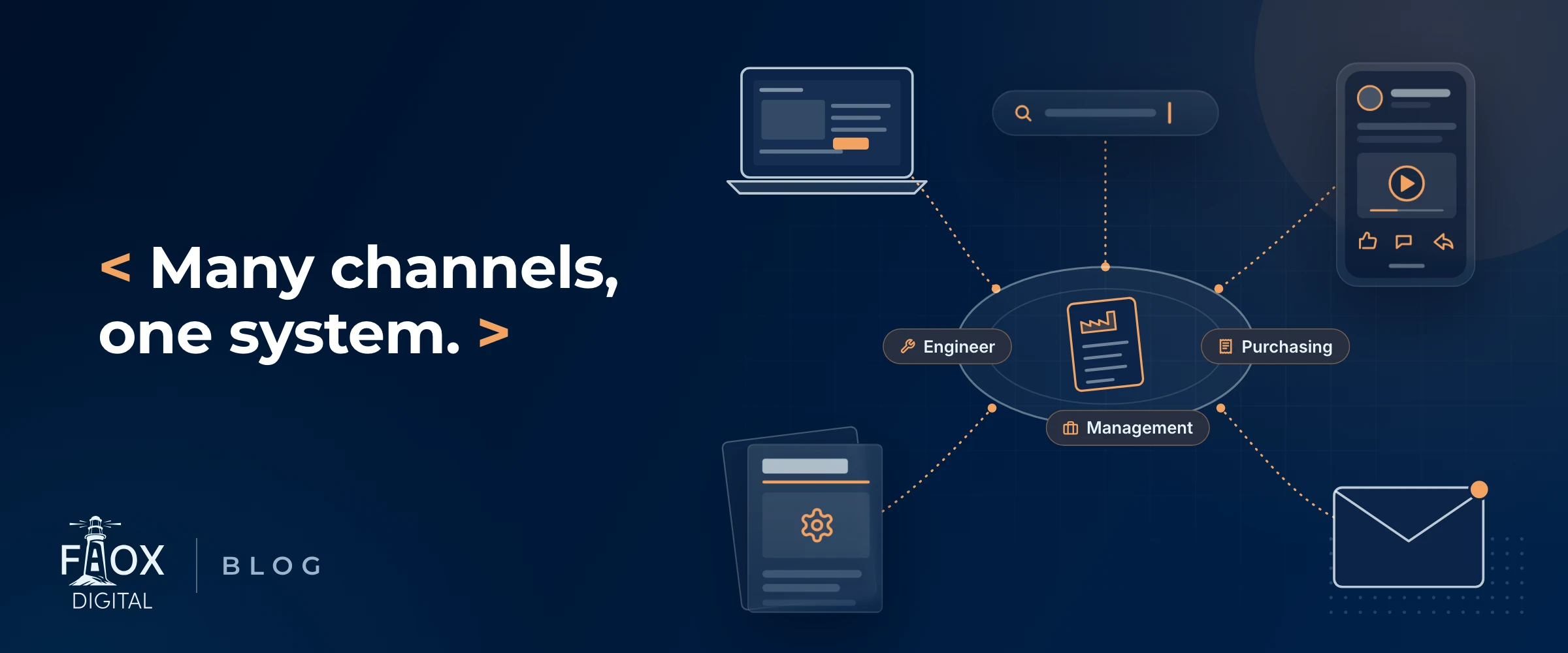
B2B digital marketing is how a company uses its website, search, AI answers, LinkedIn, email, digital PR and brand positioning to reach other businesses and turn their interest into quote requests. It works differently from B2C because a group of people decides over months, so each channel has a job: being found, being trusted, staying in touch and making it easy to ask. The channels work best as one system, measured from the first visit to the closed sale.
A company buying from you rarely decides in one sitting or through one person. Engineers compare specifications, purchasing checks your credentials, a manager asks an AI tool and a colleague forwards a LinkedIn post. Forrester’s 2026 research counts 13 internal stakeholders and nine external influencers in a typical buying decision. Much of what they see of you happens online, before you know they exist.
That is why a strong website or a busy LinkedIn page is not enough by itself. This guide explains what B2B digital marketing is, how it differs from B2C, what each channel does and how they work together. It opens our series on B2B marketing fundamentals; you can find all B2B Growth articles on the category page.
What is B2B digital marketing?
B2B (business-to-business) means a company selling to other companies, and B2C means selling to consumers. B2B marketing is everything a company does to make the right businesses aware of it, trust it and ask to buy from it. B2B digital marketing is the online part: your website, search and AI answers, LinkedIn, email and CRM, digital PR and the positioning behind them, plus the measurement that ties them to sales.
It does not replace sales or trade fairs. Buyers want much of the process online: in Gartner’s survey of 646 B2B buyers in 2025, 67% said they prefer a rep-free experience. But in McKinsey’s 2024 survey of nearly 4,000 decision makers, at any stage of buying, about one-third prefer in-person contact, one-third remote contact and one-third digital self-service. And in its 2026 survey, buyers use an average of ten channels, with inconsistent information among the leading reasons for switching supplier.
So the job is to make sure that the company a buyer meets online is the same one they meet in person.
How B2B differs from B2C
The basic ideas are the same, but the buying is not:
| Aspect | B2C | B2B |
|---|---|---|
| Who decides | Usually one person | A buying committee of engineers, purchasing and management |
| Timing | Minutes to days | A long sales cycle, often months |
| What persuades | Price, reviews and convenience | Fit, proof, risk and total cost |
| Where it ends | A checkout | A conversation, often a quote request |
| What is at stake | A return | A decision someone has to defend |
Four facts shape everything that follows:
- A committee has many readers. Procurement acts as a decision maker in 53% of buying cycles, Forrester says. An engineer, a purchaser and a manager need different answers from the same company.
- The cycle is long. 6sense’s 2025 survey of more than 4,000 buyers puts the average at about 10 months. You have to stay useful for a long time before anyone is ready to talk.
- Most buyers are not buying today. LinkedIn’s B2B Institute, in research with the Ehrenberg-Bass Institute, argues that 95% of potential buyers are not ready to buy right now, because companies replace things rarely. LinkedIn sells advertising, so weigh its interest, but the logic holds: you want to be remembered when the need appears.
- The shortlist forms early. In 6sense’s survey, 94% of buying groups ranked their preferred vendors before first contact, and its release puts that favorite’s win rate at 77% in one place and 80% in another. Among technical buyers, GlobalSpec’s 2026 survey finds that 62% of the buying process happens online before they contact a vendor, and 70% are likely to choose the better-known brand when two solutions are technically similar.
In practice, each member of the committee arrives with different questions:
| Who | What they want to know | What helps them |
|---|---|---|
| Engineer or technical lead | Does it meet the specification? | Full specifications, drawings and application guides |
| Purchasing | Can we trust this supplier, and on what terms? | Certificates, lead times, minimum quantities and references |
| Manager or owner | Is it worth the cost and the risk? | Evidence of results, total cost and named customers where possible |
| Daily user or operator | Will it work in daily use? | Manuals, videos and service details |
Our article on B2B vs B2C marketing goes through the differences, and our guide to the B2B buyer journey follows how a committee reaches a decision.
How does B2B marketing work?
B2B marketing works as a chain of four jobs: be found, be trusted, stay in touch and make it easy to ask. Positioning sits under all four, and measurement shows which link is weak.
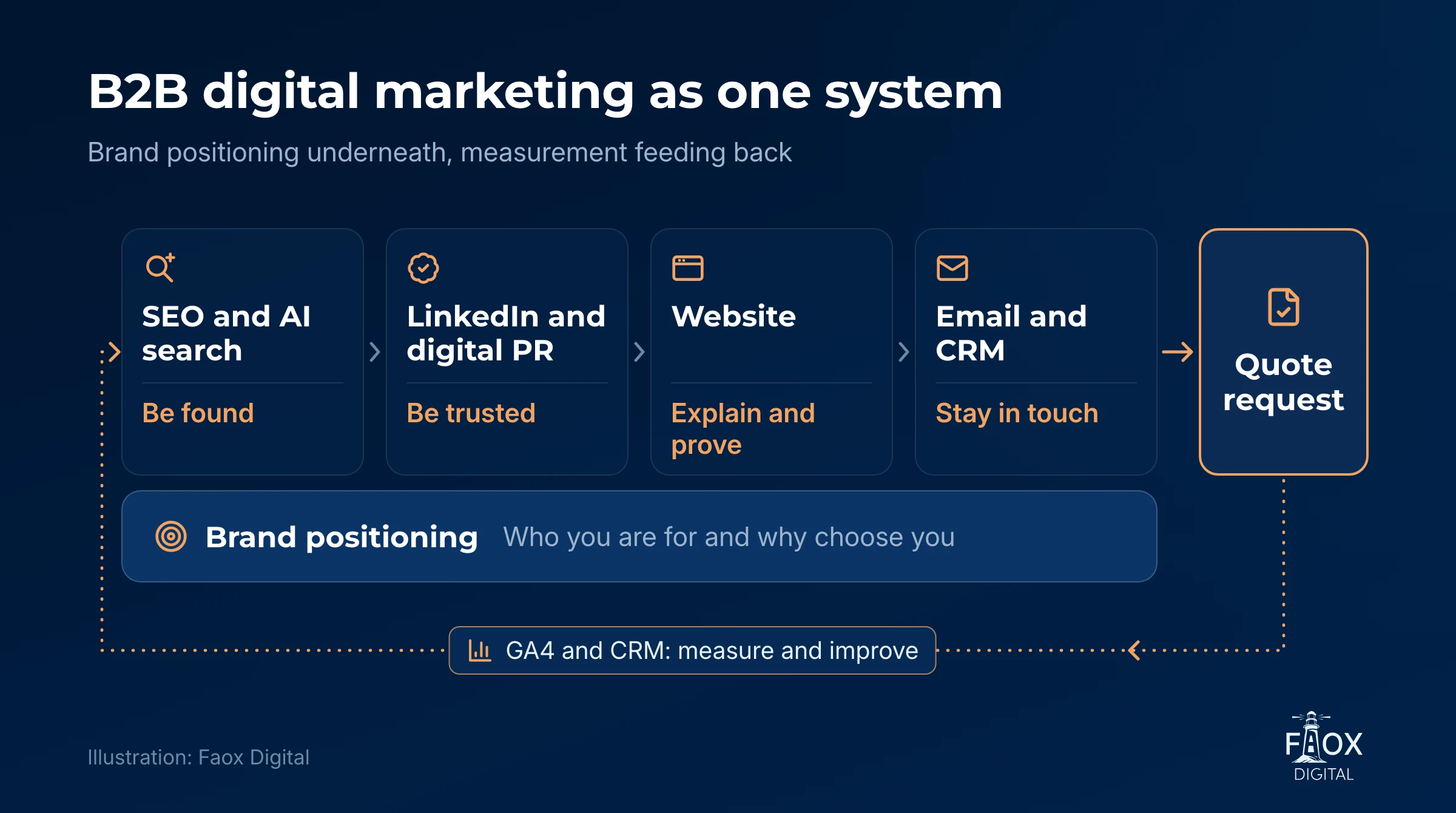
Six parts do this work, and each depends on the others:
| Part | Its job | What it needs from the others | What to watch |
|---|---|---|---|
| Brand positioning | Say who you are for and why to choose you | What sales and search data show about buyers | Whether buyers repeat your message |
| Website | Explain, prove and take the quote request | Positioning, and content from your experts | Quote requests by page |
| SEO and AI search | Be found when buyers search or ask | Pages worth finding, and mentions elsewhere | Impressions, clicks and test questions |
| LinkedIn and social media | Reach the committee before the need | A clear message and expert voices | Engagement from target accounts |
| Email and CRM | Stay in touch and record every contact | Contacts from the site and trade fairs | Replies, meetings and pipeline |
| Digital PR | Earn proof from others | Real news and real experts | Coverage in the right titles |
No single channel does all of this. Search can bring an engineer to a page, but the page has to convince. A good page is wasted if nobody follows up on the form. And a follow-up email falls flat if the company’s message changes from one channel to the next. We offer all six as services, so we have an interest in saying they belong together. The test is your own data: look for the link in the chain where buyers drop away.
A buyer does not experience your channels. A buyer experiences one company.
The six parts of the system
Brand positioning
Brand positioning decides who you are for, what you do better and why a buyer should believe it. Every other channel repeats it, so unclear positioning gets more expensive the more you publish. Keep it to one page: the customers you want, the problem you solve, what sets you apart and the proof. Then test it on your sales team and on a few customers. If you are entering a new market, a B2B go-to-market plan turns it into message, channels and sequence.
Website and the quote request
Your website is where the other channels lead. In GlobalSpec’s survey, 74% of technical buyers routinely research on supplier websites, and McKinsey lists supplier websites among the top five channels for finding and evaluating suppliers. A website has to explain what you do, prove it and make the next step easy.
The quote request is where marketing turns into sales. Keep the form short, allow file uploads for drawings and say who will reply and by when. Then reply quickly: research in Harvard Business Review back in 2011 found that most companies were not responding to online leads nearly fast enough, and a slow answer can still undo months of work.
SEO and AI search
SEO makes sure search engines can find and understand your pages, and that those pages answer what buyers look for. AI search adds a newer layer, as buyers ask ChatGPT, Gemini, Perplexity and Google’s AI Overviews and AI Mode. How common this is depends on how you ask. Forrester says 94% of business buyers use AI during their buying process, Gartner says 45% used it during a recent purchase, and GlobalSpec says 21% of technical buyers routinely research on generative AI platforms.
Google says there are no additional requirements to appear in AI Overviews or AI Mode, so sound SEO, clear facts and mentions on other sites do most of the work. Forrester adds that AI tools can give incomplete or unreliable information, so buyers check with sources they trust. Nobody can promise a ranking or a citation. You can only create the conditions for them.
LinkedIn and social media
LinkedIn reports more than 1.4 billion members, and in B2B its value lies in reaching the people on a committee long before they need you. Forrester’s 2026 research finds social media to be the second most meaningful source of information for buyers, just behind generative AI search tools, and says most marketers see the biggest impact from LinkedIn. The buyers themselves cite Facebook, Instagram and YouTube ahead of it, so check where your own buyers actually spend time.
People trust people. In GlobalSpec’s survey, 66% of technical buyers rate engineering experts at vendor companies as very or extremely trustworthy, so your experts’ posts usually do more than company announcements. Treat it as a place to be known, not a place to sell: only 1% of technical buyers prefer a LinkedIn message for first contact with a vendor. Our guide to B2B social media strategy covers the planning.
Email and CRM
Email and CRM keep the relationship going through a long cycle. The CRM records who is who and what has been said, and email follows up with something useful. In GlobalSpec’s survey, 59% of technical buyers prefer email for first contact with a vendor, far ahead of a phone call at 22%.
Without a CRM, a contact from a trade fair and an enquiry from the website sit in different inboxes, and you cannot see which marketing led to which sale. Start simply: one list of contacts, grouped by role, sector and stage, and a clear rule for who follows up. Rules on commercial email differ by market, so check them where you sell.
Digital PR
Digital PR earns mentions in trade publications, association sites and news media. It does three jobs at once. It gives buyers proof from someone other than you: 76% of technical buyers routinely research in online technical publications, according to GlobalSpec. It can earn links, and Google says its systems that analyze links, including PageRank, remain part of its core ranking systems. And it adds to what others say about you, which buyers and AI tools can both find. Editors decide what they publish, so coverage can be earned but not promised. Label any paid placement clearly.
How the channels work together: an example
Here is what the chain can look like. This company is invented, and the path is simplified:
- A need appears. An engineer at a food plant needs a new type of valve, and remembers a trade article and a colleague’s LinkedIn post from months ago.
- They search and ask. A search and an AI tool suggest three suppliers, including you.
- They check the fit. Your application guide leads to a product page with full specifications.
- They share it. The engineer sends the link to purchasing, who checks your certificates and the about page.
- You stay in touch. The engineer downloads a data sheet and joins your newsletter, and your CRM records it.
- They ask. A few months later, someone sends a quote request with a drawing attached, and your team replies the same day.
- You learn. Sales records the outcome in the CRM, so you can see which pages and campaigns touched that account.
Take away any link and the chain weakens. Without the trade article, you may not make the shortlist. Without the specifications, the engineer leaves. Without the CRM, you never learn what worked.
How to measure B2B digital marketing
Measure the chain, not each channel on its own. GA4 (Google Analytics 4) shows how visitors arrive and what they do. Mark the actions that matter as key events, which Google describes as actions particularly important to the success of your business: quote requests, data sheet downloads and contact forms.
GA4 alone cannot see the whole picture in B2B. Its default lookback window for key events is 90 days, and it keeps user-level data for 2 or 14 months, while the average buying cycle in 6sense’s survey is about 10 months. It also cannot see phone calls, trade fairs or closed deals. So connect it to your CRM, and look at four levels:
- Reach: search impressions, and visits from the sectors and companies you want
- Interest: visits to product pages, downloads and newsletter sign-ups
- Intent: quote requests, and how many of them are the right kind
- Sales: meetings, proposals and deals, with their value and source
A simple extra helps: add a "How did you hear about us?" field to your forms. People often name what no analytics tool can see, such as a colleague or a trade fair. Our guide to measuring marketing’s contribution to sales goes further.
Give it time, too. As a planning range for search work, we expect first movement in a few months and meaningful results in around six to eight months, depending on your site and your competitors. Other channels vary, and no channel can promise a date.
Common mistakes in B2B digital marketing
These are the mistakes we would look for first:
- Running channels as separate projects. With different suppliers, messages and reports, nobody owns the chain, and buyers notice the gaps.
- Expecting results in weeks. In LinkedIn’s research, 96% of B2B marketers expected the main effect of their ad campaigns within two weeks. With a buying cycle of about ten months, that is the wrong test.
- Speaking only to people ready to buy. Most of your market is not buying now, so content that only asks for a meeting misses them.
- Writing without your experts. General content is easy to produce and easy to ignore. Your engineers’ knowledge is what others cannot copy.
- Leaving sales out. Sales hears the real questions every day. Agree together what counts as a good enquiry, or the two teams will argue about the numbers.
- Counting activity. Posts, opens and visits do not show whether the right companies are asking to buy.
Where to start with B2B digital marketing
You do not need all six parts at once. For most companies, this order works:
- Write your positioning on one page. Everything else repeats it.
- Fix your key pages and forms. Start with main product pages and the quote request, and test them on a phone.
- Set up measurement. Use GA4 key events, Search Console and a simple CRM.
- Cover the searches that matter most. Answer what buyers ask about your main products.
- Follow up on every enquiry. Name who replies, and set a time limit.
- Give your experts a voice. Start with one or two people on LinkedIn.
- Earn outside proof. Begin with the trade publications and associations your buyers read.
On a small budget, you can do the first steps yourself. GA4 and Search Console are free, and a clear page written with your own engineers beats a campaign that points to a weak site. Focus on one product line or one market, and do it properly.
If you sell in several countries, plan by market. Buyers in each one search in their own words, read their own trade press and may prefer different channels, so a translated site is only the start. Google recommends separate URLs for each language version. Choose one or two priority markets, get the chain working there and then expand.
When you are ready to plan more widely, our guide to building a B2B marketing strategy shows how to set priorities across channels. If you make physical products, our article on marketing for manufacturers shows what an integrated program looks like. And if you are thinking about outside help, our guide to how a marketing agency works explains what to expect.
How Faox Digital approaches B2B digital marketing
Faox Digital is a digital growth partner for B2B companies selling in complex and international markets, and our six services work as one system rather than as separate channels. We suggest first steps that fit the company’s budget and stage, even if that means doing some of the work yourself.
Key takeaways
- B2B digital marketing uses website, search, AI answers, LinkedIn, email, digital PR and positioning to turn interest from other businesses into quote requests.
- It differs from B2C because a committee decides over months, and most potential buyers are not buying today.
- Each part has a job, and each depends on the others: be found, be trusted, stay in touch and make it easy to ask.
- Measure from first visit to closed sale, because GA4 alone cannot see a long B2B cycle.
- Start with positioning, key pages and measurement, then add channels one at a time.
Frequently asked questions
What is B2B digital marketing?
It is how a company uses online channels to reach other businesses and turn their interest into enquiries and sales. The usual channels are the website, search and AI answers, LinkedIn, email and CRM, and digital PR, all resting on clear brand positioning.
What is the difference between B2B and B2C in digital marketing?
B2C usually persuades one person to buy quickly, often on price and convenience. B2B has to convince a group over months, with proof, specifications and low risk. So B2B leans on search, detailed content, expert voices and follow-up, and it usually ends in a conversation and not a checkout.
How does B2B marketing work?
It works as a chain of four jobs: be found, be trusted, stay in touch and make it easy to ask. Positioning gives every channel the same message, and measurement through GA4 and a CRM shows which link needs work. Sales then picks up the conversation, and its results feed back into marketing.
How do you start B2B digital marketing?
Start by writing your positioning on one page, then fix your main product pages and quote form and set up measurement. After that, add search, follow-up, LinkedIn and digital PR one at a time. A small team can do the first steps itself.
What does a marketing agency do for a B2B company?
It plans and carries out work across channels such as SEO, content, the website, LinkedIn, email and PR, and it reports on the results. The useful question is what stays with your team, because your experts and sales people hold the knowledge that good B2B marketing needs.
Sources
Let’s talk
Not sure where to start?
Tell us about your business and your goals. We will suggest first steps that fit your budget, even if that means doing some of it yourself.