
B2B Go-to-Market Strategy Template: Message, Channels and Sequence
A fill-in plan that puts every launch decision for a new market in one place, with a worked example for a hypothetical valve maker entering Poland.

A B2B go-to-market strategy template puts every launch decision for a new market into one plan: the market and goal, a target account list, the buyer roles, the positioning and message, market-specific proof, a channel plan, the materials, the sequence and calendar, how sales follows up and the measurement points. Fill it in from decisions you have already made, give every section an owner and a date, and review it each quarter.
A go-to-market strategy is a set of decisions; the plan is what turns them into work. In many B2B companies the decisions are made in a meeting and then lost between departments: marketing prepares a campaign, sales calls the accounts it already knows, and nobody owns the order of things. One template keeps message, channels and timing together, so everyone works from the same page.
This guide gives you that template, explains how to fill in each section and shows a worked example for a hypothetical valve maker entering Poland. If the strategic decisions are still open, start with our guide to B2B go-to-market strategy.
What a B2B go-to-market plan contains
A go-to-market plan is the working document for one launch: one market, one segment or one new product. It answers five questions in a form people can act on:
- Who: the target accounts and the buyer roles inside them.
- What: the position, the message and the proof for this market.
- Where and with what: the channels and the materials.
- When: the sequence and the calendar.
- How you will know: the sales follow-up rules and the measurement points.
It is not the company’s whole marketing plan, and it is not a handbook for every situation. Keep it to a few pages that the market owner, sales, marketing and partners actually open.
The B2B go-to-market strategy template
Copy the sections below into a shared document. The right column shows how the hypothetical valve maker filled them in; square brackets mark the figures a real company would set:
| Section | What to write | Example: hypothetical valve maker entering Poland |
|---|---|---|
| Market and goal | The market, the segment and what year one should achieve | Poland, mid-sized dairy and food plants; [number] reference customers and one working distributor by the end of year one |
| Target account list | Named companies that fit the customer profile, and how you found them | [Number] plants from an industry association’s member list and last year’s fair visitors |
| Buyer roles | The people who decide in each account and what each needs | Maintenance engineer, purchasing manager, quality manager, plant manager |
| Positioning and message | The position for this market and the core message for each role | Valves that arrive documented for audits; for quality managers, audit-ready records in Polish |
| Market-specific proof | Evidence that counts in this market, and the gaps | Certificates and Polish documentation ready; the first Polish reference still missing |
| Channel plan | Each channel and its one job | Search to be found, LinkedIn to reach named roles, the fair to meet, the press for credibility, the distributor for stock and service |
| Materials | What is needed in the language, and by when | Catalogue pages, data sheets, a presentation, a website section, a proposal template |
| Sequence and calendar | What happens in which month | See the calendar below |
| Sales alignment | Who follows up which leads, how fast, and how they are handed over | Market owner and distributor share one account list and meet weekly |
| Measurement points | What you count at the end of each phase, and the decision you will take | Meetings, quote requests and samples at month six; orders and references at month twelve |
| Owner, budget and reviews | Who owns the plan, the budget by quarter, the review dates | Export manager; [budget] per quarter; a review every quarter |
Before you fill it in: market, position and messages
The template records decisions; it does not make them. Three come first. The market itself should be chosen on evidence, as our guide to market entry strategy explains. The position should be written down in one internal sentence, using a positioning statement template. And the messages for each role should come from a shared messaging framework, adapted to the new market rather than written from scratch.
How to create a go-to-market strategy and plan, step by step
- Confirm the decisions. Market, customer profile, position and sales model, agreed with management.
- Build the target account list. Named companies, ranked by fit.
- Map the buyer roles. The people who decide in each account, and what each needs.
- Adapt the message. The core message and a version for each role, in the market’s language.
- List the proof and the gaps. What you can show buyers there, and what you still need.
- Give each channel one job. And decide which channels start first.
- Prepare the materials. In the language, before any channel starts.
- Set the calendar. Phases, dates and a measurement point at the end of each phase.
- Agree the follow-up with sales. Who calls whom, how fast, and how partners are briefed.
- Name the owner and the review dates. One person, one plan, a quarterly review.
The sections below explain the parts that need the most care.
Market, goal and target account list
Write a goal for year one that you can check. In a new B2B market, the first year rarely brings large orders, so useful goals include reference customers, a working distributor and a pipeline of quotes, not only revenue.
The target account list is the heart of the plan. Name the companies you want, from industry association member lists, trade fair exhibitor and visitor lists, your own enquiries from the market and, if you work with a distributor, its customer list. Rank them: a first tier you will contact personally and a second tier you will reach through search, content and the press. Keep the first tier small enough for your team to serve well.
Buyer roles in each account
A company does not buy; people do, and several of them. Forrester’s State of Business Buying 2026 found that the typical buying decision now includes 13 internal stakeholders and nine external influencers, with that number rising for more complex or strategic purchases. So plan contacts by role, not one contact per company.
For each first-tier account, list the buyer roles: the engineer who specifies, the purchaser who negotiates, the quality or plant manager who signs off, and anyone outside, such as a consultant or contractor. Find names where you can, through trade fairs, LinkedIn and partners, and note which message and material each role should receive first.
Positioning and message for the market
The positioning and message section records what you will say in this market. Often the core position stays the same and the emphasis changes: in a market with strict audits, documentation may lead; where buyers compare you with importers, delivery time may. Write the core message and one line per role in the market’s language, by people who know the industry, with local units and standards.
Market-specific proof
Market-specific proof is what makes a foreign supplier believable. List what you already have, such as certificates, documentation in the language and references from neighboring markets, and what is missing. The first local reference is usually the biggest gap, so plan how to earn it: a pilot installation, extra support for the first customer or an introduction through a partner.
The channel plan: one job per channel
A channel plan gives each channel one job in the launch, and a point at which it is ready:
| Channel | Job in the launch | Ready when |
|---|---|---|
| Search | Be found by buyers searching in their own language | Local-language pages for the main products are live |
| Reach named roles in first-tier accounts | The page and your experts’ profiles work in the language | |
| Follow up people you met or who asked | Contacts have a lawful basis and the sequence is written | |
| Trade fair | Meet first-tier accounts in person | Meetings are booked before the fair |
| Trade press | Give buyers a third-party reason to trust you | A story or byline is placed before the fair |
| Distributor | Stock, service and local relationships | The partner is trained and has materials and prices |
Each channel has its own craft, from local search to press outreach abroad, and the details belong in each channel’s own plan. What the template adds is the order and the handoffs: a press story before the fair, a landing page for fair visitors, an email after the meeting. How channels pass buyers to each other is covered in our guide to building a B2B marketing strategy.
Materials: catalogue, data sheets and presentations
Materials are the slowest part of most launches, so start them first. The usual set is catalogue pages or a short product overview, data sheets, a sales presentation, a website section, a proposal template, trade fair materials and a kit for distributors. All of it belongs in the market’s language, checked by a native speaker who knows the technology, with local units, standards and references.
Plan who writes, who adapts, who checks and by when. A channel that starts before its materials are ready wastes the first impression.
Sequence and calendar
The sequence and calendar turn the plan into dates. A hypothetical twelve-month calendar for the valve maker:
| Period | Focus | Ready at the end |
|---|---|---|
| Months 1 to 2 | Basics and materials | Account list, role messages, Polish materials, distributor shortlist |
| Months 3 to 4 | Become findable | Polish website section, LinkedIn page, first press story |
| Months 5 to 6 | First contacts | Outreach to first-tier accounts, trade fair with booked meetings |
| Months 7 to 9 | Learn and adjust | First quotes reviewed, messages adjusted, distributor decision |
| Months 10 to 12 | Scale what works | A second channel added, first references published |
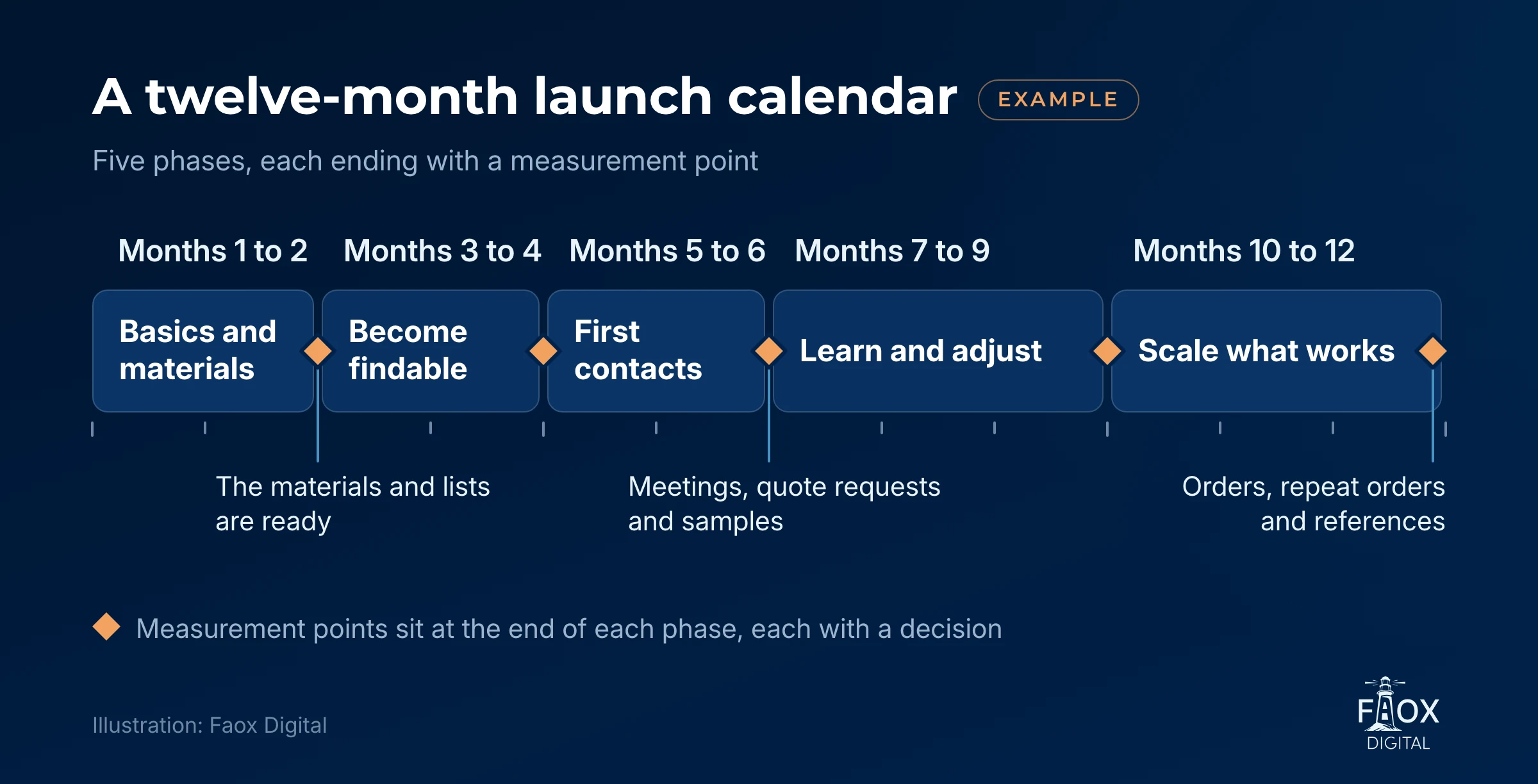
Real calendars bend around trade fair dates, certifications and partner contracts, so fix those dates first and plan the rest around them.
Sales alignment
A launch fails quietly when marketing creates interest and nobody follows it up. Sales alignment means writing down:
- Who owns each first-tier account: your market owner, your distributor or your sales team
- How fast a quote request or a fair contact is followed up, and by whom
- How a lead passes from marketing to sales or to the partner, and with what information
- How sales reports back objections, lost bids and questions, so the messages can improve
- How often the market owner, sales and partners review the account list together
Agree these rules before the first campaign, not after the first lost lead.
Measurement points
Measurement points sit at the end of each phase, each with a decision. At the end of the second month, check that the materials and lists are ready. At month six, count meetings, quote requests and samples from first-tier accounts. At month twelve, look at orders, repeat orders and references.
Write down in advance what you will do if a number is low: adjust the message, change a channel, replace a partner or pause. A measurement point without a decision is only a report.
When to get outside help
A plan like this needs a market owner with time, people who write well in the market’s language and someone who can run several channels in order. If those are missing, the next question is what outside help should deliver; our guide to go-to-market support sets out what the first 90 days should produce.
How Faox Digital works on a market launch
Faox Digital, a digital growth partner for B2B companies in complex and international markets, treats a market launch as one system rather than six separate services: the brand is adjusted for the market and rolled out in the right order across the channels that matter. Search work follows a keyword map built market by market, press outreach happens in the market’s own language, and email follow-up can start from trade fair contacts or a spreadsheet.
Key takeaways
- A go-to-market plan turns the strategy into one document: accounts, roles, message, proof, channels, materials, calendar, follow-up and measurement.
- Start from named target accounts and the roles that decide in each one.
- Give every channel one job, and have the materials ready in the market’s language before it starts.
- Agree with sales and partners who follows up what, and how fast.
- Put a measurement point and a decision at the end of each phase, and review the plan every quarter.
Frequently asked questions
What should a B2B go-to-market strategy template include?
The market and the goal for year one, the target account list, the buyer roles, the positioning and message, market-specific proof, a channel plan, the materials, the sequence and calendar, the sales follow-up rules and the measurement points, plus an owner, a budget and review dates.
Do we need a go-to-market handbook as well as a plan?
Usually not at first. A plan of a few pages is enough for one launch. A handbook makes sense when many people outside the core team, such as distributors in several countries, need the same rules, messages and materials.
How is a market penetration strategy executed?
Market penetration means growing your share in a market you already serve. The same template works: a target account list of companies that do not buy from you yet, the reason each should switch, the proof they need, and the channels and calendar to reach them.
How often should a go-to-market plan be updated?
Review it at each measurement point and at least every quarter in the first year. Update the account list, the messages and the calendar when the market teaches you something, and keep the goal unless the evidence says it was wrong.
Sources
Let’s talk
Does your brand say what makes you different?
Show us how you describe your business today. We will tell you where it is clear and where buyers may get lost.