
What a Brand Positioning Agency Does: Process, Timeline and Deliverables
The stages of a brand positioning project, from discovery interviews and buyer research to the workshop and the decision document, with the people, time and deliverables each one involves.
A brand positioning agency helps a company decide where it stands in its market and why a buyer should choose it, then writes that decision down so the whole team can use it. The work runs from discovery interviews and buyer research through a positioning workshop to a decision document holding the positioning statement, the value proposition and a messaging framework. In our experience, a focused positioning and messaging project takes a few weeks; a new identity and a rollout across markets take longer.
Hiring a brand positioning agency means bringing in outsiders to help answer a question only your company can settle: why should a buyer choose you over the alternatives? This guide covers what the agency does, the stages of a project, your team’s part, the timeline and what you should receive. For the ideas behind it, start with our guide to brand positioning for B2B.
We work as a brand strategy agency, so we have a stake in the answer; the process below applies to any agency, including us.
One distinction first: this guide is about what your brand means to buyers, not about registering it. Trademark registration is legal work for a trademark attorney and is not covered here, although you will need one if the project ends with a new name.
What a brand positioning agency does
A brand positioning agency, sometimes called a brand consultancy, works on decisions before designs: which buyers you serve best, which category they compare you in, which difference you can prove and how to say it. Its work has three parts:
- Research: what your own people believe and what your buyers actually say.
- Decisions: made by your leaders in a facilitated workshop, not by the agency alone.
- Writing: the positioning statement, the value proposition, the messages and a document that records why.
The work is led by a brand strategist: the person who runs the interviews, reads the evidence, facilitates the workshop and writes the result. Ask who that will be, because their judgment is what you are paying for. Logo and visual identity usually come afterwards, from the same agency or a separate designer, with the position as their brief.
The brand positioning process, stage by stage
A typical project moves through six stages:
| Stage | What the agency does | What your team does | What you receive |
|---|---|---|---|
| Kickoff | Agrees scope, questions and dates; collects your materials | Names a project owner and the deciding group | A work plan |
| Discovery interviews | Interviews leaders, sales, engineering and service one by one | Makes people available | Where internal views agree and differ |
| Buyer research | Interviews customers and lost prospects; reviews bids and competitors | Introduces customers; shares bid records | A summary in buyers’ own words |
| Positioning workshop | Presents findings and options; runs the session | Makes the decisions | Recorded decisions |
| Writing and sign-off | Drafts the statement, value proposition and messages | Reviews, tests and approves | Approved position and messages |
| Handover | Writes the decision document and next steps | Agrees who uses what, and when | The decision document |
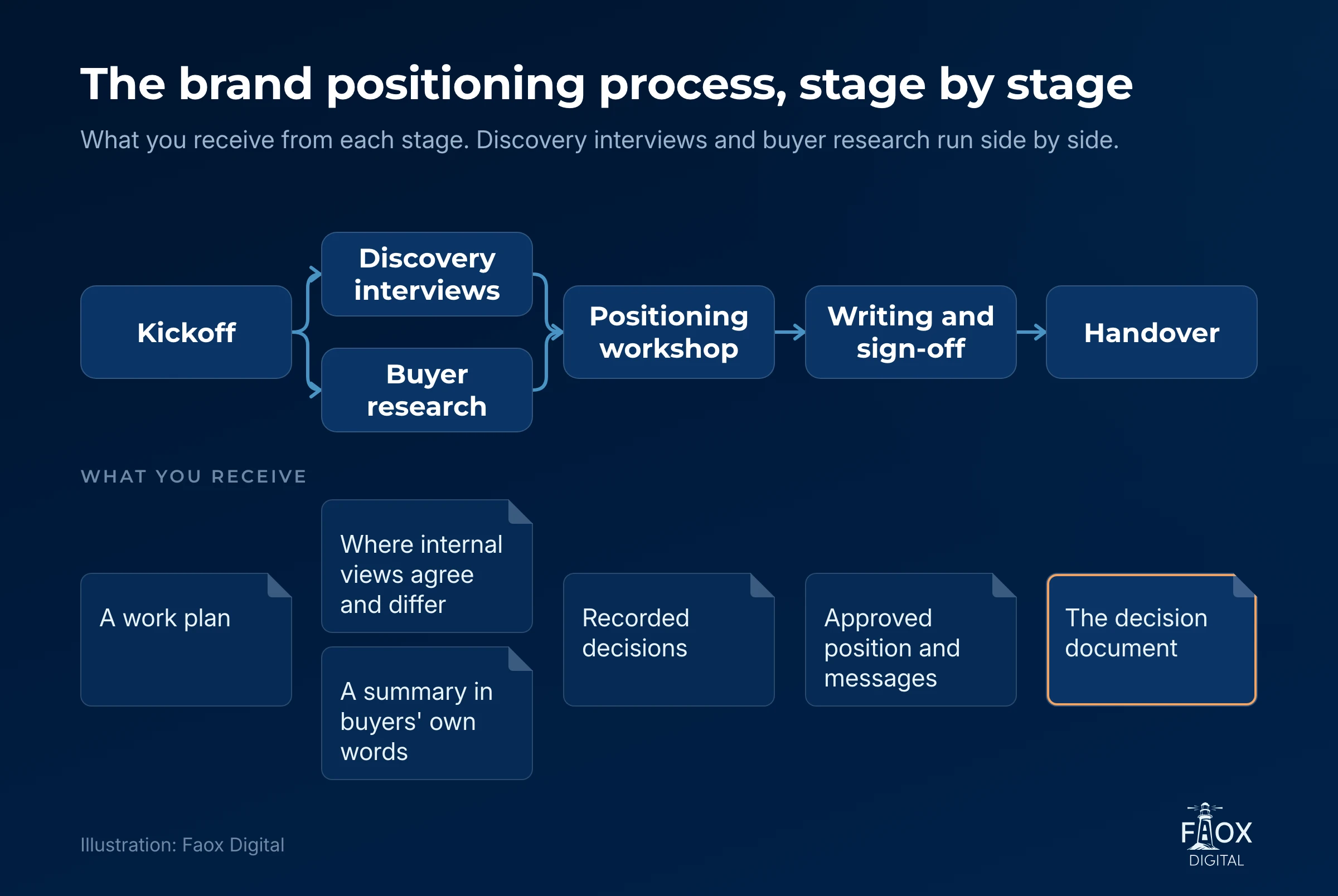
The order matters more than the names: evidence before the workshop, decisions before words.
Kickoff: four decisions to settle first
Positioning consultant April Dunford, author of Obviously Awesome, argues in a January 2026 article that four decisions belong before a positioning exercise starts:
- Is now the right time? Before a product has launched, she writes, you can only form a positioning thesis, so keep it loose.
- Who is it for? Customers, not investors, employees or partners.
- What exactly are you positioning? One product, the whole company, a suite of products or a combination.
- Whom must it convince? The deal champion: in B2B, usually the person who builds the shortlist, brings in the right colleagues and recommends a choice to the economic buyer.
A good agency raises these questions at kickoff and writes the answers into the work plan, along with the deciding group and the dates its members can attend.
Discovery interviews and buyer research
Discovery interviews start inside the company. The strategist talks one by one with the managing director, the heads of sales, engineering, operations and service, and a few people who deal with customers every day. The questions are simple: what do we sell, to whom, why do we win and why do we lose? The answers show how the company describes itself and where views differ, and staff often speak more openly to an outsider than in a meeting with their manager.
Buyer research tests those beliefs against the market. The agency interviews current customers, customers who left and prospects who chose a competitor, and adds what your won and lost bids and your competitors’ messages show. It should reach more than one role per customer: Forrester’s State of Business Buying 2026 found that the typical buying decision now includes 13 internal stakeholders and nine external influencers. Research that hears only the purchaser misses most of the group.
The positioning workshop
The positioning workshop is where the decisions are made. The agency presents what it heard and sets out two or three candidate positions with the evidence for and against each; the deciding group then chooses the target customer, the category, the point of difference and the proof behind it.
Keep that group small: the managing director or owner, the heads of sales and of the main business line, and the person who knows the product most deeply. If the first session ends in disagreement, plan a second with more evidence rather than settling on a position nobody believes.
A good workshop ends with recorded decisions rather than a list of adjectives, including what the position rules out, such as tenders you will stop chasing.
From decisions to words: statement, value proposition and messages
The agency then turns the decisions into three pieces of writing:
- Positioning statement: one internal sentence naming the target customer, the category, the difference and the proof. It guides everything else and is not a tagline.
- Value proposition: what each buyer gains, with a version for each role in the buying group, because an engineer, a purchaser and a plant manager weigh different things.
- Messaging framework: a core message, a few supporting messages with their proof, and words to use and avoid, so that your website, proposals and sales presentations say the same thing.
Salespeople and a few customers should see the drafts before sign-off: they are the first to notice a claim that does not hold.
The decision document and other deliverables
The decision document holds the project together. It records what was decided and why: the research findings, the options rejected, the statement, the value proposition by role, the proof points, the messaging framework, what the position rules out and who signed it off. It is what you hand a designer, a copywriter or a new sales manager, and it explains the choice to anyone who questions it later.
Before you sign a proposal, check that it names each deliverable:
- Who will be interviewed, inside the company and among buyers
- A research summary in buyers’ own words
- The workshop sessions and who attends them
- The positioning statement
- The value proposition, by role in the buying group
- The proof points behind the position
- A messaging framework your team can write with
- A decision document with the sign-off recorded
- A work plan for what changes first: website, sales materials or identity
Ask for editable files too, so that you can update the documents when your market changes.
What your team puts in
Internal involvement shapes the result as much as the agency does. Your side provides:
- A project owner who collects materials, books interviews and keeps the schedule.
- The deciding group, present at the workshop and the sign-off.
- Interviewees from sales, engineering, operations and service.
- Introductions to customers, made by the people who know them.
- Salespeople willing to try the new messages before they are final.
A position decided without the people who have to deliver it is rarely used.
Brand positioning timeline: what sets the pace
In our experience, a focused positioning and messaging project usually runs a few weeks, and a full identity system with a rollout across several markets takes longer. Clutch’s 2026 Branding Pricing Guide, based on client reviews of agencies listed on its site, gives 8 months as the typical timeline for branding projects. The guide does not break that figure down by service, and it notes that a project’s length follows its scope.
The calendar depends on your side as much as on the agency’s:
- Interviews: customers and lost prospects take time to schedule, more so across time zones and languages.
- Markets: each market you research adds interviews and a local check of the messages.
- The deciding group: the workshop waits for a date everyone can attend, and sign-off for the slowest reviewer.
- Naming: a new name adds language checks and a trademark attorney’s clearance.
- Identity: design starts only after the position is signed off.
Put these dates into the work plan at kickoff.
Positioning with an agency, in-house or in a rebrand
| In-house | Positioning agency | Full brand project | |
|---|---|---|---|
| Who runs it | One of your managers | A brand strategist | A branding agency team |
| What you get | A position written by your own team | Research, facilitated decisions, statement, value proposition, messages and decision document | The same, plus naming if needed, identity, guidelines and rollout |
| Calendar time | Depends on your team’s availability | A few weeks, in our experience | Months |
| Fits when | Leaders broadly agree and someone has time to run it | Leaders disagree, or buyers would talk more freely to an outsider | The identity has to change along with the position |
What comes after positioning
A new position often raises the next question: does your identity still fit it? Our guide to rebrand or refresh lists what to check before you decide, and our article on what brand identity work costs explains what drives the price if the answer is new design work. If the position is meant to open a new market or segment, the next step is a launch plan, and our guide to hiring a go-to-market agency sets out what the first 90 days should deliver.
How Faox Digital approaches a positioning project
Faox Digital, a digital growth partner for B2B companies in complex and international markets, runs branding in five steps, each a working session with the client; positioning takes up the first two. We listen to how the company describes itself and what its buyers believe, then decide with the client where it sits in its market and the single reason a buyer should choose it, in plain words.
The voice step turns that decision into a messaging framework the team can write inside, and identity and rollout follow, adjusted per market. For an early-stage company or a smaller budget, we suggest a first step that fits its stage, even if the team does part of the work itself.
Key takeaways
- A brand positioning agency researches, facilitates and writes; your leaders make the decisions.
- Expect discovery interviews, buyer research across roles, a positioning workshop and a written decision document.
- Get every deliverable named in the proposal, from the interview list to the messaging framework.
- The timeline depends on interviews, workshop dates and sign-offs on your side as much as on the agency.
- Trademark registration is separate legal work for a trademark attorney.
Frequently asked questions
What is brand positioning, in simple words?
It is the place your company holds in buyers’ minds compared with the alternatives, and the reason they should choose you. Put simply: who you are for, what you are compared with and why you are the better choice for those buyers.
Why is brand positioning important?
Several people judge a B2B supplier, and each compares you with others. A clear position gives them one reason to choose you that they can repeat to colleagues, and it makes your website, proposals and sales team say the same thing. Without one, price easily becomes the only comparison.
What is a brand positioning statement?
One internal sentence that records the decision: the target customer, the category, the difference and the proof. It guides messages and design, but it is not a tagline and rarely appears in public as written.
Sources
- Clutch: Branding Pricing Guide 2026, updated September 2026
- Forrester: press release on The State Of Business Buying, 2026, January 2026
- April Dunford: Positioning Prep Part 1: Decisions to Make Before a Positioning Exercise, January 2026
Let’s talk
Does your brand say what makes you different?
Show us how you describe your business today. We will tell you where it is clear and where buyers may get lost.