
How to Write a Byline Article: From Topic Pitch to Final Draft
The steps from a topic pitch to a final draft: a thesis the expert can prove, the editor’s guidelines, evidence and a case example, no sales language, the word limit, the author bio, originality and publication rights.

Knowing how to write a byline article comes down to a clear sequence: agree one thesis the expert can prove, read the publication’s editorial guidelines and pitch the topic to the editor before you write. Then outline the article around that thesis, back each point with evidence, data or a case example, remove every trace of sales language, keep to the word limit, add a short author bio, and check originality and publication rights before you submit.
An engineer at your company knows a problem better than anyone writing about it, and a trade editor has said they would look at a pitch. What happens between that conversation and a finished article decides whether it runs. This guide walks through each step, from the topic pitch to the final draft, using the published rules of two trade publications as examples. If you are new to bylines, our byline article guide explains what they are, who should write them and how they differ from other formats.
How to write a byline article, step by step
The whole process fits in nine steps; the sections below explain each one.
- Find the thesis: the one claim the article will prove.
- Read the editor’s guidelines for length, originality, AI use and rights.
- Pitch the topic in a short email before writing the full piece.
- Outline the lead, the thesis, three or four points and the conclusion.
- Gather evidence: data, sources and a case example for each point.
- Draft in the expert’s voice from an interview, then remove the sales language.
- Fit the word limit and write the author bio.
- Check originality, facts and approvals inside your company.
- Submit and sign the contributor agreement, then share the published article.
Start with a thesis, not a topic
A topic is a subject; a thesis is a claim about it that the article will prove. "Compressed air leaks" is a topic. "Plants that look for leaks once a year let small leaks run for months, and a short weekly check by operators finds them sooner" is a thesis. Editors accept theses, because a thesis gives readers something to learn, test or disagree with.
Test yours with the questions The OpEd Project suggests opinion writers ask themselves: can you back up what you say, what is new, and why should readers care? If the thesis would fit any company in your industry, sharpen it until it reflects what your expert has actually seen. If you cannot state it in one sentence, the article is not ready to pitch.
Read the editor’s guidelines before you pitch
Editorial guidelines decide what an editor can accept, and they differ more than most writers expect. Two trade titles that publish contributed articles show the range:
| Rule | IndustryWeek | T&D World |
|---|---|---|
| Length | Generally 600 to 1,200 words | 800 words for commentary, 800 to 1,500 for an explainer |
| Voice | Conversational, "not a white paper" | Third person in print features |
| Promotion | Not accepted if it pushes a product or service | Edited to a vendor-neutral perspective |
| AI use | At most 10% from a generative AI tool, disclosed | At most 20%, disclosed; detection tools may be used |
| Author bio | Two to three sentences, plus a headshot from authors new to IndustryWeek | 50 to 75 words for print features |
| Rights | A contributors’ agreement once accepted | An author’s agreement signed by each named author |
IndustryWeek’s guidelines were updated in June 2026, and T&D World’s were checked in November 2026. Read the current version for every title you pitch, together with a few recent contributed articles, before you write a word.
Write a topic pitch the editor can accept
A topic pitch asks the editor to agree the idea before anyone writes the full piece, which saves both sides time. IndustryWeek’s guidelines invite a well-crafted pitch for feedback before the full article, although the final decision comes only with the finished text. Keep the pitch to a short email:
- A working title and the thesis in one sentence
- The three or four points the article will make, with the evidence behind each
- Why it matters to this publication’s readers now
- Who the author is and why they know the subject
- The planned length, based on the guidelines, and a delivery date
- A line confirming that the article has not been published elsewhere
Send it to the person or address the guidelines name, and wait for an answer before you write the full draft. IndustryWeek, for example, says it typically answers unsolicited pitches within two to four weeks.
Outline the article around the thesis
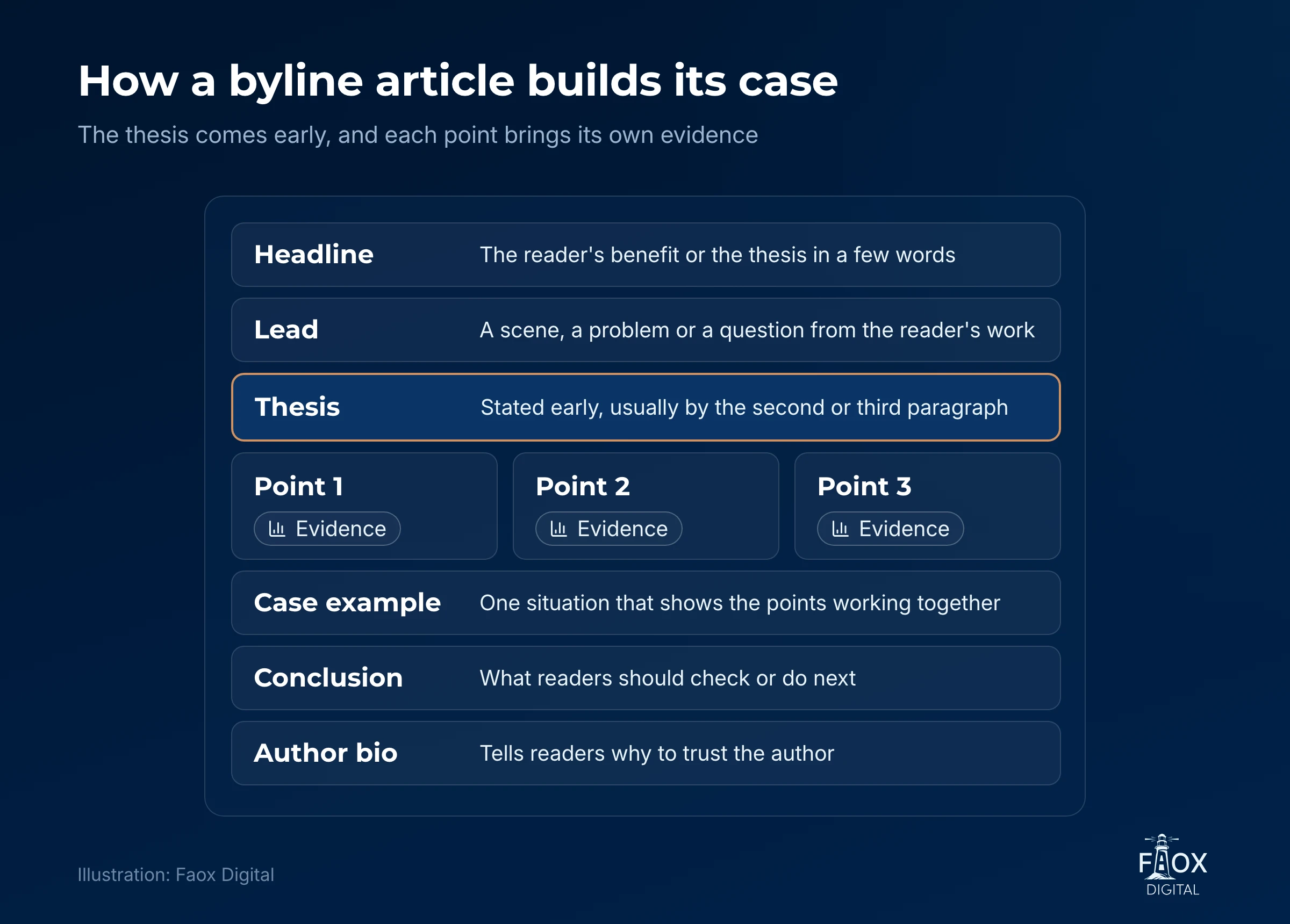
A byline argues and teaches; it is not news. A press release puts the most important facts first and adds detail in order of importance, as our guide to press release structure explains. A byline article builds a case instead:
- Headline: the reader’s benefit or the thesis in a few words.
- Lead: a scene, a problem or a question from the reader’s work. T&D World’s guidelines ask for a lead that piques curiosity and warn against opening with history, technical details or statistics.
- Thesis: stated early, usually by the second or third paragraph.
- Three or four points: each a short section with its own evidence.
- Case example: one situation that shows the points working together.
- Conclusion: what readers should check or do next.
Back each point with evidence, data and a case example
Readers of a trade title test every claim against their own experience, so each point needs evidence and data: test results with the method, field data from your service records, a standard or regulation quoted correctly, a calculation readers can repeat, or outside research named with its year. In the 2024 B2B Thought Leadership Impact Report by Edelman and LinkedIn, 55% of decision-makers named strong research and data as a top characteristic of high-quality thought leadership, and less than half rated the thought leadership they read as good. Both companies have an interest in the subject, but the point holds in trade media: opinions without proof are easy to ignore.
Cite the original source, not a website that repeats it. IndustryWeek fact-checks contributed pieces and asks writers to name the original source of every outside fact in the text or through a link, not in footnotes.
A case example shows the thesis at work: the situation, what was done, what changed and what others can learn. Name a customer only with their written approval; otherwise describe the plant or project without details that identify it. Keep it honest: T&D World’s guidelines invite authors to include the challenges and what did and did not work.
Draft in the expert’s voice and remove the sales language
Most bylines are drafted from an interview: a writer records the expert explaining the topic, writes it up in their words and sends the draft back for correction. Keep the expert’s own examples and phrasing, and match the publication’s style: IndustryWeek wants a conversational tone, while T&D World asks for print features in the third person. IndustryWeek also generally does not accept Q&As or pieces built on quotes from interviewed sources as contributed articles.
Avoiding sales language is where most drafts fail. IndustryWeek does not accept articles that push a product or service or read as promotional, and gives the example of a CNC machine maker explaining why its machine would make the reader’s life better. T&D World asks contributors to avoid commercial language and claims that cannot be proven, such as "better than" or "unprecedented". In practice:
- Use generic terms for the technology, and name products only where readers need them
- Replace claims about your company with explanations readers can apply
- Drop superlatives and absolute advice such as "you must"
- Mention your company in the bio, and in the text only where its experience explains a point
If the goal is to promote a product, the right format is paid space, labeled as such; our guide on how to write an advertorial covers it.
Check originality, approvals and rights
Originality means two things to an editor. The article must be unpublished: IndustryWeek takes only first-run pieces that have not appeared elsewhere, even on the author’s own website. And the thinking must be the expert’s own: IndustryWeek allows no more than 10% of a piece to come from a generative AI tool and T&D World no more than 20%, and both ask you to disclose where AI helped. Check that no passage is copied, and keep a note of where each fact came from.
Then get the approvals inside your company: the author, a technical reviewer, and legal or the customer where a case example needs it. T&D World makes authors responsible for obtaining internal reviews, approvals and permissions before they submit.
Publication rights are set in the contributor agreement. Read what it gives the publisher: first publication only, exclusive rights for a period, or the copyright itself, and ask whether and when you may republish the full text on your own site. Without an express transfer of the copyright or of any rights under it, US copyright law presumes the publisher acquires only the privilege of reproducing and distributing the article as part of that issue, any revision of it and later issues in the same series (17 U.S.C. § 201(c)). An article an employee writes as part of their job can be a work made for hire owned by the employer (§ 201(b)), so the company should approve the agreement too. Rules differ by country, so follow the agreement.
Byline article example: from pitch to final draft
Here is how the steps come together in one fictional example, for a hypothetical compressor maker writing for a plant maintenance magazine. Placeholders in square brackets stand for the company’s real data.
| Stage | Example |
|---|---|
| Thesis | Annual leak surveys leave small compressed air leaks running for months; a weekly operator check finds them sooner |
| Pitch | Subject line "Byline idea: what plants miss between leak surveys", with the thesis, four points and the author’s role |
| Headline | Do not wait a year to find compressed air leaks |
| Lead | A maintenance manager hears a hiss on a night shift that nobody had reported |
| Points | Why leaks start between surveys; a short weekly check; what to record; when to call for a full survey |
| Evidence | [Leaks found per survey from the company’s service records, with the method] |
| Case example | [One plant, described without identifying it unless it approves] |
| Bio | Two sentences: [name], service manager at [company], [years] in compressed air systems |
The company appears only in the bio and in the evidence its service team collected.
How to write an op-ed instead
An op-ed argues one position on an issue in the news, while a byline usually teaches. The OpEd Project, which runs workshops for experts writing opinion pieces, offers a structure it calls a guide rather than a rule: a lead built around a news hook, the argument, three points each with evidence, a "to be sure" paragraph that acknowledges the flaws in your argument and answers the obvious counterarguments, and a conclusion that often returns to the lead. Length follows the guidelines too: T&D World asks for 800 words of commentary on a pressing issue in the industry, kept vendor- and product-neutral. Placing an op-ed has its own rules, covered in our guide to getting an op-ed published.
After publication
Once the article is live, the author should share it with a comment of their own, and your company can add it to the author’s page with a short summary, within the rights you agreed. Our guide to thought leadership on LinkedIn shows how to adapt the article’s argument for LinkedIn. If you are still deciding whether an idea suits a byline, an op-ed or a paid placement, our comparison of byline vs op-ed vs sponsored content is the next step.
How Faox Digital helps experts write byline articles
Faox Digital, a digital growth partner for B2B companies in complex and international markets, writes bylines with a company’s experts as part of digital PR. We look for the part of an expert’s knowledge that is genuinely news to readers, write the pitch and the draft for one publication and its readers, and contact editors directly, never through mass sends. In other markets, the work happens in the market’s own language.
Key takeaways
- Start from a thesis the expert can prove in one sentence, and pitch it before you write the full article.
- Read each publication’s guidelines: length, voice, AI use, the bio and rights differ from title to title.
- Back every point with evidence, data or a case example, and cite original sources.
- Write in the expert’s voice without sales language; promotion belongs in labeled paid space.
- Check originality, internal approvals and the contributor agreement before you submit.
Frequently asked questions
What is a byline in a magazine article?
It is the line that names the author, usually under the headline, such as "By [name], [role], [company]". In a contributed article, the byline names the outside expert who wrote it, and a short bio at the end explains who they are.
How do you write a guest post article?
Treat it like a byline article: read the site’s guidelines, pitch a clear thesis, write for its readers rather than for your company, and keep links and promotion within its rules. Offer an article that has not been published anywhere else.
How do you write an op-ed?
Choose one position on an issue in the news and argue it with evidence. A common structure, suggested by The OpEd Project, is a lead around a news hook, the argument, three supporting points, a paragraph that answers the obvious objections, and a conclusion that often returns to the lead.
How long should a byline article be?
As long as the publication’s guidelines say. IndustryWeek generally runs contributed articles of 600 to 1,200 words, and T&D World asks for 800 words for commentary and 800 to 1,500 for explainers, so check each title before you write.
Sources
- IndustryWeek: Contributors’ Guidelines, updated June 2026
- T&D World: Editorial Guidelines and Submission Policy, accessed November 2026
- The OpEd Project: Op-ed Writing, The Basics, accessed November 2026
- LinkedIn Marketing Blog: Reach Beyond The Ready, B2B Thought Leadership Research From LinkedIn and Edelman, February 2024
Let’s talk
Have a story worth telling?
Tell us what is new in your business. We will tell you honestly whether it is news and where it could be published.