
Byline Articles: A B2B Guide to Publishing Your Executives’ Expertise
What a byline article is, why it suits B2B companies, who should write it, what editors expect, how an article gets from topic to publication, and how to build the author’s profile.

A byline article is an article written by an expert from outside a publication, such as one of your engineers or executives, and published under their own name in a trade or business publication. Unlike a press release or sponsored content, it is accepted and edited by the publication and has to inform readers rather than promote the company. B2B companies get bylines published by offering editors original expertise: a clear topic agreed in advance, written to the publication’s guidelines, with an author profile that shows why the author knows the subject.
Most B2B companies hold knowledge their buyers would pay for: why a seal fails at high temperature, how to size a pump for a new process, what a new standard changes for an installer. That knowledge usually stays in the heads of engineers and managers, or ends up in a brochure that buyers skim. A byline article puts it in front of the trade press audience, under the name of the person who knows it.
This guide explains what a byline article is, how it differs from other formats, why it suits B2B companies, who should write it, what editors expect and how an article gets from a topic to publication. It opens our series on thought leadership and bylines; you can find all Digital PR articles on the category page.
What is a byline article?
A byline is the line that names the author of an article, such as "By Jane Smith, Head of Application Engineering, Example Valves". A byline article is an article written by a named expert from outside the publication’s staff, often an executive or a specialist at a company, and published under that person’s name. It is also called a contributed article, a bylined article or an expert article.
What makes it a byline article is the arrangement, not the topic. The publication decides whether to publish it, edits it to its standards and does not charge for it, and the author writes to inform the publication’s readers, not to sell. The byline article meaning is therefore close to that of journalism by an outside expert: the author brings knowledge, the editor brings judgment.
Several formats sit close to it:
| Format | Who writes it | Who decides | Paid? | What it is for |
|---|---|---|---|---|
| Byline article | An outside expert, under their name | The editor | No | Sharing expertise: how-to, analysis, lessons learned |
| Op-ed | An outside expert or leader | The editor | No | Arguing a position on an issue |
| Column | The same author, regularly | The editor | Usually no | A recurring slot with a personal view |
| Expert commentary | A journalist, quoting your expert | The journalist | No | Adding an expert view to the publication’s story |
| Sponsored content | The company or the publisher’s studio | The sponsor, within the publisher’s rules | Yes | Promotion, labeled as paid |
| Press release | The company | The editor decides whether to use it | No | Announcing news |
A column is a recurring slot, usually offered to authors who have already written well for a publication. Expert commentary is the lighter version: a journalist quotes your expert in a story of their own. Our guide to choosing a publishing format weighs these options in detail, and our press release basics cover the news side.
Why byline articles matter for B2B companies
A byline article shows expertise instead of claiming it. A brochure says the company knows hydraulics; an article that explains how to diagnose pressure loss proves it, and readers can judge for themselves.
B2B buyers trust that kind of author. In the 2026 State of Marketing to Engineers survey by GlobalSpec and TREW Marketing, 66% of technical buyers rated engineering experts at vendor companies very or extremely trustworthy as authors of technical content, more than technical product managers (58%) or technical publication editors (45%). Your engineers are the authors your buyers want to hear from.
Bylines also reach people your sales team never meets. In the 2025 B2B Thought Leadership Impact Report by Edelman and LinkedIn, 71% of "hidden buyers", people in finance, legal, compliance, procurement or operations who may not use the product or sign the contract but still influence the decision, said they have little or no interaction with sales teams, and 64% said they trust thought leadership more than product sheets or brochures when assessing a supplier’s capabilities. Edelman is a communications firm and LinkedIn sells advertising, so both have an interest in the subject, but the point holds: published expertise travels where your sales team cannot.
An article published by a trade publication also carries the weight of an editor’s choice, stays online for years and can bring readers, links and mentions to your company long after it appears.
Who should write: executives, engineers and spokespeople
The author should be the person whose knowledge the article shares. An executive byline, from a managing director or a head of business, suits topics such as markets, investment, strategy and the direction of an industry. Technical topics are better written by an engineer, a product manager or an application specialist, whose name tells readers that the article comes from practice.
Often the same people act as the company’s spokesperson in interviews, and a good byline makes them easier to quote later. Choose authors who:
- Know the topic from their own work, not from a brief
- Can explain it clearly to the publication’s readers
- Will review the article and stand behind every sentence
- Are willing to answer readers’ and editors’ questions afterwards
Writing with the executive
Executives and engineers rarely have time to write a 1,500-word article from scratch. Writing with the executive is the usual answer: a writer interviews the expert, drafts the article in their voice, and the expert corrects and approves it. Publications accept this: Automation.com’s guidelines for agencies, checked in November 2026, say articles submitted by PR companies can be ghost-written and bylined by someone within the client company.
What makes this honest is that the expertise and the approval are real. The named author must hold the views in the article, check every fact and be able to discuss it. Google’s guidance on helpful content, updated in October 2026, encourages accurate bylines and calls fabricated creator profiles, such as made-up names or false credentials, a form of deception. Never invent an author, a title or a credential, and if an AI tool helps with the draft, the expert’s review matters even more.
What editors expect: editorial guidelines
Many trade publications publish editorial guidelines for contributors. Read them before you pitch, because they decide what will be accepted. Two examples show what to look for.
Automation.com’s guidelines for bylined articles, checked in November 2026, describe feature articles of generally 500 to 1,500 words, with no more than two links to references or resources, and papers of 1,800 to 3,000 words. They ask for a named author and a bio of two to three sentences or 350 characters with the author’s company, website and LinkedIn profile, and they warn that articles may be reviewed by practitioners for technical accuracy. Opinion pieces, they note, are rare.
Modern Machine Shop’s guidelines, last updated in 2021, say most features are written by staff or solicited from industry experts, that contributed features must be exclusive and previously unpublished, and that authors may be asked to sign a copyright release. They advise contacting the editors about six months before the issue you have in mind.
- The topics the publication covers, and the readers it writes for
- Length limits, number of links and image requirements
- Whether the article must be original content, exclusive and unpublished elsewhere
- Rules on promotion, product names and links to the author’s company
- What the author bio should contain
- How far ahead to pitch, and whom to contact
- Who owns the article after publication, and what you may reuse
Choosing topics editors accept
Good byline topics come from the questions your buyers already ask. Sources include:
- The questions customers ask sales and application engineers again and again
- Problems your service team sees in the field, and how they are fixed
- Changes in regulations or standards, and what they mean in practice
- Test results or data you can share, with the method
- Lessons from a project, with the customer’s permission if they are named
Then frame the topic for the reader, not for your company. "How to choose a valve seal for steam service" is a byline topic; "Why our new seal is the best on the market" is an advertisement. The article can mention your experience and products where they help explain a point, but most publications cut promotion, and readers notice it.
Example: from a customer question to a byline
Take a hypothetical valve maker whose application engineers keep hearing the same question from food plants: why do valve seals wear faster after the plant switches to a new cleaning chemical?
- Topic: "Valve seals and aggressive cleaning chemicals: what plant engineers should check before they switch."
- Publication: a food processing trade title whose readers include plant and maintenance engineers.
- Pitch: a short email to the editor with the problem their readers face, the four points the article will cover (how cleaning chemicals affect seal materials, how to read a compatibility chart, what to test before a switch, and the warning signs in operation) and why the author, the company’s head of application engineering, knows the subject.
- Draft: an interview with the engineer, a draft in their voice, then their corrections and a check of every technical statement.
- Bio: two sentences on the author’s role and field, with a link to the company website if the publication allows it.
The company appears in the bio and wherever its test experience explains a point, and nowhere else. That restraint is what makes an editor accept the article, and what makes readers trust it.
How a byline article gets published
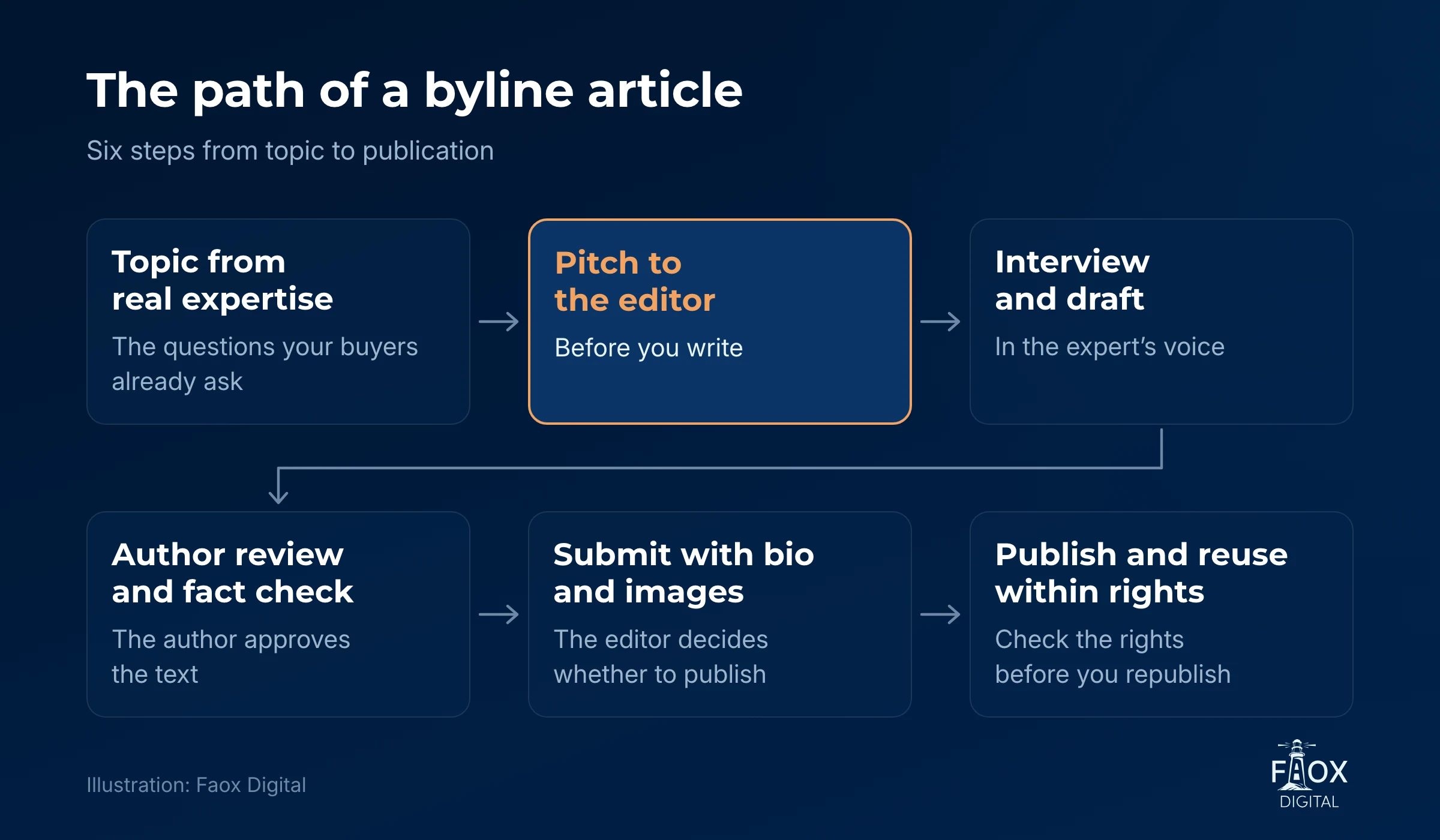
- Choose the publication whose readers match your buyers, and read its guidelines and recent issues.
- Pitch the topic to the editor before you write: a working title, three or four points, why it matters to their readers and a short author bio.
- Agree the details: length, deadline, exclusivity, images and who reviews the text.
- Interview the expert and draft the article in their voice, with examples and data.
- Review and check: the author approves the text, and someone checks facts, figures and anything said about customers.
- Submit with the bio, a headshot, images with captions and credits, and any required permissions.
- Work with the editor’s changes, and answer questions quickly.
- Share and reuse the published article within the rights you agreed.
Our guide to byline writing steps covers the pitch and the draft in detail. Opinion pieces follow a different route, which our guide to submitting an op-ed explains. Either way, a byline is easier to place with an editor who already knows you, and our media relations guide explains how to build that relationship.
Byline articles in other markets
Bylines work in every market where buyers read trade media, but each market needs its own approach. Write the article in the publication’s language, ideally by or with an expert who works in that market, and have any translated draft reviewed by a native-speaking engineer before it goes out. Read each publication’s guidelines, because rules on length, promotion and exclusivity differ from title to title and country to country. A local expert’s name and title often mean more to local readers than those of a head office executive they have never heard of, and a local author can also answer the editor’s questions in the editor’s own language.
Rights, reuse and measurement
Check the rights before you republish. Some publications ask for exclusive first publication or a copyright release, so you may need permission, or a waiting period, before you put the full article on your own site. Often the simplest reuse is a short summary on your website with a link to the publication, plus sharing by the author.
Measure byline articles by what they lead to: placements in the titles on your list, the reader data the publication can share, visits and enquiries from the article, invitations to speak or comment, and editors who come back for more. Over time, a series of bylines in the right publications makes your experts the people the industry associates with their subject.
Common mistakes with byline articles
- Writing an advertisement and calling it an article.
- Writing first and pitching later, then finding the publication covered the topic last month.
- Choosing the most senior author rather than the one who knows the subject.
- Sending the same article to several publications when the first one expected exclusivity.
- A bio longer than the article’s main point, or one full of superlatives.
- No review by the named author, so they cannot discuss what they "wrote".
How Faox Digital approaches byline articles
Faox Digital, a digital growth partner for B2B companies in complex and international markets, treats bylines as part of the materials in a digital PR program: we find what is genuinely worth telling in an expert’s knowledge and write each byline and pitch for the outlet and readers it is meant for. Outside the home market, the work happens in each market’s own language.
Key takeaways
- A byline article is written by an outside expert under their own name and accepted, unpaid, by the publication’s editor.
- It shows expertise instead of claiming it, and B2B buyers trust engineering experts as authors.
- Choose the author who knows the subject; writing with the executive is normal, as long as the expertise and approval are real.
- Read each publication’s editorial guidelines, pitch the topic before writing and respect exclusivity and rights.
- Build a consistent author profile across the publication, your website and LinkedIn.
Frequently asked questions
What is a byline in an article?
The byline is the line that names the author, usually under the headline, for example "By Jane Smith, Head of Application Engineering, Example Valves". In newspapers and magazines it tells readers who wrote the article; in a byline article, it names the outside expert who contributed it.
What is a byline article?
It is an article written by an expert who does not work for the publication, such as an engineer or executive at a company, and published under their name. The publication accepts and edits it without payment, and it has to inform readers rather than promote the author’s company.
How do you write a byline article?
Choose a publication whose readers match your buyers and read its guidelines. Pitch the topic to the editor first, then interview the expert, draft the article in their voice, have them review it and check every fact. Submit it with a short bio and images, and work with the editor’s changes.
Can someone help an executive write a byline article?
Yes. Writers often interview the expert, draft the article and revise it with them, and publications such as Automation.com say ghostwritten articles may be bylined by someone in the client company. The named author must hold the views, approve the text and be able to discuss it.
Sources
- GlobalSpec and TREW Marketing: 2026 State of Marketing to Engineers, 2026
- Edelman: The Rise of the Hidden Buyer (2025 Edelman and LinkedIn B2B Thought Leadership Impact Report), June 2025
- Automation.com: Submit content, guidelines for bylined feature articles, accessed November 2026
- Google Search Central: Creating helpful, reliable, people-first content, updated October 2026
Let’s talk
Have a story worth telling?
Tell us what is new in your business. We will tell you honestly whether it is news and where it could be published.