
Press Release Translation: Why a Translated Release Is Not Enough
Why a translated press release rarely works in another market, and how to rebuild it for each one, with the local news angle, the industry’s own terms, a local quote, local formats and a native-speaker check, plus notes on Spanish, French and Arabic.
Press release translation changes the words, not the story. An editor in another market publishes news that matters to their readers, written the way their industry writes, so treat each language version as a release of its own: start from the local news angle, use the sector’s own terms, add a quote from someone editors can interview in their language, adapt numbers, units and dates, and have a native-speaking editor who knows the industry check it before it goes out.
A translated release usually fails for reasons a dictionary cannot fix. The angle is about head office, the terms are not the ones engineers in that market use, the quote sounds translated and the dates can be misread. In Muck Rack’s 2026 State of Journalism survey, 45% of the 897 journalists whose answers were analyzed said clear local or cultural context makes a pitch genuinely relevant to their audience. Most of them work in the US, but editors everywhere write for their own market.
This how-to explains the difference between translation and localization and shows how to rebuild a release for each market, with notes on Spanish, French and Arabic. It is one part of a global PR strategy, the plan that decides which markets you work in and how.
Press release translation vs localization
Translation moves a text from one language into another. Localization, as the W3C, the web’s standards body, defines it, adapts content to the language, cultural and other requirements of a specific market, and the W3C notes that it is often mistaken for a synonym of translation. Press release localization keeps the news and the facts, but rewrites the release for the editor who will judge it.
| Part | Translated release | Localized release |
|---|---|---|
| Headline | The English headline in another language | The local angle, in the terms local buyers use |
| Lead paragraph | The same opening for every market | What changes for buyers in this market |
| Terms | Dictionary equivalents | The words engineers and buyers use there |
| Quote | Head office’s quote, translated | A quote from someone editors can interview in their language |
| Numbers and dates | The source formats | Local separators, units, dates and month names |
| Contact and links | Head office, English pages | A local contact and pages in the same language |
Your website faces the same choice, and our article on localization vs translation covers it page by page.
Find the local news angle first
A local news angle answers the editor’s first question: why should my readers care? The same news can matter for different reasons in each market: a distributor with stock in Mexico, a certification that opens the French market, a reference project in Saudi Arabia shown with the customer’s permission, or a regulation your product helps local buyers meet. In Muck Rack’s 2026 survey, 78% of journalists said a pitch feels genuinely relevant when it directly affects the community their audience belongs to.
Decide the angle with the people who know the market, such as the country manager or the distributor. Then decide who receives it, because each market needs its own list of titles and editors; our guide to market-by-market media lists shows how to build them.
Use the industry’s own terms
Industry terminology is where general translation slips, because a dictionary offers words buyers do not use. Take a forklift: buyers in Spain search for carretilla elevadora, while buyers in Mexico search for montacargas, a word the Real Academia Española’s dictionary defines as a lift for raising loads. Our guide to international keyword research shows how to find the terms buyers use in each market.
Standards have local names too. ISO 9001 is listed in the catalog of UNE, Spain’s standards body, as UNE-EN ISO 9001 and sold by AFNOR in France as NF EN ISO 9001, and its French title speaks of systèmes de management de la qualité, not the gestion a literal translation might choose.
Keep a glossary of approved terms for each language, with product names, standards and the words your distributor’s engineers use, and check new terms against articles in the titles you pitch.
Give each market a local quote
A quote from head office, translated word for word, often reads like what it is. A local quote comes from someone editors can call in their language: a country manager, a sales engineer, a distributor’s managing director or, with permission, a customer. In Muck Rack’s 2026 survey, 28% of journalists said voices from the community affected make a pitch genuinely relevant to their audience.
If the head office quote stays, have it rewritten in natural local language and approved by the person quoted. Name a press contact who answers in the language and the market’s time zone.
Adapt numbers, units and dates
Unit and date formats change even between markets that share a language, and a separator can change a figure: 12.000 is twelve thousand in Spain and twelve in the US. The Unicode CLDR, the locale data built into modern operating systems and browsers, shows how far formats differ. These examples follow CLDR 49, released in October 2026:
| Market | Number | Numeric date | Watch for |
|---|---|---|---|
| United States, English | 12,345.6 | 11/18/2026 | Month before day |
| Spain, Spanish | 12.345,6 | 18/11/2026 | Comma for decimals, point for thousands |
| Mexico, Spanish | 12,345.6 | 18/11/2026 | Point for decimals, as in the US |
| France, French | 12 345,6 | 18/11/2026 | A space separates thousands |
| Canada, French | 12 345,6 | 2026-11-18 | Year first in numeric dates |
| Saudi Arabia, Arabic | ١٢٬٣٤٥٫٦ | ١٨/١١/٢٠٢٦ | Arabic-Indic digits by default |
| Morocco, Arabic | 12.345,6 | 18/11/2026 | Western digits; November is نونبر |
Write dates with the month as a word, as in 18 November 2026, and give the year in full. Convert units to the ones the publication uses, or give both, and write currencies and phone numbers with their codes.
Spanish, French and Arabic: what to check
A press release in Spanish written for Spain will not always suit Mexico. The vocabulary differs, as the forklift shows, and so do the formats: in CLDR, Spain, Argentina and Colombia write decimals with a comma, while Mexico and Spanish in the US use a point. Write one version per major market, or have the Spanish checked by someone from the market you target.
French conventions also vary by country. CLDR writes the same date as 18/11/2026 for France, 2026-11-18 for Canada and 18.11.2026 for Switzerland, so write for the market of the publication, not for French in general.
Arabic runs right to left, while numbers, units and Latin product codes run left to right, so check the final file for codes and punctuation in the wrong place. Choose digits and month names by market: in CLDR, November is نوفمبر in most Arab markets, تشرين الثاني in Iraq, Jordan, Lebanon, Syria and Palestine, and نونبر in Morocco.
Match the cultural context
Cultural context decides how the story should sound: how direct the headline can be, how formal the quote, how much technical detail the editor expects and which examples feel familiar. A confident claim that reads well in one market can sound boastful in another, and humor rarely survives translation. Use examples from the market, such as a local plant or project, and match the formality of the publication. The brand itself adapts as well, as our guide to brand localization strategy explains.
How to build a multilingual press release, step by step
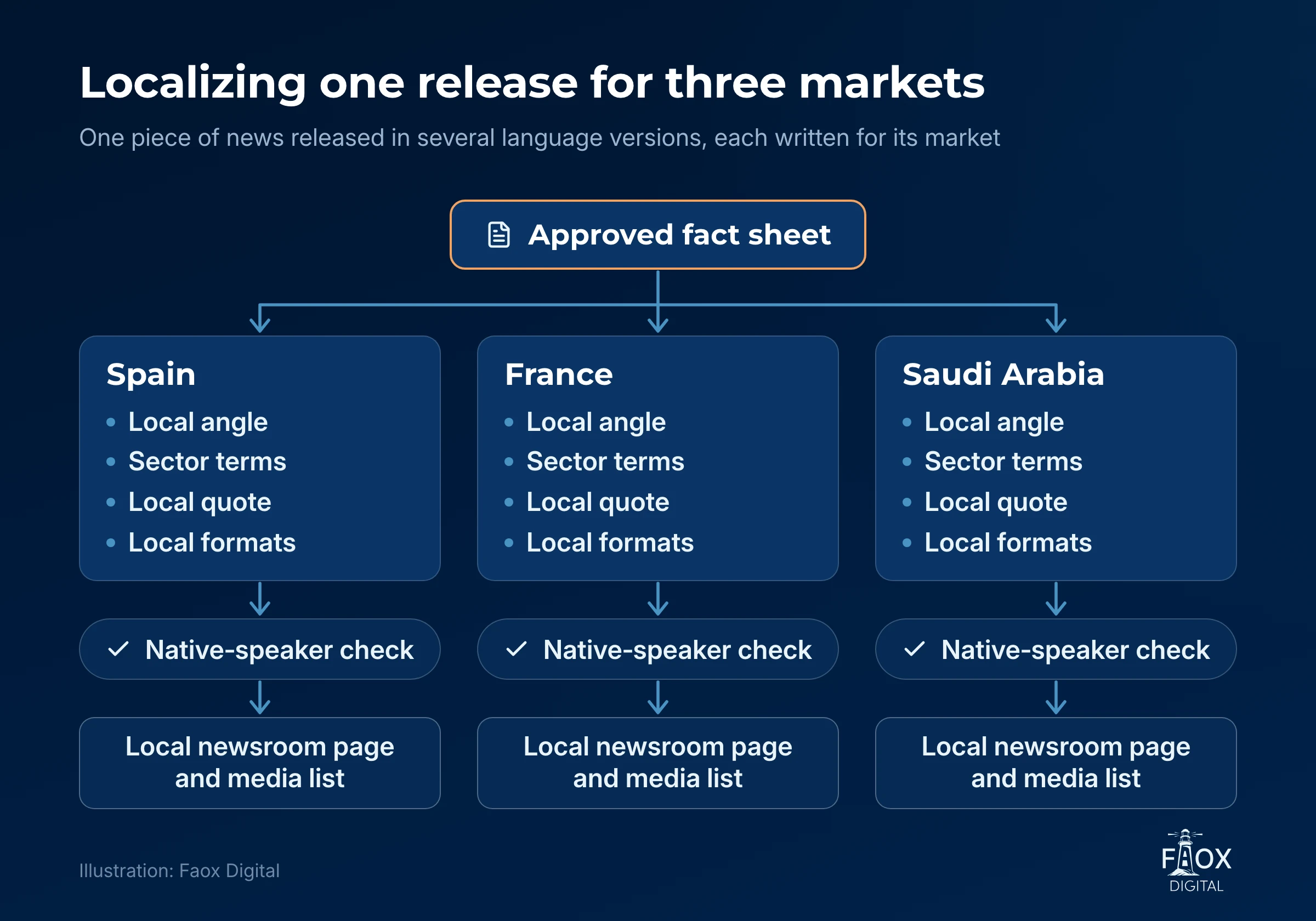
A multilingual press release is one piece of news released in several language versions, each written for its market. This order keeps the facts identical and the rest local:
- Agree one fact sheet. The news, figures, names and approvals in the source language, so that every version says the same thing.
- Set the angle for each market. Decide it with the country team or distributor, as above.
- Write each version in its language. Keep the press release structure and your press release template, but write the text for that market, ideally with a native writer who knows the sector.
- Apply the glossary and local formats. Terms, standards, numbers, units, dates and currencies.
- Add the local quote and contact. Someone who answers editors in the language and time zone.
- Have a native speaker check it. Use the checklist below.
- Get head office approval. If head office cannot read the language, ask the writer for a short back-translation of the headline, lead and quote, so the facts can be approved.
- Publish and send. Put each version on the matching language page of your online newsroom and send it to that market’s media list at a time that suits its editors.
The native-speaker editor check
A native-speaker editor check is the last step before sending. The reviewer should be a native speaker who knows your industry and how its trade press writes, not only someone fluent in the language. Ask them to confirm that:
- The headline and lead state the local angle in the first lines
- Technical terms and standard names match the glossary and local usage
- Numbers, units, dates, currencies and phone numbers follow local formats
- Quotes sound natural and are approved by the people quoted
- Names, job titles and company names are written as they are used locally
- Links lead to pages in the same language
- Nothing is left in the source language except product names
Machine translation can speed up a first draft, but it does not replace this check. The next question is who does this work in each market, your own team, a local agency or one team across markets; our comparison of international PR support weighs the options.
How Faox Digital handles press releases in other languages
Faox Digital, a digital growth partner for B2B companies in complex and international markets, writes each release and pitch for its outlet and its readers instead of translating one text for every market. We look for what is newsworthy in each market, and international outreach happens in that market’s own language, directly with the editors who matter to a company’s buyers.
Key takeaways
- Translation changes the language; localization rebuilds the release for the editors and buyers of one market.
- Start each version from the local news angle, not from the head office headline.
- Use the sector’s own terms and the local formats for numbers, units, dates and month names, which differ even between markets that share a language.
- Give editors a local quote and a contact who answers in their language and time zone.
- Have a native-speaking editor who knows the industry check every version before it goes out.
Frequently asked questions
Can I use AI to translate a press release?
AI and machine translation can produce a first draft quickly, which helps when several markets are involved. They do not know your local angle, your approved terms or what a trade editor expects, so a native-speaking editor who knows the sector should rework and check the text. Check your tool’s data terms before pasting news that is still under embargo.
Should I send the English release as well?
Send the local version as the release. You can add a link to the English original for editors who want to check a detail, but do not expect them to translate it themselves.
Which languages should a B2B company use for its press releases?
Start with your priority markets, where you can offer a local angle and someone who answers editors in their language. Add a language when you have news that matters there and a contact who can support it.
Sources
- W3C Internationalization: Localization vs. Internationalization, accessed November 2026
- Unicode CLDR 49 charts: Numbers, symbols, October 2026
- Muck Rack: The State of Journalism 2026, 2026
- UNE: UNE-EN ISO 9001 Sistemas de gestión de la calidad, accessed November 2026
Let’s talk
Have a story worth telling?
Tell us what is new in your business. We will tell you honestly whether it is news and where it could be published.