
How to Write a Press Release: Step-by-Step Structure and a B2B Example
The parts of a B2B press release and how to write each one so that an editor can use it, from the headline to the press contact, with a complete example for a hypothetical valve maker.
To write a press release, start from a one-sentence news angle and the answers to the basic news questions, then write it in the order an editor reads it: a headline that states the news, a subheadline, a dateline and lead paragraph, a body in inverted pyramid order with technical data, one quote that adds a view, the boilerplate and a press contact. Write in the third person, in plain and specific language, and check every fact before you send it.
In Muck Rack’s 2026 State of Journalism survey of 897 journalists, 71% said they immediately disregard a pitch that is overly promotional or advertorial, and 40% one that is too long or unclear. A press release travels with the pitch, so the same faults sink it: the news buried under company history, adjectives instead of facts, a quote nobody would repeat. Muck Rack sells PR software and most of its respondents work in the US, but the trade titles’ own guidelines cited below make the same points.
This how-to takes you through writing a release part by part and ends with a complete example for a hypothetical valve maker. It assumes you have news worth sending; if you are not sure, start with our press release basics, which cover the news angle, embargoes and distribution.
What is press release writing?
Press release writing is news writing for an editor: you report your company’s news in the form a journalist uses, so that it can be checked, cut and published quickly. Three rules separate it from marketing copy.
- It is written in the third person. Automation.com, the news site of the International Society of Automation, asks companies to write to the editor, not the customer: "an engineer can use the product", not "you can use the product".
- It supports every claim. The same guidelines say that superlatives such as "industry-leading" will be removed, and so will unsupported claims such as "faster" unless the release cites evidence.
- It carries one piece of news. Modern Machine Shop asks for product releases that highlight a single product.
A release is not the place for an expert’s opinion at length. That is a byline article, published under the expert’s own name, and our guide on how to write a byline covers it.
Before you write: answer the basic news questions
Collect the facts in a short fact sheet and have them approved before anyone writes a headline. The basic news questions come first, followed by what an editor will ask next:
- Who: your company, and any partner, customer or person involved
- What: the news in one sentence, without adjectives
- When: the date of the launch or decision, and when the release may be published
- Where: the plant, market or event concerned
- Why: what changes for the publication’s readers
- How: how the product works or how the change was made, with figures
- Evidence: test results, certificates and data, with their sources
- People: who will be quoted, and who will answer journalists’ questions
- Assets: photos, drawings and data sheets, with permission to publish them
- Approvals: technical and legal sign-off, and the customer’s if they are named
If the "why" stays empty, stop. You may have an update for your website or newsletter, not news for an editor.
How to write a press release, step by step
Write the parts in this order. The first three carry the news; the rest support it.
- Headline. State the news in one short line.
- Subheadline. Add the strongest supporting fact.
- Dateline and lead paragraph. Give the place and date, then answer the basic news questions in one or two sentences.
- Body. Add detail in inverted pyramid order, most important first.
- Quote. Add one view that the facts cannot give.
- Technical data and images. List specifications with units and link to images and drawings.
- Boilerplate and press contact. Close with the About paragraph and a person who answers.
- Release line. Mark it for immediate release or set an embargo date.
Write the headline, subheadline and lead
The headline decides whether the editor reads on, so put the news in it: who did what, for whom. Automation.com notes that shorter is always better and that it may edit headlines anyway, so aim for clarity, not cleverness. Compare:
- Weak: "[Company] proudly unveils its innovative new valve solution"
- Better: "Valve maker launches stainless steel series for dairy plants that clean in place"
Use a verb, name the product type in your readers’ words, and drop "innovative", "leading" and "unique", which give an editor nothing to check. The subheadline adds one fact the headline could not hold, such as availability, a test result or the market concerned.
The first paragraph opens with the dateline, the city and date, for example "IZMIR, Türkiye, [date]". The lead paragraph then answers the basic news questions in one or two sentences, so that an editor who reads nothing else still has the story. Automation.com asks for a one- or two-sentence summary of every release; a good subheadline and lead give the editor exactly that. Test your lead on someone in the industry: they should understand what happened and why it matters to them without reading on.
Build the body in inverted pyramid order
The body follows the inverted pyramid: the most important information first, then supporting detail, then background. Modern Machine Shop’s guidelines ask product releases to present the most important features first. Editors cut from the bottom, so anything you need them to keep belongs near the top.
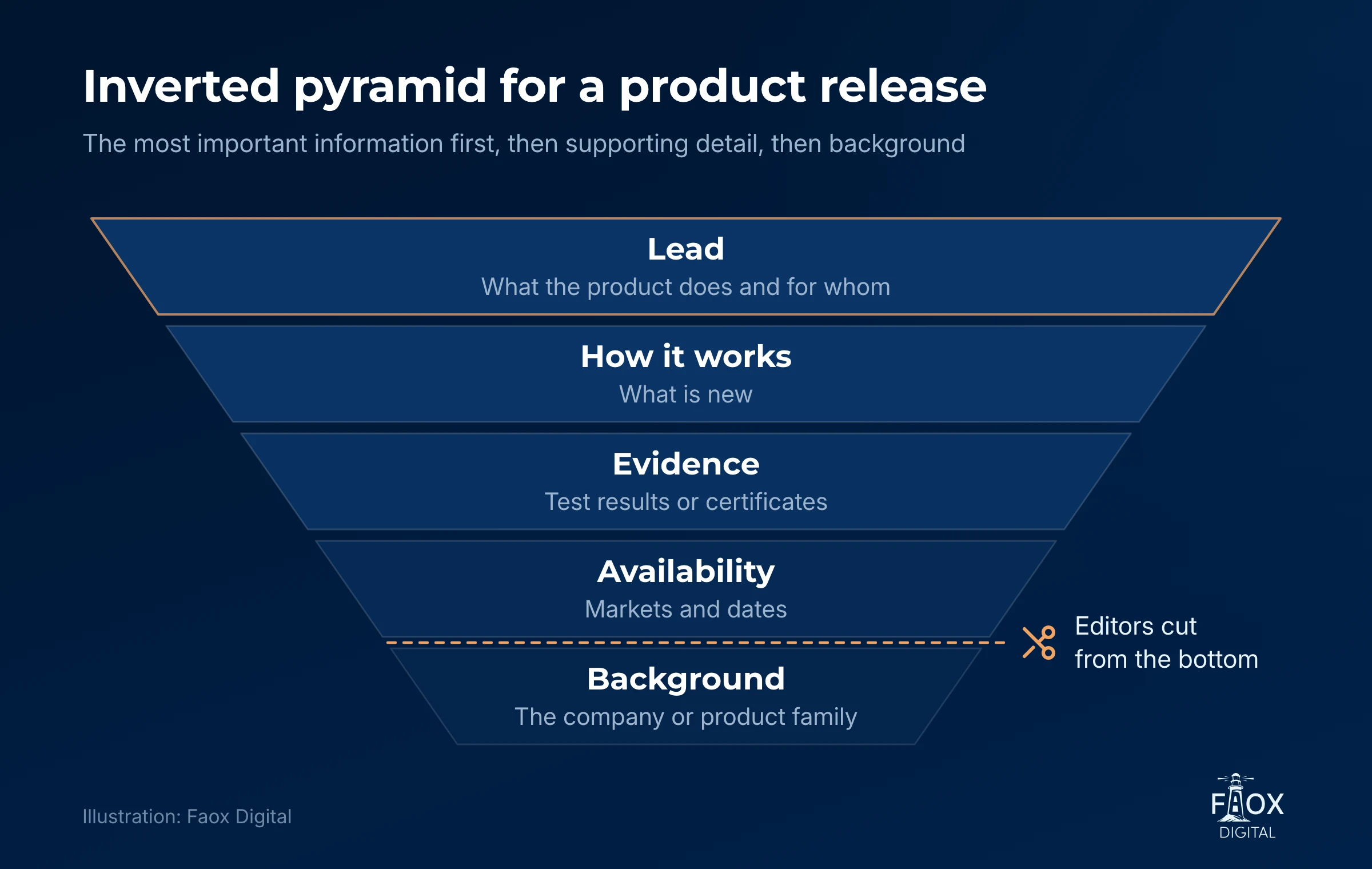
For a product release, a typical order runs from what the product does and for whom, to how it works and what is new, the evidence such as test results or certificates, availability with markets and dates, and finally background on the company or product family. Keep paragraphs to two or three sentences, with one idea in each, and cut anything that would read the same in any company’s release.
Add a quote that says something
A quote in a press release is a statement in quotation marks, attributed to a named person with their job title, that an editor may reuse in a story. Its job is to add what the facts cannot: a view, a reason, or what the news means for customers.
Editors do not need more quotes; they need sources. In Muck Rack’s 2026 survey, only 14% of journalists counted pre-written quotes among the things a PR professional should ideally offer with a pitch, against 58% for interview access to relevant sources. Write a quote that a sentence of fact could not replace, and offer the person for an interview.
- Weak: "We are proud to introduce this innovative series, which reflects our commitment to quality."
- Better: "Dairy engineers told us that cleaning stops were costing them production time. We designed this series so that a line can be cleaned without anyone opening a valve."
Choose the speaker for the readership: an engineer or product manager for a technical title, the managing director for news about investment or strategy. Use one or two quotes, not more, and quote a customer only with their written approval.
Add technical data, images and technical drawings
Trade readers buy on specifications, so give them materials, sizes, ratings, standards met, operating ranges and availability, each figure with its unit. A short list after the main text works better than numbers packed into sentences, and a link to the data sheet covers the rest.
Good images and technical drawings can decide whether a product story runs. In Muck Rack’s 2026 survey, 37% of journalists wanted high-resolution images offered with a pitch, and 40% original data or research. Requirements differ: Modern Machine Shop’s guidelines, last updated in 2021, ask for photos of at least 2,400 × 3,300 pixels as .jpg or .tif files, while Automation.com’s guidelines, checked in November 2026, prefer a main image of 1,518 × 950 pixels. Send photos of the real product or site, not only renderings, give each a caption and a credit, make sure you hold the rights, and supply them as separate files or a download link. Both titles ask for images as separate files rather than embedded in the text.
Close with the boilerplate, press contact and release line
The boilerplate is the "About [Company]" paragraph at the end: what you make, for whom, where you are based and your website, in neutral words. Keep one approved version for every release and update it when the facts change.
The press contact is a named person with job title, email, phone number and the languages they speak, who can be reached on the day the release goes out. Both trade titles ask for contact details; Automation.com wants the release date, company name, contact name, email address and phone number.
The release line sits at the top: "FOR IMMEDIATE RELEASE", or an embargo with its date, time and time zone, such as "EMBARGOED UNTIL 09:00 CET, [date]". Set an embargo date only when editors need time to prepare a story, and send embargoed news only to journalists who have agreed to hold it. In Muck Rack’s 2026 survey, 33% of journalists counted exclusive or embargoed content among the things worth offering with a pitch. End the release with "###" or "Ends".
Use industry terminology for the right reader
Industry terminology is a strength in a trade title and a barrier in a business newspaper. For a specialist publication, use the terms its readers use, precisely: the full designation of a standard, the material grade, the name of the process. For a general business title, explain what the product does in plain words and keep one or two technical terms. Spell out abbreviations at first use, give figures in the units your readers work with, and keep sentences short.
Have an engineer check every fact, including any text an AI tool drafted, and someone outside the project check that the lead makes sense. Each language needs its own version, written for that market’s editors, because a straight translation is not enough; our article on localizing press releases explains how.
Press release format: a complete B2B example
Here is the whole release for our hypothetical valve maker, part by part. Names, dates and figures are placeholders in square brackets; replace them with your own verified facts.
| Part | Format | Example |
|---|---|---|
| Release line | Top of the page | FOR IMMEDIATE RELEASE |
| Headline | One short line with a verb | Valve maker launches stainless steel series for dairy plants that clean in place |
| Subheadline | One sentence | The new valves can be cleaned without being taken apart and are available in Europe from [month] |
| Dateline and lead paragraph | City, country and date, then one or two sentences | IZMIR, Türkiye, [date]. [Company], a manufacturer of industrial valves, today launched a stainless steel valve series for dairy and food plants that clean their lines in place. The valves have no internal pockets where product can collect, so a line can be cleaned without stopping to take valves apart. |
| Body | Short paragraphs, most important first | In tests at [laboratory], the valves [result, with the method]. The series covers [sizes] and fits existing lines without changes to the pipework. Deliveries in Europe start in [month], and distributors in [countries] will hold stock. |
| Quote | In quotation marks, with full name and job title | "Dairy engineers told us that cleaning stops were costing them production time," said [Name], head of application engineering at [Company]. "We designed this series so that a line can be cleaned without anyone opening a valve." |
| Technical data | A list with units, and a link | Material: [steel grade]. Sizes: [range]. Pressure rating: [value and unit]. Certificates: [names]. Data sheet: [link] |
| Images | Separate files or a download link | Three photos of the valve on a dairy line and one sectional drawing, each with a caption and the credit "[Company]" |
| Boilerplate | One standard paragraph | [Company] designs and makes valves for the food, beverage and chemical industries. Founded in [year] and based in Izmir, it sells through its own offices and distributors in [countries]. [Website] |
| Press contact | Name, job title, email, phone, languages | [Name], [job title], [email], [phone]. Speaks Turkish, English and German. |
| End mark | After the last line | ### |
For other announcements, such as an investment, a certification or a new distributor, our press release template gives filled-in versions. Once the release is written, the next question is how to send it: our comparison of press release distribution services and direct outreach to editors helps you choose.
How Faox Digital writes press releases
Faox Digital works with B2B companies selling in complex and international markets and writes a press release only after finding the story: the part of a company’s news that is genuinely newsworthy. Each release and pitch is then written for the outlet and reader it is meant for. Outside the home market, it is written in that market’s own language and sent to editors directly, never in mass sends.
Key takeaways
- Collect and approve the facts first: the answers to the basic news questions, the evidence, the images and the people involved.
- Put the news in the headline and lead paragraph, then write the body in inverted pyramid order, in the third person and without superlatives.
- Use one or two quotes that add a view, from someone the readers will trust, and offer that person for interviews.
- Give technical data with units, and supply images and technical drawings as separate, captioned files.
- Check each publication’s guidelines for length, file format and image size before you send.
Frequently asked questions
How do you format a press release?
Start with a release line, then the headline, subheadline, dateline and lead paragraph, the body, one or two quotes, technical data as a list, links to images, the boilerplate, a press contact and an end mark such as "###". Paste the text into the email to the editor, and attach a Word file and separate image files when the publication asks for them. Modern Machine Shop and Automation.com both want Word documents, and Automation.com does not accept PDFs.
What is a quote in a press release?
It is a statement in quotation marks from a named person, usually a manager, an engineer or a customer, with their job title. A good quote adds a view or explains what the news means; it does not repeat the facts. Editors may reuse it word for word, but many prefer to interview the person, so make them available.
How long should a press release be?
As long as the news needs, and no longer. Guidelines differ: Modern Machine Shop’s, last updated in 2021, ask for news releases of fewer than 300 words, while Automation.com’s, checked in November 2026, ask for 500 to 1,500 words and add that shorter is usually better. Keep the covering email short too. Muck Rack’s 2026 report, summing up eight years of its surveys, says 69% of journalists prefer pitches under 200 words.
How are press releases distributed?
Send it by personal email to the editors who cover your field: Muck Rack’s 2026 report, summing up eight years of its surveys, says 62% of journalists prefer to be pitched by one-to-one email. A paid distribution service and your own channels, such as your online newsroom, LinkedIn page and newsletter, can add reach. For trade news, reaching the right editors matters more than reaching many.
Sources
- Muck Rack: The State of Journalism 2026, 2026
- Automation.com: Submit content, guidelines for news and press releases and for product announcements, accessed November 2026
- Modern Machine Shop: Editorial submission guidelines, updated January 2021
Let’s talk
Have a story worth telling?
Tell us what is new in your business. We will tell you honestly whether it is news and where it could be published.