
How to Choose a Digital PR Agency: Questions to Ask and Red Flags
The brief to write, the questions to ask, how to compare proposals and the promises that should make a B2B company walk away from a PR agency.
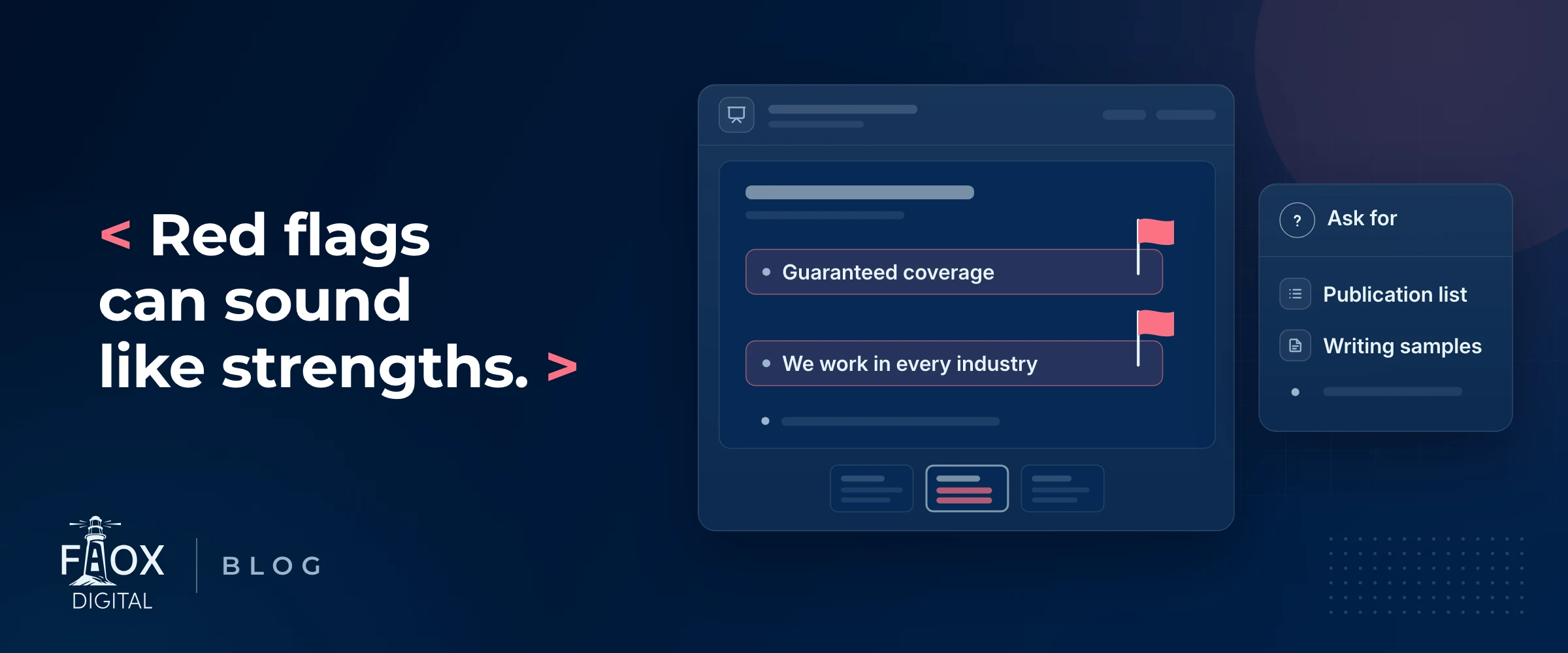
Choose a digital PR agency by how it works, not by what it promises. Give every candidate the same brief, ask each one for a target publication list, writing samples and coverage it earned in your industry, and compare how each plans to reach editors and report results. Walk away from guaranteed coverage, mass sends to bought lists and reports built on advertising value.
This guide shows how to choose a digital PR agency for a B2B company: the brief to write, the questions to ask, how to compare proposals and which promises are red flags. The same steps answer how to choose a PR agency that works only with print and trade media. We work as a digital PR agency ourselves, so we have a stake in the answer; the questions below apply to any agency, including us.
How to choose a digital PR agency: what matters
Agency selection in PR is harder than in most services, because the result an agency sells, coverage, is decided by editors it does not control. Relationships still count: in Muck Rack’s State of Journalism 2026 (897 journalists, mostly in the US; Muck Rack sells PR software), 53% said relationships with PR professionals are important or very important to their work. So judge an agency on what it can control. A good digital PR agency for a B2B company:
- Knows your industry and the trade media your buyers read.
- Finds real stories in your business before it writes anything.
- Writes well for editors, in each market’s language.
- Reaches editors one by one, never through mass sends.
- Reports honestly on what ran, where and what it did for you.
- Says plainly what it cannot promise.
Start with a brief and a target publication list
A written brief makes proposals comparable, because every agency answers the same questions. Keep it to two pages:
- Goals: what PR should achieve, such as coverage in the trade titles of one industry, a launch in a new market or expert articles by your engineers
- Audience and markets: who buys from you, in which countries and languages
- News and expertise: the announcements planned for the next year and the people who can speak for the company
- What you have done so far: releases, coverage and contacts with editors
- Your team: who approves texts and answers journalists’ questions
- Budget range and timing
Then ask each agency for a draft target publication list: the titles it would approach for you first, and why. A good list names the trade magazines, portals and newsletters your buyers read, not only famous national outlets. In the 2026 State of Marketing to Engineers by GlobalSpec and TREW Marketing, 76% of engineers and technical buyers said they routinely research work-related purchases in online technical publications.
Send the same brief to two or three agencies, and ask how each would start, not only what it would deliver.
Questions to ask a PR agency
These questions show quickly how an agency works, and they help most when the shortlist looks alike on paper:
- Which titles would you approach for us first, and why those?
- Which editors in our industry have you worked with, and what did they publish?
- Can we see releases, bylines and pitches you wrote, and the articles that came from them?
- How will you find the news in our company, and how much of our time will you need?
- Who will write for our other markets, and in which languages?
- How do you build media lists, and how many editors receive each pitch?
- Will any placement be paid, and how will it be labeled?
- What will your monthly report contain?
- Who will work on our account day to day?
- What does the fee include, how long is the contract and what is the notice period?
Comparing proposals: strong answers and red flags
Put the proposals side by side. This table shows what to look for on each point:
| Point | A strong proposal | A red flag |
|---|---|---|
| Industry experience | Work in your sector or a neighboring one, and knowledge of its trade press | "We work in every industry", with no examples |
| Editor relationships | Named titles and published articles you can check | Claims to know everyone, with nothing to show |
| Target publication list | The titles your buyers read, market by market | A long list of famous outlets, the same for every client |
| Writing samples | Releases, bylines and pitches written for each outlet | Templates, with no input from your experts |
| Outreach | One editor at a time, with a reason the story suits them | Mass sends to bought lists |
| Promises | A plan of stories, outreach and follow-up | Guaranteed coverage or a fixed number of articles |
| Reporting | Every story with its publication, market and link | Total reach and advertising value |
| Working model | A clear scope, a named team and a notice period | A long lock-in and a team you never meet |
PR agency red flags
Four red flags deserve a closer look, because each one can sound like a strength in a sales meeting.
Guaranteed coverage. No agency controls what an editor publishes. The Global Alliance for Public Relations and Communication Management lists "expertise without guarantee of results beyond capacity" among its global ethics principles (2018), and the International Public Relations Association’s code of conduct bars members from offering the media any financial or other inducement. A promise of a fixed number of articles therefore usually means paid space. Paid space is legitimate only when it is labeled: the US Federal Trade Commission’s guide to native advertising (December 2015) rests on the principle that an ad should be identifiable as an ad. Ask which placements are paid, and keep them apart from earned coverage in every report.
Mass sends. Sending one release to hundreds of addresses looks productive and rarely works. In the same Muck Rack survey (2026), 88% of journalists said they immediately delete a pitch that does not match their coverage, and 50% one that looks like a mass email. A wire service has its uses, such as a public record of an announcement, and our guide to distributing a press release explains when it helps. Reposted copies on partner sites are not editorial coverage, though.
Bought lists. Looking up the right editor in a media database is research; buying a file of thousands of addresses and emailing everyone on it is a mass send with extra risk. The European Commission’s guidance on the GDPR gives an address such as [email protected] as an example of personal data, while [email protected] is not. Ask where an agency’s contacts come from and how it keeps them.
Link packages. Some digital PR offers sell a set number of links. Google’s spam policies (updated August 2026) count buying or selling links for ranking purposes, including money exchanged for posts that contain links, as link spam. An agency can earn links through stories editors choose to cover; it cannot sell them safely.
Industry experience and editor relationships
Industry experience matters because trade editors expect technical accuracy. An agency that knows your sector knows which titles matter, which trade fairs set the news calendar and which terms editors use. It does not need to have worked for your competitors: experience with the same buyers or a neighboring product often transfers.
Editor relationships are real, but they are built on useful stories, not on favors. Check them. Ask for articles the agency’s clients appeared in during the past year, open them and see whether they are editorial pieces or labeled sponsored content. If you sell in several countries, ask who handles each market, in which language, and whether a partner agency is involved; our comparison of global vs local PR agencies covers that choice.
Writing samples and success stories
Ask for writing samples: two press releases, a byline article and a pitch email the agency wrote, ideally for B2B clients. Read them as an editor would. Is the news in the first lines? Is every claim supported? Would a trade magazine run it without rewriting it? Then ask for the articles that came out of them.
Success stories show whether the agency has done similar work. Ask for the starting point, the period, what the agency did and what ran, with links. A case study that shows famous logos without the coverage behind them is a brochure, not evidence. Speak to at least one client whose audience resembles yours.
Reporting and the working model
Reporting shows what the agency is trying to achieve. A useful monthly report lists every story with its publication, date, market, headline and link, says whether your messages and spokespeople appeared, keeps earned coverage apart from paid placements and distribution copies, and recommends what to do next. Be wary of reach totals on their own and of advertising value equivalents (AVEs), which price coverage as if it were advertising space. AMEC, the International Association for the Measurement and Evaluation of Communication, runs a global campaign to end the use of AVEs as a PR metric.
The working model sets how the work runs: a monthly retainer for continuous media relations, a project fee for a launch or a market entry, or a mix of the two. Ask what the fee covers, how many stories and markets are included, who does the work and how much notice either side must give. Our guide to PR agency cost explains what drives fees.
If you need PR together with a website, SEO or social media, our marketing agency selection questions cover the wider decision.
How Faox Digital answers these questions
If you put the questions in this guide to Faox Digital, the answers follow our five steps. We start by mapping the field, meaning the market, the buyers and the outlets and writers who matter to them, and by finding what in your company is genuinely newsworthy. Releases, bylines and pitches are written for each outlet and reader, in each market’s own language, and go to editors directly, with no mass sends and no bought lists. Paid placements are arranged only when they make sense and are labeled as sponsored, and what landed in one round shapes the next.
Key takeaways
- Send every agency the same brief, and ask each one for a target publication list for your markets.
- Judge agencies on what they control: industry knowledge, writing, outreach to the right editors and honest reporting.
- Check every claim: read the writing samples, open the articles they produced and call a client.
- Treat guaranteed coverage, mass sends, bought lists and link packages as red flags.
- Compare proposals on scope, team, reporting and notice period, not only on the fee.
Frequently asked questions
How do you choose a digital marketing agency, and is it different for PR?
The basics are the same: a written brief, two or three candidates, the same questions for each and references you can call. The test differs. For PR, judge the writing samples, the target publication list and published coverage you can check, because the result depends on editors rather than on ads or tools.
How do you hire a PR agency, step by step?
Write a short brief, send it to two or three agencies, meet each one with the same questions and compare the proposals side by side. Ask for writing samples and a draft publication list, call a reference, then agree the scope, team, reporting and notice period in the contract. A first project or a short initial term lets both sides test the fit.
How does a digital PR agency work day to day?
Each month it plans stories with you, writes releases, bylines and pitches, approaches editors one by one, follows up, answers journalists’ questions and arranges interviews. It monitors what runs and reports what landed, where and what comes next. Your part is the news, quick approvals and an expert who is available.
What should a PR agency contract include?
The scope (stories, markets and languages), the named team, what the fee covers and what costs extra, how paid placements are approved and labeled, the reporting format, who owns the texts the agency writes for you, and the notice period. Avoid a long lock-in before the agency has shown its work.
Sources
- Muck Rack: The State of Journalism 2026, 2026
- Global Alliance for Public Relations and Communication Management: Global principles of ethical practice, 2018
- AMEC: Say No to AVEs, accessed November 2026
- European Commission: Data protection explained, accessed November 2026
Let’s talk
Have a story worth telling?
Tell us what is new in your business. We will tell you honestly whether it is news and where it could be published.