
What Is B2B PR? What a PR Agency Does and What It Cannot Promise
What public relations means for a company that sells to other businesses, the work a PR agency takes on, and why no one can promise coverage when editors decide what they publish.

B2B PR is public relations for companies that sell to other businesses: earning the trust of buyers, partners and the trade press through news, expertise and relationships, not paid space. A PR agency finds your stories, writes press releases and byline articles, works with editors at home and abroad, and monitors coverage. It cannot promise the coverage itself, because what gets published is an editor’s decision.
Two questions come before any PR budget: what is B2B PR, and what can a PR agency actually promise? Most companies start with a concrete hope, such as an article in the trade magazine their buyers read, a quote in a national business title or more visibility in search and AI answers. This guide explains what the work involves, which parts an agency controls and where the editor’s decision begins.
What is B2B PR?
Public relations is, in the Public Relations Society of America’s definition, "a strategic communication process that builds mutually beneficial relationships between organizations and their publics." For a company, the publics are the people whose opinion affects the business: customers, partners, employees, neighbors and the media. Much of the work runs through media relations, the part of PR that deals with journalists and editors.
B2B PR applies this to companies that sell to other businesses. Three things set it apart from consumer PR:
- Smaller, expert audiences. A purchase may involve an engineer, a buyer and a finance director, each reading different titles. One article in a respected trade magazine can matter more than a national headline.
- Long decisions. B2B purchases take months and involve several people, so PR builds trust over time rather than in one campaign.
- Specialist media. Trade magazines, industry newsletters, association bulletins and trade fair issues carry much of the news B2B buyers act on. In the 2026 State of Marketing to Engineers by GlobalSpec and TREW Marketing, 76% of engineers and technical buyers said they routinely research work-related purchases in online technical publications, slightly more than the 74% who use supplier websites.
For exporters, B2B PR also means the international press: the trade and business titles of each target market, approached in their own language.
Earned media and the editorial decision
The goal of media relations is earned media: coverage you neither own nor pay for, because a journalist decided it was worth publishing. Your website and newsletter are owned media; advertising and sponsored articles are paid media. The US Bureau of Labor Statistics (BLS) draws the same line in its handbook entry for PR specialists: they get stories covered by the media instead of buying ad space.
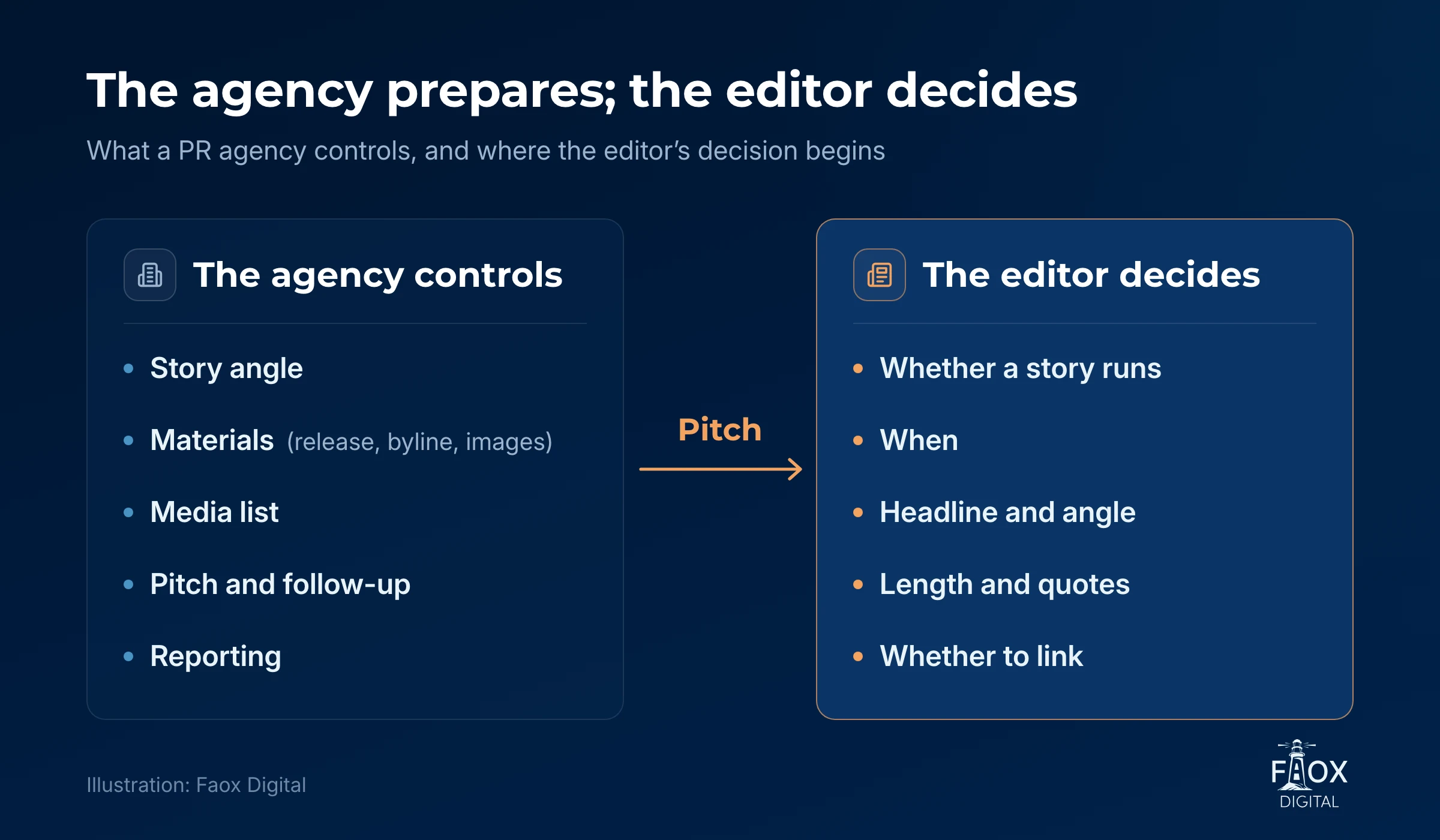
This is why every PR plan depends on an editorial decision. The editor decides whether a story runs, when, under which headline and angle, how long it is, who is quoted and whether it links to you. Editors judge by news value and by what their readers need, so it helps to know what makes news newsworthy before you send anything.
The same independence that makes coverage hard to win makes it worth having. Readers give more weight to what an independent publication says about you than to what you say yourself, and our article on why people trust others explains the reasons.
Journalists’ own answers show both sides. In Muck Rack’s State of Journalism 2026 (897 journalists, mostly in the US; Muck Rack sells PR software), 86% said at least some of their stories start with a PR pitch, while 54% said they seldom or never respond to pitches.
What does a PR agency do?
A PR agency turns what your company does into material editors can use, and keeps that work going month after month. The core matches the duties the BLS lists for PR specialists: writing press releases, answering information requests from the media and arranging interviews for executives. For a B2B company, the work usually covers:
| Service | What the agency does | What you provide |
|---|---|---|
| Strategy and messages | Finds the story angle in your plans, chooses target titles and markets, agrees key messages | Access to managers and facts |
| Press releases | Writes news announcements as stories an editor can use, with images and data | Approval of facts, figures and quotes |
| Media relations | Builds a media list of the right editors, pitches them one by one, answers journalists’ questions | A spokesperson who replies quickly |
| Byline articles | Drafts expert articles with your specialist, under their name, for suitable titles | The expert’s time and knowledge |
| International press | Reaches editors in each target market, in their language | Product facts and local contacts per market |
| Sponsored content | Arranges clearly labeled sponsored content when paid space makes sense | Budget and approval |
| Media monitoring | Records coverage and reports what ran and what it means | Feedback from sales |
The raw material is always your news and your experts, so a company that shares little gets little coverage. Some agencies also offer specialist work such as crisis communications or investor relations; ask about it separately if you need it. If you are weighing a PR specialist against an agency that also runs your website, SEO or social media, our guide to how a marketing agency works explains how multi-service agencies are organized.
What is a digital PR agency?
A digital PR agency does the same media work with online publications, search and AI answers in mind. Digital PR aims at coverage on news sites, trade portals and newsletters, where a story can link to your site, appear in search results and be read by AI tools.
That last point is new. In Muck Rack’s What Is AI Reading? report (October 2026), journalism accounted for 22% of the citations in answers from ChatGPT, Claude, Gemini and Perplexity in September 2026, and paid and advertorial content for 0.3%. For AI answers too, earned coverage counts and paid space hardly does.
Links follow the same rule as coverage: the editor decides whether to link. Google’s spam policies (updated August 2026) count paid articles with links that pass ranking credit, and links with optimized anchor text in press releases distributed on other sites, as link spam. A digital PR agency can earn links; it cannot promise them.
What a PR agency cannot promise
Because editors decide, some results are outside any agency’s control, and the profession says so. The global ethics principles of the Global Alliance for Public Relations and Communication Management (2018), drawn from more than a dozen PR codes, describe expertise without promises of results beyond a practitioner’s capacity, and its code asks members to define accurately what PR can and cannot accomplish. The International Public Relations Association (IPRA) adds in its code of conduct that members may not offer the media any financial or other inducement.
| An agency can commit to | It cannot promise |
|---|---|
| Finding news angles and preparing accurate materials | That a given publication covers you, or how many articles run |
| Pitching the right editors and following up once | A publication date, a headline or a positive tone |
| Drafting byline articles and offering them to suitable titles | That a title accepts an article or prints it as written |
| Getting your approval on its own texts before they go out | That you see an article before the publication runs it |
| Earning links and mentions through useful stories | Links, rankings or citations in AI answers |
| Reporting what ran, where and what it says | Enquiries or sales from a given article |
Treat promised placements with care. A package of a fixed number of articles in named outlets usually means paid space, or a distribution network that reposts your release, not editorial coverage. Paid placements are legitimate when they are labeled: the US Federal Trade Commission’s guide to native advertising (December 2015) rests on the principle that an ad should be identifiable as an ad. What matters is that you know which is which.
How to judge whether PR is working
Since coverage cannot be promised, judge an agency by its work and its reporting. Media monitoring records every story that mentions you: publication, date, market, headline, whether your messages and spokespeople appear, and whether it links to your site. Over a few months, that record shows which stories and titles work, how you compare with competitors and whether sales hears about the coverage from buyers.
A useful report keeps earned coverage, paid placements and release copies on distribution sites apart. Ask for the list of stories, not only a total reach figure.
When to hire a PR agency and when to start yourself
An agency makes sense when you have a steady flow of news or expertise, markets whose media you do not know, or no one in-house with time for editors. If news comes rarely, start yourself: a press page on your website, a one-page fact sheet, an expert ready to comment and a short list of the titles your buyers read.
Once you know what the work involves, the next question is usually timing: how long PR takes and what the first 90 days should bring.
How Faox Digital approaches B2B PR
At Faox Digital, a digital growth partner for B2B companies in complex and international markets, PR starts by mapping the market, the buyers and the outlets and writers who matter to them, then finding what is genuinely newsworthy. We write releases, bylines and pitches for each outlet and reach editors directly, in each market’s own language, with no mass sends and no bought lists. Paid placements are arranged only when they make sense, and they are labeled as sponsored.
Key takeaways
- B2B PR is public relations for companies that sell to other businesses, aimed at the trade and business media their buyers trust.
- A PR agency finds stories, writes press releases and byline articles, works with editors at home and abroad, arranges labeled sponsored content and monitors coverage.
- Earned media exists because an editor chose to publish it, so no agency can promise coverage, dates, tone, links or AI citations.
- Digital PR applies the same work online, where earned stories can bring links and appear in AI answers.
- Judge an agency by its work and its reporting, and keep earned coverage and paid placements apart.
Frequently asked questions
What is PR for a company?
It is how a company manages its reputation with the people who matter to it: customers, partners, employees, neighbors and the media. In practice, that means sharing real news, offering expertise and answering questions honestly, so that independent voices describe the company accurately.
What is a B2B agency?
It is an agency whose clients sell to other businesses. It may specialize in one service, such as PR, SEO or web design, or offer several. What it should know is the B2B context: long sales cycles, several decision makers, technical buyers and the trade media they read.
What is the difference between a PR agency and a digital marketing agency?
A digital marketing agency mostly works on channels you run or pay for: your website and its search visibility, ads, social media and email. A PR agency works on earned media, meaning coverage in publications you do not control. Some agencies offer both, so ask which of the two you would be buying.
Can a PR agency promise media coverage?
No honest agency can promise editorial coverage, because editors decide what they publish. It can promise the work: angles, materials, outreach, follow-up and reporting. If an offer lists a fixed number of articles in named outlets, ask whether they are paid placements, and make sure they are labeled.
Sources
- Global Alliance for Public Relations and Communication Management: Global principles of ethical practice, 2018
- Muck Rack: The State of Journalism 2026, 2026
- GlobalSpec and TREW Marketing: 2026 State of Marketing to Engineers, 2026
- US Bureau of Labor Statistics: Occupational Outlook Handbook, Public Relations Specialists, accessed November 2026
Let’s talk
Have a story worth telling?
Tell us what is new in your business. We will tell you honestly whether it is news and where it could be published.