
CRM for Manufacturers: How to Choose a System That Fits Your Sales Cycle
The selection criteria that matter for a manufacturer, what free and entry-level CRM plans offer at the time of writing, and when they are enough.
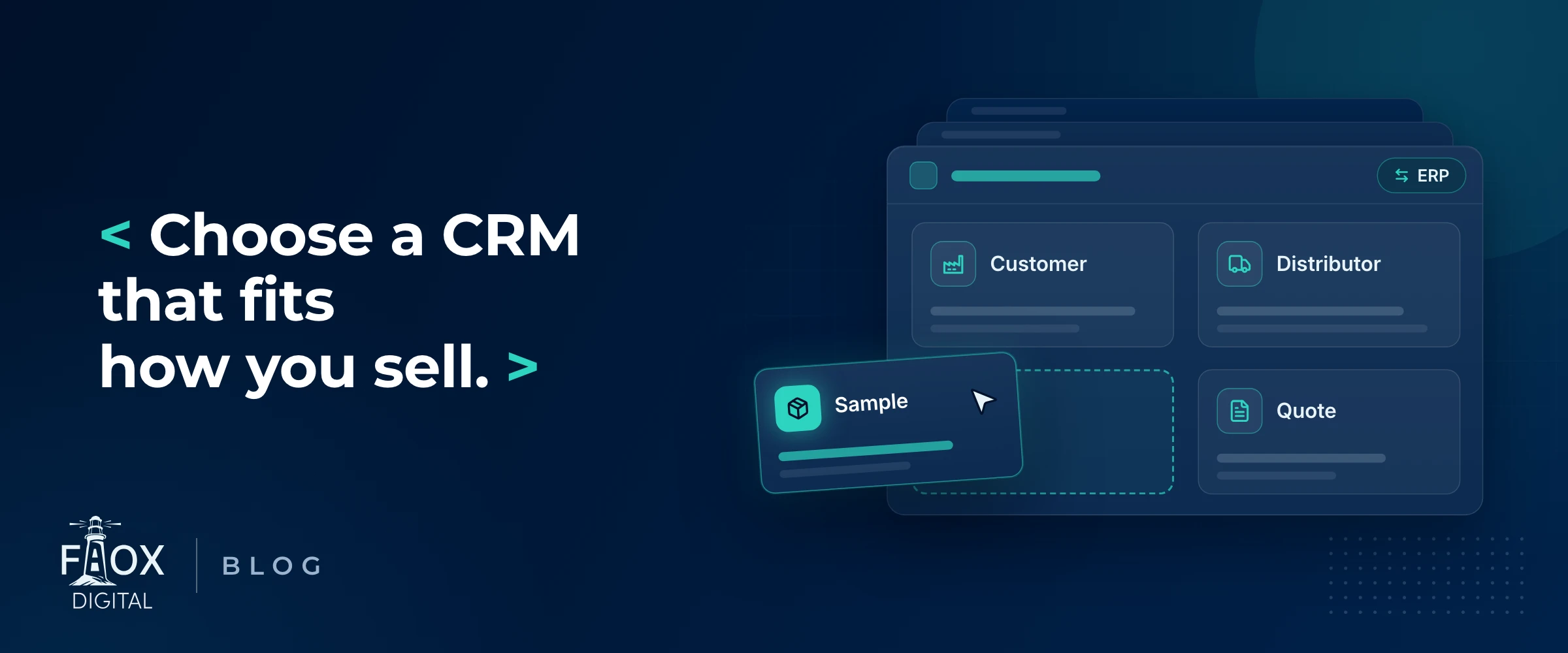
The right CRM for manufacturers is the one that fits how you sell: companies with many contacts, dealers and distributors, quotes and samples, several languages and an ERP that holds products, prices and orders. Judge systems on those needs first, then on the per-user license, setup and training cost, data hosting and scalability. A free or low-cost CRM is enough for a small team with one pipeline and no ERP link; plan for a paid tier when you need integrations, permissions or more users.
Many manufacturers still run sales from spreadsheets, the ERP’s customer list and their salespeople’s inboxes. In Eurostat’s 2025 survey, 26.2% of EU manufacturing companies with 10 or more persons employed used CRM software, with 38.1% in machinery and 44.8% in chemicals.
This guide sets out the CRM selection criteria that matter for a manufacturer, shows what free and entry-level plans offer at the time of writing and explains when they are enough. For the basics, see our B2B CRM guide. We set up CRMs in clients’ own tools as part of our B2B email marketing services, so we have a stake in the answer; the criteria below apply to any system and any provider, including us.
CRM for manufacturers: what is different
A manufacturer’s sale rarely fits the simple funnel that many CRM demos show:
- Long cycles with technical evaluation: drawings, samples, trials and approvals before an order.
- Many people per account: engineers, buyers, quality, management, often at several sites.
- Dealers and distributors who sell for you and own part of the customer relationship.
- Quotes and samples that need follow-up, versions and expiry dates.
- An ERP that already holds customers, products, prices, orders and invoices.
- Export markets, with several languages, currencies and sales teams.
A CRM that handles these well saves daily work. One that does not becomes a second spreadsheet.
CRM selection criteria for manufacturers
Use these questions to compare systems before any demo:
- Can it model companies with many contacts, sites and parent groups?
- Can it keep dealer and distributor records and link them to end customers?
- Can it track quotes and samples against each deal?
- Does it connect to your ERP for customers, products, prices and orders?
- Does it log Outlook or Gmail email and connect to your email marketing tool?
- Does it work in your team’s languages and currencies?
- Where is the data hosted, and what does the contract say about data protection?
- What does each user cost, and does every user need a full license?
- What will setup, data migration and training cost?
- Will it scale to more users, pipelines, markets and integrations?
- Who inside the company will maintain it?
Dealer and distributor records
Dealer and distributor records matter when part of your sales goes through partners. Check that the CRM can keep a partner as its own company type, link it to the end customers it serves, record territories and agreements, and show sales through each partner.
Ask also how partners would work with the system. Some companies only record partner deals themselves; others give distributors limited access to register deals or see their own customers. Partner access can require extra licenses or a portal, so price it before you decide.
Quote and sample tracking
For many manufacturers, the quote is where deals are won or lost. Quote and sample tracking should link each quote to its deal, with its version, value, validity date and next follow-up, and show which quotes are open, expiring or unanswered. If quotes are produced in the ERP, the CRM should at least show their status.
Samples deserve the same care: who received what, when, for which application, and what the customer’s test showed. A CRM that can record samples as tasks or as their own records turns them into a pipeline you can follow up.
ERP integration
ERP integration decides whether the CRM shows the whole customer or only the sales conversation. The usual links are customer master data, products and prices for quotes, and orders and invoices for the sales team’s view. Ask each vendor three questions: is there a standard connector for your ERP, what does it synchronize and in which direction, and who maintains it when either system is updated?
If no connector exists, integration means custom work through the systems’ APIs. Our web application development guide explains how such connections and customer portals are planned. Decide in advance which system owns each piece of data, so that nobody edits a customer address in two places.
Multilingual use and email integration
Multilingual use has three parts: the interface languages your sales teams need, a language field on each contact so that emails and documents go out in the right one, and multiple currencies for quotes and reports. Check all three in the demo, not on the feature list.
Email integration should log emails and meetings from Outlook or Gmail on the right records and connect to your email marketing tool, so that lists, segments, consent and unsubscribes stay in one place. Some CRMs include email marketing; others work with a separate platform. Our guide to B2B email marketing platforms covers that choice, and our article on marketing automation software explains when you need more than basic email.
Data hosting, GDPR and KVKK
Data hosting is part of the choice, because a CRM holds personal data about your customers’ employees. Ask each vendor where your account’s data would be stored, which subprocessors handle it and what its data processing agreement says. This is general information, not legal advice:
- In the EU, Article 28 of the GDPR requires a contract with any provider that processes personal data on your behalf. Transfers outside the EU are allowed where the European Commission has found the destination adequate, or with appropriate safeguards such as standard data protection clauses adopted by the Commission (Articles 45 and 46).
- In Türkiye, Article 9 of the KVKK (Law No. 6698), as amended in 2024, allows personal data to be transferred abroad with an adequacy decision or appropriate safeguards, such as a standard contract, which must be notified to the Personal Data Protection Authority within five business days of signing.
If you sell in both markets, check both sets of rules with your lawyer before signing.
Per-user licenses, setup and training costs
Most CRMs charge a per-user license each month, often at a lower rate when billed annually. Count who really needs a full license: salespeople and sales managers usually do, while colleagues who only look up a customer may not. Ask whether cheaper or read-only licenses exist.
The license is only part of the cost. Budget for the setup and training cost as well: configuration, data migration and cleanup, integrations, training sessions and the internal time of the people who design the system. Add-ons for automation, quoting or partner access can cost more than the base license, so ask for a quote for the setup you need, not for the entry plan.
Free and low-cost CRM plans at the time of writing
Several vendors offer a free plan or a low entry price. These are the plans of five well-known systems as their pricing pages showed them in November 2026, in the currency each page displayed to us. The list is an overview, not a recommendation:
| System | Free option and its limits | Entry paid plan, per user per month |
|---|---|---|
| HubSpot | Free tools for up to 2 users, with up to 1,000 contacts | Starter: $20 per seat; a new-customer offer in November 2026 cut it to $7 with annual payment |
| Salesforce | Free Suite with 2 user licenses, kept as long as someone logs in at least every 60 days | Starter Suite: $25; Pro Suite: $100, billed annually |
| Zoho CRM | Free edition for up to 3 users | Standard: €14, billed annually; Professional: €23 |
| Odoo | One App Free: a single app such as CRM, unlimited users, hosted on Odoo Online | Standard (all apps, including CRM, inventory and accounting): €14.90, or €11.90 for the first 12 months |
| Microsoft Dynamics 365 Sales | Free trial only | Sales Professional: $65, paid yearly; Sales Enterprise: $105 |
Prices and limits change often, so check the vendor’s page on the day you decide. For a detailed comparison of two common choices, see our article on HubSpot vs Salesforce.
When a free or low-cost CRM is enough
The limits of free plans are mostly about users, records and features. A free or entry-level plan is often enough when:
- One to three people sell, and they share one pipeline
- The contact list fits within the plan’s limits
- You do not yet need an ERP link, partner access or detailed permissions
- The goal is to replace spreadsheets and build the habit of logging deals
You have outgrown it when you need ERP integration, several pipelines or markets, permissions by team or territory, automation, or more users than the plan allows. Starting free is a reasonable way to learn what you need, as long as you can export your data if you move to another system.
Scalability
Scalability is about the next three years, not the first month. Check what happens when you add users, pipelines, markets and integrations: which plan you would need, and how the price changes. The jumps can be large: at the time of writing, Salesforce moves from $25 for Starter Suite to $100 for Pro Suite, and Microsoft from $65 for Sales Professional to $105 for Sales Enterprise. Ask also about limits on storage, custom fields and API calls, which matter once the CRM connects to your ERP and website.
Is there a best CRM for manufacturers?
No single system is best for every manufacturer. The right one depends on your sales process, your ERP, your markets and who will maintain it. A practical way to choose:
- Write down your must-haves from the checklist above.
- Shortlist two or three systems that meet them.
- Ask each vendor for a demo with your own data: one real customer, one distributor deal, one quote and one sample.
- Run a short trial with two or three salespeople before you sign.
- Ask for a reference customer with a similar sales process.
How Faox Digital approaches CRM for manufacturers
Faox Digital works in the client’s own tools, so a CRM project starts from the system the company already has or chooses, not from one we prefer. Our email, CRM and funnel work begins with an audit that cleans the list, the CRM and past sends; we then plan segments by behavior and stage and build the CRM, emails and automations, with the client signing off what we build. On a smaller budget, we suggest a first step that fits the company’s stage, even if that means the team does some of the work itself.
Key takeaways
- Choose a CRM for manufacturers by how you sell: many contacts per account, dealers and distributors, quotes and samples, languages and an ERP.
- Ask about ERP integration, data hosting and the full cost, including setup, migration, training and add-ons, not only the per-user license.
- Free and entry-level plans suit a small team with one pipeline; plan to upgrade when you need integrations, permissions or more users.
- Check how prices change as you grow, and make sure you can export your data.
- Shortlist two or three systems and test them with your own customers, deals, quotes and samples.
Frequently asked questions
What is the best CRM for manufacturers?
There is no single best CRM for manufacturers. The best fit is the system that models your accounts, distributors, quotes and samples, connects to your ERP, works in your languages and fits your budget as you grow. Test two or three with your own data before deciding.
What is CRM in manufacturing?
In manufacturing, a CRM is the shared record of customers, distributors, contacts, deals, quotes, samples and conversations, used by sales, marketing and service. It covers the work before and around the order, while the ERP handles production, stock, orders and invoices.
Is a free CRM enough for a manufacturing company?
It can be for a team of one to three salespeople with one pipeline and no ERP link. Free plans limit users, records and features, so expect to move to a paid plan when you need integrations, permissions or more users, and make sure you can export your data.
Which CRM suits manufacturers’ representatives?
An independent manufacturers’ representative who sells for several principals needs a CRM that separates each principal’s products, territories, quotes and commissions, and can share reports with each principal without exposing the others. Ask vendors to show that setup in the demo.
Sources
- Eurostat: Integration of internal processes by NACE Rev. 2 activity (isoc_eb_iipn2), CRM software use, 2025, updated February 2026
- Salesforce: Sales Cloud pricing, accessed November 2026
- EUR-Lex: Regulation (EU) 2016/679 (GDPR), Articles 28, 45 and 46, 2016
- Mevzuat Bilgi Sistemi: Law No. 6698 on the Protection of Personal Data (KVKK), Article 9 as amended by Law No. 7499, 2024
Let’s talk
Have contacts you never follow up with?
Tell us about the list you already have. We will show you how email and CRM can turn it into conversations.