
How to Use a CRM Every Day: Shared Rules for Sales and Marketing
The daily rules that keep a B2B CRM trustworthy for sales and marketing alike, from stages, required fields and activity logging to ownership, shared definitions, the weekly meeting and dashboards.

Knowing how to use a CRM every day comes down to a few shared rules: keep opportunity stages and required fields consistent, log every meaningful activity the same day, give every open deal a next step with a reminder, give every record one owner, agree definitions that sales and marketing both use, and run the weekly sales meeting from the CRM. Dashboards built on that data then show the same picture to everyone.
A CRM rarely fails on the day it goes live. It fails months later, quietly: a salesperson keeps the best deals in a spreadsheet, marketing counts leads that sales never sees, and the pipeline report shows numbers nobody believes.
This guide sets out the daily rules that prevent that: what to record, when and by whom, and how sales and marketing agree on what the records mean. For the basics of the system itself, see our guide to what a B2B CRM is.
How to use a CRM every day: a short routine
Most of the work takes minutes a day if it is done at the time. These CRM best practices fit into a normal working day:
- Log calls, meetings and important emails on the record the same day
- Update the stage of any deal that moved, with its value and close date
- Set a dated next step for every open deal and quote
- Start the day with your tasks and overdue reminders
- Search before you create a contact or company, to avoid duplicates
Once a week, the sales meeting runs on the CRM. Once a month, sales and marketing review the data together. Once a quarter, the definitions and fields are checked against how the team really works.
Opportunity stages and required fields
Opportunity stages only help when everyone reads them the same way. Write down what must be true for a deal to enter each stage, and do not skip stages, even for a fast deal: the stage history is what shows where deals stall. The sample stages in our B2B CRM guide work for many manufacturers.
Required fields enforce those rules without anyone nagging, as long as they ask for the right thing at the right moment. Ask for little at the start and more as the deal matures:
- At enquiry: company, contact, source and product interest
- When qualified: application, estimated quantity and expected decision date
- When the quote is sent: quote value, validity date and next follow-up
- When won or lost: the order reference, or the reason for losing
A field that is required too early gets filled with guesses, and a guess is worse than a blank.
Activity logging, tasks and reminders
Activity logging keeps the history complete, so anyone can pick up a customer where a colleague left off. Log what matters: calls, meetings, site visits, samples sent, and the emails that change something, ideally through the email integration rather than by copying and pasting. A good note is short: what was discussed, what was promised and what happens next. After a site visit, log it from the phone before driving off.
Tasks and reminders keep deals moving. Every open deal and every open quote needs a dated next step: a call, a sample to send, a follow-up before the quote expires. A deal with no next step is a deal nobody is working on, and the CRM can list those deals every morning.
Record ownership
Record ownership answers the question "who looks after this?" Give every company record one owner, usually the salesperson or account manager responsible for it, who keeps its contacts, deals and notes current. Contacts at the same company belong to the same owner unless another team, such as service or a distributor manager, is named.
Until a new enquiry is qualified, marketing usually owns it. Leads that turn out not to be ready go back to marketing, for example to the newsletter, rather than sitting in a salesperson’s list. How a form enquiry is checked and handed to sales is covered in our article on lead capture forms.
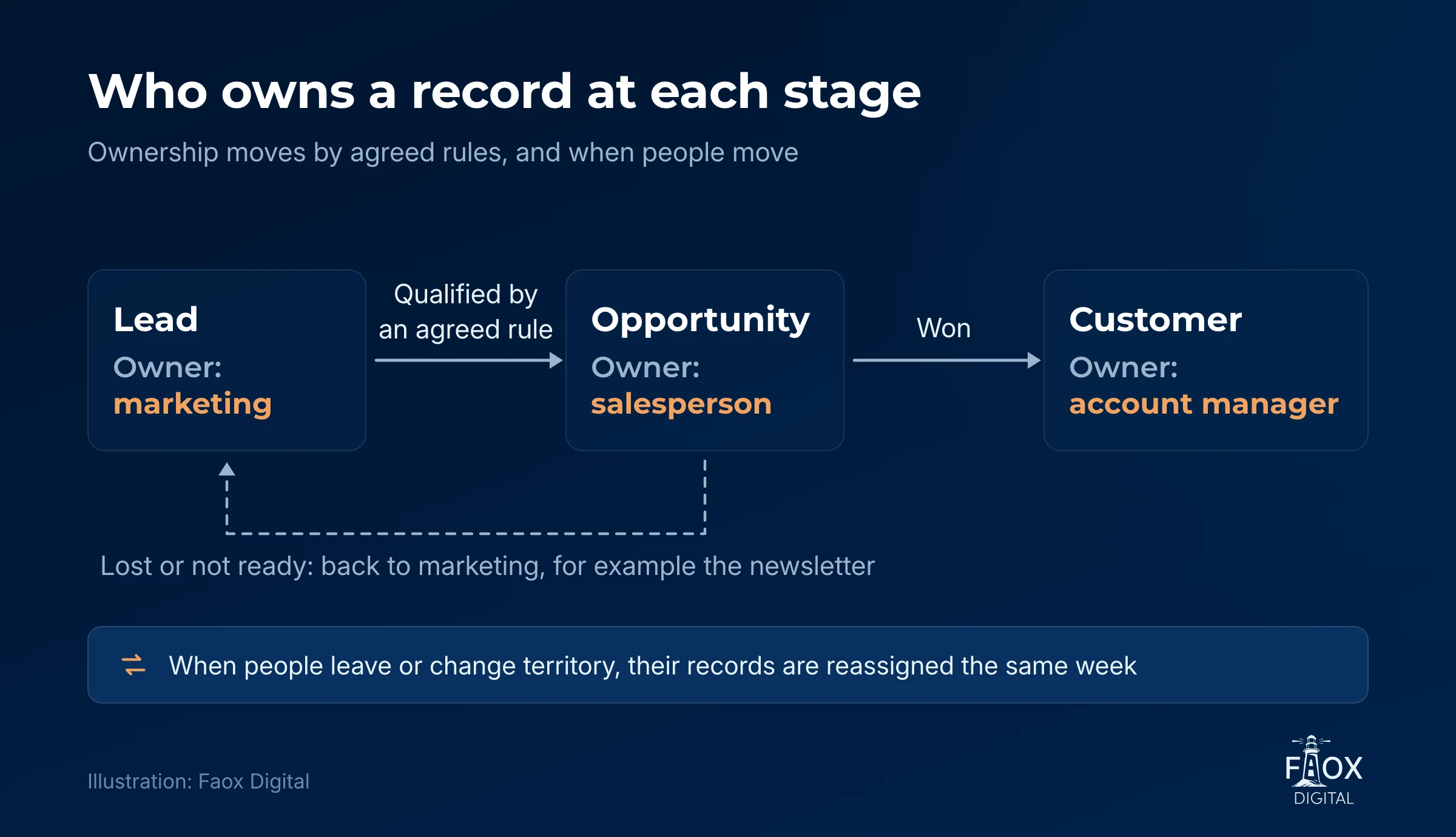
Ownership must move when people do. When someone leaves, changes territory or goes on long leave, the sales manager reassigns their records the same week, together with their open deals and tasks.
The weekly sales meeting
The weekly sales meeting is where the CRM becomes a habit or fades away. Run it from the CRM screen, not from slides or personal spreadsheets, and keep the agenda the same every week:
- New opportunities since last week, and their source
- Deals that moved stage, and deals that stalled
- Open deals with no next step
- Quotes that expire in the next two weeks
- Deals lost this week, and why
The rule is simple: if it is not in the CRM, it is not discussed. People soon start updating their records before the meeting rather than during it.
The monthly sales and marketing review
Once a month, sales and marketing look at the same reports together, for half an hour. A fixed agenda keeps it short:
- New leads by source, and how many became opportunities
- Qualified leads that have had no follow-up
- Won and lost deals by source, with the lost reasons
- Leads sent back to marketing, and why
- Data problems found this month, such as duplicates or missing sources
Agree one or two changes, such as a clearer qualification rule or a new value in a fixed list, and check them at the next review.
Data entry discipline and CRM adoption
Data entry discipline is less about effort than about removing the reasons to skip it. Connect email and calendars so that activities log themselves, use fixed lists instead of free text, enter each fact once and keep personal spreadsheets out of the process. Once a month, clean what slipped through: merge duplicates, update people who have left and fix bounced addresses. Our guide to email list hygiene explains how to clean contact records without losing good ones.
CRM adoption depends more on how the change is led than on the software. Prosci, which sells change management training, asked more than 2,600 change practitioners about their projects: 88% of projects with excellent change management met or exceeded their objectives, against 13% of those with poor change management (figures self-reported, page updated August 2026). For a CRM, that means a manager who uses it visibly, rules the team helped write and a review after the first months. The usage rules themselves are best agreed at launch, as our guide to implementing a CRM describes.
Dashboards each role will open
A dashboard should answer the questions each role asks, on one screen:
- Salesperson: today’s tasks, my open deals by stage and my quotes about to expire
- Sales manager: the pipeline by stage and value, deals with no next step and activity by account
- Marketing: new leads by source, leads that became opportunities and campaign contacts in the pipeline
Marketing’s view is also where the case for its budget starts: the source and stage data in the CRM are the basis for calculating B2B marketing ROI over a long sales cycle. And if your current system makes these rules hard to follow, the next question is whether it fits your team; our article comparing HubSpot and Salesforce looks at two common options.
Common mistakes in daily CRM use
- A private pipeline: the best deals kept in a spreadsheet "until they are real".
- Notes that say nothing, such as "called" with no outcome or next step.
- Fields filled to get past a required check, with dates and values nobody believes.
- Managers asking for updates by email instead of reading the CRM.
- Lists imported without a source or consent status, which breaks reports and segments.
How Faox Digital works with a client’s CRM
Faox Digital, a digital growth partner for B2B companies in complex and international markets, begins CRM work by auditing and cleaning the list, the CRM and past sends, and then plans segments by behavior and stage rather than one message for everyone. Everything is built in the client’s own tools and signed off by the client, and we measure the work by replies, qualified conversations and pipeline.
Key takeaways
- Do the daily CRM work at the time: log activities, update stages and set the next step the same day.
- Ask for required fields at the stage where the answer is known, not before.
- Give every company record one owner, and reassign records when people move.
- Agree shared definitions for leads, opportunities, customers, lost deals and sources, and build them into the CRM.
- Run the weekly sales meeting from the CRM and give each role a dashboard it will open.
Frequently asked questions
How do you use a CRM every day?
Log important calls, meetings and emails on the record the same day, update the stage, value and close date of deals that moved, set a dated next step for every open deal and quote, and start each day with your tasks and reminders.
What are CRM best practices for B2B teams?
Few required fields, asked for at the right stage; fixed lists instead of free text; one owner per company record; shared definitions for sales and marketing; a weekly sales meeting run from the CRM; and a monthly clean-up of duplicates and outdated contacts.
How do you improve CRM adoption after launch?
Make the CRM easier to use than to avoid: connect email and calendars, remove fields nobody uses and run meetings and reports only from the CRM. Managers should use it visibly, and the team should review the rules after the first months and change what does not work.
What should sales and marketing agree on in the CRM?
What counts as a lead, a qualified lead, an opportunity and a customer; who owns a record at each stage; how fast new enquiries are followed up; which source values to use; and what happens to leads that are not ready yet.
Sources
- Prosci: The Correlation Between Change Management and Project Success, updated August 2026
Let’s talk
Have contacts you never follow up with?
Tell us about the list you already have. We will show you how email and CRM can turn it into conversations.