
Founder-Led Content: When to Write It Yourself and When to Get Help
When a founder or executive should write their own LinkedIn content, when to get help, and how to keep the voice and views their own with interviews, approvals and clear rules.

Founder-led content works when the views, stories and decisions come from the founder or executive, whoever does the typing. Write it yourself if you enjoy writing and can spare a few hours a week; get help when time is the problem, through an interview-based process in which the executive approves every post and publishes it from their own account. Choose between in-house support, a freelance writer and an agency by how much strategy, editing and channel work you need.
Founders and executives are often the most credible voices a B2B company has, and the busiest. The question is rarely whether they should be visible on LinkedIn, but who does the writing, and how to get help without losing the voice that makes their posts worth reading.
This guide compares the options, from writing everything yourself to working with an agency, and shows how to keep the content genuinely yours. Building a presence step by step is covered in our guide to B2B thought leadership. We write expertise content for executives as part of our work as a B2B social media agency, so we have a stake in this decision; the tests below apply whoever helps you, including your own team.
What founder-led content is
Founder-led content is content published under a founder’s or executive’s own name, in their own voice: LinkedIn posts, comments, short videos and longer articles about what they know, what they have learned and how they see their industry. It differs from company page content because a person, not a logo, stands behind every line.
This guide covers the social media side. Signed opinion pieces in trade publications are a different job, with editors and pitches; our guide to writing a byline article covers that work, and our comparison of byline vs op-ed vs sponsored formats helps you choose where a longer piece belongs.
The real question is time
The time cost decides more than talent does. A good post takes thinking, drafting, editing and, after it goes live, replying to comments. Many executives can write well; few can do it every week alongside running a company.
Write it yourself if most of these are true:
- You enjoy writing and do it quickly
- You can set aside a few hours a week, every week, not only when it is quiet
- You already have more ideas than time to post them
- You want to reply to comments yourself, which you should anyway
Get help if the ideas are there but the hours are not, if your posts stop whenever business gets busy, or if you post in more than one language. Help with the writing does not mean handing over the voice.
Founder-led content support models compared
There are four ways to organize founder-led content, from doing everything yourself to working with an agency:
| Model | How it works | Executive’s time | Best for | Watch for |
|---|---|---|---|---|
| Write it yourself | The executive drafts, edits and posts | The most | Leaders who enjoy writing and have time | Silence during busy periods |
| In-house support | A marketing or communications colleague interviews, drafts and schedules | A monthly interview and reviews | Companies with a strong marketing team | Competing priorities inside the team |
| Freelance writer | An independent writer works from interviews | A monthly interview and reviews | One executive, a clear theme, a steady pace | Continuity if the writer leaves, little strategy |
| Agency | A team handles interviews, writing, editing and planning, often with the company page | A monthly interview and reviews | Several executives, several languages, or content tied to the company page | Generic writing if the agency does not learn your field |
Our estimate is that a monthly interview of 30 to 45 minutes and a few minutes of review per post replaces several hours of writing a week. What each model costs depends on scope; our guide to what social media management costs explains the drivers.
Agency or freelance writer
The choice between an agency and a freelance writer comes down to what you need besides the words.
A freelance writer suits a single executive with a clear theme. You work with one person who learns your voice closely, and the arrangement is simple. Ask what happens when they are unavailable, and whether they understand your industry well enough to ask good questions.
An agency suits companies where executive content is part of a wider plan: several leaders, several languages, a company page that should support the executives’ posts, and someone to watch the replies. Ask who will actually write, how they learn a technical field, and how they keep each executive’s voice distinct.
Whichever you choose, ask for a test month. If the drafts need rewriting from scratch, the fit is wrong. The same test applies to an executive LinkedIn profile writer hired only for the profile: the result should sound like the person, not like a template.
The view must belong to the executive
Writing on an executive’s behalf is common and legitimate, as long as the substance is theirs. The views, the experiences and the decisions described must come from the executive; the writer shapes the words, the structure and the rhythm.
Three rules keep it honest. The writer never invents stories, customers or experiences. The executive can discuss every post in person, in a meeting or on a call. And posts that reflect the executive’s actual opinions sometimes disagree with the company’s marketing tone; that is a strength, not a problem to edit away.
Interview-based content
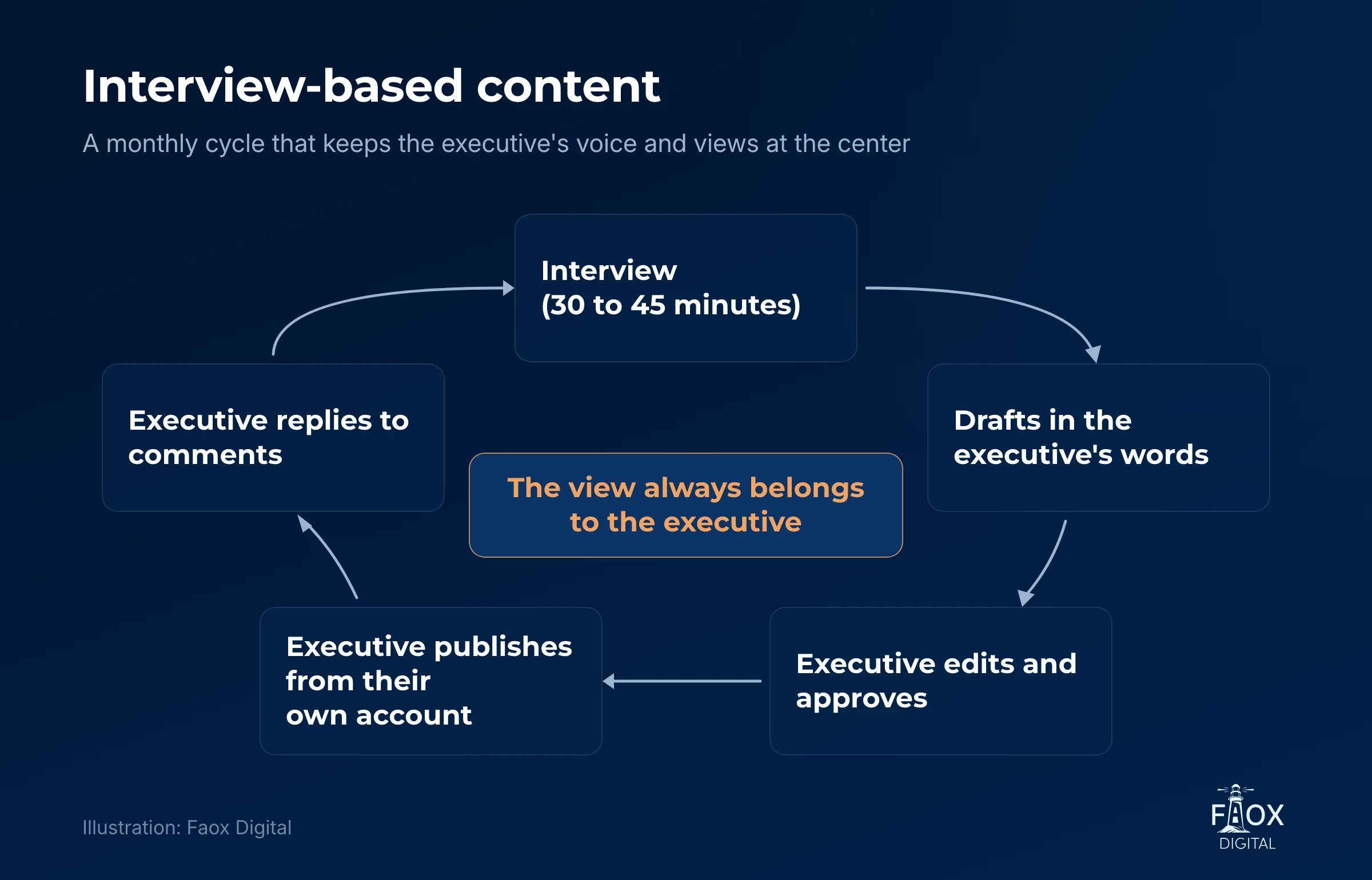
Interview-based content is the most reliable way to get ideas out of a busy executive’s head and into posts that sound like them:
- Hold a monthly interview of 30 to 45 minutes, recorded with permission, around three or four questions: what customers asked recently, what went wrong or right, what is changing in the market.
- Turn the transcript into drafts that keep the executive’s words, examples and opinions.
- Let the executive edit, from small corrections to rewriting a line in their own phrasing.
- Publish from the executive’s own account, at an agreed time.
- Reply to comments personally, because readers came for the person, not the writer.
The approval process
The approval process should be short and absolute: the executive approves every post before it goes live. Agree a turnaround, such as two working days, and a simple rule for sensitive topics such as legal matters, financial results or safety incidents, which also go to communications or legal before publishing.
Keep account access with the executive. LinkedIn’s User Agreement says members will keep their password secret and will not share their account with anyone else. So a writer or agency prepares the drafts, and the executive publishes them. This also keeps the executive close to their own profile, where the replies and messages arrive.
Transparency
Transparency is simpler than many executives fear. Readers know that leaders get help with writing, as they do with speeches. What damages trust is pretending: presenting invented experiences, letting someone else reply to comments in your name, or saying you write every word when you do not.
Be open inside the company about who helps and how, answer honestly if someone asks, and apply the same rule to AI drafting tools: they can help with structure, but the views and stories must be yours and the final text must be checked by you.
Personal profile and company page
The personal profile and the company page should support each other without repeating each other. The page carries the company’s news, products and announcements; the executive’s profile carries a personal view, lessons and experience. An executive who reshares every company post becomes a second company page, and readers stop paying attention.
Agree a shared monthly calendar: which company news the executive will comment on with their own view, and which themes stay on the executive’s profile alone. Employees can then add their own voices to both.
How Faox Digital supports founder-led content
Faox Digital includes expertise content for founders and executives in its organic social media work for B2B companies in complex and international markets. We start by looking at what the company and its leaders already post, who follows them and what buyers care about, then plan topics market by market and language by language. The client approves a monthly calendar before anything goes live, and we reply to comments and messages on the company’s channels. We judge the work by reach among the right people and the conversations and inquiries that follow.
Key takeaways
- Founder-led content works when the views and stories belong to the executive, whoever does the typing.
- Time is usually the deciding factor: write yourself if you can keep a weekly rhythm, get help if you cannot.
- In-house support, a freelance writer and an agency differ mainly in strategy, continuity and channel work, not in the words alone.
- Use monthly interviews, let the executive approve every post and keep account access with the executive.
- Keep the personal profile and the company page distinct, and be honest about the help you get.
Frequently asked questions
What is founder-led content?
Content published under a founder’s or executive’s own name, in their own voice, mostly on LinkedIn: posts, comments, videos and articles about their expertise, lessons and view of the industry. It builds trust in a person, and through them in the company.
What does a founder-led content agency do?
It interviews the founder or executive, turns the conversations into drafts in their voice, plans topics and timing, and often coordinates the executive’s posts with the company page. The executive still approves every post and publishes it from their own account.
Does founder-led content work on LinkedIn?
It works when the posts are specific, regular and clearly the executive’s own: lessons from real projects, views on the market, answers to customer questions. Generic motivational posts and reshared company news rarely help.
Should a founder use a ghostwriter?
Yes, if time is the problem and the views stay the founder’s. Use an interview-based process, approve every post, never let the writer invent experiences, and reply to comments yourself.
Sources
- LinkedIn User Agreement (effective November 3, 2025), accessed November 2026
Let’s talk
Want social media that reaches the right people?
Tell us who you want to reach. We will look at your channels and suggest a plan your team can keep up with.