
Website Redesign Project Plan: A Realistic Timeline for a B2B Site
How long a B2B website redesign realistically takes, stage by stage, what makes projects run late and what your own team has to prepare.

A website redesign project plan for a typical B2B site usually runs 4 to 8 weeks if the content is ready and decisions come quickly, while large sites, several languages or complex product data take 8 to 16 weeks or more. Plan six stages: needs analysis and site plan, content preparation, design approval, development, testing and launch. Content, feedback time and changes in scope are what usually stretch the date, so your own team’s time matters as much as the agency’s.
Ask how long a new website takes and you can hear anything from a few weeks to most of a year. A date promised too early creates its own problems: rushed content, skipped testing and a launch that puts search traffic at risk.
This guide gives realistic ranges, sets out each stage, explains what makes projects run late and shows how to approach a website redesign. The ranges are planning figures and not promises. We work as a B2B website design agency, so we have a stake in the answer; the checks below apply to any provider, including us.
How long a website redesign really takes
Two public sources give very different answers:
- GoodFirms’ 2026 survey of 300+ companies and freelancers gives provider estimates. For a standard mid-sized site, half say 4 to 8 weeks and 32% say 8 to 16. Its most common ranges are 2 to 4 weeks for a basic site and 8 to 36 weeks or more for an enterprise site.
- Clutch’s client reviews say that most web design projects last 7 months.
Both can be useful. GoodFirms reports what providers expect for a typical scenario, while Clutch reflects what clients recorded on the projects they reviewed, which may be larger and may include waiting time. So treat 4 to 8 weeks as the working time for a typical B2B site with content ready and quick decisions. The calendar time is often longer, and much of the gap comes from content and waiting, not from development.
Website redesign project plan: the six stages
This project schedule shows how the stages usually compare. The totals are GoodFirms’ most common ranges. The stage lengths are our planning estimates, and they add up to more than the totals because stages overlap.
| Stage | Basic site | Typical B2B site | Large site or several languages |
|---|---|---|---|
| Needs analysis and site plan | A few days | About 1 week | 2 to 3 weeks |
| Content preparation | About 1 week | 2 to 4 weeks | 4 to 8 weeks or more |
| Design and approval | Up to 1 week | 1 to 2 weeks | 3 to 4 weeks |
| Development | Up to 1 week | 2 to 3 weeks | 4 to 8 weeks |
| Testing | A few days | About 1 week | 2 weeks or more |
| Launch and checks | A few days | A few days | About 1 week |
| Total | 2 to 4 weeks | 4 to 8 weeks | 8 to 16 weeks or more |
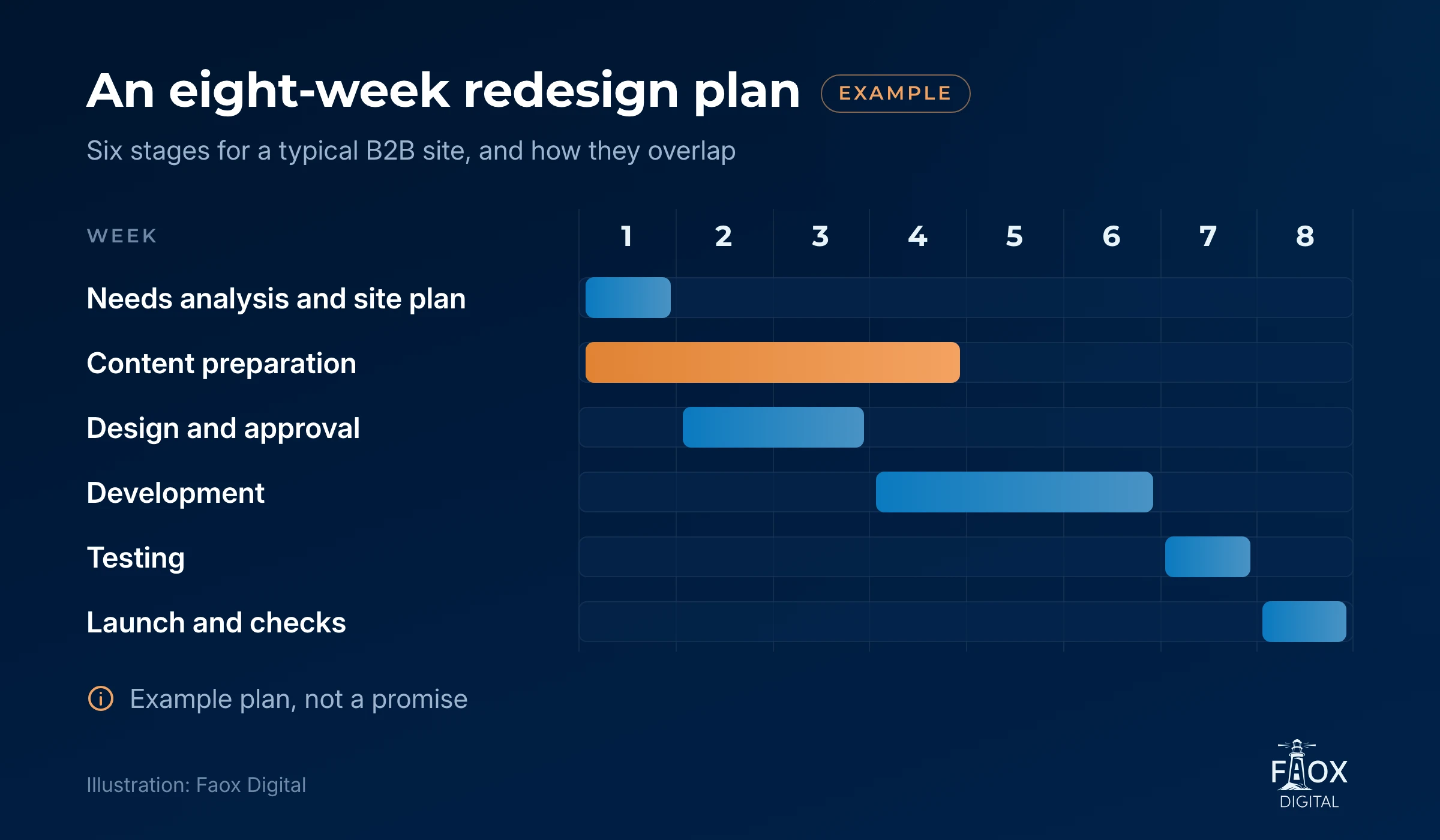
An eight-week plan might run like this: needs analysis and site plan in week 1, content preparation in weeks 1 to 4, design and approval in weeks 2 and 3, development in weeks 4 to 6, testing in week 7, and launch and checks in week 8.
Needs analysis and site plan
Needs analysis sets the goals, the buyers, the evidence from your current site and the scope. The site plan then lists the pages, templates and URLs, including which old pages stay, merge or redirect. In GoodFirms’ survey, discovery and planning most often get 5% to 10% of the budget, which GoodFirms calls often too lean. A week saved here can cost several later.
Content preparation
Content preparation is usually the longest stage, and it runs alongside the others. Orbit Media’s 2026 survey puts the average blog post at 3 hours 20 minutes. At that pace, 40 pages take about 133 hours, more than three working weeks for one person doing nothing else. Technical pages that need an engineer’s review take longer, so start before design is finished and name an owner for each section.
Design approval
Design approval covers the key templates, not every page. Keep the group small, review against the goals and agree how many revision rounds each stage includes. Our article on choosing a custom or template website explains how that choice changes this stage: a theme needs far less design time than templates drawn from scratch.
Development
Development builds the templates, loads the content and connects forms and integrations. Agree early who supplies product data, and in what format. A link to your CRM or ERP can look small in a proposal and take weeks in practice, as GoodFirms’ respondents note when they rank integrations among the top reasons for overruns.
Testing
Testing checks every template on phones and desktops, every form in every language, speed on key pages and all redirects. GoodFirms’ respondents most often give it 10% to 20% of the budget. Keep the test site behind a password, because Google says password protection keeps content out of its search results.
Launch and checks
The launch is a planned move, not a single click. If your URLs change, Google advises timing the move for a period of lower traffic if possible, and it recommends moving all URLs at once on small and medium sites. It says most pages on a small to medium site can take a few weeks to move, with temporary ranking fluctuation, and that redirects should generally stay for at least a year. Plan checks in the first days and again after a few weeks. Our guide on how to redesign without losing SEO lists the decisions to make first.
What makes website projects run late
Most causes of delay sit outside the code. In GoodFirms’ survey, scope expansion tops the list of hidden costs, 49% name client revisions as a cause of overruns, and one respondent warns that missing text, images, product data, legal wording or translations can hold a project up more than the technical work.
| Cause of delay | What happens | How to prevent it |
|---|---|---|
| Late content | Design and build wait, or use placeholder text | Start early and name an owner for each section |
| Slow feedback | Each review adds days of waiting | Agree a response time and book reviewers |
| Too many reviewers | Opinions conflict late in the project | Name one person who decides |
| Scope changes | New pages and features reopen finished work | Keep a list for a later phase |
| Number of languages | Each adds translation, review and testing | Launch key languages first |
| Product data | Data needs cleaning before it can be loaded | Check the data during needs analysis |
| Integrations | Other systems have their own limits and owners | Test the connection early |
| Legal review | Terms, claims and certificates need sign-off | Book the reviewer from the start |
Feedback time is the variable you control most directly. Take a project with six review points. If each one waits five working days instead of two, that adds 18 working days, or more than three and a half weeks, with nobody doing any extra work.
The number of languages deserves its own plan. We found no reliable published figure for how fast this work goes, so ask for a schedule by language and by step: translation, review and checks in the live layout.
How to plan a website redesign
- Start from the reason. Write down what the redesign must fix, and collect your analytics, top pages and full URL list.
- Work back from the date. Avoid trade fairs, year-end and your busiest season, then set dates for each stage.
- Name one decision-maker. Give that person the authority to close a review.
- Book your own people. Engineers, legal and sales need time in their calendars for reviews.
- Agree a feedback time. Two working days is a sensible target for most reviews.
- Freeze the scope. Put new ideas on a list for the next phase, unless they block the launch.
- Add a buffer. Leave room before any fixed date, such as a trade fair, and do not announce the launch until testing is finished.
Ask your provider which stages depend on you, and what happens to the date if you are late. A plan is also a budget, because extra weeks and rounds cost money. Our guide to B2B website cost explains what drives the price. Remember that launch is not the end: ongoing search work is a separate budget, and our article on what SEO costs per month shows what it can buy.
Can a redesign go faster?
Yes, if you reduce the work and do not simply squeeze it:
- Use a good theme. You skip most of the design and much of the development.
- Reuse what works. Keep strong pages and edit them instead of rewriting everything.
- Launch in phases. Start with your main product templates and one or two languages.
- Decide faster. Short feedback times can save more than extra developers.
Be careful with cuts to testing, redirects or content review. They save days before launch and can cost far more afterwards.
How Faox Digital plans a website redesign
Faox Digital plans a redesign in five steps: learning the business, mapping the site, design, build, then launch and support. You see each step and sign it off before we move on, so decisions are made in order rather than all at the end. Before launch, the site is tested in every language and on every device, and after launch we keep it fast and healthy.
Key takeaways
- A typical B2B site usually takes 4 to 8 weeks of work with content ready and quick decisions, and larger sites take 8 to 16 weeks or more.
- Plan six stages: needs analysis and site plan, content preparation, design approval, development, testing and launch.
- Content, feedback time and scope changes are what usually stretch the date.
- Name one decision-maker, book your reviewers and agree a response time before work starts.
- To go faster, reduce the scope and do not cut testing or redirects.
Frequently asked questions
How long does a website redesign take?
A typical B2B site usually takes 4 to 8 weeks of work if the content is ready and decisions come quickly, in line with GoodFirms’ 2026 survey. Larger sites take 8 to 16 weeks or more, and most projects reviewed on Clutch last 7 months. Your scope and your own team’s speed decide the real date.
How do you plan a website redesign?
Start with what the site must fix and the evidence for it. Then list the pages, templates, content and integrations, name one decision-maker, work back from your target date and agree a feedback time. Plan the URL map and redirects from the start.
What usually delays a website redesign?
Late content, slow feedback, too many reviewers and scope changes are the usual causes. Several languages, messy product data and integrations add time as well. Most of these can be spotted during needs analysis, if someone looks for them.
Can a company website be redesigned in a month?
A small site can, especially with a ready-made theme, existing content and one decision-maker. A site with many products, several languages or integrations usually cannot, and rushing it tends to cut testing and redirects, which are the parts that protect you after launch.
How do you redesign a WordPress site without taking it offline?
Build the new version on a separate test copy behind a password, then test it and switch over at a quiet time. Keep your URLs where you can, and set up redirects for those that change. Your current site stays live until the switch.
Sources
- GoodFirms: Website development cost 2026, updated October 2026
- Clutch: Web design company pricing guide, updated September 2026
- Orbit Media: Blogging statistics, annual survey of content marketers, September 2026
- Google Search Central: Site moves with URL changes, accessed November 2026
Let’s talk
Planning a new website or a fix?
Send us your current site and what you need it to do. We will tell you whether it needs a rebuild or a few focused changes.