
B2B Content Writing Services: Paying per Article or Paying for a Strategy
Published market prices with their sources, what each price can realistically buy, and how a B2B company decides between buying articles and paying for a strategy.

B2B content writing services are priced per word, per article, as a monthly package or as a service that includes strategy, and published prices run from about 2 cents to $1 or more a word. The price follows the research, expert input, editing and technical checks behind the text, not its length. Buy articles when you already have a plan and an expert to check them; pay for a strategy when nobody has decided what to publish or how to judge it.
A quote of $100 and a quote of $2,000 can both be for a 2,000-word article. Both prices sit on public price lists today, and they do not buy the same thing. One may buy text. The other may buy an hour with your engineer, checked specifications and an editor who sends the draft back.
This guide gives the published prices with their sources, explains what moves them and shows how to choose between buying articles and paying for the plan behind B2B content that gets cited. The figures are market data, not our own prices. We offer this work as part of our B2B SEO services, so we have a stake in the answer; the checks below apply to any provider, including us.
What B2B content writing services cost
These are the prices we could verify at the time of writing (November 2026), all in US dollars. The vendors are examples of public price lists, not recommendations, and the last column is our own arithmetic.
| Source and date | What it covers | Price per word | 2,000 words at that rate |
|---|---|---|---|
| Textbroker, November 2026 | Self-service marketplace, three quality levels | 2.3 to 9 cents | $46 to $180 |
| WriterAccess, November 2026 | Marketplace, plus $49 or $79 a month | 4 cents to $1.00 or more | $80 to $2,000 or more |
| Verblio, November 2026 | Marketplace: AI-assisted, plus $49.50 a month, or human only | 6 cents or 16 cents | $120 or $320 |
| Jack Limebear, 2025 | Survey of 350 freelancers in the US and Europe | Most common band 5 to 10 cents (46.6%); top 3% over 20 cents | $100 to $200 |
| Editorial Freelancers Association (EFA), 2026 | Work-for-hire blog posts, members’ median range for 2025 | 25 to 45 cents | $500 to $900 |
| EFA, 2026 | Work-for-hire business and marketing writing | 32 to 87.5 cents | $640 to $1,750 |
| EFA, 2026 | Work-for-hire technical writing | About $1.00 | About $2,000 |
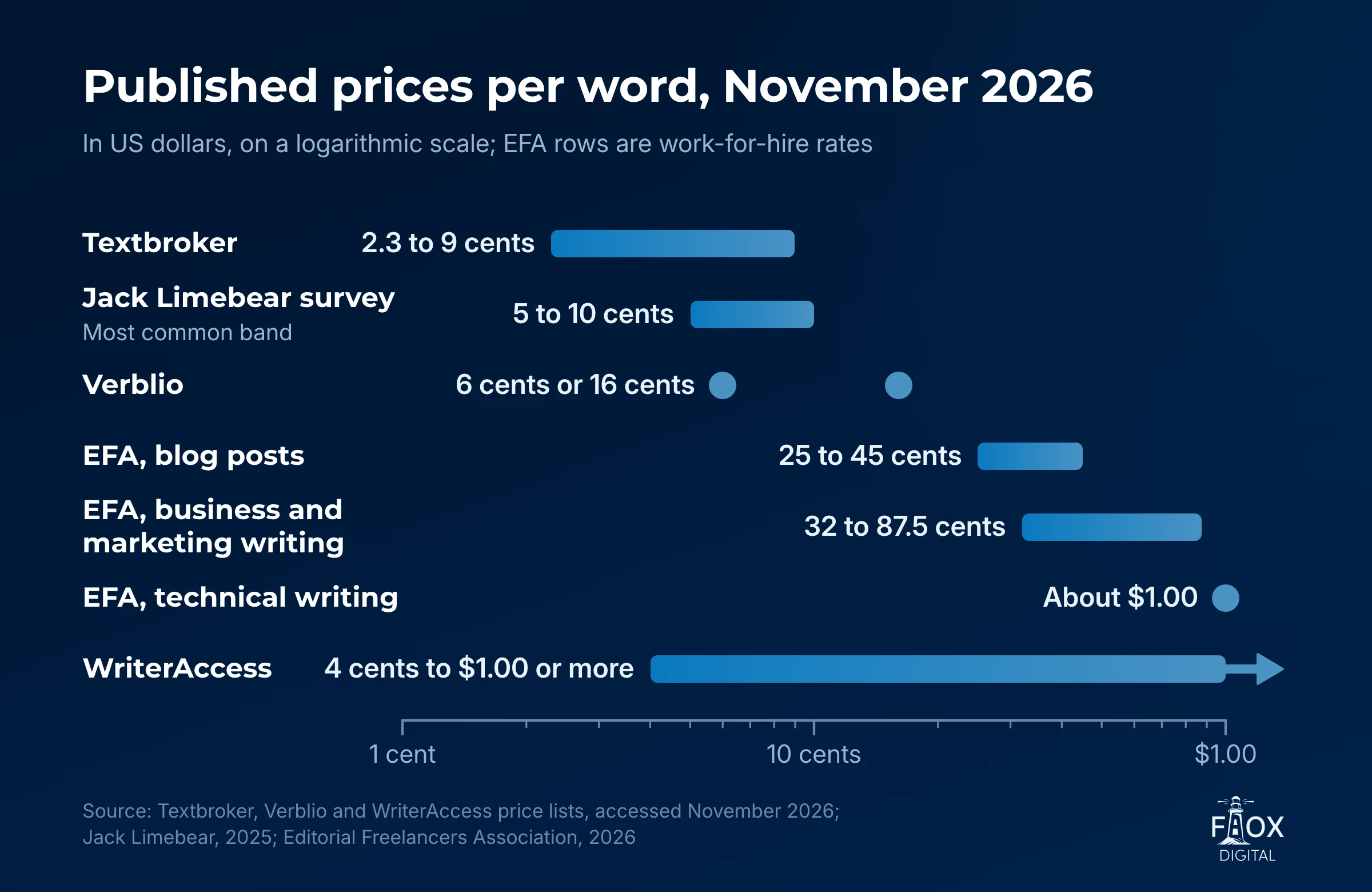
Read these as rough ranges. Vendors set their own lists, and the two surveys reach very different writers. The EFA’s chart draws on over 1,100 members of a professional association, and it warns that the number of answers varied widely by question. We found no survey limited to B2B content, so your own scope is the real benchmark.
Hourly rates show the same spread. Upwork shows median rates of $15 to $40 for content writers worldwide (November 2026), and Clutch lists $100 to $149 for content marketing agencies in the US and under $25 in India (updated September 2026). Orbit Media’s 2026 survey of 1,042 content marketers puts the average blog post at 3 hours 20 minutes. That is about $50 to $130 of writing time at Upwork’s rates and $330 to $500 at Clutch’s US rates, before research, expert review or editing.
Per word, per article, package or strategy
Providers sell four main models. Each can reach a similar total, so ask what the money pays for:
| Model | You pay for | Fits when | Watch for |
|---|---|---|---|
| Price per word | Length | Short, simple, repeated text | Padding, because length earns the fee |
| Price per article | One agreed piece | You have a brief and a clear scope | What is left out: research, interviews, revisions |
| Content package | A set volume each month | You have a plan and a steady need | Publishing to use up the allowance |
| Strategy-included service | Planning, briefs, interviews, writing, editing and measurement | You have no plan, or content has not brought enquiries | Plans and reports with few published pages |
Word pricing pays for length, yet Google says it has no preferred word count, and an engineer will not thank you for padding. A flat fee avoids this but says nothing about the work inside it.
Public figures for the other models are thinner. For a flat fee, the most common answer among 213 writers in Peak Freelance’s survey was $250 to $399 for 1,500 words, though its data dates from about 2021. Verblio sells a monthly subscription of human-written text at 16 cents a word. WriterAccess lists a managed plan with keyword research and content strategy from $449 a month, with content priced separately, and 20 hours a month at Clutch’s US agency rates comes to $2,000 to $2,980.
What drives the price of an article
Word count explains little. These four things explain most of the gap:
- Research and expert input: a writer working from other websites can only repeat them, while an hour with your application engineer gives them facts a competitor cannot copy. In the 2026 survey by TREW Marketing and GlobalSpec, which both sell marketing to engineers, 66% of technical buyers rated vendors’ engineering experts very or extremely trustworthy, against 10% for generative AI tools. Interviews also take your experts’ time, which no quote shows.
- Technical accuracy: someone has to check each specification, standard and material name against its source. The EFA’s medians show the premium: about $1.00 a word for technical writing against 25 to 45 cents for blog posts, with fact-checking listed separately at $50 to $60 an hour. Ask who signs off, because a wrong pressure rating on a product page can cost far more than the article did.
- Editing: the EFA lists copyediting of business and marketing text at 3 to 4 cents a word, so $60 to $80 for 2,000 words. In Orbit’s 2026 survey, 22% of marketers with a formal editor report strong results, against 12% of those who let AI edit and 10% of those who edit their own work. That is a correlation, not proof, but an editor is cheap next to the writing.
- Translation and localization: the EFA lists translation from English at 12 to 19 cents a word, or $240 to $380 per language at this length. Translation alone does not find the words buyers use in each market, so budget for keyword checks, local examples and a review by someone in that market.
The risk of AI mass production
Using AI is not the problem in itself. In the Content Marketing Institute and MarketingProfs report for 2027 (861 B2B marketers, published November 2026), 88% say their organization uses AI content tools. They credit the tools with speed (78%) and volume (44%), while 17% name quality, and their top challenges are accuracy (54%) and quality control (54%).
AI mass production is the risk behind a very low price: many pages, and few people checking them. Google’s spam policies (updated August 2026) treat generating many pages with AI tools, without adding value for users, as scaled content abuse. Its guidance on AI content (updated October 2026) says generative models predict a likely sequence of words rather than retrieve facts, and that it is critical to fact-check all AI output by hand. Google adds that you are responsible for the actions of any company you hire, so the risk stays with you.
Ask where AI is used and whether your unpublished technical data goes into outside tools. If a proposal sells volume as the route into AI answers, read our guide to choosing a GEO agency first. Nobody can promise a citation.
Content ownership: what to get in writing
Content ownership is easy to assume and easy to lose. Under US copyright law, copyright starts with the author, and a transfer is valid only in writing, signed by the owner. An employee’s work belongs to the employer, but a commissioned article counts as work made for hire only in listed categories and with a signed agreement. So paying an invoice is not the same as owning the text.
The U.S. Copyright Office concluded in January 2025 that generative AI output is protected only where a human author has determined sufficient expressive elements, and that prompts alone are not enough. Using AI to assist does not bar protection, but text made by prompts alone may give you little to own. Other countries have their own rules, so have a lawyer check the clause. Ask for these in the contract:
- The text, images and drafts transfer to you on payment.
- You may edit, translate and reuse all of it.
- Briefs, keyword research and interview notes are handed over too.
- Pages are published under your own accounts, which you keep when the contract ends.
- Your unpublished technical data stays confidential.
How to choose: articles, strategy or your own team
The real question is who does the thinking. An SEO content writer turns a brief into a page that answers a search. An SEO content strategist decides what the pages should be: which searches matter, which page answers each one, in what order and how to judge them. SEO content writing services sold without strategy assume that someone on your side does the second job.
| Buy articles | Pay for a strategy | Keep it in-house | |
|---|---|---|---|
| Who decides the topics | You | The provider, with you | Your team |
| Fits when | You have a plan, briefs and a reviewer | You have no plan, or articles have not brought enquiries | Someone has the time and can write |
| Main risk | Good articles on the wrong topics | Paying for plans that never ship | Work stops when the busy season starts |
Three questions usually settle it. Can you name your next ten topics and say why each one matters? Can an expert review a draft within a week? Do you know which pages bring enquiries? Three yes answers mean you can buy articles. A no means the plan is the first thing to buy.
You do not have to choose forever. A one-off plan, followed by articles bought against it, can be the most economical route. On a small budget, start with the pages closest to a quote; our guide to commercial search intent shows which searches those are. They are hard to write without product knowledge, so do not save on expert time there. For a wider engagement, our guide to the first 90 days of SEO shows what a plan should produce before volume starts.
Sometimes the problem is not the content at all. If the pages are slow or the structure confuses buyers, read about when to redesign a website before you pay for more articles.
Measurement: how to judge what you bought
Measurement should be agreed before the first article. In Orbit’s 2026 survey, nearly one in five marketers could not say whether their blog delivers results. Traffic and other volume metrics were the most common choice of main metric (42%), and 11% of that group report strong results, against 15% of those who watch leads and revenue and 19% of those who watch rankings, AI mentions and branded search.
Judge the work in three layers:
- Delivery, from the first month: were briefs, expert reviews and deadlines met?
- Visibility, after a few months: impressions, queries and clicks per page in Search Console.
- Business, from around six to eight months: enquiries, quote requests and the articles sales really uses.
Those timings are our planning ranges, not promises. A provider who ties the fee to a ranking or an AI citation is selling something nobody controls.
Questions to ask before you sign
- Who writes, and what have they written for technical buyers?
- How many hours of research and expert time does the price include?
- Who checks the facts and who edits, by name?
- Where is AI used, and who verifies the output?
- What does each extra language cost, and does it include keyword research for that market?
- How many rounds of revision are included?
- Who owns the text, the briefs and the research when the contract ends?
- What will be measured, and when?
Then commission one paid trial article on a hard topic from your own field, and ask your engineer to read it. That tells you more than any sample.
How Faox Digital approaches content work
At Faox Digital, content writing sits in the content and authority step of an SEO project, after the audit, the keyword map and the foundations. We write pages built to rank and to be quoted by AI tools, and we earn placements in the press buyers read. Our reports show rankings, organic traffic and whether AI tools start to cite the company.
Key takeaways
- Published prices run from about 2 cents to $1 or more a word, and the gap comes from research, expert input, editing and technical checks.
- Compare quotes by what they include, not by the price per word or per article.
- Buy articles if you have a plan, briefs and a reviewer; pay for a strategy if you do not.
- AI can assist, but a very low price can mean nobody is checking, and the risk stays with you.
- Get ownership in writing, and agree how results will be measured before the first article.
Frequently asked questions
What is SEO content writing?
It is writing for one specific search and the person behind it: a direct answer, clear headings, the terms buyers use and a link to the next step. It depends on knowing which search to target and what your experts can add.
How much do SEO content writing services cost?
At the time of writing, public price lists run from 2.3 cents to $1.00 or more a word, so about $46 to $2,000 or more for 2,000 words. Freelancers in the EFA’s 2026 chart report medians of 25 to 87.5 cents for blog and marketing writing. Ask whether research, interviews, editing and translation are extra.
Can we create a B2B content strategy ourselves?
Yes, if someone has the time. Start with the questions buyers ask your sales team, check how they search for them and group the answers into topics. Outside help is most useful for search research and for keeping the work moving.
Can our own team learn SEO content writing?
Often, yes, and engineers who can explain their work have a head start. The basics are quick to learn: answer first, write for one search, use the buyers’ terms and cite your sources. What usually runs out is time, so one option is an in-house expert working with an outside editor.
Sources
- Editorial Freelancers Association: Editorial rates, 2026 Rate Chart, 2026
- WriterAccess: Pricing, accessed November 2026
- Google Search Central: Spam policies for Google web search, updated August 2026
- U.S. Copyright Office: Copyright law, chapter 2, ownership and transfer, accessed November 2026
Let’s talk
Where do you want to be found?
Tell us the searches that matter to your business. We will review your site and tell you plainly what to fix first, including what you can do yourself.