
SEO for Heavy Equipment Manufacturers: Models, Dealers and Spare Parts
How buyers, mechanics and owners search for heavy equipment, and the model, dealer, parts and service pages that let manufacturer and dealer sites work together.
SEO for heavy equipment manufacturers means answering three kinds of search: models and specifications, dealers, and spare parts. Give each model a page with its specifications in text, give each country a real dealer page and make part numbers findable by owners and mechanics. Then agree with your dealers who answers what, so your sites support each other instead of competing.
A contractor comparing 20-tonne excavators, a mechanic holding a worn filter and a fleet manager pricing a used machine all start with a search. Many of those searches end on a dealer’s site, a marketplace or a parts reseller, even when the best answer should come from the manufacturer.
The stakes go beyond the first sale. Caterpillar’s 2025 results put services revenues, which include aftermarket parts, at $24 billion against total sales and revenues of $67.6 billion, with machines sold through 150 dealers serving 190 countries.
We offer this work as part of our B2B SEO services, so we have a stake in the answer, and you can do much of it in-house.
SEO for heavy equipment manufacturers: who searches for what
Heavy equipment SEO differs from most manufacturing in one way: many searches come after the sale, from people who already own the machine. These examples use placeholders for brand and model:
| Who is searching | Example search | Page that should answer it |
|---|---|---|
| Contractor comparing machines | "20 ton excavator specs", "[model] vs [model]" | Model page, comparison table |
| Buyer close to a decision | "[brand] dealer Ohio", "[model] price" | Dealer page, then the dealer’s own site |
| Parts manager or mechanic | "[part number]", "[model] hydraulic filter" | Part page or parts catalog |
| Owner or service technician | "[model] fault code", "[model] oil capacity" | Service article or manual |
| Used machine buyer | "used [model] for sale", "[model] common problems" | Used section, older model page |
Construction equipment SEO has its own vocabulary too: one market says "digger" and another "excavator", so build your term list from enquiries, dealers and Search Console. For measurement and choosing support, see our guide to SEO for manufacturers.
Model and specification pages
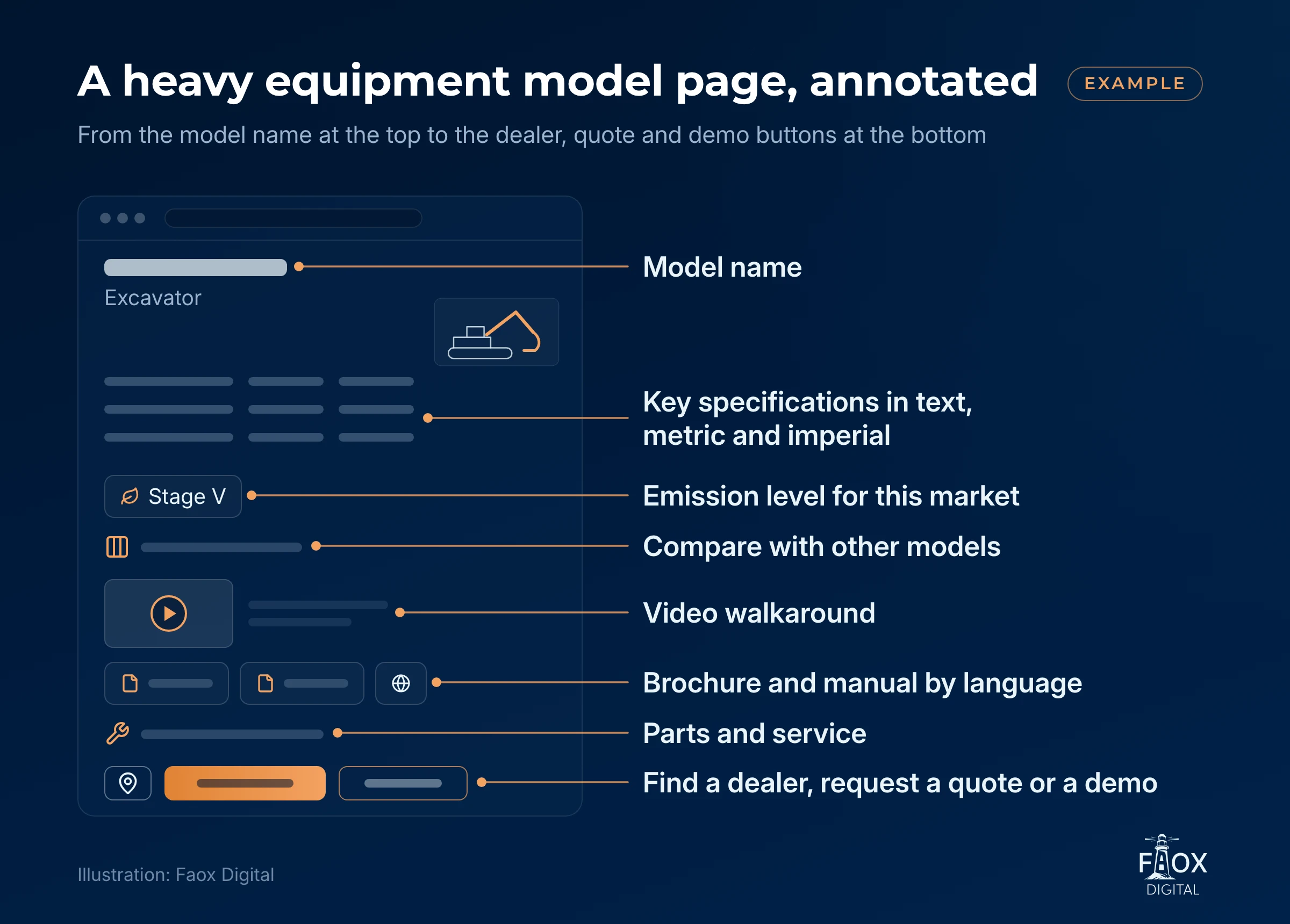
Model and specification pages carry most commercial searches, so every current model needs its own page with specifications in text: operating weight, engine power, bucket capacity, digging depth and attachments. Link it to the comparison table, video, brochure and manual, parts and service pages, the dealer finder and the quote and demo buttons.
Give metric and imperial figures wherever you sell in both, and name how a figure was measured, as Caterpillar does by labelling net power "ISO 9249".
Market versions matter because one model name can hide different machines. At the time of writing (November 2026), Caterpillar lists its 320 excavator at 172 hp and 49,800 lb for markets under the US Tier 4 and EU Stage V engine limits, and at 157 hp and 47,000 lb for regions such as South America and India. So give each market its own version, and connect versions in one language with hreflang, as Google’s localization guide describes.
Keep pages for older models online, marked as out of production and linked to the current model, because owners and used buyers keep searching for those names.
Comparison tables
Comparison tables answer "[model] vs [model]" searches. Start with your own range: one page, in text rather than an image, with the same measures and units for each model and a line on the job each one suits.
Comparing against competitors takes more care. EU rules allow comparative advertising that objectively compares material, relevant, verifiable and representative features of goods meeting the same needs, without discrediting the competitor (Directive 2006/114/EC, Article 4). Date each table, name the source of competitors’ figures and have your legal team review it; this is not legal advice.
Manufacturer and dealer sites in the same searches
This is the sector’s own problem: manufacturer and dealer sites go after the same model names. Nobody gains when a dealer’s copy of your text outranks your page, or when your page outranks a dealer who has the machine in stock.
Canonical tags will not sort this out: Google’s guidance on syndicated content says the canonical link element is not recommended for partners’ copies, and that the most effective solution is for partners to block indexing. So a dealer’s page should add local value or stay out of the index. The better fix is to give each side a different job:
| Search | Manufacturer site answers | Dealer site answers |
|---|---|---|
| "[model] specs" | Full, current specifications for each market | A short summary, stock and a link to your model page |
| "[model] price" | Configurations and options, with a route to a dealer | Local price or quote, finance and delivery |
| "[brand] dealer [place]" | Every dealer by country, with the region each covers | Address, hours, service area and contacts |
| "[part number]" | Number, description, what it fits and what it replaces | Local stock, price and delivery |
| "[model] maintenance" | Manuals, schedules and service guidance | Workshop, field service and appointments |
| "used [model]" | Specifications, and a used section if you run one | The individual machine: year, hours, place and price |
Put the split in writing, with links both ways and rules for using your brand in dealer domains, page titles and search ads.
Country and dealer pages
Country dealer pages answer "[brand] dealer [country]". Give each country or region a real page in the local language: the dealers, the regions they cover, what each sells and services, the models available and a named contact. Google’s spam policies (August 2026) list pages aimed at specific regions that funnel users to one page, and multiple websites with slight variations, as doorway abuse. So pages that differ only in the country name are a risk, as are template dealer websites with no stock, people or service details of their own.
Behind the map search, add a plain list of countries and dealers with real links, because Google says it can generally crawl a link only if it is an <a> element with an href.
"Near me" searches belong to dealers, because Google says local results are mainly based on relevance, distance and popularity. Google’s guidelines also shape dealers’ Business Profiles: a business selling another company’s brand uses its own name, and only an authorized, fully dedicated seller may use the brand’s name.
Spare parts and part number searches
Part number searches show exact intent: the person knows what they need and wants to know who has it. Too often they reach a reseller first, because the reseller publishes the number and the manufacturer does not.
Trust works in your favor. In a LECTURA survey published in January 2026, which does not state its sample size, 65% of buyers preferred OEMs or authorized dealers for engine and machine components and 12% bought parts online, with authenticity, warranty and compatibility among their worries. So a part page should settle those points: that the part is genuine, what it fits and where to buy it.
- Make the data public. Google says it will not crawl a page that requires a log-in, so a catalog behind a dealer log-in cannot appear in search. You can keep prices and stock private and still publish the number, the name and the fit.
- Write numbers as text, with and without hyphens or spaces, along with the older numbers each part replaces.
- Show the fit: the models, and serial number ranges where they matter.
- Start with wear parts, such as filters, hoses, seals and teeth, which are bought again and again.
Dealer portals are web applications with their own scope, so we leave them out here.
Service content for owners and technicians
Service content serves people who already own your machine: maintenance schedules, fluid capacities, fault code explanations and how-to articles. Have your service engineers sign off each one and put their names on it, since a wrong step can injure someone or damage a machine.
Manuals may also move online. The EU Machinery Regulation, which applies from 20 January 2027, lets manufacturers provide instructions for use digitally, if they can be printed and downloaded, the machine or its packaging shows how to reach them, and they stay online for the machine’s expected lifetime and at least 10 years after it is placed on the market, with paper on request at the time of purchase (Regulation (EU) 2023/1230, Article 10).
A further EU package, Omnibus IV, still being adopted in November 2026, may change the details, so check with your compliance team; this is not legal advice. Either way, give each manual a stable address, because the machine will point to it for years.
Used equipment
Used equipment searches often go to marketplaces, auction sites and dealers, since a manufacturer rarely has the machine to sell. You can still serve them with older model pages, a page on any certified used program and a route to dealers’ stock. Caterpillar’s used equipment page, for example, sends visitors to CatUsed.com to see its dealers’ inventory in one place.
Each listing should give the model, year, hours, location, photos and a price or a way to ask for one. When the machine sells, remove the page or redirect it to the model page; Search Console reports an empty page as a soft 404.
Video and visual search
Video needs pages of its own. Google’s video guidance says that to be eligible for video features, including key moments, you should create a dedicated watch page for each video, and it gives a product page with a 360 video as an example of what is not a watch page. So embed a walkaround on the model page if it helps, and also give it a page of its own.
Visual search matters for parts. Google said in September 2025 that Lens sees 25 billion searches a month, so a mechanic may photograph a worn part or a nameplate instead of typing. Use your own photos, write alt text that names the model and the part, and place each photo near relevant text, as Google’s image guidance advises.
Brochures and PDFs
Brochures and PDFs are where many specifications still live. Move the key figures to the model page and keep the brochure as a download, with one stable address per model and language. Split long documents: Googlebot fetches only the first 64 MB of a PDF (Google Search Central, 2026), so the end of a very large catalog may never be read.
Quote and demo requests
Quote and demo requests are where a search becomes an enquiry, so put both buttons on every model page. Ask for the model, the application, the quantity, the country and region, any trade-in and the target date, and keep most fields optional. For a demo, say where it happens and who arranges it.
The country and region route the request to the right dealer. Agree how fast dealers reply and ask them to report what happened, because otherwise you will not see which searches led to a sale. Track each request as a key event in Google Analytics and in your CRM, with the model and the dealer.
Where to start
Start with the models that matter most to sales:
- List the searches from enquiries, dealers and Search Console.
- Fix your main model pages, with specifications in text.
- Agree the split with your largest dealers, using the table above.
- Publish your most-searched wear parts, with their numbers and what they fit.
- Track quote and demo requests by model and by dealer.
If your platform cannot hold specifications by market, a dealer list or parts data, the fix may be a rebuild; our guide to what a website redesign costs explains what drives the price. Other sectors have their own patterns, as our guides to SEO for chemical manufacturers and SEO for packaging manufacturers show.
How Faox Digital runs SEO for heavy equipment manufacturers
Faox Digital, a digital growth partner for B2B companies in complex and international markets, starts SEO for a heavy equipment manufacturer with an audit and baseline: what the site ranks for, who it competes with and what buyers search. The keyword map follows market by market, and each language gets its own structure. The foundations work then covers site architecture, speed, structured data and crawler access, and you see the priorities and the reasons before any work begins.
Key takeaways
- Buyers, mechanics and owners search for models, dealers, part numbers and fault codes, so each needs a page that answers it.
- Put specifications on model pages in text, in each market’s units, and keep pages for older models online.
- Agree with your dealers what each site answers, so you stop competing with the same text.
- Publish part numbers on public pages with what they fit and replace, because Google does not crawl pages behind a log-in.
- Track quote and demo requests by model and dealer, and ask dealers what happened next.
Frequently asked questions
What is SEO for heavy equipment manufacturers?
It is the work of making a machine maker findable by the buyers, mechanics and owners who search for its models, dealers and parts, and of settling who answers what between you and your dealers.
How is SEO for equipment dealers different?
A dealer competes locally, often with its own supplier’s site. Its strength is what the manufacturer’s page lacks: stock, prices, finance, delivery and a workshop nearby. That means a complete Business Profile for each branch, stock pages, individual used listings and service pages for the area it covers.
What should an SEO agency for manufacturers know about heavy equipment?
It should understand model ranges, market versions, dealer networks and parts data. Ask how it would split searches between your site and your dealers, and who checks technical accuracy. Be wary of anyone who promises first place.
Does international SEO for manufacturers change the dealer setup?
Yes. Each market has its own dealers, machine versions, emission rules, units and words for the same machine. Give each country its own dealer page and model versions, and open one market at a time.
Sources
Let’s talk
Where do you want to be found?
Tell us the searches that matter to your business. We will review your site and tell you plainly what to fix first, including what you can do yourself.