
How Long Does SEO Take? A Realistic Timeline for B2B Websites
A realistic timeline from first movement to competitive position, the factors that shorten or stretch it, and how to judge progress before results arrive.
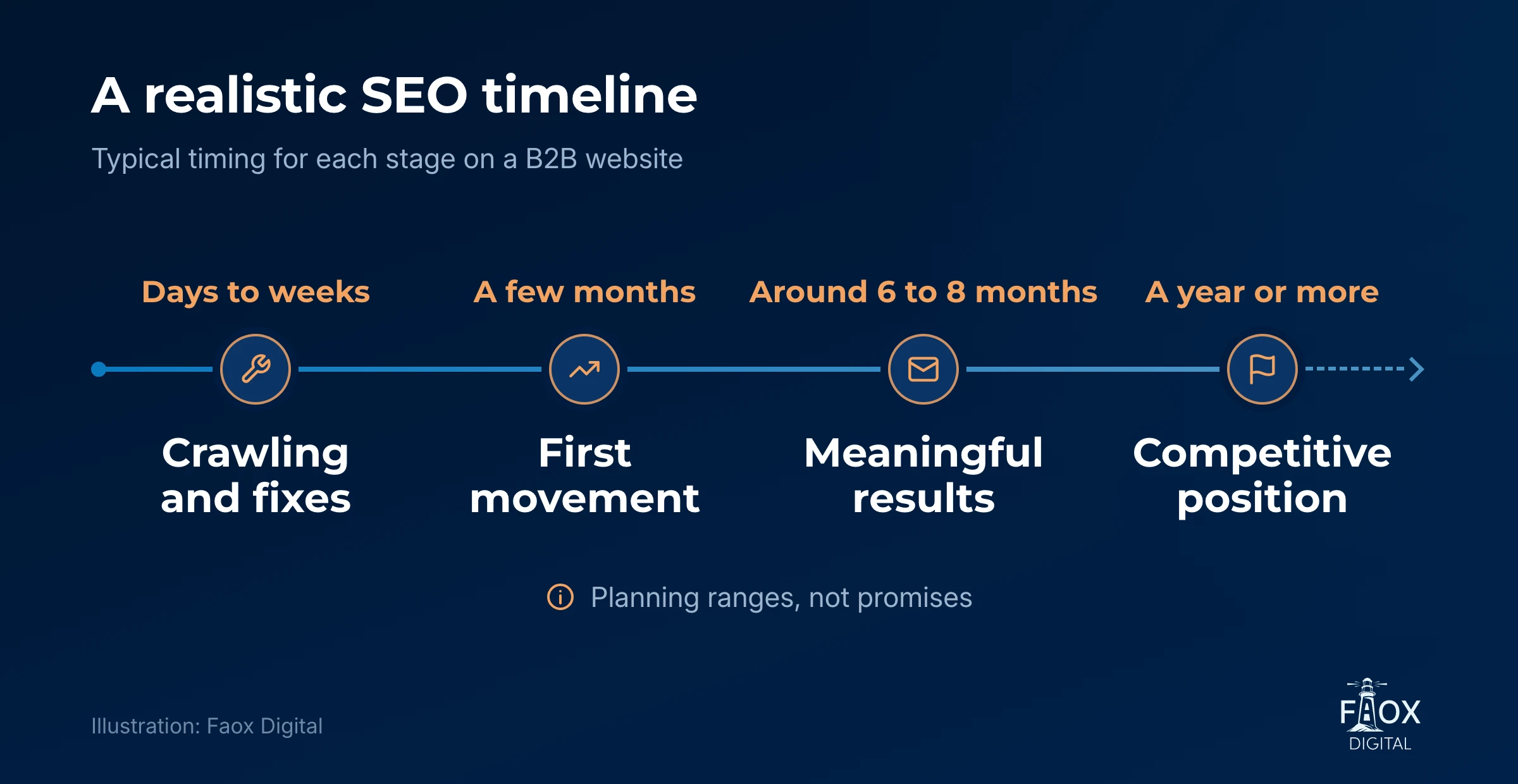
How long does SEO take? For most B2B websites, expect first movement within a few months, meaningful results in around six to eight months and a competitive position in a year or more. An established domain, a sound technical base and low competition shorten this; a new domain, strong rivals or several markets stretch it. These are planning ranges, not promises, and a real timeline should follow an audit of your site.
Every SEO proposal faces this question, and the honest answer is a range. In its 2017 video on hiring an SEO, Google said that in most cases an SEO needs four months to a year to help a business first implement improvements and then see potential benefit. For a B2B company with long sales cycles, the wait for revenue can be longer still.
This guide sets out a realistic timeline, the factors that shorten or stretch it and how to judge progress before results arrive. We offer this work as part of our B2B SEO services, so we have a stake in the answer; the ranges below are the ones we use ourselves, and none of them is a promise.
How long does SEO take: a realistic timeline
SEO results arrive in stages, and each stage has its own evidence:
| Stage | Typical timing | What you can expect to see | Where to check |
|---|---|---|---|
| Crawling and fixes | Days to weeks | Fixed pages recrawled and new pages indexed | Page indexing report |
| First movement | A few months | More impressions, and better positions on specific searches | Search Console, by page |
| Meaningful results | Around 6 to 8 months | Clicks on commercial searches, and first enquiries from search | Search Console and your CRM |
| Competitive position | A year or more | Steady positions on contested terms, and enquiries that keep coming | CRM and key term tracking |
These are our planning ranges, not the result of a controlled study. They fit Google’s four months to a year, and large-scale data shows why contested terms take longest:
This is one vendor’s data on the whole web, not on B2B, and it dates pages by when its crawler first saw them. Ahrefs also found that high-volume keywords generally take longer, and that 40.82% of the pages that did reach the top 10 got there within a month. So a specific, low-competition search can move early while your main commercial terms take much longer.
What shortens or stretches the timeline
| Factor | Shorter timeline | Longer timeline |
|---|---|---|
| Domain | An established domain with links, mentions and indexed pages | A new domain with no history |
| Competition | Technical terms with few strong pages | Terms held by large brands and marketplaces |
| Technical foundation | Clean crawling and indexing, and developers with time | Indexing problems, a migration or slow release cycles |
| Content volume and consistency | Steady publishing around a plan | Bursts followed by silence, or thin pages |
| Authority | Existing trade press coverage and real references | No mentions beyond your own site |
| Markets and languages | One market and one language | Several markets, each with its own research and local links |
Four of these deserve a closer look:
- New domain or established domain: Google says it primarily finds pages through links from pages it has already crawled, so a site that nothing links to starts behind. An older domain’s advantage is what it has collected: links, mentions and indexed pages. A new site starts without them.
- Technical foundation: a rebuild can reset part of the clock. On a site move, Google says a medium-sized site may take a few weeks or more to show the new URLs, with temporary ranking fluctuation. If you are weighing a rebuild, also look at what a website redesign costs.
- Your own speed: in its 2017 video, Google says one of the biggest holdups is not the SEO’s recommendations but the business making time to implement them. Whether you choose in-house SEO or an agency, name someone who can get fixes released.
- Authority: recognition builds slowly, then holds. Buying links to hurry it along is not a shortcut, because Google’s spam policies list it as link spam and say that sites violating them may rank lower or not appear at all.
Indexing time: the first clock
Indexing time is the part you can check soonest. After you request a recrawl, Google says crawling can take from a few days to a few weeks, that a request does not ensure inclusion and that repeating it does not speed anything up. When you fix a reported problem, Search Console’s validation typically takes up to about two weeks, and sometimes much longer.
Google also says that some changes take effect in a few hours and others could take several months, and that you will likely want to wait a few weeks before judging whether a change helped. Not every change has a visible effect, so judge groups of pages, not a single title.
AI answers run on two clocks
There is no separate timeline for AI answers, because they draw on two different sources. Google’s AI Overviews and AI Mode use its Search index: a page must be indexed and able to show a snippet, with no additional technical requirements. ChatGPT combines what its models learned from training data with web search for current information.
So a new page can appear through live search once it has been crawled, while what a model has learned changes only with later training, on a schedule you do not control. We found no reliable public data on how long it takes to be named. In Ahrefs’ 2025 analysis of about 17 million citations, AI assistants cited pages that were 25.7% fresher on average than organic results, but the average cited page was still about 2.9 years old. Test your buyers’ questions regularly, and remember that no one can promise a mention.
From rankings to revenue: why B2B takes longer
Rankings come before clicks, clicks before enquiries and enquiries before revenue. 6sense’s 2025 survey of about 4,000 B2B buyers puts the average buying cycle at about 10 months, and it found that 94% of buying groups had ranked their preferred vendors before first contact. It is one vendor’s survey, but the point holds: a page that starts ranking in month six may not show up in revenue until the following year, even though it has already started to influence buyers.
That is why meaningful results in B2B should be defined before work starts, usually as qualified enquiries from the right markets and not as total traffic. If you need enquiries this quarter, SEO alone will not get you there. Paid search, trade fairs and direct sales work faster, while SEO builds.
Setting expectations: how to judge progress
Clear expectations protect both sides. Before you sign, ask for these:
- A timeline written after an audit of your site, not before it
- A plan for the first 90 days of SEO, judged by the work delivered
- An agreed measure for each stage: indexing, impressions, clicks and enquiries
- A named person on your side who can get fixes and content approved
- A review point at around six months, when pages still outside the top 10 get reworked
- No promised position, and no date for a ranking
Budget for the whole period and not only the first months, because stopping early pays for the slow part and misses the rest. Our guide to what SEO costs per month shows what a monthly fee can realistically cover. If the budget cannot last a year, narrow the scope to one product line or one market instead of spreading it thin.
How Faox Digital sets an SEO timeline
At Faox Digital, the timeline is set after the audit and baseline rather than on the first day, because it depends on where the site stands and who it competes with. The work then runs in order: a strategy and keyword map, foundations and on-page work, content and authority, then measurement. Progress is reported as rankings, organic traffic and whether AI tools start to cite the company. We do not promise rankings, since Google decides positions.
Key takeaways
- Expect first movement in a few months, meaningful results in around six to eight months and a competitive position in a year or more.
- These are planning ranges, and a real timeline should follow an audit.
- A new domain, strong competitors, slow releases and several markets all stretch the timeline.
- B2B revenue lags behind rankings, so agree what counts as a meaningful result before work starts.
- Judge the early months by work delivered and by leading measures, not by a promised position.
Frequently asked questions
How long does SEO take to work for a new website?
Expect the longer end of the ranges. A new site has no links or history, so plan on a year or more for competitive terms, and start with specific searches where fewer strong pages compete. Technical setup and indexing can be right from the first day, which is the main advantage of starting new.
How long does SEO take to rank a page?
It varies widely. In Ahrefs’ 2025 data, 6.11% of new English-language pages reached the top 10 within a year, and many of those got there in the first month, while high-volume keywords generally took longer. If a page is still outside the top 10 after about six months, Ahrefs suggests reviewing it.
How long does SEO take to update after a change?
Google says some changes take effect in a few hours and others could take several months. Crawling after a recrawl request can take a few days to a few weeks. Wait a few weeks before you judge whether a change helped.
How long does SEO take to kick in?
The first signs are usually more impressions in Search Console within a few months, once fixes and new pages are live. Enquiries usually follow later. If nothing has moved after about six months, ask for a review of the plan.
Sources
Let’s talk
Where do you want to be found?
Tell us the searches that matter to your business. We will review your site and tell you plainly what to fix first, including what you can do yourself.