
Market Entry Strategy: How to Choose and Prioritize Your Next Market
How a B2B company compares candidate markets on demand, size, competition, regulations, distance, logistics and risk, ranks them in a scoring matrix and picks an entry mode.
A market entry strategy decides which new market a B2B company enters first, and how. Start from your own customer and enquiry data, compare a short list of markets on market size, demand, competitive intensity, certification and regulatory requirements, language and cultural distance, logistics, distribution channels and payment and country risk, and rank them in a weighted scoring matrix. Check the leading market on the ground before you commit, and choose the entry mode that fits it: direct export, a distributor or an agent.
Many B2B companies do not choose their export markets; the markets choose them. An enquiry arrives from abroad, a distributor writes after a trade fair, and a few years later the company sells a little in many countries and a lot in none. A market entry strategy turns that around: it compares the candidates on evidence and decides where to go next, and how.
This guide covers that choice: the criteria, where to find the data, a scoring matrix and the entry modes. What happens after the choice, from positioning to sales channels, is covered in our guide to entering a new market.
What is an international market entry strategy?
An international market entry strategy answers two questions: which foreign market to enter next, and by which route. The first is target market selection: comparing candidate countries or regions on evidence. The second is the entry mode: selling directly, through a distributor or through an agent.
Between the two sits market prioritization. Most companies have more candidate markets than people and budget, so the strategy also sets the order: one market now, the next when the first is working.
It is the starting point of the wider go-to-market strategy, which then decides the customer profile, messages, channels and plan for the chosen market.
Start with your own customer and demand data
The cheapest evidence is already in your company. Before you look at statistics, collect existing customer and demand data by country:
- Enquiries and quote requests in the CRM, with their country and outcome
- Visitors and contact form submissions by country in your website analytics
- Trade fair contacts and the countries they came from
- Distributors and agents who have asked to represent you
- Existing customers with plants abroad who would buy from you there too
Markets where buyers already find you are often better first candidates than larger markets where nobody knows you. Then check search demand in each candidate’s own language: buyers search with their own terms, not a translation of yours, as our guide to international keyword research explains.
A market entry strategy framework: the criteria
Compare every candidate on the same criteria, and write down where each answer comes from:
| Criterion | What to look at | Where to find it |
|---|---|---|
| Existing demand | Customers, enquiries, distributor requests | CRM, website analytics, trade fair contacts |
| Market size | Imports of your product category, number of target customers | Trade statistics, industry associations, fair visitor data |
| Competitive intensity | Local producers, importers, price levels | Exhibitor lists, distributor catalogues, search results |
| Certification and regulation | Approvals, standards, documents in the language | Regulators’ official pages, customers, test labs |
| Language and cultural distance | Languages needed, business culture, time zones | Your team, partners and customers in the market |
| Logistics and delivery | Transport time and cost, customs, service response | Freight forwarders, customs brokers |
| Distribution channel | How buyers there buy, and which partners are free | Buyer interviews, trade fairs, associations |
| Payment and country risk | Payment habits, currency, political and transfer risk | Your bank, trade credit insurers |
| Fit with your position | Whether your difference matters there | Buyer interviews, won and lost bids |
The table is our summary. The sections below explain the criteria that take the most work.
Market size: use trade data, then count customers
Market size starts with trade statistics. UN Comtrade, run by the United Nations Statistics Division, publishes detailed annual and monthly imports and exports by product and trading partner, reported by about 200 countries and areas. Look up your product’s HS code to compare how much each candidate imports and whether that is growing.
Trade data has limits: it counts a whole product category, not your segment, and it misses what local producers supply. Complete it with a count of the customers you could actually serve, from industry associations, plant directories and trade fair visitor lists.
Competitive intensity and distribution channels
Competitive intensity is about how crowded the field is: strong local producers, many importers or a price level you cannot match. Walk the main trade fair, read the distributors’ catalogues and search as a local buyer would. A crowded market can still work if your difference fills a gap; an empty one may simply have no demand.
The distribution channel decides how fast you can sell. Find out how buyers there usually buy, through distributors who hold stock, through agents or directly from manufacturers, and whether a good partner is still free or already sells for your main competitor.
Certification and regulatory requirements
Certification and regulatory requirements can decide the order of markets on their own, because approvals take time and money. In the EU, many products require CE marking before they can be sold, but only products covered by harmonised EU rules that specifically mandate it, such as some kinds of pressure equipment and machinery. The manufacturer is responsible for meeting the requirements, and no central EU body issues a certificate for the mark: the manufacturer assesses conformity, with a notified body where the rules require one, gathers the technical documentation and signs an EU declaration of conformity.
Other markets have their own approvals, standards and language rules for documentation. List them for every candidate early, with the time and cost each will take.
Language, cultural distance and logistics
Language and cultural distance decide what it costs to be understood. Count the languages you will need for the website, documentation, support and contracts, and consider how business works there: how formal first contacts are, how long decisions take, how much a local presence matters and how many time zones lie between you.
Logistics and delivery terms decide whether you can compete on service. Compare transport time and cost, customs procedures and how fast you can deliver spare parts or send a technician. Agree delivery terms with the ICC’s Incoterms rules, which clarify the tasks, costs and risks of delivering goods from seller to buyer; the current edition, Incoterms 2020, has been in force since 1 January 2020.
Payment and country risk
Payment and country risk can turn a large market into a poor first choice. Find out how buyers there usually pay (in advance, by letter of credit or on open account), how volatile the currency is and whether political or transfer risk could delay payments. Your bank and trade credit insurers can tell you which terms are usual and what cover is available. A smaller market where customers pay reliably often beats a larger one where every order needs security.
Build a scoring matrix to rank the markets
A scoring matrix turns the evidence into a ranking. Agree the criteria and their weights with management before anyone scores, so that the weights reflect your strategy rather than a favorite country. Then score each market from 1 to 5 on each criterion, using the evidence you collected, multiply each score by its weight and add up.
Here is a hypothetical example for a valve maker comparing three markets. A higher score is always better, so low competitive intensity or low risk scores high:
| Criterion | Weight | Market A | Market B | Market C |
|---|---|---|---|---|
| Existing demand | 20 | 4 | 2 | 3 |
| Market size | 15 | 3 | 5 | 3 |
| Competitive intensity | 15 | 2 | 2 | 4 |
| Certification and regulation | 15 | 4 | 3 | 2 |
| Language and cultural distance | 10 | 4 | 2 | 3 |
| Logistics and delivery | 10 | 5 | 3 | 3 |
| Distribution channel | 10 | 3 | 4 | 2 |
| Payment and country risk | 5 | 5 | 4 | 3 |
| Weighted total (out of 500) | 100 | 360 | 300 | 290 |
Market B is the largest, but Market A ranks first because buyers there already know the company and the market is easier to serve. Before you accept a ranking, change the weights a little: if the order flips, the decision is close and needs more evidence, not more arithmetic.
Some criteria are knock-outs rather than scores. If a market needs an approval you cannot obtain in time, or its payment risk is unacceptable, remove it before scoring.
How to determine your market entry strategy, step by step
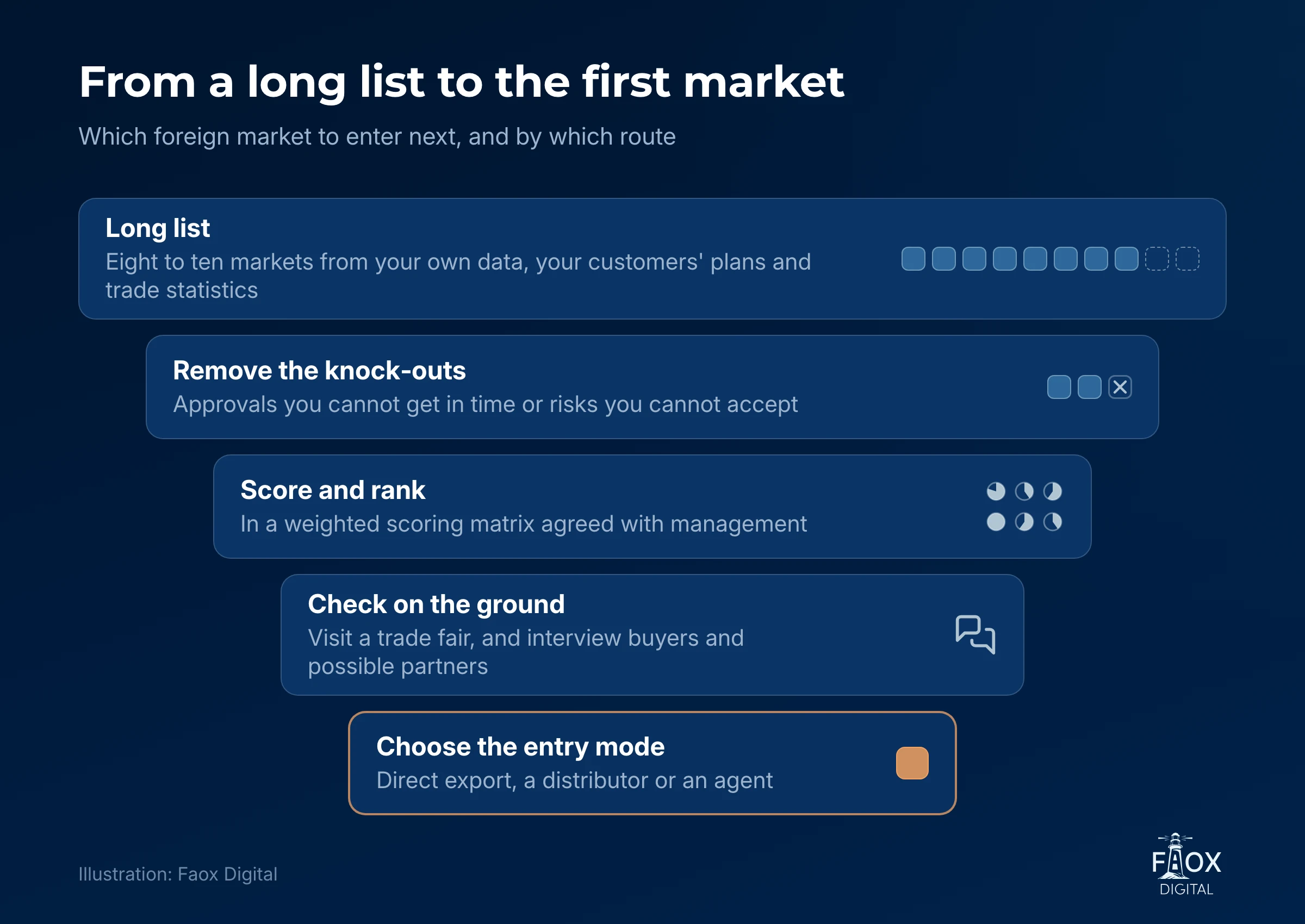
- Make a long list. Eight to ten markets from your own data, your customers’ plans and trade statistics.
- Remove the knock-outs. Markets with approvals you cannot get in time or risks you cannot accept.
- Agree criteria and weights. With management, before anyone scores.
- Collect the evidence. For each criterion, with its source.
- Score and rank. In the scoring matrix, then test the ranking by changing the weights.
- Check the leading market on the ground. Visit a trade fair, and interview buyers and possible partners.
- Choose the entry mode. Direct export, a distributor or an agent.
- Decide and plan. Write down the decision and its reasons, then build the go-to-market plan.
Choose the entry mode: direct export, distributor or agent
The entry mode follows from what you learned about the market:
- Direct export suits markets with a few large buyers who order big projects and accept delivery from abroad.
- A distributor suits markets where buyers expect local stock, fast delivery and service, and where many small customers buy standard products.
- An agent suits technical or project sales where a local person opens doors and you deliver directly.
The choice also shapes your marketing: who owns the customer relationship, which materials partners need and which channels you run yourself. Give each new market its place in your overall B2B marketing strategy, so that channels in different countries support each other rather than compete. Partner contracts need a legal check in the market before you sign.
After the choice: position, adapt and plan
Choosing the market is the first decision, not the last. A position that wins at home may not win there, so revisit it with buyers in the new market; our guide on how to do brand positioning walks through the steps. Decide what changes in the brand itself, from names to examples and proof, with a brand localization strategy. Then turn the decision into messages, channels and a sequence with a go-to-market strategy template.
One market at a time
Enter one market properly before the next. A first market done well gives you references, a working partner model and lessons that make the second entry faster and cheaper. Review the scoring matrix once a year, because demand, competitors and risks change. If you would rather have outside help with the first entry, our guide to hiring a go-to-market agency sets out what the first 90 days should deliver.
How Faox Digital supports a new market entry
Faox Digital, a digital growth partner for B2B companies in complex and international markets, works on a new market once the company has chosen it: the brand is adjusted for that market, so that it reads as local rather than translated, and rolled out in the right order across the channels that matter. On the search side, the keyword map is built market by market, and for a test of one market before the full push, we start with an honest audit and a first step sized to the company’s stage.
Key takeaways
- Start with the evidence you already have: customers, enquiries, distributor requests and search demand by country.
- Compare every candidate on the same criteria, and write down the source of each answer.
- Remove knock-out markets first, then rank the rest in a weighted scoring matrix agreed with management.
- Check the leading market on the ground before you commit.
- Choose the entry mode to fit the market, and enter one market properly before the next.
Frequently asked questions
What is exporting as a market entry strategy?
Exporting means producing at home and selling abroad. In direct export you sell to buyers or partners in the market yourself; in indirect export a trading company in your own country sells for you. Direct export, alone or with a local distributor or agent, needs no investment in the market, so it is a low-risk way to test one.
What is licensing as a market entry strategy?
Licensing lets a company in the market use your technology, design or brand in return for a fee or royalty. It needs little investment, but you give up control over quality and customers, and you must protect your intellectual property in that market first. It fits when local production is required or transport costs make export impractical.
What is franchising as a market entry strategy?
Franchising licenses a complete business format, including the brand, methods and support, to a local operator. It is common in retail and services and rare for industrial manufacturers, whose closest equivalent is an authorized partner or service network.
How do you write a market entry strategy?
Keep it short: the markets you compared, the criteria and weights, the scoring matrix with its evidence, the chosen market and why, the entry mode and the first steps. The go-to-market plan then adds the messages, channels, owners and dates.
Sources
- United Nations Statistics Division: UN Comtrade, accessed November 2026
- Your Europe: CE marking, last checked July 2026
- International Chamber of Commerce: Incoterms rules, accessed November 2026
Let’s talk
Does your brand say what makes you different?
Show us how you describe your business today. We will tell you where it is clear and where buyers may get lost.