
How to Choose a B2B Social Media Agency: A Practical Checklist
The criteria, questions and warning signs that help a B2B company choose a social media agency, from industry experience and scope to reporting and a first step.
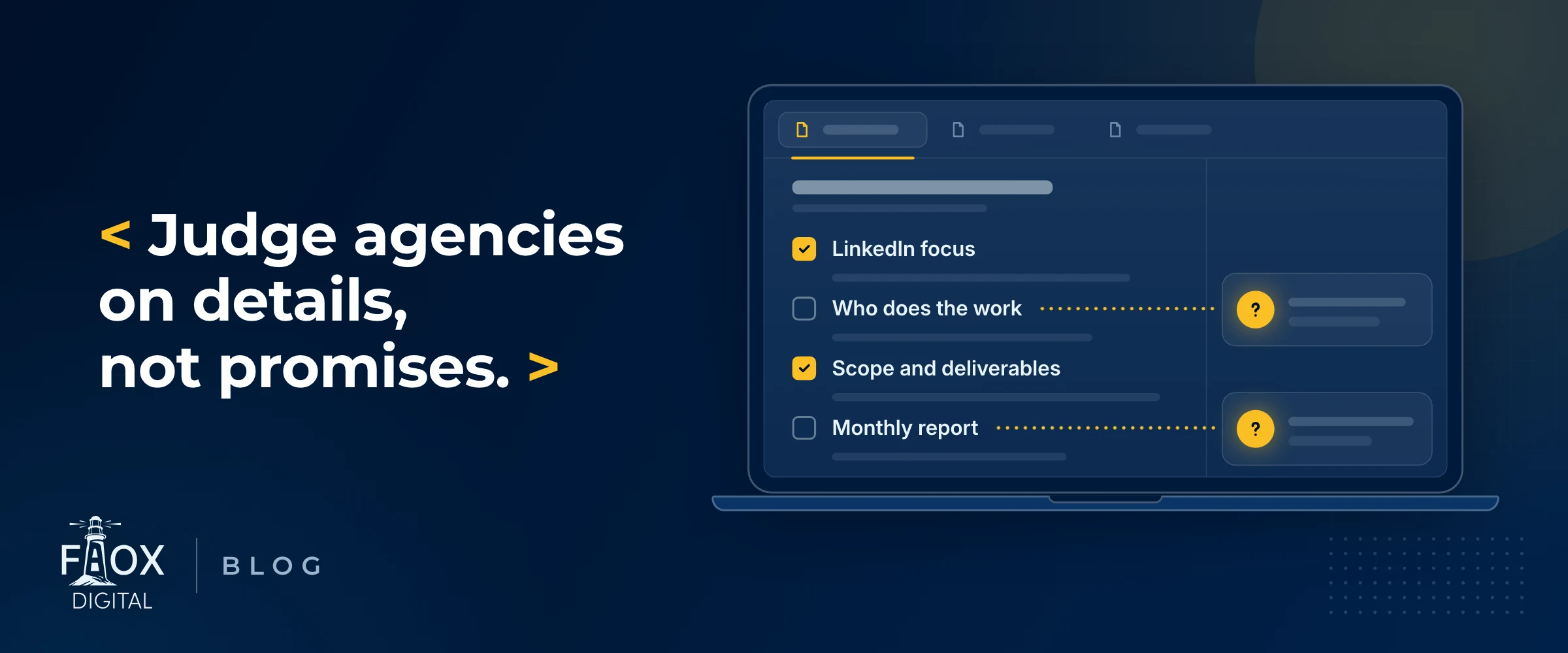
Knowing how to choose a social media marketing agency for a B2B company comes down to a few checks: experience with buyers like yours, a clear LinkedIn focus, case studies you can check, a written scope with deliverables, a named team, an approval process that fits your company and a monthly report tied to your goals. Be wary of anyone who guarantees followers, reach or a post that takes off, and start with a defined first step before you sign a long contract.
Choosing a social media agency is harder than it looks, because most proposals sound alike. Every agency promises strategy, great content and measurable results; the differences are in the details: who does the work, what exactly is delivered and how progress is judged.
This guide gives a B2B company a practical way to compare agencies: the criteria that matter, the questions to ask, what a good proposal shows and which promises to treat with caution. We work as a B2B social media agency ourselves, so we have a stake in the answer; the checks below apply to any agency, including us.
B2B and industry experience
B2B and industry experience matters because B2B social media works differently from consumer social media. The audience is a buying committee, the cycle runs for months and the content has to stand up to an engineer’s scrutiny.
Ask for examples of work for companies that sell to other businesses, and for anything in your field or a related one. Industry experience shortens the learning curve, but it is not everything: an agency that has never worked in your sector can still do well if it knows how to learn from your experts. Ask how they would do that. A good answer involves interviews with your engineers, sales team and customers, not a week of desk research.
If you are choosing an agency for several services rather than social media alone, the questions are broader; our guide to marketing agency selection questions covers them.
A clear LinkedIn focus
For most B2B companies, LinkedIn is the main channel, so an agency’s LinkedIn focus deserves a close look. Some agencies describe themselves as LinkedIn agencies because they specialize in it; others treat it as one channel among many.
Either can work, as long as the agency can explain how it will run your company page, how it will involve your experts and executives on their own profiles, and how it will measure who the posts reach. Ask to see LinkedIn work they have done for B2B clients, and how they handle comments and messages that come in.
Case studies you can check
Case studies are the strongest evidence an agency can offer, and the easiest to dress up. When you read one, check:
- The period: results without dates cannot be compared or checked.
- The definitions: "views", "impressions", "reach" and "traffic" are different things, and an honest case study says which it means.
- Organic or paid: results bought with an ad budget say little about content and community work.
- Context: what the starting point was, and which other work ran at the same time.
Ask whether you may speak to a client the agency has worked with, and what that client would say went less well. An agency that can answer that question calmly usually has nothing to hide.
Scope, deliverables and who does the work
A proposal should state scope and deliverables in writing: which channels, how many posts per channel per month, which formats (text, design, carousels, video), which languages, how many hours of community management, what the monthly report contains and what strategy work comes first. Without that, two proposals cannot be compared, and you cannot hold an agency to what it promised.
Ask just as clearly who does the work. The people who pitch are not always the people who write your posts. Ask for the names and roles of the team, how much of their time your account gets, whether any work goes to freelancers or partners, and who your day-to-day contact will be.
Price follows scope. To judge whether a fee matches the work described, turn it into hours; our guide to what social media management costs explains how.
Content approval process
B2B content often needs a technical check, and sometimes a legal one. Ask how the agency’s content approval process works:
- Who prepares the monthly plan, and who approves it on your side?
- How drafts reach your experts, and how long they have to reply
- What happens when a check is late: does the post wait, or move to a later slot?
- What can go out without approval, such as replies to comments
A good process is light enough to keep posts moving and firm enough that nothing goes out that your experts would not stand behind. Agree it before the first post, not after the first delay.
What the monthly report should contain
The monthly report shows whether the work is working. Ask for an example report before you sign, and check that it covers:
- Reach among the people you want to reach, by job function, industry and market
- Engagement and comments from those people, not only total reactions
- Conversations and messages that started on social media
- Visits from social media to your website and the inquiries that followed
- A short commentary on what worked, what did not and what changes next month
A report of follower counts and likes alone is a warning sign. So is a report that changes its metrics every month.
Multilingual market experience
If you sell in several countries, ask about multilingual market experience. Who writes or reviews each language? Do they know the market, or only the language? How do they adapt examples, standards and references for each market rather than translating the same post?
Ask to see work in your markets’ languages, and have a native speaker on your side read it. Poor localization is easy to spot for a buyer and hard for a non-speaker to judge from a proposal.
Promises to be wary of
Some promises should end the conversation. Be wary of follower or reach guarantees: no agency controls the platforms’ feeds, and a promise of a set number of followers, views or a post that takes off can only be kept with methods that harm you, such as bought followers or engagement groups that trade likes.
Bought followers also carry legal risk in some markets. In the United States, the FTC’s rule on reviews and testimonials, announced in August 2024, prohibits buying or selling fake indicators of social media influence, such as followers or views generated by bots or hijacked accounts, when the buyer knew or should have known they were fake and uses them to misrepresent influence for a commercial purpose.
Good agencies commit to the work instead: the plan, the rhythm, the quality checks, the replies and an honest report. Results among the right people take months; our guide to social media’s first 90 days explains what to expect early on.
Start with a defined first step
You do not have to commit to a long contract to find out whether an agency fits. Agree a trial period and first step instead: a strategy project with a clear deliverable, or a pilot of a few months on one channel with an agreed scope and report. Check the notice period, and make sure your company keeps ownership of its accounts, content and data whatever happens.
An agency is not the only option. Depending on your size and the knowledge you have in-house, a B2B social media consultant or your own team may suit you better, and many companies combine them.
Frequently asked questions
What is a LinkedIn agency?
A LinkedIn agency is an agency that specializes in LinkedIn: running company pages, helping executives and experts post on their own profiles, and often LinkedIn advertising as well. For a B2B company, the question is less what an agency calls itself than whether it can show B2B LinkedIn work and explain how it would measure results.
What does a social media agency do for a B2B company?
It plans and runs a company’s social media for business buyers: strategy, content in the right formats and languages, publishing, replies to comments and messages, and monthly reporting. A good one also involves the company’s own experts, because their knowledge is what B2B buyers want to hear.
What is B2B social media marketing?
B2B social media marketing is using social platforms to reach, inform and build trust with the people who buy for businesses, usually several people in a buying committee over a long buying cycle. It relies more on expertise, proof and conversation than on entertainment or promotions.
How much does a social media agency cost per month?
It depends on the scope: the number of channels, posts, formats, languages and hours of community management. Compare quotes on the same written scope, and turn each monthly fee into hours to see whether it can cover the work promised.
Sources
Let’s talk
Want social media that reaches the right people?
Tell us who you want to reach. We will look at your channels and suggest a plan your team can keep up with.